P is for Paul

Although I’ve chosen a proper noun for my favorite word that starts with “P”, I’m well within the bounds of the rules I set for myself. (Use only small words, 4 letters or less.)

“What’s the big deal with all these rules?” you say.
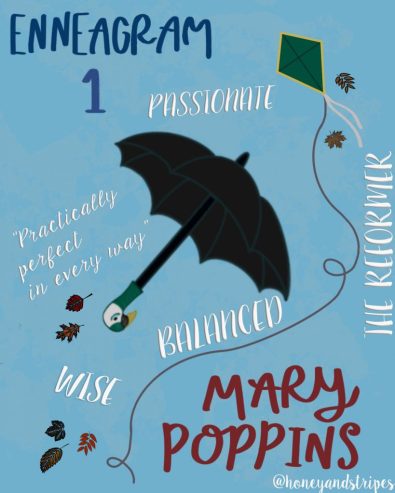
Well, the Apostle Paul and I are both #1s on the Enneagram scale.
We like rules.
We like to make the rules.
We like to obey the rules.
We like to make sure everyone else obeys the rules.

rules

Paul is my Bible Buddy.

Before he was Apostle Paul he was Pharisee Paul, a devotee to all things rules and laws. So much so, in fact, that he set out to arrest, imprison and seek the death sentence for all rule-breakers. In Acts 8:1, we see Paul’s dark side as he gave approval to the stoning of Stephen, the first Christian martyr.

Characteristics of unhealthy Ones:

  • Highly critical, both of self and of others
  • Picky, judgmental, perfectionistic
  • Self-righteous, intolerant, inflexible
  • Corrects others, badgering them to do the “right thing”
  • Is the only one who knows what the “right thing” is

But then Paul met Jesus and God began the transforming work of bringing health into his personality. God redeemed Paul’s temperament and used him to carry the gospel to the Gentile world. The man who was determined to destroy the church became the man who built it.

Characteristics of healthy Ones:

  • Inspiring, hopeful and wise
  • Conscientious with strong personal convictions
  • Fair, objective, and ethical
  • Values truth and justice
  • Self-disciplined, mature and moderate in all things

Enneagram1WM-819x1024

I have been known to go into a business to inform them that a word is spelled wrong on their sign. Sometimes I correct PB when he puts the silverware in the dishwasher the wrong way. I shake my head at those who fold towels improperly. And I refold them. So far, I haven’t made any citizen’s arrests or breathed any murderous threats (Acts 9:1).

God is still at work in me,
transforming my not-so-healthy side of my personality
into a more grace-filled person, both toward myself and others.
Me, Mary Poppins and Paul.

My favorite word in the Bible that starts with “P” is PAUL.

Samekh

Samekh is the fifteenth letter in the Hebrew alphabet. Samekh (also written as Samech) has the same sound as “s” as in “saw”. Every line in Psalm 119:113–120 starts with this letter. Samekh looks like this:

samekh

Samekh is the only letter in the Hebrew alphabet that is enclosed. It is a complete circle that portrays how God completely surrounds and encompasses His people. We are upheld by the loving arms of the Father, whose surrounding presence is like a hug.

What have I to dread, what have I to fear,
Leaning on the everlasting arms?
I have blessed peace with my Lord so near,
Leaning on the everlasting arms.

tree

The circular nature of God is evident all over creation.
The planets orbit around the sun.
Tree trunks have concentric rings.
A pebble thrown in water makes circular ripples.
Sand dollars, acorn cups, the center of a daisy.
Onion rings, a slice across an orange, blueberries.
Rabbit droppings.
The cycle of seasons.
The circle of life.

ripples

Rabbis also teach that the “Samakh” is a picture of a strong support,
propping us up so we can weather the storms of life.
“Uphold me….” Psalm 119:116
“Hold me up….” Psalm 119:117
Jesus is our “Samakh”, our great Upholder.

“In Him all things hold together.” Col. 1:17

samach
Next: My favorite word in the Bible that starts with P.

Long Song Study, part P

study

This section of Psalm 119 might be the most difficult one for me so far. It’s tempting to “clean up” scripture that seems a bit shocking or disturbing. I look up the Hebrew meanings, hoping to find a less harsh definition — something more pleasant. But it’s real and raw and right there in God’s Word. We have to deal with it!

Verse 113
I hate the double-minded, but I love your law.
Right off the bat, David started with a cringe-worthy word. Hate. It’s a hated word, especially in our present culture. I checked it out in Hebrew. It means “hate” as in “to hate”. There’s no way around it, folks. What is the object of this hatred? Double-minded people. I looked that up, too. This is the one and only time in the whole Bible this word is used (in Hebrew). It’s a word David was saving for this moment. It means “skeptical, doubtful, divided in thinking”. Also, “two-faced”, “double-dealing”, and “underhanded”.
James said it like this: “The one who doubts is like a wave of the sea that is driven and tossed by the wind; he is a double-minded man, unstable in all his ways.” (James 1:6,8) The Greek word James used is “di-psychos” = two-spirited, vacillating in opinion.

Or in the words of Aaron Burr,
“Don’t let them know what you’re against or what you’re for.”
Or in the words of Alexander Hamilton,
“If you stand for nothing, Burr, what’ll you fall for?”

Verse 114
You are my hiding place and my shield; I hope in your word.
In the midst of such inconstancy all around him, David turned to the stability of God and His word. God Himself was David’s safe place. He found shelter and protection in the Lord. It wasn’t the first time. “You are a hiding place for me; you preserve me from trouble.” (Psalm 32:7) Spurgeon said, “It is easy to exercise hope where we have experienced help.”

Verse 115
Depart from me, you evildoers, that I may keep the commandments of my God.
David was clear about who he could and could not hang around with. It’s hard to keep God’s commands when in the company of those who insist on evil behavior. Instead of leaving the scene of evil shenanigans, David sent them packing: “Get away from me! Leave me alone!” And he told them why. It is our right and our duty to kick out all sources of wickedness from our midst. “Evildoers make evil counselors, and therefore we must not sit with them.” (Spurgeon)

The distance he has in mind is more the avoidance of partnership than of physical proximity. He wants to avoid sharing their values and being infected by their fellowship. This cry points up an ongoing tension for believers who are in the world but must not let the world’s values get into them. As D. L. Moody is supposed to have said “The ship is in the sea; but woe betide the ship if the sea gets into the ship.” (Christopher Ash)

Verse 116
Uphold me according to your promise, that I may live, and let me not be put to shame in my hope!
In this verse and the following verse, David asked to be held up. The double-minded influences would try to bring him down, so he asked God to lift him above the rancor that sucked the life out of him. (Sound familiar?) Aware of the weakness in his own heart, David went to prayer, pleading for the grace of God. “David meant to keep the law of the Lord, but he first needed the Lord of the law to keep him.” (Spurgeon)

Verse 117
Hold me up, that I may be safe and have regard for your statutes continually!
Without the hand of God holding him, David questioned his physical safety and his spiritual fortitude. He didn’t want to be tossed by the winds of popular culture. Instead, he desired to maintain a steady gaze at God’s word — to develop a regular, consistent, daily time studying and meditating on the statutes.

Verse 118
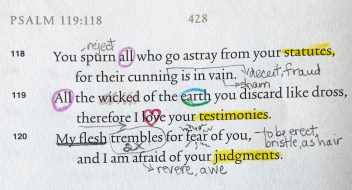
You spurn all who go astray from your statutes, for their cunning is in vain.
We know how David felt about double-minded people (v. 113), but here he seems to think God feels the same way. What happens to those who spurn (which means: to reject with disdain, scorn and contempt) God? Does He spurn them back?
Paul addressed this in his letter to the Romans.

Therefore God gave them over in the lusts of their hearts to impurity….because they exchanged the truth about God for a lie.” (Ro. 1:24) “For this reason God gave them over to dishonorable passions.” (Ro. 1:26) “And since they did not see fit to acknowledge God, God gave them over to a debased mind to do what ought not to be done.” (Ro. 1:28)

When we choose sin over the goodness of God, we spurn Him. No matter how sly or smart we think we are, that choice will always be futile. If we insist that sin is what we want, God will give us over to it. Thankfully, just as the Father let the Prodigal Son go to a far country to squander the inheritance, that same Father also ran to embrace him when the wayward child turned toward home.
Still, God’s judgment is certain. “Sooner or later, God will set his foot on those who turn their foot from his commands; it has always been so, and it will be so to the end.” (Spurgeon) 

Verse 119
All the wicked of the earth you discard like dross, therefore I love your testimonies.
Yep. God discards the wicked like dross.
Dross: waste matter, slag, or scum left over after melting metal in a furnace; something regarded as worthless or rubbish; impurity.
It may be that the things that are so highly valued in this world (fame, power, money, celebrity status) will become nothing but garbage in the next world. The testimonies of God, on the other hand, will be pure gold in eternity. “But who can endure the day of his coming? Who can stand when he appears? For he will be like a refiner’s fire.” (Malachi 3:2) “Pure gold put in the fire comes out of it proved pure; genuine faith put through this suffering comes out proved genuine. When Jesus wraps this all up, it’s your faith, not your gold, that God will have on display as evidence of his victory.” (1 Peter 1:7)

Verse 120
My flesh trembles for fear of you, and I am afraid of your judgments.
David shivered at the thought of God’s righteous judgment. He had goosebumps and the hair on his arms stood straight up. That’s a fitting reaction to God’s power. The word “afraid” means reverence and awe, so for the believer, it sounds like “awe”; for the unbeliever, who defies God with contempt, it will sound more like “AHHHHH”. As beloved children, we don’t need to feel dread or terror in the presence of God, only stupefaction (overwhelming amazement)!

img_0488img_0490

Things I know for sure from this passage:

  • Double-minded thinking is to be avoided, as it casts doubt and creates instability.
  • We are responsible to keep evil influence from entering our homes and our hearts.
  • God holds us up as we place our hope in Him alone.
  • I need to discard “dross” from my life and focus on investing in “gold”.
  • It is right and good to be awe-struck by God Almighty.

Next: Samekh

Stanza P

This trek through Psalm 119 started way back on April 4th.
The trees were just starting to bud and spring was in the air.

Today we start week 15 with only 7 more weeks to go.

When we finish this Long Song series,
the trees will be dropping their leaves and a chill will be in the air.

May your summer of 2020 be remembered for more than Covid-19.
May your summer of 2020 be remembered as the days of Psalm 119.

summer

Psalm 119:113-120

Pretense in people is loathsome,
     but I adore Your commandments.

Protection and shelter are mine;
     Your word helps me face the future.

Push those scoundrels away from me,
     so I can focus on your word.

Promise me You’ll keep me alive;
     I’m hoping You’ll come through for me.

Prop me up and I will be safe;
     I’ll respect Your law forever.

Put aside those who snub Your ways;
     there is no point to their falsehood.

Purge the world of the wicked ones;
     Your lovely law will outlast them.

Panic sets in at thoughts of You.
     No, it’s more like wonder and awe.

img_0484-1

Next: Long Song Study, part P

(If you’re new here, click here to get the gist of what this is all about.)

O is for O

Not many letters get to be words.
I can only think of three: A, I, and O.
As in, “O Lord, I have a problem.”

O!

We usually write this word with an “h” (oh!) but it means the same thing with or without the “h”. The original biblical languages of Hebrew and Greek don’t include the word “O”, but there are markings in the text that indicate intense emotion, which translators express as “O”.

Every time you come across an “O” in your Bible reading, give your voice a little oomph, a small burst of energy, a bit of zing. The Holy scriptures are not monotone. They are full of power and life, so read them with zest and zeal. Especially the “O”s.

It can mean awestruck wonder.
O Lord, how majestic is your name in all the earth.” Ps. 8:1

It can mean spirited approval.
O Lord my God, you are very great.” Ps. 104:1

It can mean desperation.
“How long, O Lord? Will you forget me forever?” Ps. 13:1

It can mean urgency.
“Arise, O Lord, in your anger.” Ps. 7:6

It can mean exasperation.
“Answer me when I call to you, O God.” Ps. 4:1

It can mean joy.
“Praise the Lord, O my soul.” Ps. 146:1

Jesus said it.
“Why are you afraid, O you of little faith?” Matt. 8:26

Paul said it.
O death, where is your victory? O death, where is your sting?” 1 Cor. 15:55

The angels in heaven say it.
“Just are you, O Holy One, who is and who was.” Rev. 16:5

Oh, such a versatile little word that packs a punch with just a breath!
My favorite word in the Bible that starts with “O” is “O”.

Nun

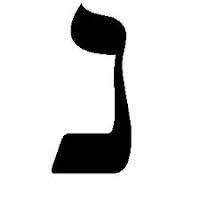
Nun is the fourteenth letter in the Hebrew alphabet. Nun (also written as “Noon”) has the same sound as “n” as in “nut”. Every line in Psalm 119:105–112 starts with this letter. Nun looks like this:

nun

“Nun” means “life” and is associated with a picture of a fish swimming in the water. Rabbis teach that “Nun” represents all movement and growth in life, like a fish darting in the water, but also as a new seed sprouting or a branch bearing fruit. It carries with it the idea of multiplying, continuing, perpetuating.

Last week, we learned that the letter Mem meant “water”, representing the waters of baptism for a new believer.  The energy of that new life in Christ is found in the letter Nun. It’s no wonder that the early church used the sign of a fish as a secret symbol of being a follower of Jesus.

When threatened by Rome in the first century, Christians used the fish to mark meeting places and to distinguish friends from foes. If a believer met a stranger in the road, he sometimes drew one arc of the simple fish outline in the dirt. If the stranger drew the other arc, both believers were assured of safe company. They knew they were both followers of the One who said, “I will make you fishers of men.” The early disciples understood the importance of multiplying in order to keep the gospel alive.

fish

The first mention of the word “Nun” in the Bible is in Exodus 33:11, in reference to Joshua, the “son of Nun.” Joshua was the one who led the Israelites into the Promised Land. Joshua was, literally,  the “Son of Life” — and a foreshadowed figure of Jesus, the coming Messiah, who will lead us into the promised land of eternity.

The Hebrew word for son is “ben.” The first letter is ב bet with a letter sound of “B” and a word picture of a house. The second letter is a nun נ with a word picture of life and a letter sound of “N”. These two letters together are a word picture of “life in the house.” In other words, the son perpetuates the life of the family; through the son, generations will continue.

“I will be a Father to you,
    and you will be my sons and daughters,
says the Lord Almighty.”
2 Cor. 6:18

We are the life in the house.

The life of faith is revealed in the second half of the Hebrew alphabet. First we are taught (Lamed) and then we take a step of obedience by going into the waters (Mem) of baptism. Nun shows us that the next step is to grow in the new life we have in Christ.

nun1

Next: My favorite word in the Bible that starts with “O”.

Long Song Study, part O

After extolling the wisdom of God’s Word in the previous section of Psalm 119, David made a decision to follow it. It was settled — he was determined to live according to God’s ways and words.

thy

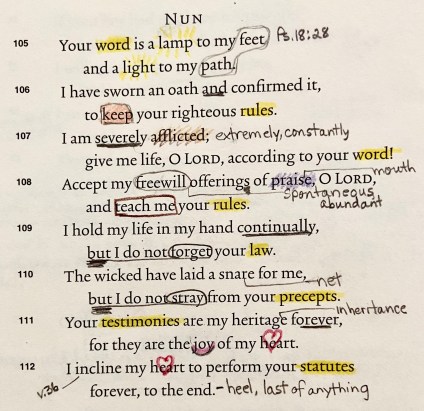
Verse 105
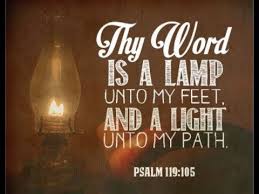
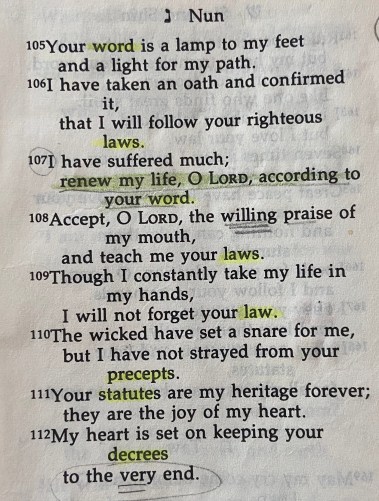
Your word is a lamp to my feet and a light to my path.
David thought of God’s word as light to help him see things he wouldn’t otherwise be able to see. Jerusalem didn’t have street lights in David’s day. If people ventured out at night, they carried a lantern to illuminate their path, helping them avoid open sewers or horse poop on the road. The lamp didn’t serve as a guide as much as it provided a way to keep from stumbling into the muck. This lamplight only was effective for the person who was up and moving on the path, not for the the one who was sitting on the couch wishing for direction. As Thomas Manton said, “It is not a light to our brains to fill us with empty notions, but a light to our feet to regulate our practice and to guide our actions.”

Verse 106
I have sworn an oath and confirmed it, to keep your righteous rules.
David had made a promise to carry the light of God’s Word throughout his course of life. That was a good move, but he knew he had to revisit that decision often and recommit himself to it regularly. Why did he swear on a stack of Bibles to stick with God? Because he knew himself — he could be stubborn, fickle and lazy. And he had a thing for beautiful women. Still, it was good to make a vow, even though he didn’t have the strength within himself to keep it perfectly. Paul prayed for New Testament believers with this idea in mind: “We pray for God’s power to help you do all the good things that you hope to do and that your faith makes you want to do.” (2 Thess. 1:11)

Verse 107
I am severely afflicted; give me life, O Lord, according to your word!
This determination to keep God’s righteous rules wasn’t based on an arrogant view of his own strength. As soon as he swore to live by God’s standards, he pled for God to give him grace to keep that promise. Affliction may have driven David to confirm his resolve. It’s hard to stay true when going through seasons of severe testing. “We need to remember that the Christian life always ends well, but it doesn’t always go well.” (Stephen Yuille) An initial decision to follow Jesus, especially when made publicly, helps us stay on course during difficult times that may come down the road.

Verse 108
Accept my freewill offerings of praise, O Lord, and teach me your rules.
There’s nothing more powerful that genuine, heart-felt praise in the face of severe affliction. David offered praise, not because he felt obligated or under constraint, but because he wanted to, of his own free will. He meant it. The word “freewill” implies a spontaneous and abundant outpouring from his mouth. In other words, he spoke his praise out loud, even while beset with troubles. His offering of praise was not required by Old Testament law and had nothing to do with payment for sin. It just bubbled up from a heart of love for his Lord. Once again, David humbly asked for continued instruction.

Verse 109
I hold my life in my hand continually, but I do not forget your law.
Evidently, David’s decision to commit himself to God was fraught with danger on a daily basis. That is still true today for believers in many parts of the world. Whether we are aware of it or not, there are always evil forces working against any believer’s resolve to follow righteousness. The life of faith is something we have to continually fight for. Even so, David kept God’s law in the forefront of his thinking. “While he carried his life in his hand, he also carried the law in his heart.” (Spurgeon)

Verse 110
The wicked have laid a snare for me, but I do not stray from your precepts.
Traps had been set to trip David up and take him down. Snares are tricky — they are hidden from view and meant to catch or entangle something unawares. No wonder David felt like he was being hunted; every move he made was risky. For the second time in two verses, David used my favorite word in the Bible — but. No matter what, David would not abandon God’s law or wander away from God’s truth.

lantern

Verse 111
Your testimonies are my heritage forever, for they are the joy of my heart.
In light of the daily pressure of snares and affliction, David turned his thoughts to eternity. He needed some joy, so he pinned his happiness on the everlasting nature of God’s word. He relished the thought of a “forever” where every promise would be fulfilled and peaceful joy would reign. He was able to get a taste of that joy by affirming his future inheritance.

Verse 112
I incline my heart to perform your statutes forever, to the end.
Back in verse 36, David wrote, “Incline my heart to your testimonies.” He was asking God to help him “stretch toward” and “lean in” to God’s word. Seventy-six verses later, David was taking hold of his heart and telling it where to lean. He took the long view and then reconfirmed his intention to stick it out to the end. To infinity and beyond.

I like this illustration by Stephen Yuille:

“We struggle with inordinate affection for this world. If I offer a three-year-old child a choice between a chocolate bar and a check for one thousand dollars, which will he choose? He will choose the chocolate bar. Why? He doesn’t see the big picture. He doesn’t see the future. He doesn’t perceive the value of the check in comparison to the chocolate bar. I fear many of us don’t perceive the difference between the temporal and eternal.”

img_0456

Things I know for sure from this passage:

  • It takes pre-determined resolve to finish well.
  • God sheds light on my path as I spend time in His Word.
  • Snares come in many shapes and forms: revenge, unforgiveness, lust, and pride, to name a few.
  • I need the light of the Lord to help me stay out of the muck of the world.
  • I must “incline” my heart, or make it lean, toward Jesus.

Next: Nun

Stanza O

The 14th section of Psalm 119 begins with a verse David made famous around 1000 B.C. Then Amy Grant and Michael W. Smith made it famous all over again in 1990 A.D.

amy

Bible writers have compared the Word of God to fire, a hammer, seed, water, honey, gold, a sword, an anchor, and a mirror. David saw the Holy Law as lamplight that guided his steps.

Psalm 119: 105-112

Opening Your word shines a light,
     illuminating my life’s path.

Once I made a vow to follow;
     I meant it then, I mean it now.

Often I have suffered deeply,
     Oh Lord, revive me by Your Word.

Out of my mouth comes willing praise,
     receive it and then teach me more.

Observe the risks I take for You;
     even so, I keep Your word close.

Others bully me and set traps,
     still I hang tough and stay on course.

On and on Your legacy lives;
     such words make my heart sing for joy!

One thing alone motivates me–
     staying true till my dying breath.

img_0454

Next: Long Song Study, part O

N is for Now

How frustrating it was as a kid to hear,
“Maybe later, but not now.”
When was “later” going to arrive, exactly?
Did “maybe” mean “probably not gonna happen”?

How thrilling it was as a kid to hear,
“I have time right now. Let’s play!”

Now.

It’s a short word that packs a punch.
It appears in over 1200 verses in the Bible (NIV).
But Romans 8:1 is my favorite.

Therefore, there is now no condemnation
for those who are in Christ Jesus.

What would that verse sound like without this powerhouse syllable?
“Therefore, there is * no condemnation for those who are in Christ Jesus.”
When, exactly? Maybe later? What about now?
See? Aren’t you glad there is no condemnation NOW?

now

Perhaps you remember my favorite word that starts with “B”.
Team that word up with this one and you’ve got a potent duo.

“Once you were alienated from God,
BUT NOW he has reconciled you…”
Colossians 1:21-22

“Once you were not a people,
BUT NOW you are the people of God.”
1 Peter 2:10

“I was blind,
BUT NOW I see.”
John 9:25

“For this son of mine was dead,
BUT NOW he is alive;
he was lost,
BUT NOW he has been found.”
Luke 15:24

It has been said that we live between the “already” and the “not yet”. The Kingdom of God has come in Jesus, but the complete fulfillment of the Kingdom is still in the future.

John said it like this,
“Beloved, we are God’s children now,
and what we will be has not yet appeared.”
1 John 3:2
Now and not yet.

How thrilling it will be to witness the moment the God of the universe says,
“NOW!”.

“For the Lord himself will come down from heaven, with a loud command, with the voice of the archangel and with the trumpet call of God, and the dead in Christ will rise first. After that, we who are still alive and are left will be caught up with them in the clouds to meet the Lord in the air. And so we will be with the Lord forever.” 1 Thess. 4:16-17

Not maybe.
Not probably.
Not now.
But soon.

one-minute-to-midnight-5549171

Mem

Mem is the thirteenth letter in the Hebrew alphabet. Mem has the same sound as “m” as in “mom”. Every line in Psalm 119:97-104 starts with this letter. Mem looks like this:

mem

As you can see, there are two forms of this letter. The open one on the right is used at the beginning or middle of a word. The closed one on the left is only used at the end of a word.

This letter is closely connected to water.
The Hebrew word for water looks like this:

water

See the open “Mem” followed by a “Yod” and finally the closed “Mem”? (Hebrew reads from right to left!) Some rabbis teach that the “Yod” in the middle is a drop of water within the word “water”.

Water is the most basic and important element in life. Sixty percent of our bodies are made up of water. The earth is 71% water. Without water, we can’t live more than three days. There is a Jewish saying, “There is no water but Torah.” Rabbis teach that the Torah is the most basic and important element in one’s spiritual life. Without the Torah, the Jew is like a fish without water — he couldn’t live.

Since “Mem” is the letter of water, it symbolizes the “spring” of wisdom found in the scriptures. Like an underground spring rises up from an unseen source, so does the spring of wisdom rise up from the mysterious Source that is God. http://www.hebrew4christians.com

Maybe that’s why David wrote about wisdom, understanding and insight in the “Mem” section of Psalm 119.

It’s easy to find Jesus in the 13th letter.
The Messiah is our Living Water.
He is the only one who truly satisfies our inner thirst for real life.
He is the most basic and vital of all elements in this world.
He is the Living Word and we cannot survive without Him.

spring

As the second half of the Hebrew alphabet reveals the life of faith in response to the good news of the gospel, so the letter “Mem” reflects the believer’s baptism. First we are taught (Lamed) and then we take a step of obedience by going into the waters (Mem) of baptism.

“Let anyone who is thirsty come to me and drink.
Whoever believes in me, as Scripture has said,
rivers of living water will flow from within them.”
John 7:37-38

mem2

Next: My favorite word in the Bible that starts with “N”.