I am breaking rule #2 today. 2) Use only small words, four letters or less.
And I am invoking rule #3. 3) Change the rules when necessary.
I sure am glad I left that loophole open, because I sure do love this word.
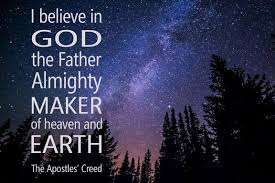
My favorite word in the Bible that starts with “M” is “Maker.”
I’ve noticed lately that artists of all kinds are calling themselves “makers.”
The Original Maker was, indeed, an artist.
But the term is nothing new.
“Come, let us bow down in worship before the Lord our Maker.” Ps. 95:6
“My help comes from the Lord, the Maker of heaven and earth.” Ps. 121:2
“He is the Maker of heaven and earth and everything in them.” Ps. 146:6
“Let Israel rejoice in their Maker.” Ps. 149:2
God is a Maker with a capital “M”.
We have been made by Him.
“For you created my inmost being;
you knit me together in my mother’s womb.”
Ps. 139:13
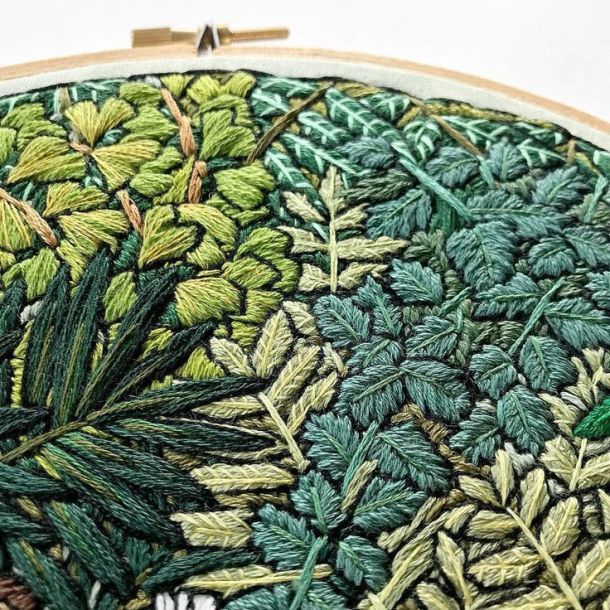
The Hebrew word for “knit” is similar to our word for “embroidered.” In other words, He didn’t print off a copy and slap us together with some scotch tape. No! He used the very finest of handiwork, creating detail upon detail. Each stitch was an artful expression, resulting in a one-of-a-kind. Our word “embryo” comes from this beautiful root word “embroidery.”
The Bible opens with the Lord making one thing after another.
“So God made the expanse…”
“God made two great lights…”
“God made the wild animals…”
He made the seventh day holy.
He made a man from the dust.
He made a woman from the rib.
It was good.
For a little bit.
Until it wasn’t.
So the Maker kept on making.
“The Lord God made garments of skin for Adam and his wife.” Gen. 3:21
Then the Maker kept on making.
God was pleased to reconcile to Himself all things by
“making peace through Jesus’ blood, shed on the cross.” Col. 1:20
And the Maker will keep on making.
“I am making everything new!” Rev. 21:5
We have been made in the image of God.
Let’s be like Him and make something good today.
My favorite word in the Bible that starts with “M” is MAKER.
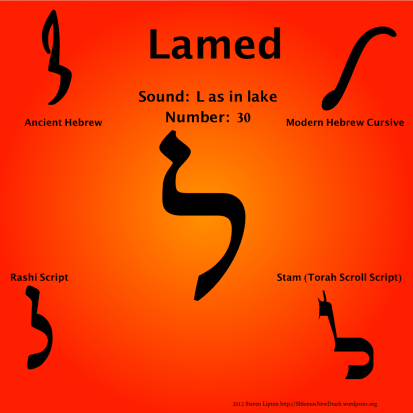
Lamed (also written as Lamedh) is the twelfth letter in the Hebrew alphabet. Lamed has the same sound as “l” as in “lake”. Every line in Psalm 119:89-96 starts with this letter. Lamed looks like this:
“Lamed” is unique in the Hebrew alphabet because it is the tallest letter.
Also, it is considered the central letter, or “heart” of the Hebrew alphabet.
By the way, the Hebrew word for “heart” starts with the letter “lamed”.
Heart = לֵב (lev)
The word “lamed” means to learn or to teach and it is first seen in the Bible in Deuteronomy 4:1, “Now, Israel, hear the decrees and laws I am about to teach you.” Learning has always been viewed as sacred to the Jewish people. It was a high calling for a man to become a Rabbi because it meant devoting his whole life to learning the Torah and teaching it to others. Every student’s goal was to move from knowledge to understanding to wisdom. Knowledge alone came up short without moving from the head to the heart. The wisest Rabbis were seen as head and shoulders above everyone else, just like the “lamed” rises above the other Hebrew letters.
In the Jewish tradition, learning wasn’t an end in itself, but found its purpose in action. The accumulation of knowledge was only of value if it spurred one to do something. James, Jesus’ brother, wrote about this idea in his letter.
“But be ye doers of the word,
and not hearers only,
deceiving your own selves.” (James 1:22)
A true disciple, then, is both a learner and a doer,
one who “learns” in order to “do.”
Sometimes we need a little prodding to “learn” and “do”.
The “lamed” is shaped like a cattle prod,
which farmers used to direct their animals.
A little poke, a kick in the behind, or a spur in the side
motivates us to keep moving along.
Even though Jesus was a Teacher while He lived on earth, He also was a learner. “Son though he was, he learned obedience from what he suffered.” Heb. 5:8
Israel = יִשְׂרָאֵל (yisrael)
The name Israel starts with the smallest letter, “yod”, and ends with the biggest letter, “lamed”. Some scholars interpret this to mean that the nation of Israel may have started out small, but in the Last Days it will be higher than all the other nations, teaching them the truth about God and Jesus, the Messiah.
The first eleven letters of the Hebrew alphabet revealed the gospel. The second set of eleven letters will reflect the response of a believer and the walk of faith. It all starts with learning, being teachable, and recognizing the prodding of the Holy Spirit.
Next: My favorite word in the Bible that starts with “M”.
David made it through the low point, or “midnight of the psalm” in last week’s passage. In this section, his tone changes from despair and doubt to steady reliance on God’s words.
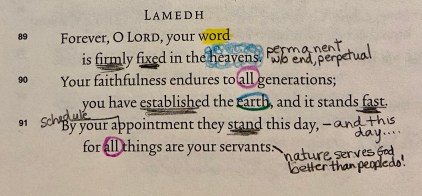
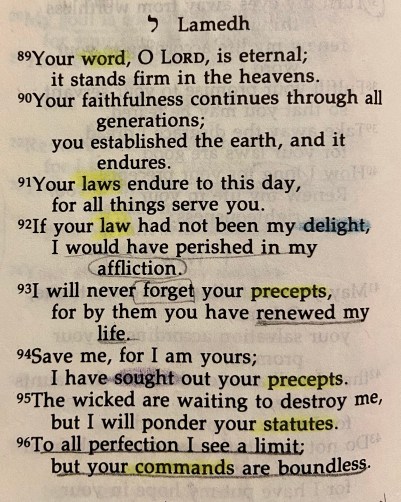
Psalm 119:89-96
Verse 89 Forever, O Lord, your word is firmly fixed in the heavens. Here is why it is worth our time to study the Bible: it’s going to last forever. Every moment we spend in the Word will be of value in eternity. The Bible is the only thing on this earth that is not temporary. It is a permanent fixture in heaven that we will recognize and rejoice in when we get there.
Verse 90 Your faithfulness endures to all generations; you have established the earth, and it stands fast. Just as the Word is firmly fixed in the heavens, so too, the faithfulness of the Lord is firmly fixed on the earth. Hundreds of generations of people have come and gone, and God has faithfully endured every one. Evidence of His faithfulness is everywhere. The hymn writer said it best:
Summer and winter, and springtime and harvest,
Sun, moon and stars in their courses above,
Join with all nature in manifold witness
To Thy great faithfulness, mercy and love. (Great Is Thy Faithfulness, Thomas Chisholm)
Verse 91 By your appointment they stand this day, for all things are your servants. David saw the sun rise every morning, the planets stay on their tracks, and the seasons turn in time. God had organized the universe with His creative word. This gave David confidence that if he held on to the Creator God and His creative words, he was secure.
David used every expression he could think of to drive this idea home. Verse 89: “firmly fixed”; verse 90: “established” and “stands fast”; verse 91: “stand” — they all mean the same thing. “The order and stability of the created work of God is guaranteed by the authority of the word of God. And therefore the believer who rests upon that word, rests upon firmness and will not fall into a pit.” (Christopher Ash) All of nature is serving the purposes of God, to show us His power and faithfulness.
Verse 92 If your law had not been my delight, I would have perished in my affliction. Looking back on his period of suffering, David realized how close he came to giving up. And sometimes people do give up. For some, affliction can lead to destructive anger, bitterness and hopelessness. For others, trials drive them deeper into the arms of God where His Word sees them through dark times. David understood that holding on to the word that was firmly fixed in creation was his only place of security.
Verse 93 I will never forget your precepts, for by them you have given me life. Having come out on the other side of suffering, David had fresh appreciation for life. He would not soon forget the help and hope he received from God’s Word.
There are some verses I will never forget, because they spoke to my heart during difficult circumstances. Those words are marked in my Bible with a date in the margin. They stand as a testimony of God’s help when I was struggling. Spending regular time in the Word keeps me from forgetting His provision in the past and His promises for the future.
Verse 94 I am yours; save me, for I have sought your precepts. David had given himself to God, so he knew he could continue to depend on God’s care. All believers have the seal, or mark, of the Holy Spirit, God’s sign of ownership. “Having believed, you were marked in Him with a seal, the promised Holy Spirit, who is a deposit guaranteeing our inheritance.” (Eph. 1:13-14) We belong to Him. Guaranteed. “You are not your own; you were bought at a price.” (1 Cor. 6:19-20)
Verse 95 The wicked lie in wait to destroy me, but I consider your testimonies. His troubles weren’t over, but David had learned not to obsess about what his enemies were up to. He knew they were watching him, but David turned his attention from them to God’s testimonies. The wicked were lying in wait for David, but David was waiting upon God. It takes strength and resolve to keep our eyes on Jesus when under attack. It’s another three word prayer I whisper often — “Eyes on Jesus, eyes on Jesus, eyes on Jesus.”
Verse 96 I have seen a limit to all perfection, but your commandment is exceedingly broad. As a bit of a perfectionist (Enneagram #1), I’m always bumping up against imperfection. What a relief to come to terms with the fact that perfection isn’t required or even expected. Spurgeon said, “He does not expect perfection in the creature, and, therefore, he is not disappointed when he does not find it.” God is different. He is limitless, bottomless, boundless, inexhaustible, immeasurable, and every other word in my thesaurus.
Things I know for sure from this passage:
During times of uncertainty, I need the firmly fixed Word of God that stands fast.
Nature is constantly speaking to me of God’s faithfulness.
Delighting in God’s Word is a mark of spiritual maturity.
The first eleven letters of the Hebrew alphabet tell the story of our rescue, from the God-man bridging the gap between heaven and earth (Aleph) to the believer’s place of safety and security in the hands of the Father (Kaph). The 12th letter marks the beginning of the second half, and a new story. The theme shifts from God’s work on our behalf, to our response and our need to persevere to the end with our faith intact.
Psalm 119:89-96
Made to last beyond space and time, Your divine word stays rock solid.
Marching through time, You are faithful. The earth lasts because You say so.
Morning to night, Your laws live on, and all creation waits on You.
Minus Your laws that delight me, I couldn’t have survived for long.
Mindful of all You’ve said to me, I feel reinvigorated.
My life is all Yours, so save me, for I keep on searching Your Word.
Many foes are out to get me, still I fix my thoughts on Your law.
Most of the time I’m deficient, But not You — You are limitless.
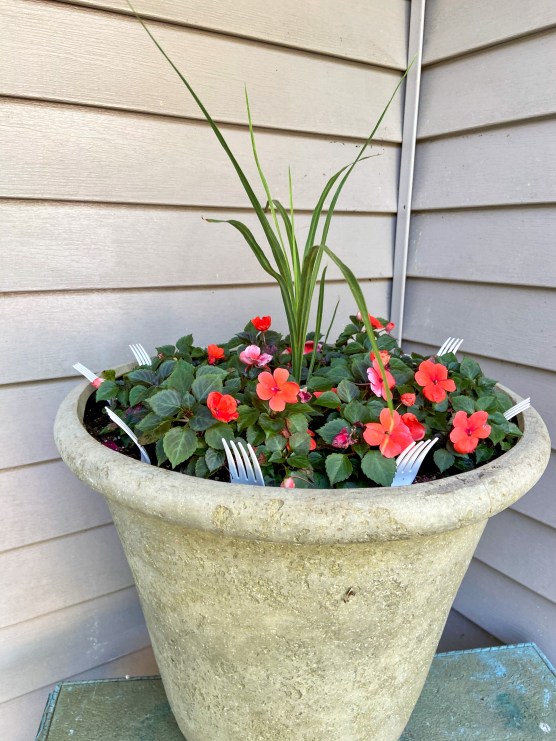
Every summer, my flower pots are attacked by chipmunks.
The little rodents crawl in and their little back feet go to work,
uprooting my blooms and spraying dirt all over the porch.
Not this year.
Not in 2020.
I may not be able to control this wild and crazy world.
The stores may not stock yeast and my favorite toilet cleaner.
The crack of the bat may not be heard in stadiums and ball fields.
We may not sit in theaters watching the summer blockbuster.
We won’t spread blankets on the city square and listen to concerts.
But, by gum, those insolent critters are not going to dig in my flower pots.
My weapons of warfare are plastic forks and they are holding off the enemy.
I’m standing my ground.
It’s the obvious choice.
“Love” is my favorite word in the Bible that starts with “L”.
It may be my favorite word in the whole Bible.
It might be my favorite word in the English language.
But I’m not a good enough thinker or writer to do this word justice.
Today, I defer to the Apostle Paul who wrote the consummate essay on love.
You know it well
You’ve heard it at weddings.
You’ve seen it on coffee cups.
But today, read it like it’s something brand new
that just landed in your inbox.
Go ahead.
Read it out loud.
Today and every day.
If I were to speak with eloquence in earth’s many languages, and in the heavenly tongues of angels, yet I didn’t express myself with love, my words would be reduced to the hollow sound of nothing more than a clanging cymbal.
And if I were to have the gift of prophecy with a profound understanding of God’s hidden secrets, and if I possessed unending supernatural knowledge, and if I had the greatest gift of faith that could move mountains, but have never learned to love, then I am nothing.
And if I were to be so generous as to give away everything I owned to feed the poor, and to offer my body to be burned as a martyr, without the pure motive of love, I would gain nothing of value.
Love is large and incredibly patient. Love is gentle and consistently kind to all. It refuses to be jealous when blessing comes to someone else. Love does not brag about one’s achievements nor inflate its own importance. Love does not traffic in shame and disrespect, nor selfishly seek its own honor. Love is not easily irritated or quick to take offense.Love joyfully celebrates honesty and finds no delight in what is wrong. Love is a safe place of shelter, for it never stops believing the best for others. Love never takes failure as defeat, for it never gives up.
Love never stops loving. It extends beyond the gift of prophecy, which eventually fades away. It is more enduring than tongues, which will one day fall silent. Love remains long after words of knowledge are forgotten.Our present knowledge and our prophecies are but partial,but when love’s perfection arrives, the partial will fade away.When I was a child, I spoke about childish matters, for I saw things like a child and reasoned like a child. But the day came when I matured, and I set aside my childish ways.
For now we see but a faint reflection of riddles and mysteries as though reflected in a mirror, but one day we will see face-to-face. My understanding is incomplete now, but one day I will understand everything, just as everything about me has been fully understood. Until then, there are three things that remain: faith, hope, and love—yet love surpasses them all.
Kaph (also written as Kaf or Khaf or Chaf) is the eleventh letter in the Hebrew alphabet. Kaph has the same sound as “k” as in “kite”. Every line in Psalm 119:81-88 starts with this letter. Kaph looks like this:
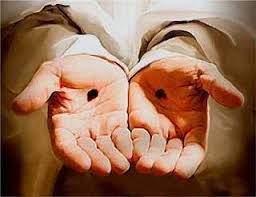
The word “Kaph” means “the palm of a hand” and is shaped like a hand curving around a cup to hold it. In the Old Testament, fathers would place their hands on their children’s heads when pronouncing a blessing. In the New Testament, Jesus often laid His hands on people who needed healing.
Orthodox Jewish men wear a “kippah”, or a skull cap, that represents the palms of God’s hands (Kaph) resting on the head, as a protective covering for the mind, body and spirit.
“Kaph” is closely associated with the idea of “covering” as described in Exodus 33. When Moses said to God, “Show me your glory,” the Lord replied, “I will put you in a cleft in the rock and cover you with my hand (Kaph) until I have passed by.” (Ex. 33:22)
The word “cover” is the same word for “atonement”.
Can you see where this is going?
Jesus,
who is at the right hand of God,
provided covering
for our sins
through His blood.
God made clothes with His hands
out of animal skins for Adam and Eve.
He’s been covering for us ever since.
Hear Jesus’ last words on the cross:
“Father, into your hands I commit my spirit.” Luke 23:46
See Jesus’ hands, which bore the mark of sacrifice — and still do.
“Look at my hands and my feet. It is I myself!” Luke 24:39
Watch Jesus’ final act before ascending:
“When he had led them out to the vicinity of Bethany,
he lifted up his hands and blessed them.” Luke 24:50
We are safe in His hands. “See, I have engraved you on the palms of my hands.” Is. 49:16
Next: My favorite word in the Bible that starts with “L”.
This is the 11th week of the Long Song Study, which means, after part L, we are halfway through! Back in April, when I started this series, I wondered if anyone would stick with it. I wondered if I would stick with it. But here we are — 11 down, 11 to go.
Psalm 119:81-88
Verse 81
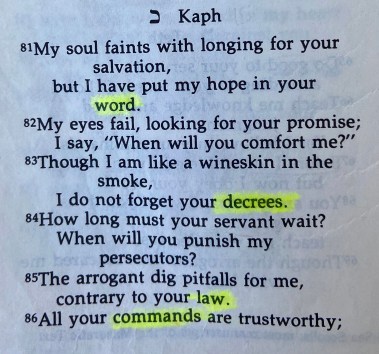
My soul longs for your salvation; I hope in your word. There’s a lot of longing in this section of Psalm 119. It is definitely the low point, or as Spurgeon said, “the midnight of the psalm.” David was not just wishing for better days; he had worn himself out with yearning for a rescue, even to the point of fainting. His struggle had gone on for so long, that his spiritual strength was faltering. So David lamented. He honestly expressed his anguish and asked the questions we all wrestle with when experiencing periods of suffering: When? How long? Why? As in verses 43 and 74, David’s hope came from the word of God. Paul wrote, “But if we hope for what we do not yet have, we wait for it patiently.” (Romans 8:25) David was running out of patience.
Verse 82
My eyes long for your promise; I ask, “When will you comfort me?” David could read the words of God’s promise and he believed them, but he couldn’t see them working on his behalf. Time was ticking away and nothing seemed to be happening. For the first time in his long song, he asked questions. God’s comfort was something he had experienced many times in the past, but what about now? David was saying, “If You’re not going to save me right now, can’t You at least comfort me? Like, right now?” Instead of asking, “When will you deliver me?” David’s question revealed what he truly desired: God’s reassuring presence with him.
Verse 83
For I have become like a wineskin in the smoke, yet I have not forgotten your statutes. You probably don’t have an animal skin full of wine hanging in your chimney. It was common in David’s day, as the smoke added flavor and mellowed the new wine. However, if the heat became too intense or if the wineskin was left too long, the skin would dry and crack, ruining the contents. David felt he was coming dangerously close to cracking under the heat of persecution. He was burning out during this prolonged time of stress.
True to the biblical form of lament, it didn’t take David long before he turned his mind back to God. Although at the moment he felt as if God had forgotten him, he would not forget God’s statutes.
Verse 84
How long must your servant endure? When will you judge those who persecute me? Almost immediately though, the questions returned. Like David, we ask, “How much longer until this is over? On what date and time will You come through for me? If I knew when this trouble is going to pass, I would be able to gut it out.” But God does not often let us in on His timetable. Faithfulness and perseverance matter more to God than worldly success and ease.
Did you notice that something is missing in this verse? There are no “word” words here: law, word, precept, statute, commandment, etc. This is one of only five verses in the entire psalm that doesn’t refer to God’s word. Perhaps lingering too long on the questions fostered doubt and crowded out the Word.
Verse 85
The insolent have dug pitfalls for me; they do not live according to your law. David wasn’t just whining about minor offenses. He had legitimate enemies that were trying to take him out. He couldn’t reason with them about their malicious attacks because they had no basis for morality, living apart from God’s law. David was dealing with cruel and crafty deceivers who were intent on causing the kingdom and the king to fail. He had to watch his step, knowing land mines were everywhere, waiting to blow him up.
Verse 86
All your commandments are sure; they persecute me with falsehood; help me! In contrast to the pits that caused fear with every step, David reminded himself of the sure foundation and solid footing of God’s truth. Even so, he was near the end of his rope. His reputation was being sullied by a smear campaign based on lies. Things were spiraling down so David desperately prayed, “Help me.” It wasn’t the first time. “When I said, ‘My foot is slipping,’ your unfailing love, Lord, supported me.” Ps. 94:18
Verse 87
They have almost made an end of me on earth, but I have not forsaken your precepts. If this was it — if this was the way it was going to end for David — then his days on earth would be over, but it wouldn’t be his final chapter. David kept the promise of eternal life before him. He also knew “the grass withers and the flowers fall, but the word of our God endures forever.” (Is. 40:8) He hung on with incredible tenacity to the words of God, knowing he would take them with him into eternity. In troubling times, the Bible should be the one thing we cling to above all else. We can’t quit reading, memorizing, studying and meditating on God’s Word in times of hardship. It shouldn’t be the last resort. (Did you notice that big “but”?)
Verse 88
In your steadfast love give me life, that I may keep the testimonies of your mouth. There it is again — that “hesed” love: “steadfast love, lovingkindness, mercy, unfailing love, faithful love, loyal love; a long-suffering love that extends to the undeserving and even intervenes on their behalf”. David wasn’t eager to see the curtain come down on his time on earth. He wanted to live. Why? So he could clear his name? Or get his popularity back? Or see his persecutors judged? No! It wasn’t about him at all! David wanted to live so that he could make God’s name great, so that he could display the steadfastness of God’s character, and so that the Words of God could be exalted!
Things I know for sure from this passage:
God is not offended by our questions.
We need His presence more than His answers during times of suffering.
God’s Word provides stability, certainty, and steadiness.
Those who are hostile to God are often hostile to God’s people.
We are to stay faithful and leave the timing of things to God.
Next: Kaph
The Exodus Music recording of this section of Psalm 119 is especially beautiful. I’m a sucker for a cello accompaniment. You can feel the ache in David’s lament – take a listen!
Maybe you noticed that I skipped from J to L? I have nothing against K. My firstborn’s name starts with K. It’s just that I had to shave 4 letters off the English alphabet in order to match the 22 letter Hebrew aleph-bet. K, Q, X and Z got the boot because they have the least number of words in my thesaurus. It was strictly an objective decision. K?
Psalm 119:81-88
Longing for rescue, I fade fast, till I think of Your hopeful words.
Looking high and low for lifelines, I say, “Are you coming, or not?”
Listless as a shriveled up leaf, I make myself remember You.
Lonely, long days pass while I wait; when will my foes get their payback?
Look! Those hotshots plan my downfall; surely that goes against Your law.
Listen, Lord, I trust Your commands, but I need help with these bullies.
Life just about ended for me, still I won’t turn my back on You.
Love me, Lord, and safeguard my life; say the word and I will obey.
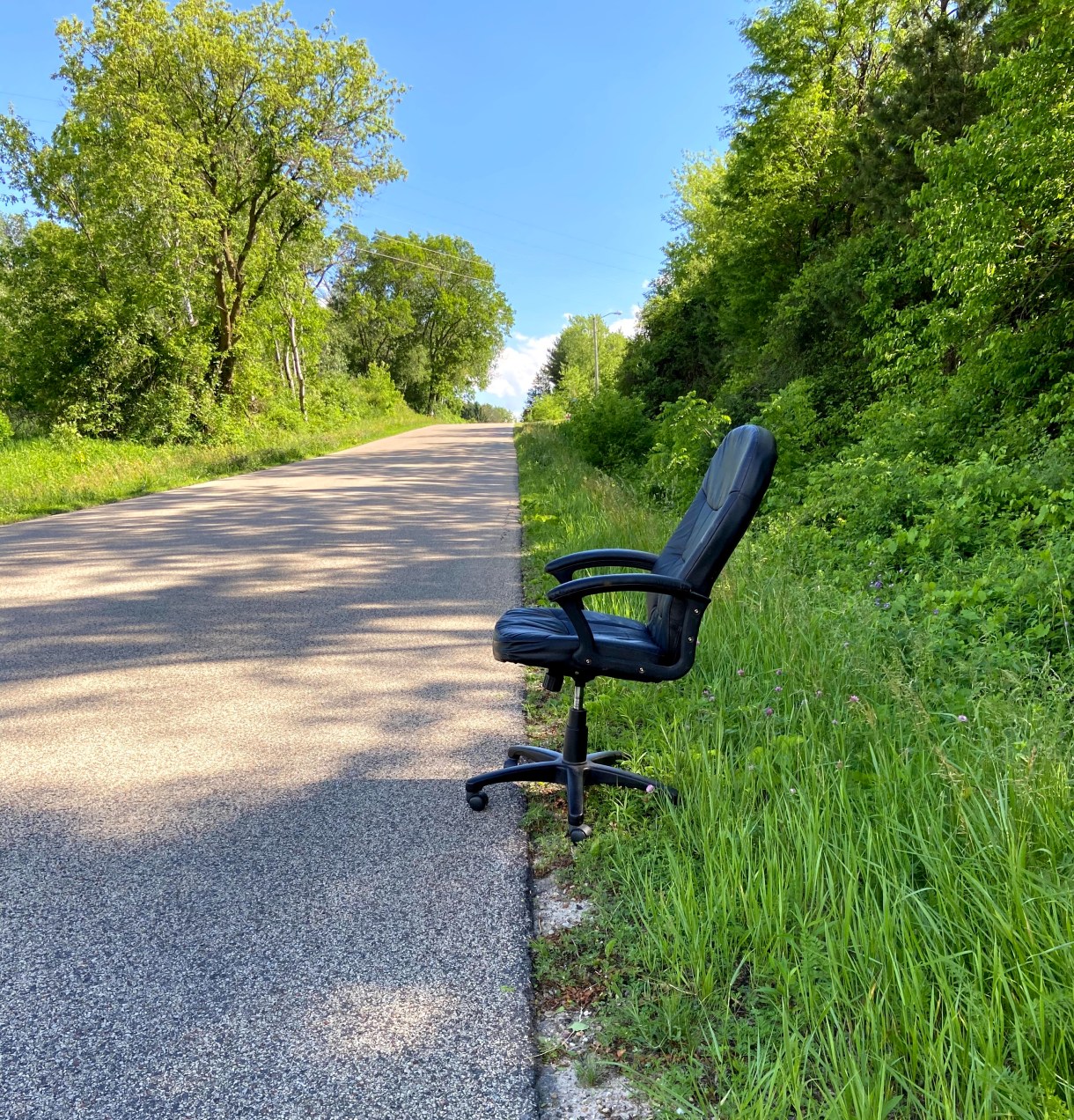
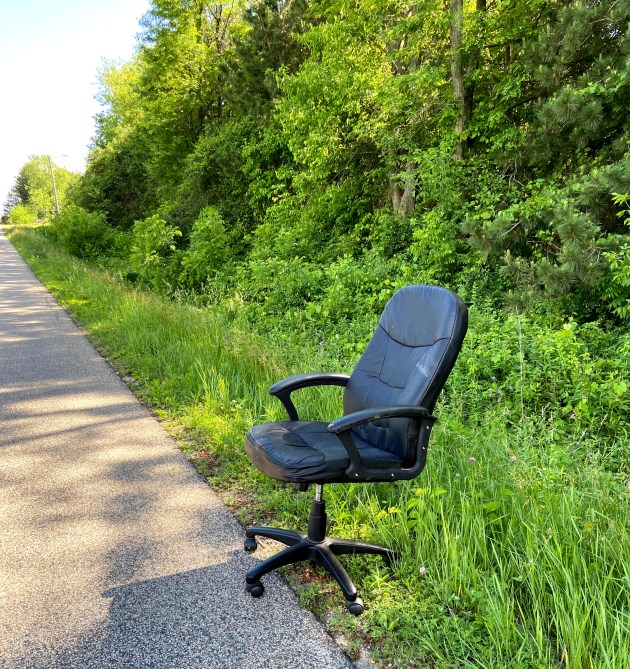
A curious sight on a country road.
Someone saved a seat for me.
Stop and take a load off.
Don’t mind if I do.
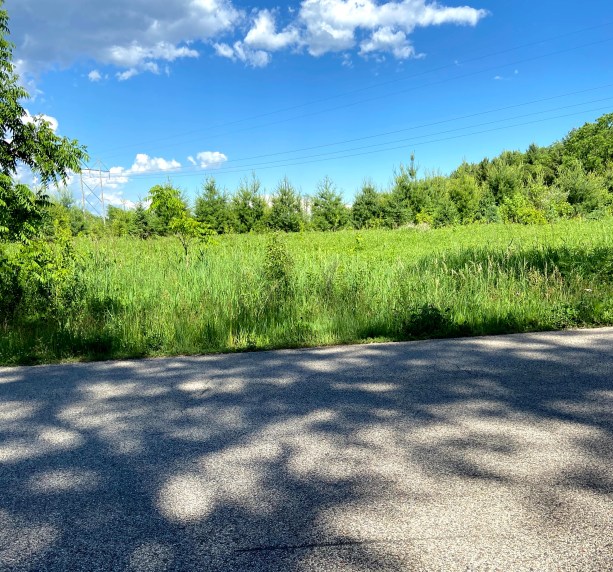
A standing room only show of
green pastures
blue skies
white clouds.
Take a seat, ma’am.
This is your Father’s world.
Look! Listen!
All nature sings and ’round you rings
the music of heaven.
See! Hear!
Though the wrong seems oft so strong,
God is the ruler yet.
May we have eyes to see and ears to hear.
He’s saving us a seat.


 “Lamed” is unique in the Hebrew alphabet because it is the tallest letter.














 a small drop of ink