Dalet

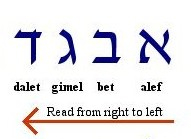
Dalet (also written as Daleth or Daled) is the fourth letter in the Hebrew alphabet. It sounds like our letter “D” as in “Dad”. Every line in Psalm 119:25-32 starts with this letter. Dalet looks like this:

Vector illustration of the Hebrew Letter Daleth

Remember from last week how Gimel meant “giver” and how that letter was a picture of a person with his foot stretched out in motion, running toward Dalet to give it gifts? The reason why Gimel was running toward Dalet is because “Dal” means poor, weak, or needy.” The God-Man (Aleph — Jesus) came to earth to be master of the house (Bet) and to give the good gift of redemption (Gimel) to the poor and weak (Dalet).

The word “Dalet” means “door” or “gate”. A door is a barrier that must be opened in order to go through to another place. It separates two spaces and has a threshold which must be crossed.

Jesus said:

I am the door. If anyone enters by me, he will be saved and will go in and out and find pasture. John 10:9

Jesus Christ is our means of crossing over from death to life, from darkness to light. But we must go through Him (I am the way… John 14:6). The Messiah is our Dalet, our portal to fellowship with God and eternal life. When a person believes in Jesus and accepts the gift of redemption, it’s like stepping over a threshold into a new life. (“He has crossed over from death to life.” John 5:24)

In Jewish tradition, the fourth letter of the aleph-bet is connected to the fourth day of creation. On day four, God separated the day from night by setting the sun, moon, and stars in the sky. They were to “serve as signs” (Gen. 1:14).

Every sunrise opens the door to a new day.
Each morning sun is a sign to us that Jesus is our source of Light.
“I am the light of the world.” John 8:12.

Every night the moon reflects the sunlight.
Each nighttime sky is a sign to us that darkness can’t prevail.
“The light shines in the darkness,
but the darkness has not overcome it.”
John 1:5

The Dalet-Door is open.
God is turning hearts toward His Son.
Could a global pandemic stir up a resurgence
of spiritual awakening and revival on the earth?
“Revive me according to your word.” Psalm 119:25

dalet

Next: My favorite word in the Bible that starts with “D”.

Long Song Study, part D

bstudy4

Today we’re going to look at Psalm 119:25-32,
which is the fourth section of this twenty-two part poem.
Yeah, we’ve got a ways to go.

Verse 25
“My soul clings to the dust; give me life according to your word!”
David was struggling. For a reason we don’t know, he felt like he was going to die. His situation was so grim, he recalled the words of God that cursed Adam, “For you are dust, and to dust you shall return.” Yet from face down in the dirt, he asked God to breath life back into him. He knew the Word could do that. (“All scripture is God-breathed…” 2 Tim. 3:16) He could have asked for comfort or deliverance from trouble, but instead he prayed, “quicken me” (KJV); “revive me” (AMP); “give me new life” (NLV).
“It is a grand thing to see a believer in the dust and yet pleading the promise.” Spurgeon

Verse 26
“When I told of my ways, you answered me; teach me your statutes!”
While he was down in the dust, David talked to God about his “ways”, or the road he was on. He didn’t go to his advisors or his best friend to rehash his troubles. He went to God. His words might have come in the form of complaint, or request, or confession. Or all three rolled into one. He got an answer and it must have been something like, “There’s something for you to learn in all this” because David responded, “Teach me!”

Verse 27
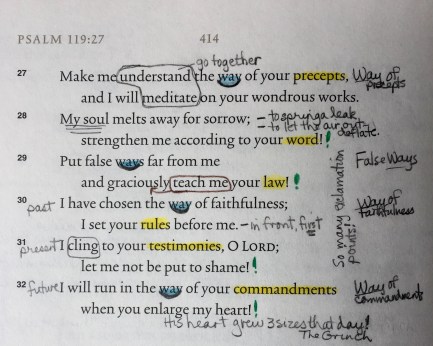
“Make me understand the way of your precepts, and I will meditate on your wondrous works.”
David asked for clarity to see the difference between his ways and God’s ways. There’s usually a gap there. What a great prayer – “Help me understand Your ways.”
Meditating is sometimes compared to a cow chewing its cud. These animals have four stomaches! They chew a while, swallow, regurgitate it and chew some more, repeating the process until the nutrients have gone through all four chambers. This process is called “rumination” and it’s where we get the word “ruminate” (to ponder or think about). We may need to slow down in order to have time to mull over the truths in God’s Word.

Verse 28
“My soul melts away for sorrow; strengthen me according to your word!”
Similar to verse 25, David was feeling all the feelings. The word for “melts” means “to spring a leak.” His tears were draining him of vitality, drop by drop. Like a balloon slowly leaking air, he was becoming deflated and defeated. As he wept, David asked for God to give him strength. I admire him for feeling things deeply, yet not getting stuck in the emotion. Even in desperately trying situations, he seemed to find his way to God, knowing God was the only One who could help.

Verse 29
“Put false ways far from me and graciously teach me your law!”
There was his way (v. 26) and God’s way (v. 27); and then there was a false way. Perhaps David’s sorrow was connected to some kind of deceptive outside influence. Or maybe he came face to face with his own lies. (“The heart is deceitful above all things…” Jere. 17:9) David wanted nothing to do with a fake form of religion that denied his need for grace. Some commentators believe David was confronting his own sin in this section. “Repentance happens when we see our sin without making excuses. We dare not confuse regretting with repenting. Esau regretted. Saul regretted. Ahab regretted. Judas regretted. But none of them ever repented.” (Christopher Ash)

Verse 30
“I have chosen the way of faithfulness; I set your rules before me.”
Looking back at his previous words in v. 1-24, David was reminded of his commitments. “I will keep your statutes” (v. 8); “I will fix my eyes on your ways” (v. 15); “I will not forget your word” (v. 16). And here is another “way” — a faithful way in contrast to a false way. His only hope of staying the course was to return to the promises he had made earlier in his life and to put God’s word back in front of his eyes. As long as he had life, he was determined to choose the Lord.

Verse 31
“I cling to your testimonies, O Lord; let me not be put to shame!”
This statement is the pivot point in this passage. David let go of the dust of death he had been clinging to and reached out for the Lord of life. He broke through the sadness and misery by releasing it in the presence of the Lord and then clinging to the truth of God’s word. It’s a great exchange!

Verse 32
“I will run in the way of your commandments when you enlarge my heart!”
No longer face down in the dirt, David vowed to get up and run in the freedom of forgiveness. For the fifth time in eight verses, “the way” was his focus. He finally found the one that gave him room to run and space to grow in love.
David began this section by asking God to revive him according to the word. That renewal happened as he confessed, repented and turned toward God. His heart grew three sizes that day.

img_9890img_9891

Things I know for sure from this passage:

  • On days when I feel down in the dumps, I need to speak to God first about it.
  • When my spirit feels weak, strength is available in God’s Word.
  • I need to pay attention to what I am clinging to for security and significance.
  • Every day I have to choose which way I will go: faithfulness or falseness.
  • Running in freedom is better than lying in dust.

Next: Daleth

Stanza D

How is everybody doing? I’ve heard it said that the whole world is a little depressed right now. Do you feel it? God knows it’s hard to be us. Thankfully, we get a whole range of emotions in the Psalms that give us some insight into how to navigate the ups and downs of life.

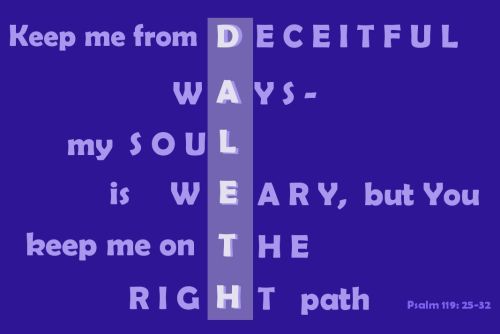
David had his share of bad days and he wasn’t afraid to be honest about it. Green pastures and still waters were not on his mind as he composed this fourth stanza. However, in eight verses he went from wallowing in sorrow to a full heart. He started out clinging to dust and ended up clinging to God’s testimonies. How did he do it? Let’s see what we can learn from stanza D this week.

daleth

(Here’s a review of my self-imposed rules for re-writing each passage.)

Psalm 119:25-32

Down at the bottom of the heap,
    I need Your word to renew me.

Describing my ways, You answered;
    now teach me what I need to learn.

Drill into me how Your law works,
    so I can chew on it in awe.

Deep inside I’m tired and sad;
    let Your word give me stamina.

Deceit must be put on the shelf;
    tenderly teach me Your precepts.

Determined to walk by Your side,
    I put Your laws front and center.

Deciding to stick with Your word,
    Lord, keep me from messing this up.

Delight comes with going full tilt;
    Your love makes my heart want to burst!

img_9879

Next: Long Song Study, part D

Sing Along

How I wish David and the other psalm writers had saved their sheet music. I long to know what these songs sounded like. Someday I’m going to insist on a concert from David and the Sons of Korah, along with appearances by Asaph and Heman the Ezrahite.

We must not lose sight of the fact that
these were songs
that were sung
by singers.

music

I guess I’m not the only one who has dreamt of singing these magnificent lyrics. Several creative artists have put many of the psalms to music using the exact words right out of the Bible. For anyone interested in putting scripture to memory, this is the way to go. It’s so much easier to remember words put to music, evidenced by the fact that we can all sing the entire theme song to “Gilligan’s Island”. (Those of us who were kids in the 60s.)

This week, I felt like I hit the jackpot when I stumbled onto two albums put out by Exodus Music called “Psalm 119, Volume 1” and “Psalm 119, Volume 2”. The names of the first three songs in Volume 1 are Aleph, Bet and Gimel.

Yes, I did a cartwheel.

These two albums put the first 15 sections of Psalm 119 to music using a variety of styles, from folk to blues to country. Naturally, I emailed them and asked if they had plans to record Volume 3. I received a lovely response:

We are currently working on volume 3. We were scheduled to record the first week of quarantine and things are currently delayed. We still hope to finish the project as soon as possible.

More cartwheels.

Let’s end this week’s study by enjoying the song “Gimel” performed by Bethany Griffin.

Here are more Psalm albums to check out if you’re interested:
Psalms — by Sandra McCracken (“Flourishing” is based on Psalm 119)
Psalm Songs, Volumes 1 & 2 — by The Corner Room (Psalm 119:33-40 is on Vol. 2)
Psalms; Psalms Volume 2; Psalms Live — by Shane & Shane
Psalm 1, 16, 46, 91, 139 — five singles recorded by Sons of Korah (!)

In case you need to catch up on this week’s study:
Monday — Stanza C
Tuesday — Long Song Study, part C
Wednesday — Gimel
Thursday — C is for Come

C is for Come

C is for COME.

“Come” is a word of invitation.
“We bid you to come and celebrate.”
“Hey, wanna come over?”

“Come” is a command.
“Come over here right now, young man.”
“Come and get it!”

“Come” is an action word.
“I’m coming!”
“Come along with us!”

God the Father is forever the gracious host.
Hear His invitation:

“Come now, and let us reason together.” Isa. 1:18
” Come, all you who are thirsty, come to the waters.” Isa. 55:1
“Come, follow me.” Matt. 4:19
“Come to me all you who are weary.” Matt. 11:28
“Come away with me to a quiet place.” Mark 6:31
“‘Come,’ he replied, ‘and you will see.'” John 1:39
“‘Come and have breakfast,’ Jesus said to them.” John 21:12

come

The Father’s hospitality is seen in the very beginning, in Eden, where He provided a perfect place for the flourishing of humankind. Adam and Eve were the first guests in God’s wonderland called earth. The serpent crashed the party, introducing evil and discord. Ever since, the call has gone out to all the image-bearers: Come.

The Father’s hospitality will be seen in the very end, where He will provide a new heaven and a new earth for whoever RSVPs to the invitation. “Whoever is thirsty, let him come; and whoever wishes, let him take the free gift of the water of life.” Rev. 22:17

To that I say, “Amen. Come Lord Jesus.”

My favorite word in the Bible that starts with C is COME.

Next: Sing Along

Gimel

Shalom!
(Shalom means “hello — peace to you”.)

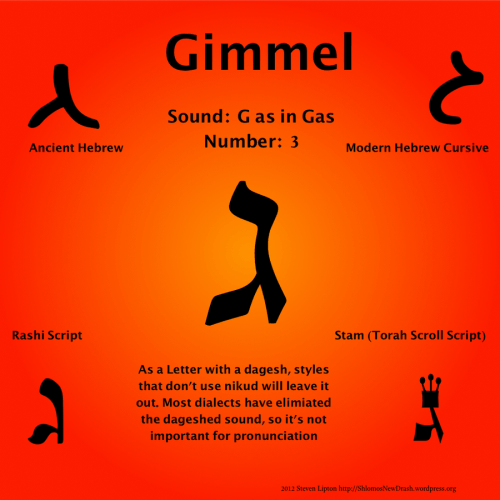
Gimel (also written as Gimmel) is the third letter in the Hebrew alphabet. It sounds like our letter “G” as in “God is good”. Every line in Psalm 119:17-24 starts with this letter. Gimel looks like this: gimel2

The Hebrew language is read from right to left across the page, which seems backward to us. There is a general rule in Judaism that the right side gets precedence because it represents strength. “The Lord’s right hand has done mighty things.” (Ps. 118:15) Even today, a father gives his children a blessing by putting his right hand on their heads.

So, the first four letters of the Aleph-Bet look like this:

abc

That’s important because it helps us see the story the Aleph-Bet is telling. God, in the form of Jesus (Aleph) is the God-Man reaching up to heaven and down to earth. The Son was sent to be master of the house (Bet).

Gimel means “giver” and the letter is a picture of a person with his foot stretched out in motion; the person is running toward Dalet to give it gifts. The Hebrew word for Redeemer starts with gimel, so Jews believed the Messiah would be the One who runs from the house to bestow redemption, chasing after poor sinners with lovingkindness. The Messiah came to give His life for the life of the world.

Another definition of gimel is “to lift up” and the animal associated with this letter is a camel, which was a beast of burden that carried goods across the known world. “Surely he has borne our griefs and carried our sorrows.” (Isa. 53:4) As a camel must bow down to let people get on, so Jesus made Himself low. (“He made himself nothing.” Phil. 2:7) But when the camel gets up, it lifts its rider, as Jesus was lifted up on the cross to bring us redemption. (“The Son of Man must be lifted up.” John 3:14)

In fact, the Hebrew word for Golgotha also starts with gimel, which is followed by a letter that means “shepherd”, followed by a letter that means “cross”. Golgotha = where the shepherd was lifted up on the cross. *shiver* 

Gimel’s motion serves as a reminder that we should keep running after the truth of God’s Word and to be givers of lovingkindness to those around us. We should always be quickly going toward those who are in need of help and lifting up. In this way, the third letter is identified with the third person of the Trinity: the Holy Spirit. As Jesus said, “But the Helper, the Holy Spirit, whom the Father will send in My name, will teach you all things.” (John 14:26)

Jesus told a parable of a prodigal son who left home after demanding his inheritance. After living it up and losing everything, he decided to go back home and offer to be a servant in his father’s house.

“But while he was still a long way off,
his father saw him and was filled with compassion for him;
he ran to his son,
threw his arms around him and kissed him.”
(Luke 15:20)

running

We have a Father who runs to us.
You can see Him right there in the third letter of the Aleph-Bet.

gimel

Shalom!
(Shalom also means “good-bye — peace to you”.)

Next: My favorite word in the Bible that starts with C.

Long Song Study, part C

bstudy1

Today we’re going to look at Psalm 119:17-24.
Open your Bible and let’s pray:
“Open my eyes, that I may behold wondrous things out of your law.”

Verse 17
“Deal bountifully with your servant, that I may live and keep your word.” 

The psalmist begins this section by asking for a generous outpouring of blessing from God. Sometimes we forget that we are invited to “approach the throne of grace with boldness” (Heb. 4:13). But there’s more to it than marching up to God and demanding what we want. David asked with humility. He acknowledged that he was the servant, so he made his request with respect and reverence. Also, he wasn’t after a blessing so he could kick back and relax by the pool. He asked for God’s bounty so that he could live a long life of obedience that glorified the Lord.

Verse 18
“Open my eyes, that I may behold wondrous things out of your law.” 

This is a verse that should be on our lips whenever we open the Bible to study. Here is the result of God’s bounty — eyes to see wonders in the Word. The word “wondrous” means “great” or “difficult”. Raise your hand if you think there are some difficult passages in the Bible. (*Raising my hand high.) “The reason we do not understand the Bible is not primarily that we lack the necessary intelligence. The reason is that we are sinners, and we need God to open our eyes.” (Christopher Ash) Instead of saying, “Why didn’t God make things clearer in the Bible?” we should pray, “Open my eyes so I can see it clearly.” There are wonders in there and the Holy Spirit will illuminate them if we ask. 

Isn’t it interesting that David thought of the law as “wondrous”? The only scripture he had was the Torah — the first five books of the Bible. We’re talking Leviticus, Numbers and Deuteronomy here, folks. Genesis and Exodus have some exciting accounts, but still — what if that was the only Bible you had? Imagine a Bible without “Trust in the Lord with all your heart…” (Prov. 3:5), or “His mercies are new every morning…” (Lam.3:23), or “soar on wings like eagles…” (Isa. 40:31). The Psalms hadn’t been completed or compiled yet and the New Testament was centuries away from being written. “David felt sure that there were glorious things in the law; he had not half the Bible we do, but he prized it more than some men prize the whole.” (Spurgeon)

Verse 19
“I am a sojourner on the earth; hide not your commandments from me!”
Do you ever feel like you don’t fit in? Good! Earth is our temporary home — we’re not supposed to act like this is all there is. Even David, with his palaces and power and prosperity knew he was just passing through, which was another reason to store up eternal truth.

Verse 20
“My soul is consumed with longing for your rules at all times.”

Is your soul ever consumed with longing? Do you ever feel like you’re wasting away with desire? For rules? At all times? David certainly had an emotional connection with God’s Word. We (okay, I) tend to approach the Bible studiously by looking up definitions, original language and commentaries. If I’m not careful, I can easily slide into an academic exercise that results in head knowledge. After spending time in study, it’s important for me to look over what I’ve learned and pray it back to God. As I put the facts into my own words and talk them over with God, they make their way into my heart.

Verse 21
“You rebuke the insolent, accursed ones, who wander from your commandments.”
So far, this psalm has had two leading characters: the psalmist and God. Now we’re introduced to another group: adversaries who disregarded God and made David’s life miserable. This crowd defied God’s commands and they were proud of it. Instead of entering into a debate or calling them out publicly, David left the rebuking to God. He understood that his antagonists wandered far from God’s truth, so he didn’t expect them to act like believers.

Verse 22
“Take away from me scorn and contempt, for I have kept your testimonies.”

Things were bad enough that David asked for relief from the public rancor directed at him. Even three thousand years ago, people in positions of leadership had to deal with disrespect and derision. Again, David didn’t go on the offensive and shoot back a vitriol response to his opponents. He went to the Lord with his complaint: “Here I am, doing my best to obey your laws and still, I’m being attacked. What is up? It’s not fair!” (To which I say, “The fair comes to town once a year and the rest of the year it’s just not fair.”)

Verse 23
“Even though princes sit plotting against me, your servant will meditate on your statutes.”

Other prominent leaders were dragging David’s name through the mud with lies and false accusations. How did David respond? By keeping his mouth shut and keeping his mind on God’s truth. The pressure he felt on the outside made him press in closer to God, even though his request did not get him an immediate answer.

“The best way to deal with slander is to pray about it: God will either remove it or remove the sting from it. When we suffer from a libel it is better to pray about it than go to law over it, or even to demand an apology from the inventor. O ye who are reproached, take your matters before the highest court, and leave them with the Judge of all the earth.” (Spurgeon)

Verse 24
“Your testimonies are my delight; they are my counselors.”

In the midst of that kind of turmoil, David still found pleasure in the Torah. He promised to delight in the Lord’s statutes back in verse 16, and now he’s making good on that promise. The words of God helped him emotionally (my delight) and practically (my counselors).
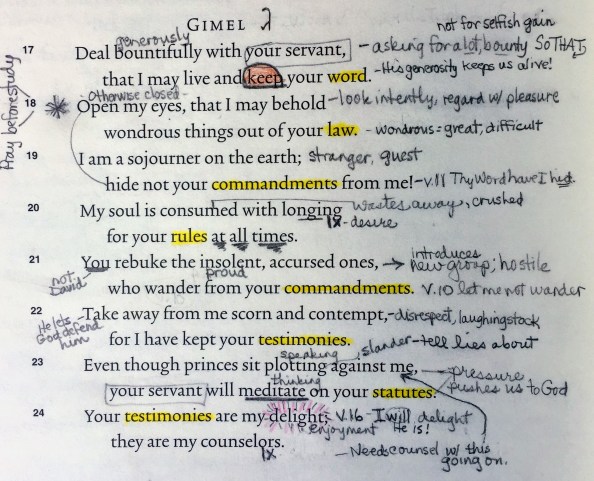
img_9845

Things I know for sure from this passage:

  • There is no end to the wondrous treasure that is in the Bible. When we think we know all there is to know about a passage, there’s still more to uncover.
  • We don’t need God to give us more benefits as much as we need eyes to see what He has already given.
  • Going through times of trouble can serve to draw us closer to the Lord.
  • Instead of rescuing us from all our troubles, God often gives us a new perspective.
  • This world is not my home, I’m just a passin’ through.

Next: Gimel

Stanza C

Psalm 119 is long, y’all.

I’m doing my best to keep these posts from getting too lengthy. I don’t want to overload you with information and get all lecture-ish on you. Just be glad Thomas Manton isn’t writing this series. Who is Thomas Manton, you ask? He was a Puritan preacher who lived from 1620-1677, but he does not make my list of favorite old dead guys.

Rev. Manton was famous for preaching 158 sermons on Psalm 119 — three sermons a week for a year. But that wasn’t enough for him. He went on to write a three volume work on Psalm 119 with 190 chapters — more than one chapter per verse — for a total of 2025 pages. Without the internet. It’s safe to say that I will not rival Manton’s word count.

Let’s start week three!
Only 19 more to go!
Are you with me?

woman hands on bible


Psalm 119:17-24

Consider being kind to me,
    so I can serve well and obey.

Continue to sharpen my eyes,
    to see wonders jump from your word.

Clearly I’m a stranger on earth,
    so don’t cover up the roadmap.

Consume my soul with deep desire
    for your laws, all day, every day.

Come down hard on the prideful ones,
    on those who veer off with disdain.

Cast off from me their hateful jeers,
    as I resolve to stay the course.

Crown princes gather to shame me,
    but I will think only of you.

Counsel me with your commandments,
    and I will delight in them all.

img_9841

Verse 18 is a good one to memorize and use as a prayer at the beginning of your Bible study time. Why not put it to memory this week?

ABC Confession

Remember the post “Praying the Alphabet”  from two weeks ago? Several people have told me how much that has helped them and I’m so glad. I find I need to discover new ways to give thanks because I tend to get in a rut and say the same things over and over. “Thank you, God, for my family and friends, my house and food and clothes, and for Your love.” I wonder if God gets bored listening to me. Using the alphabet forces me to be grateful for some things I wouldn’t have thought of otherwise. “Thank you, God, for my Arms, for Babies, and for Cheese…”

2

We’ll end this week’s study by putting a twist on using the alphabet to help us in another aspect of prayer.

The Day of Atonement, or Yom Kippur, was considered the most important high and holy day in the Jewish faith. It was the one day each year when the high priest went into the Holy of Holies to ask for forgiveness on behalf of the Israelites. A rope was tied to the ankle of the high priest, just in case he died in the presence of God, so he could be dragged out of the inner chamber. Approaching the mercy seat was serious business.

Still today, Yom Kippur includes a 24 hour fast and day-long services at the synagogue. Leading up to the Day of Atonement, there are ten days of introspection and repentance for sins, both individual and corporate. Ten days is a long stretch to keep coming up with sins to confess, so according to Jewish tradition, they use the Aleph-Bet to guide them in their penitence.

Atonement18_MS_Header_01

When asked why the confession of sins was to be done in alphabetical order, Rabbi Yizak of Vorki (1779–1848) answered, “If it were otherwise, we should not know when to stop beating our breasts. For there is no end to sin, and no end to the awareness of sin, but there IS an end to the alphabet!” 

I confess that my confessions sound just as repetitive as my thanksgivings sometimes do. “I’m sorry, Lord, for eating too much, for general laziness, and for using snarky, sarcastic words. Again today.” Ho-hum. Perhaps alphabetizing my transgressions will force me to be sorry for some things I wouldn’t have thought of otherwise. “Forgive me, Lord, for my Attitude, for being Bossy, for Criticizing the way PB makes the bed…”

Now I see why there are ten days to prepare for the Day of Atonement. Thank goodness it only comes around once a year. At least I know that when I finally get to confessing my lack of zeal, I can stop. Until next time.

If you need to catch up:
Monday – Stanza B
Tuesday – Long Song Study, part B
Wednesday – Bet
Thursday – B is for But

B is for But

The Bible is chock full of terrific words.
Wonderful words like love, joy, and peace abound in the scriptures.
(Abound is a pretty good word too.)

There are long words in the Bible, like Mahershalalhashbaz (Isa. 8:1).
(What were his parents thinking?)

There are short words in the Bible, like Ur (Gen. 15:7).
“Where do you live?” “Ur.” (Confused look.)

There are impressive sounding words in the Bible,
like sanctification, justification and propitiation.

There are precious words like Savior, heaven, grace and redeemed.
I could go on and on.

I have a hands-down favorite word in the Good Book.
(My Bible study buddies know what I’m about to say.)
It’s easy to overlook this humble three letter word.
Here it is. Are you ready?
But.

Don’t be fooled by this well-worn word, this scant syllable, this inconsequential conjunction. It packs a wallop when it’s perfectly placed. “But” is the pivot point in so many sentences, and so many lives. I have circled every “but” in my Bible.

“That is what you were. But you were washed…” (1 Cor. 6:11)
“If Christ has not been raised, your faith is futile. But Christ has indeed been raised from the dead.” (1 Cor. 15:20)
“We were objects of wrath. But because of His great love for us, God made us alive in Christ.” (Eph. 2:4)
“I am suffering like a criminal. But God’s word is not chained…” (2 Tim. 2:9)

Those are big buts, but I think the best buts in the Bible are found in the Psalms.

How long will you hide your face from me?
But I trust in your unfailing love. (Ps. 13)

My life is consumed by anguish…
But I trust in you. (Ps. 31)

The arrogant are attacking me, O God…
But you, O Lord, are compassionate and gracious. (Ps. 86)

If you kept a record of sins, who could stand?
But with you there is forgiveness. (Ps. 130)

but

My favorite word in the Bible that starts with B is BUT.