Bet

Ready for your Hebrew lesson?
I bet you are!

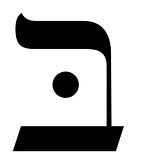
Bet (also written as Beth/Beit) is the second letter in the Hebrew alphabet, or Aleph-Bet. It sounds like our letter “B.” Every line in Psalm 119:9-16 starts with this letter. Bet looks like this:
hebrew-beth

Bet means “house.”
For example, Beth – lehem means “house of bread.”
The letter signifies a house with the front door opened.

See the roof on top?
We can’t see the heavens that are beyond our world.
The highest heavens belong to the Lord,
but the earth he has given to man. Ps. 115:16

See the floor on the bottom?
God built us a house with a solid foundation.
In the beginning you laid the foundations of the earth. Ps. 102:25

See the wall behind on the right?
We can’t see what came before the creation of our world.
Where were you when I laid the earth’s foundation? Job 38:4

See the open door on the left?
For now, the way is open to the future – a new heaven and a new earth.
Behold, I will create new heavens and a new earth. Isa. 65:17

Now let’s look for Jesus in the letter “bet.”

This letter has the distinct honor of being the first letter of the first word in the Hebrew Bible. (“In the beginning” in Hebrew is “B’resheet.”) This reveals that God created the world because He wanted to dwell in a house with us. In Jewish culture, the father’s house was given to the first-born son.

See where we’re going here?

God sent His Son, Jesus, to be the master of this house. The Messiah was the fulfillment of the promise made to King David, “The Lord Himself will establish a house…that will endure forever.” (2 Sam. 7:11, 16) Christ Himself is the Chief Cornerstone and all believers are members of the household of faith. (Eph. 2:19-20) We are, even now, living stones being built into a spiritual house. (1 Peter 2:5)

One more thing.

“There are many stories as to why Bet is the first letter of the Hebrew Bible and not Aleph, which is the first letter of the Hebrew alphabet. While some say it was due to Aleph’s humility, another theory explains that God decided to start the Bible with the letter Bet in order to show man that he did not know the first thing about how the world works!” (hebrewtoday.com)

To reflect that understanding, all ancient Jewish literature written as commentary on God’s Word begins on page two (beit); the first page is left blank, to show that we can’t assume to know how the beginning began.

So when Jesus said “I am the Alpha and the Omega,” He was saying “I was here before the beginning of creation, before Bet, before the house was built.”

Selah.
That’s Hebrew for “stop and think about that for awhile.”

bet 

Next: My favorite word that starts with “B”.

Long Song Study, part B

bstudy

Today we’re going to dive into Psalm 119:9-16. Go get your Bible!

Some scholars believe that David wrote this long psalm bit by bit, over the course of his lifetime. In the first section, he saw that there was blessing for those who walked in the ways of the Lord. Perhaps he was looking up to older men who modeled a walk with God. He stated his willingness to learn and his desire to be steadfast. In the second installment, David started by asking a really good question.

Verse 9
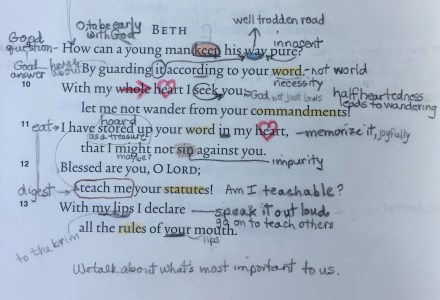
“How can a young man keep his way pure? By guarding it according to your word.”

“How can a young man keep his way pure?” Kudos to David for even asking this question. Not many young people contemplate purity. It seems he knew the answer to his own question: “By guarding it according to your word.” David understood that he had to guard his way and his only hope of succeeding was to live by the Word. The word “guard” means “to hedge about, to surround, to protect or be careful about”.
So, there are things we need to keep guarded, like our thoughts and emotions. And there are things we need to guard against, like worldly influence and temptation. The Word has the power to do both. But it takes intention. “The narrow way was never hit upon by chance.” (Spurgeon)

Verse 10
“With my whole heart I seek you, let me not wander from your commandments!”

Sometimes we believers get mixed up about what to seek. We attempt to try to live according to a checklist of virtuous behaviors. We set out to be good, seeking some kind of perfection through self-righteousness. David knew he had to set his whole heart on seeking God, not just obedience to His laws, because half-heartedness would result in straying from the Lord. David made it his priority to seek God in the place where He could be found — in the Word.
How do we wander? 1) By neglecting prayer, Bible reading, and corporate worship; 2) By chasing after frivolous entertainment; 3) By indulging in careless thoughts and temptations. The shocking reality is, if we’re not actively seeking God, then we’re wandering from God. We don’t have time to be wanderers.

Verse 11
“I have stored up your word in my heart, that I might not sin against you.”

David may have been young, but he had been taught well. Young Jewish boys memorized large portions of the Torah (the first five books of the Bible), so he had a rich storehouse from which to draw. Notice David didn’t say “I should store up” or “Someday I’ll try to store up”. Nope, he already did, and that was going to help him keep his way pure.

Verse 12
“Blessed are you, O Lord; teach me your statutes!”

Even though he had stored up the words, David needed instruction to be able to understand and follow through on the commands. Simply knowing the law wasn’t enough. He had to learn to love it and live by it.
Ten more times in this long song David asked God to teach him, indicating that he never felt like he knew it all, even as he got older. He stayed teachable.

Verse 13
“With my lips I declare all the rules of your mouth.”
You don’t have to ask me twice to tell you about my grandchildren. Get me started and I will bubble over with delight as I talk about them. We tend to talk the most about the things that are most important to us. For David, that topic was God’s law. It wasn’t something he just thought about — he talked about it. Out loud. With his lips. Our love for God and His Word should be spoken of in a way that attracts others. You’ve probably heard the quote, “Preach the gospel, and if necessary, use words.” Well, I’m sorry folks, but words are necessary. If the Lord is important to us, we won’t be embarrassed to talk about Him.

Verse 14
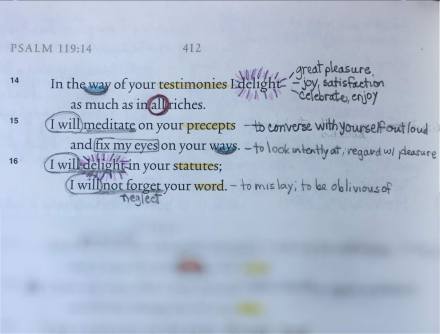
“In the way of your testimonies I delight as much as in all riches.”
The Bible wasn’t boring to David. It was something he enjoyed with great pleasure. He thought of it as hidden treasure just waiting to be dug up. David wouldn’t trade the richness of God’s Word for a whole pile of money.
Jewish rabbis call Psalm 119 “a love song to Torah” and they actually kiss the scrolls of scripture before and after each reading in the synagogue. “When a human being kisses a leather bound sheaf of paper, the loving essence of the gesture penetrates into the realm of the non-material. The kiss reaches deep, beyond paper and ink, into the meaning of the words in the Torah… The Torah is, so to speak, the lips of God.” (Dr.Michael Chighel)

Verse 15
I will meditate on your precepts and fix my eyes on your ways.”
David concluded this stanza with another set of “I will” statements. Biblical meditation is nothing like the eastern religion type that sits in silence, empties the brain and hums “om”. The word “meditate” means “to converse with yourself out loud; to murmur or mumble to oneself.” If memorizing scripture is like eating it, then meditating is like digesting it, with the goal of internalizing it and letting it transform us from the inside out. “Our hearts are naturally cold, but meditation makes them hot, causing them to boil with love for God and His word.” (J. Stephen Yuille) Meditation increases the pleasure of reading and studying God’s Word and helps us keep our eyes fixed on His ways.

Verse 16
“I will delight in your statutes; I will not forget your word.”
Some versions say, “I will not neglect your word.” Ouch. Neglect: to pay no attention or too little attention to; disregard or slight through indifference or carelessness. Let’s commit, along with the psalmist, to give the Word our full attention instead of being haphazard, hit-or-miss, or slipshod.
“Men do not readily forget that which they have treasured up (v. 11), that which they have meditated on (v. 15), and that which they have often spoken of (v. 13).” (Spurgeon)

img_9834

img_9835

What do we know for sure from this passage?

  • What we store up in our hearts is going to make its way to our lips.
  • If we don’t take seriously the need to guard our way, we might wander away.
  • There is power in the spoken Word, whether it’s to others or ourselves.
  • God and His Word are delightful.
  • We’re never too old to learn to walk in His ways, but there’s a great advantage in starting young.

What do you think?

Next: Bet

Stanza B

Are you ready for another week of study on Psalm 119? Let’s go!

thy word

It’s obvious that the author of this psalm thought long and hard about this poem before he sat down to write it. I admire how organized it is, with its alphabetical structure and even numbered stanzas. He definitely was showing off his love for the Hebrew language. Only a skillful writer could make each section sound fresh, even though he used the same eight words over and over.

Have you noticed the “word” words?
law
word
statutes
precepts
promises
judgments
testimonies
commandments

Each one has a slightly nuanced meaning, but when it comes down to it, they all mean the scriptures, or the Bible. One of these eight words is used in all but five of the 176 verses, yet it doesn’t seem redundant. That’s some crazy good writing. It’s a lot harder than it looks, I’m finding out. I dare you to try it.

Psalm 119:9-16

By what means can one remain pure?
    Only by staying in the Word.

Bent on pursuing You, I search.
    Keep me from wandering off track.

Because I have stored up Your words,
    I hope I won’t sin quite so much.

Boundless praise unto You, O God!
    Instruct me in all of Your ways.

Blurting out, I go on and on,
    repeating the words that You said.

Bursts of joy flow as I follow;
    I feel like I hit the jackpot.

Bless me as I chew on Your words
    and ponder what everything means.

Best of all, Your words thrill my heart.
    I vow not to be a slacker.

img_9786

“The Word became flesh and lived for a while among us.” John 1:14

What happens when you substitute Jesus’ name for “word” words?

ABCs

Here’s a little something for you to ponder over the weekend!

“In the beginning God created the heavens and the earth.” Gen. 1:1

Follow me now.
This will blow your mind.

What did God create before He created our beginning?

I see that blank look.
Ok, I’ll tell you.

Words.
Language.
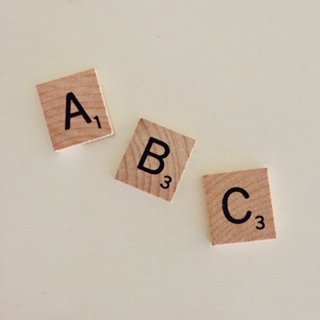
The ABCs.
Or, more accurately, the Aleph, Bet, Gimels.

IMG_9747

In order for God to speak the words, “Let there be light,” there had to be a language human beings could understand, speak, and write. We can’t be sure Hebrew was the first language. (Things got scrambled up at the Tower of Babel.) But we can be sure that the ancient 22 letter Hebrew alphabet derived from some form of the original language.

Think about it.

Adam was created with the ability to comprehend God’s words.
“Rule over the fish and birds and creatures.”
“The plants are yours for food.”
“Except that one tree.”

Adam was created with the ability to use his language to name the creatures.
“Dog.”
“Lion.”
“Yellow-bellied sapsucker.”

Adam was created with the ability to write down a historical record.
“This is the written account of Adam’s line.” Gen. 5:1

Adam was formed from the dust of the ground,
fashioned by the hand of God,
and filled with the breath of life.
Adam came with words.

According to Rabbinic tradition, the letters of the Hebrew alphabet were considered to be the “primordial building blocks of all creation.” One teacher went so far as to say that “if the letters were to depart even for an instant, all of creation would become absolute nothingness.” (Rabbi Shneur Zalman of Liadi, 1745-1812)

So, take away the ABCs, and we’ve got nothing.
Is your mind blown?

“In the beginning was the Word.”
John 1:1

A is for All

Since I’m milking this whole alphabet theme for all it’s worth, I thought I’d take it one step further. I’m going to share some of my favorite words (in English) in the Bible.

Here are the rules:
1) Go alphabetically, but leave out k, q, x, and z, to keep in step with the 22 letter Hebrew alphabet. Besides, there are no words in the Bible that start with X, except for King Xerxes, and he was not a favorite.
2) Use only small words, four letters or less.
3) Change the rules when necessary.

A is for ALL

The Bible is full of absolute words: all, every, always, never, only, whosoever. None of God’s promises contain words like sometimes, maybe, usually, probably, on the off-chance, once-in-a-while. He is not a now-and-then, half-and-half God. He proved He is “all in” when He sent His Son as a sacrifice to rescue us. “He who did not spare his own Son, but gave him up for us all — how will he not also, along with him, graciously give us all things?” (Rom. 8:32)

Just think how differently the Holy Scriptures would sound if the word “all” was exchanged for less comprehensive words.
And we know that in SOME things God works for the good…  (Rom. 8:28)
I PROBABLY won’t leave you or forsake you…..  (Heb. 13:5)
I will be with you SOMETIMES, MAYBE to the end of the age…..  (Matt. 28:20)
My God will meet A FEW of your needs ONCE-IN-A-WHILE…. (Phil. 4:19)

Instead, we get promises like this: “And God is able to make ALL grace abound to you, so that in ALL things, at ALL times, having ALL that you need, you will abound in EVERY good work.” (2 Cor. 9:8)

When PB and I stood before our family and friends on our wedding day, we made some absolute promises that are still in effect 40 years later. The only limit put on those vows was “until death do us part”. If I had said, “I’ll love and cherish you for a while…” or “Yes to the ‘for better, for richer, in health’ part, but about that ‘for worse, for poorer, in sickness’ part — well, we’ll see”. Those half-hearted vows would’ve left gaping loopholes for a quick escape when the worst day came or the financial trouble arrived or the serious diagnosis showed up. Words like that sound less like a promise and more like a business deal, made to protect the interests of the parties involved.

Will Parker sang to Ado Annie in the Broadway musical Oklahoma, “With me it’s all er nuthin’! Is it all er nuthin’ with you?” God makes His intentions clear in His Word — He holds nothing back, He makes promises that will be kept, and His love is all-encompassing. He’s an ALL kind of God. And He is calling for our “all er nuthin'” devotion.

When Jesus was asked, “Of all the commandments, which is the most important?” He didn’t have to stop to think about it. He didn’t go over the 613 Old Testament laws in His mind or even refer to the Big 10. He responded,  “Love the Lord your God with all your heart and with all your soul and with all your mind and with all your strength.” (Mark 12:30) Jesus didn’t say “Obey the Lord your God with all your heart…” or “Serve the Lord your God with all your strength…” or “Live your best life with all your soul….” 

Just love, with all you’ve got.

all

My favorite word in the Bible that starts with “A” is ALL.

If you need to catch up:
Intro – The Long Song
Monday – Stanza A
Tuesday – Long Song Study, Part A
Wednesday – Aleph

Aleph

I’m going full nerd-mode now.
We’re gonna learn Hebrew.
Don’t be scared.
It’ll be fun.

Most Bibles have a heading before every eight-verse section of Psalm 119 (although paraphrased versions might not). Each of the twenty-two stanzas of this psalm are introduced by a letter of the Hebrew alphabet, in order from A to Z, or more accurately, from Aleph to Tav.

Aleph looks like this:aleph

According to Jewish tradition,
each letter was divinely created by God
and contains revelation about the Messiah.
Do you see Jesus in the letter Aleph?
He’s in there.

See that diagonal line in the middle?
It’s a position of humility.
“Taking the very nature of a servant…he humbled himself.” Phil. 2:7-8

See that arm reaching up to the right?
It shows His deity, His connection to the divine realm.
“Who being in very nature God…” Phil. 2:6

See that arm reaching down to the left?
It shows His humanity, His connection to the earthly realm.
“…did not consider equality with God something to be grasped.” Phil. 2:6

 This is a dramatic picture of Jesus with two outstretched arms,
one to His heavenly Father, one to us.
He is the link between heaven and earth.

Wait. There’s more.

Despite the fact that Aleph, a consonant, is the first letter in the Hebrew alphabet, it is a silent letter. It takes on the sound of a vowel, depending on the marks attached to it. There is a story in Jewish folklore that says all the letters of the alphabet came before the Lord to give reasons why they should be the first letter of the first word in the Torah, or Bible. All except for Aleph. The Lord asked Aleph why it didn’t come and Aleph explained that it was silent and had nothing to say. So the Lord honored Aleph’s humility and placed it at the beginning of all the letters.

Wait. There’s more.

Jesus said, “I am the Alpha and the Omega,” which is the Greek way of saying, “I am the Aleph and the Taw.” Like the humble letter, Jesus came in humility as a human being and suffered in silence.

“He was oppressed and afflicted, yet he did not open his mouth;
he was led like a lamb to the slaughter,
and as a sheep before her shearers is silent,
so he did not open his mouth.”
Isaiah 53:7

“Then Pilate asked him,
‘Don’t you hear how many things they are accusing you of?’
But Jesus make no reply, not even to a single charge —
to the amazement of the governor.”
Matt. 27:13-14

So God the Father honored His Son’s humility and gave Him His rightful place.

“Therefore God exalted him to the highest place
and gave him the name that is above every name.”
Phil. 2:9

And that’s just the first letter.

aleph (1)

Next: My favorite words.

Long Song Study, part A

It’s Bible Study Day!
Since we can’t gather together in person right now,
let’s meet up here!

study

Psalm 119 is the longest chapter in the Bible, longer than some entire books of the Bible. Perhaps its length is meant to tip us off to a little secret: learning to walk with God in faith and obedience is not learned in a day. It takes a lifetime. So take God up on His gift of grace, and give yourself some, too.

This study will be more like a slow marathon than a speedy sprint. For those of us non-runners, it will be more like a stroll than a power walk. We’re going to stop and smell some rose-scented words as we saunter through the first eight verses.

Ready? Open up your Bible to Psalm 119. Let’s go!

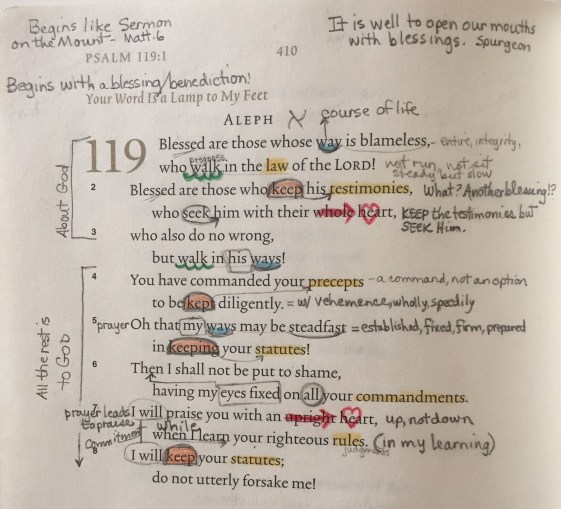
Verse 1
“Blessed are those whose way is blameless, who walk in the law of the Lord.”

How does this magnificent psalm begin? With a blessing! It sounds a lot like the first words Jesus spoke in His first public sermon: “Blessed are the poor in spirit…” The main idea is that there is great blessing in walking in the ways of the Lord.  All of the 175 verses that follow support that one key thought.
Notice it’s a walk, not a run, but also not a sit. We walk, which means there is steady progress, a quiet advance, a persistent continuance. No fast forward, no hurried quick-fix, no checklist with instant results. Also, no lazy bones, no couch potato procrastinating, no waiting for maturity to magically appear.

Verse 2
“Blessed are those who keep his testimonies, who seek him with their whole heart,”

Another blessing! This time it’s for keeping and seeking. “We must first get a thing before we can keep it. And in order to keep it well, we must get a firm grip on it.” (Spurgeon) So, we are to grab ahold of the scriptures and not let go. Keep His Word. But seek Him with all your heart. The Hebrew understanding of “heart” includes the emotions, the will, and the intellect. All of it.

Verse 3
“who also do no wrong, but walk in his ways!”

It’s not enough to refrain from doing wrong things. We are to pursue the right things! By seeking, we find out what His ways are, so that we can walk like Him.

Verse 4
“You have commanded your precepts to be kept diligently.”

At this point, the focus shifts from talking about God, to talking directly to God. And he never stops. The rest of the psalm is a prayer with praise and testimony sprinkled in.
Now we learn how the Word is to be kept: with diligence. The Hebrew word used here means “vehemently”, which is defined as zealously, ardently, strongly emotional, and intensely passionate. Is that how you feel about God’s Word?

Verse 5
“Oh that my ways may be steadfast in keeping your statutes!”

No wonder, then, that he immediately begins to confess his lack of zeal. He wishes he was farther along when it came to knowing and obeying God’s laws. That’s actually a good place to start, though. When we recognize all our best intentions and lofty goals often fall short, we are in a good position to ask God to provide a consistent desire for and love for the Word.

Verse 6
“Then I shall not be put to shame, having my eyes fixed on all your commandments.”

He doesn’t want to stand before God someday and have nothing to show for his life and be exposed as a fraud, as one who professed the name of God but did not fully live for Him. That would be embarrassing. How can we avoid that situation? Fix our eyes on God’s Word and let it do its work in us. Shame rises up when we compare ourselves to each other. Walking with God is not a competition so don’t worry about lagging behind or being out in front. Just keep walking with your eyes on Jesus.

Verse 7
“I will praise you with an upright heart, when I learn your righteous rules.”

Prayer leads to praise. We may have a long way to go, but we can give Him praise as we continue growing and learning. The more we learn about the Lord, the more we will want to praise Him.

Verse 8
“I will keep your statutes; do not utterly forsake me!”

A resolution is made: I will do this! He commits to keeping all the commandments. Whew! That’s impressive, but we all know willpower only takes us so far. Aware that he probably won’t measure up to such perfection, he appeals to God’s mercy. “Don’t give up on me!” And, of course, He never gives up on us. “Never will I leave you; never will I forsake you.” (Heb. 13:5)

img_9774

What do we know for sure from this passage?

  • There is a way that leads to a life of blessing.
  • We can choose to walk in that way, or not.
  • There are things we can do to stay on track: seek Him, keep His commands, fix our eyes on Him.
  • Walking with God is a lifelong process with some successes and some failures.
  • He walks with us and never gives up on us.

Please share your thoughts, insights, comments and questions! This is intended to be a conversation, not a monologue!

Stanza A

follow

Since most of us don’t read Hebrew,
and since I admire David’s use of his alphabet,
and since I am quarantined and have oodles of time,
I thought it would be fun to re-write David’s magnum opus.

Not to improve upon it, mind you. I find re-wording scripture is a challenging exercise because it forces me to process each word and try to match the meaning while using different expressions. You might want to read the original first (scroll down) — I guarantee it’s better.

Here are the rules:
1) Start every line of the eight verse sections with the same letter.
2) Stay true to the meaning.
3) Since David wrote with a poetic meter, keep each line to eight syllables.
4) Break the rules when necessary.

Here goes.

Psalm 119:1-8       

A blessing comes to the spotless;
   to those who walk in His footsteps.

Another for guarding the truth
   and a hearty pursuit of God.

All wrongdoing should be cut off
   in order to stay on His path.

Author of precepts and commands,
   You expect my obedience.

Alas, I am not consistent
   in keeping Your law in my grip.

Away with the shame of my sin;
   instead, my eyes rest on Your word.

Arise and make way for some praise,
   while I learn to follow Your rules.

Above all, I will stick with You.
   Please, please, please, don’t give up on me!

img_9767


*Next: a verse-by-verse study of Psalm 119:1-8.

The Long Song

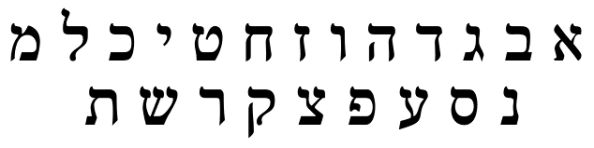
The ancient Hebrew people loved their alphabet.

They viewed the 22 letters as gifts from Yahweh
and they believed that each of the characters
held special meaning about the coming Messiah.
Nobody used that alphabet better than King David.

hebrew

Although David was a mighty warrior and military leader, the man had a way with words. He had the heart of a poet and could write lyrics like nobody’s business. He was a true wordsmith who enjoyed playing with different styles and forms.

David became quite an expert at acrostic poems (he wrote at least seven of them), but you’d never know it by reading your English Bible. That’s because David wrote in Hebrew, with an alphabet that looks strange to our western eyes and sounds like someone clearing their throat to our western ears.

The queen of all acrostic poems is Psalm 119, which has 22 stanzas, each stanza having eight lines. In the first stanza, all eight lines start with the first letter of the Hebrew alphabet. In the second stanza, every line starts with the second letter, and so on.

It’s a triumph of creativity and craftsmanship.
It’s too bad we miss out on how cool it is. 

After finishing fifteen days worth of posts in the six verses of Psalm 23, I asked God, “So, what’s next?” I’m not sure if it’s a good sign or a bad sign that I feel drawn to the longest chapter in the Bible. But here we go. As long as we’re staying home, we might as well learn something.

Besides, Psalm 119 just might save your life.

George Wishart, a bishop in the 1600’s, was sentenced to death by hanging. As was the custom of the time, the condemned man was allowed to choose one psalm to be read aloud before dying. He chose Psalm 119, with its 176 verses, and before it was over, his pardon arrived and his life was spared.

God’s Word still wants to save our lives.

psalm 119

Praying the Alphabet

Have you ever had a hard time falling asleep at night?
Let me re-phrase that.
In the past two weeks, have you had a hard time getting to sleep at night?

moon

Considering how important sleep is to staying healthy and giving our immunity a boost, this is one positive thing we can learn to do better. Even during a pandemic. Here’s a little idea for you: Pray the alphabet.

Thank God for something that starts with A. “Thank you, Lord, for animals.”
Thank God for something that starts with B. “Thank you, Lord, for beauty.”
You get the idea.

When I do this, two things happen:
1) I fall asleep with gratitude in my heart instead of worries and cares.
2) I never make it to Z.

Sometimes I thank God for people.
Thank you, Lord, for Anna-Abel, Blake, Charlie, Dan, Eli-Ella-Evie-Emma-Ember…
It’s ok to use a letter more than once.

Sometimes I thank God for things that give me joy.
Thank you, Lord, for Art, Books, Crossword puzzles…

Sometimes I thank God for flowers.
Thank you, Lord, for Asters and Bee Balm and Carnations…

Sometimes I thank God for food.
Thank you, Lord, for Apple pie and Banana cream pie and Coconut cream pie…
On second thought, that’s not such a good idea.

Sometimes I thank God for His gifts to me.
Thank you, Lord, for your Abundance, the Bible, Compassion…

Sometimes I thank God for Himself.
I praise you, God, because you are Almighty, Brilliant, Creative…

The possibilities are endless.
But on those nights when even this seems too hard
and words don’t come,
take heart from some old Jewish folklore:

If you recite the alphabet five times very slowly,
God, to whom all prayers are known,
will put the letters together to form
the prayers you can’t put to words.

“I will praise the Lord, who counsels me;
even at night my heart instructs me.
 I have set the Lord always before me.
Because he is at my right hand, I will not be shaken.
Therefore my heart is glad and my tongue rejoices;
my body will also rest secure.”
Psalm 16:7-9


Next: a whole bunch of posts on “A-Z”!