Stanza F

Welcome to week 6 of the Aleph-Bet series!

One thing that stands out to me while studying Psalm 119 is the deep love David seemed to have for the law, rules and commandments. I don’t know too many people who are head-over-heels about laws, rules and commandments. An insight from Lois Tverberg helped me understand this passion for the word from a Hebrew perspective.

    Christians may be surprised that the word “mitzvah”, meaning commandment, is positive rather than negative in Jewish culture. We think of commandments as burdensome regulations, but the usual Jewish usage of mitzvah is that it is an opportunity to do something good that God told you to do. The word is always used in a positive way, suggesting that doing what God has asked is a joy and a spiritual opportunity, not a burden.
The idea of “hiddur mitzvah” (beautifying the command) says that if God tells us to do something, we shouldn’t just do the minimum, but to perform it in the best way possible, sparing no expense or trouble. http://www.ourrabbijesus.com/articles/beautifying-gods-commands

Let’s beautify the commands of God this week by seeing them as opportunities to obey Him with excellence.

Psalm 119:41-48

Favor me with Your constant love
    and sure salvation, as promised.

Finally, my mockers will hear me,
    for Your word will not let me down.

Forfeit God’s good truth? Not these lips!
    I’ve pinned all my hopes on Your word.

Forever I will walk with You,
    always and forever. Amen.

Freely I will go through my days
    because I have found Your roadmap.

Faithfully I’ll speak up for You;
    I won’t be embarrassed at all.

Finding Your words are delightful,
    I love them more and more each day.

Farther I stretch, hands open wide,
    to grasp the heart of Your precepts. 

img_9953

Next: Long Song Study, part F

E is for Eat

I’m sorry.
There are lots of other good “E” words in the Bible.
But this quarantine life seems to revolve around food.
I don’t know how many batches of sweet rolls I’ve made.
There are several jars of sourdough in my refrigerator.
I’ve tried recipes that have been collecting in boxes for years.
PB and I are watching cooking shows, while we eat our meals.
There’s truth in the phrase “comfort food.”

Late night retro Diner Eat neon sign

The Bible has a surprising amount to say about eating,
from Genesis to Isaiah to Luke to Revelation.

One of the first things the Creator told Adam was, “You are free to eat from any tree in the garden…” (Gen. 2:16) Of course, there was more to that statement, but “free to eat” might have been all Adam heard. Granted, there weren’t any Snicker bars or Little Debbie Oatmeal Creme Pies hanging from the trees, but God’s words “free to eat” must have been music to Adam’s ears. It might be my new favorite Bible verse. Although food played a role in the downfall of humankind, it wasn’t food’s fault.

Isaiah picked up the theme. “Come, you who have no money, come, buy and eat. Listen to me and eat what is good…” (Isaiah 55:1-2) What an invitation! Water, wine, milk, food — it’s all free! Did you notice the steps to this spiritual feast?
1) Come. 2) Listen to God. 3) Eat what is good.
In other words:
1) Show up. 2) Pay attention. 3) Don’t settle for hot dogs when He’s offering prime rib.

Food played big in the gospels. Jesus was always eating with people and even put on a sit-down dinner for 5,000. When Jesus appeared to His disciples in His resurrected body, He asked, “Do you have anything here to eat?” (Luke 24:41) Don’t you love that?! Jesus had to prove He wasn’t some kind of ethereal ghost. He calmed his disciples’ troubled, doubt-filled minds by eating a piece of broiled fish before their very eyes. As they watched Him swallow and carefully observed his stomach, the truth was verified. His real body had come back to life! A filet of cod wouldn’t be my first choice post-resurrection, but eating real food convinced His friends that He was a real Savior.

Hands down, my favorite scripture about eating is in Revelation 3:20. “Behold! I stand at the door and knock. If anyone hears my voice and opens the door, I will go in and eat (dine, sup) with him, and he with me.”

Jesus Christ wants to eat with me.

Supper (deipnon in Greek) was the main meal of the day. This was the meal at which a man sat and talked for long, for now there was time, for work was ended… it is not a mere courtesy visit, paid in the passing, which Jesus Christ offers to us. He desires to come in and to sit long with us, and to wait as long as we wish him to wait.” (Barclay)

This verse perfectly sums up the first five letters of the Hebrew Aleph-Bet.

  • Aleph — the God-Man, one arm reaching to heaven, one arm reaching to earth — Jesus stands as the bridge between God and man.
  • Bet — the house that He stands outside of is my heart and He seeks entry.
  • Gimel — the figure in motion, coming to give the good gift of His redemptive presence.
  • Dalet — the door He courteously, yet persistently, knocks on, waiting for me to respond.
  • HeBehold! The Master comes in! He eats with me and I eat with Him! Heart to heart fellowship with the King of Kings! He lingers long at the table and joy fills the house!

This old earth is just a glimpse of what’s coming.
The New Earth will be a place of feasting, my friends!
We will eat on into eternity!
“On this mountain
the Lord Almighty

will prepare a feast
of rich food for all peoples,

a banquet of aged wine—
the best of meats
and the finest of wines.”

Isaiah 25:6

feast

We will feast in the house of Zion.
We will sing with our hearts restored.
He has done great things, we will say together.
We will feast and weep no more.
“We Will Feast in the House of Zion”, Sandra McCracken

Next: The Hungry Song

He

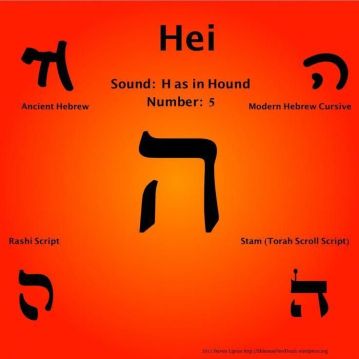
He (also written as Hey, Heh, or Hei)  is the fifth letter in the Hebrew alphabet. “He” sounds like “hay” and the letter has the same “h” sound as in “heaven”. Every line in Psalm 119:33-40 starts with this letter. He looks like this:

Hey

This one is a gem.

You know how it is on a cold day when you exhale and see your breath?
The letter “He” is considered the Divine Breath, the exhale of the Spirit.
“By the word of the Lord were the heavens made,
their starry host by the breath of his mouth.”
Psalm 33:6
God breathed out stars!

A few days later, God sculpted a mud-man and “breathed into his nostrils the breath of life.” (Gen. 2:7) It’s His breath (His “He”) in our lungs and it’s His Spirit (His “He”) in our souls that makes us living beings.

The letter “He” looks a lot like Dalet, but with something added. Jewish Rabbis taught that the arm from Aleph came over to be a part of Dalet, forming a new letter. Since Aleph represents God and Dalet represents broken humanity, what we end up with is a picture of God coming to live in the human heart, by means of the Spirit. “He” is an image of Dalet opening the door of the heart so the Spirit of God can indwell the believer.

There’s more!

Another definition of “He” is “Behold!” It sounds like an overwhelmed sigh, as if suddenly coming upon a panoramic view of a majestic sight. The God-Man (Aleph — Jesus) came to earth to be master of the house (Bet) and to give the good gift of redemption (Gimel) to the poor and weak (Dalet). Behold! (He) John the Baptist chose his words carefully: “Behold! The Lamb of God who takes away the sin of the world!” What an overwhelming, majestic sight! (Did you notice Psalm 119:40? “Behold!”)

Wait! There’s more!

God used the letter “He” to change people. Remember what happened to Abram? God renamed him Abraham — God breathed His life-giving Spirit into Abe and changed his name to show it. Sarai became Sarah, because adding the letter “He” at the end of a noun “feminized” it, allowing it to be “fruitful”. God’s announcement to Abraham that Sarai was being changed to Sarah was like a proclamation that she was no longer barren. In fact, it was believed that women needed the “H” sound in their names if they were going to be able to bear children, which gave Hagar a distinct advantage over Sarai. (Rachel didn’t have the letter “He” in her name, but Leah, Bilhah and Zilpah did.)

There’s still more!

According to Jewish tradition, the name of God is so holy it should never be written. Hebrew documents today still refer to God as “G-d”. The name of God as revealed in Genesis 1:1 is considered to be so sacred that it is never to be spoken aloud. This hallowed word is made up of four Hebrew letters: Yod, He, Vav, He.

Stay with me now. This is going to be good.

When Jesus was crucified, Pilate had a sign made that said, “Jesus of Nazareth, King of the Jews.” In Aramaic, (a form of Hebrew) that phrase consisted of four words. The first word started with the letter Yod, the second word started with He, the third word started with Vav and the fourth word started with He. Can you picture that? Pilate had a sign nailed to the cross that declared Jesus was the one true G-d. Yod, He, Vav, He.

No wonder the chief priests of the Jews protested to Pilate, “Do not write ‘The King of the Jews.'” In other words, “You cannot write the sacred, unutterable name of G-d and attach it to this man for the world to see.” But God’s will was for the world to see and to know that Jesus was and is the King of Kings. And He used an unbelieving Roman governor to carry out His will. The purposes of God cannot be thwarted.

Hallelujah! (That starts with “He”, too!)

Hei

Next: My favorite word in the Bible that starts with “E”.

If you need to review:
Aleph
Bet
Gimel
Dalet

Long Song Study, part E

Psalm 119 (6)

It’s worth repeating:
God is not going to open our eyes
to understand a word
we have no intention of obeying.
(Christopher Ash)
So shall we get this straight right off the top?
Let’s set our hearts and minds
to work out the truths that God is working into us.
Are you with me?

Now, let’s get to work on Psalm 119:33-40!

Verse 33
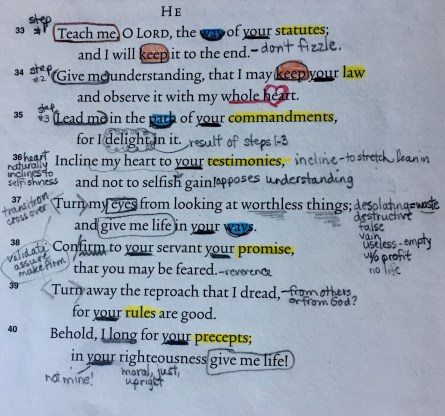
Teach me, O Lord, the way of your statutes; and I will keep it to the end.
The Lord is a teacher. He alone can instruct us. We live in a time with a plethora of good Bible teachers. Gifted communicators, scholars and commentators are only a click away. It’s easy to get dependent on them to take us by the hand and feed us. But even the best of them are like T.A.s (Teacher Assistants). We can certainly learn from good preaching and teaching, but let’s not bypass the Head Master and forfeit learning from the very Source. Ask God to teach you first, then get help from the T.A.s.

David decided how he was going to finish – not with a fizzle, but with a sizzle. He was going to stick with God until the very end, no matter what. It’s a good idea to settle that early on. The more we learn about our God, the easier it will be to finish strong.

Verse 34
Give me understanding, that I may keep your law and observe it with my whole heart.
This was step two in David’s program of discipleship. He needed a good Teacher, but he also needed the power to learn. Although David loved God’s word, he knew he needed God’s help to comprehend it. He asked God to move the law from his head to his heart.

Verse 35
Lead me in the path of your commandments, for I delight in it.
Step three was to put legs to David’s new understanding of God’s gracious teaching. A path is meant to be walked — this is the daily use of the things we learn, step by step. “Remark the order: first understanding, and then going; for a clear understanding is a great assistance towards practical action. Thou hast made me to know; now make me to go!” (Spurgeon) This process of being taught, gaining understanding and then working it into daily life is truly a delightful way to live.

Verse 36
Incline my heart to your testimonies and not to selfish gain!
David knew that “the heart is deceitful above all things…” (Jere. 17:9) Even new-found Bible knowledge and insight can lead to puffed up pride and self-absorption. It’s so important for us to lean in close to the Lord and watch out for ego-driven attention-seeking. Left unchecked, the human heart naturally inclines toward selfish ambition, so David was wise to say, “Bend me in Your direction instead.”

Verse 37
Turn my eyes from looking at worthless things; and give me life in your way.
Oh man. There’s no shortage of “worthless things” in our world. The word “worthless” encompasses these meanings: desolate, wasteful, destructive, false, vain, useless, empty and without profit. They aren’t necessarily bad things, just unworthy of our time. This verse begs the question: What am I looking at? According to my screen time report, I pick up my Iphone way too many times per hour. PB and I have watched a lot of TV in the past weeks of quarantine. Nothing wrong with that, but I can’t exactly say it’s been profitable.

Another question: What is NOT a worthless thing? The Bible tells us: Whatever is true, noble, right, pure, lovely, admirable, excellent, and praiseworthy. (Phil. 4:8) How about beauty, art, nature, people, God’s Word?

Last question: Isn’t it interesting that David didn’t pray, “Turn my mind from thinking about worthless things” or “Turn my desires from wanting worthless things”? Have you noticed how much David talks about the eyes? Go back and read verses 6, 15, 18, 37.

If the eyes do not see, perhaps the heart may not desire: at any rate, one door of temptation is closed when we do not even look at the painted bauble. Sin first entered man’s mind by the eye, and it is still a favorite gate for the incoming of Satan’s allurements; hence the need of a double watch upon that portal. (Spurgeon)

Verse 38
Confirm to your servant your promise, that you may be feared.
It’s okay to ask for reassurance and validation. David knew the promises of God, yet he needed a little boost of confidence. Perhaps he reviewed what he just wrote and was convicted by his lack of understanding, his bent toward selfishness, and his wandering eye. The promises were indeed for him, and being assured of that, David was moved to reverence for a God of such mercy and grace.

Verse 39
Turn away the reproach that I dread, for your rules are good.
Choosing God’s way doesn’t usually get a round of applause from the world. In fact, it’s more likely to bring scorn and contempt (see v. 22). David did not relish the criticism and negative press, but it didn’t make him question God’s goodness.

Verse 40
Behold, I long for your precepts; in your righteousness give me life!
David longed for God and he knew that immersing himself in the words of God would give him the intimacy with God for which he hungered. It’s one thing to long for the promises, but it takes maturity to long for the precepts. David echoed the words of Moses, “They are not idle words for you — they are your life.” (Deut. 32:47)
img_9912

Things I know for sure from this passage:

  • Focusing on worthless things will suck the life out of me.
  • I need to be careful about what enters the portal of my eyes.
  • God is pleased by a heart that is turned toward doing after the mind has turned toward knowing.
  • There’s a difference between knowing about something and understanding it.
  • I can ask the Holy Spirit to empower my good intentions.

Next: He

Stanza E

This week is brought to you by the letter “E”,
or in Hebrew, “He”, which sounds like “Hey”, as in,

“Hey you, don’t just study God’s Word — let’s see it working in your life.”

That was the gentle voice of the Holy Spirit rebuking me.
Author Christopher Ash, however, hit me upside the head.

  If I ask God to show me what the Bible means just because I am interested, or because I want to have better Bible knowledge and get a bit more credibility in my church, or become an academic biblical scholar, then I can have no confidence that God will answer my prayer. For the purpose of his statutes is to lead me into the way of his statutes, which is a changed direction and shape of life. God is not going to open my eyes to understand a word I have no intention of obeying. (Bible Delight: Heartbeat of the Word of God: Psalm 119 for the Bible Teacher and Bible Hearer)

These psalms were written as songs to be sung, but also as prayers to be prayed. It is well and good to study them, be interested in them, increase our knowledge of them. But I almost forgot to pray them. This week, try starting each day praying Psalm 119:33-40. Teach me, O Lord.

Psalm 119:33-40

Educate me, Lord, in Your ways,
    and I won’t quit till my last breath.

Equip me with keen perception;
    I’ll follow through wholeheartedly.

Each day set my course by Your word
    and I will enjoy the journey.

Empower me to lean your way
    and not ask, “What’s in it for me?”

Empty things aren’t worth gazing at,
    but your word fills me up with life.

Execute the promise you made,
    and I’ll serve you in reverent awe.

Eager to steer clear of disgrace,
    Your guidelines are just what I need.

Everything in me yearns to learn;
    may your goodness help me to thrive!

img_9909

Next: Long Song Study, part E

Exclamation!!!

I’ve been known to abuse exclamation points!
“Hi!! How are you?!”
seems friendlier, happier and more excited than
“Hi. How are you?”
Right?!

exclamation

In a Wall Street Journal news article on the use of exclamation points, Katherine Bindley writes that “Exclamation points are stressing people out.” Calling it a “tiny little torture device,” Bindley says that it’s overused and may be misinterpreted as either anger or an annoying amount of happiness.

If PB sends me a text that says, “I love you!!!” and I text back, “I love you, too” it falls flat. I have to at least match the number of exclamation points to be believable! Right?!

Or if I send PB a text that says, “Bring home milk!!” he might interpret that as, “How many times do I have to remind you to bring home milk?” When in truth, I’m just excited I don’t have to go out for milk and I love him for running the errand for me!

That little grammatical mark is fraught with danger!

Did you notice that six of the eight verses in Psalm 119:25-32 have exclamation points? That’s a lot of excitement/anger/happiness/emotion! So, what’s up with exclamation points in the Bible?

The original Hebrew and Greek languages of the Bible had no exclamation marks. “In the translation to other languages, punctuation marks were added to help readers make sense of it all. At that time, exclamation points were inserted in places to communicate passion, excitement or urgency.” (Craig Trierweiler, “Read This! It’s Important! My Exclamation Points Prove It!!!)

Consider these scriptures:

  • I believe; help my unbelief! (Mark 9:25)
  • He rebuked Peter and said, “Get behind me, Satan!” (Mark 8:33)
  • Shall we sin because we are not under law but under grace? By no means! (Romans 6:15
  • Son of David, have mercy on me! (Mark 10:48)

Those little marks express passion and intensity, absurdity and urgency.
They speak volumes, so pay attention to exclamation points!

In this week’s section of Psalm 119, the added punctuation gives extra punch.

  • Give me life according to your word!
  • Teach me your statutes!
  • Strengthen me according to your word!
  • Graciously teach me your law!
  • Let me not be put to shame!
  • Enlarge my heart!

David wasn’t kidding. He was serious. Those exclamation points prove it!

Have a good weekend!!!!!!!!!!

D is for Deep

deep

Deep and wide, deep and wide,
there’s a fountain flowing deep and wide.
Deep and wide, deep and wide,
there’s a fountain flowing deep and wide.

I sang this chorus with my kindergarten Sunday school friends as we sat on little red chairs in the basement of the Methodist church. Mrs. B pounded on the piano with exuberance and we did the hand motions to “deep” and “wide”. The boys in the back row made sure their “wide” motions were wide enough to smack each other. It got really exciting when the words were replaced with “mmm”.

“Mmm and mmm, mmm and mmm, there’s a mmm flowing mmm and mmm.”
It was hilarious when someone forgot to say “mmm” and blurted out “deep” instead.

I couldn’t figure out what M&Ms had to do with Jesus.

As a six year old, I had no idea what this little chorus was about. Mrs. B probably explained that it was a picture of God’s love, unmeasurable and bubbling up eternally. I was probably giggling and whispering with Sharon and Carol and didn’t hear her. Fifty plus years later, I’m still trying to understand how long, how wide, how deep and how high God’s love really is — and to experience it for myself. How can we wrap our minds around something that is so great that we will never see the end of it or fully know it?

IMG_9893

Can you fathom the mysteries of God? Can you probe the limits of the Almighty? They are higher than the heavens above—what can you do? They are deeper than the depths below—what can you know? Their measure is longer than the earth and wider than the sea. –Job 11:7-9

One of my favorite scenes in the gospels is in Luke 5, when Jesus asked to borrow Peter’s boat so He could sit in it and preach to the crowd. When the sermon was over, Jesus told Peter, “Put out into deep water and let down the nets for a catch.” (Luke 5:4) Peter explained that they had been fishing all night and had come up empty.

Plus, everybody knows fish don’t bite in the middle of the day.
Plus, they had just cleaned all the nets.
Plus, professional fishermen didn’t need advise from a carpenter/preacher.
It was time to call it a day and head home.

“But because you say so, I will let down the nets.”
Peter was becoming a disciple and he didn’t even know it.
“They caught such a large number of fish that their nets began to break.”
Peter walked away from his biggest catch to follow Jesus.

Obedience is rarely convenient.
Jesus often asks us to do things that don’t make sense.
He calls us into deeper waters.
It’s hard work, but it results in great blessing.
That’s where the fountains flow.

May our roots go down deep into the soil of God’s marvelous love.
May we also venture out into the deep waters of faithful obedience.

My favorite word in the Bible that starts with “D” is DEEP.

Next: Exclamation!

Dalet

Dalet (also written as Daleth or Daled) is the fourth letter in the Hebrew alphabet. It sounds like our letter “D” as in “Dad”. Every line in Psalm 119:25-32 starts with this letter. Dalet looks like this:

Vector illustration of the Hebrew Letter Daleth

Remember from last week how Gimel meant “giver” and how that letter was a picture of a person with his foot stretched out in motion, running toward Dalet to give it gifts? The reason why Gimel was running toward Dalet is because “Dal” means poor, weak, or needy.” The God-Man (Aleph — Jesus) came to earth to be master of the house (Bet) and to give the good gift of redemption (Gimel) to the poor and weak (Dalet).

The word “Dalet” means “door” or “gate”. A door is a barrier that must be opened in order to go through to another place. It separates two spaces and has a threshold which must be crossed.

Jesus said:

I am the door. If anyone enters by me, he will be saved and will go in and out and find pasture. John 10:9

Jesus Christ is our means of crossing over from death to life, from darkness to light. But we must go through Him (I am the way… John 14:6). The Messiah is our Dalet, our portal to fellowship with God and eternal life. When a person believes in Jesus and accepts the gift of redemption, it’s like stepping over a threshold into a new life. (“He has crossed over from death to life.” John 5:24)

In Jewish tradition, the fourth letter of the aleph-bet is connected to the fourth day of creation. On day four, God separated the day from night by setting the sun, moon, and stars in the sky. They were to “serve as signs” (Gen. 1:14).

Every sunrise opens the door to a new day.
Each morning sun is a sign to us that Jesus is our source of Light.
“I am the light of the world.” John 8:12.

Every night the moon reflects the sunlight.
Each nighttime sky is a sign to us that darkness can’t prevail.
“The light shines in the darkness,
but the darkness has not overcome it.”
John 1:5

The Dalet-Door is open.
God is turning hearts toward His Son.
Could a global pandemic stir up a resurgence
of spiritual awakening and revival on the earth?
“Revive me according to your word.” Psalm 119:25

dalet

Next: My favorite word in the Bible that starts with “D”.

Long Song Study, part D

bstudy4

Today we’re going to look at Psalm 119:25-32,
which is the fourth section of this twenty-two part poem.
Yeah, we’ve got a ways to go.

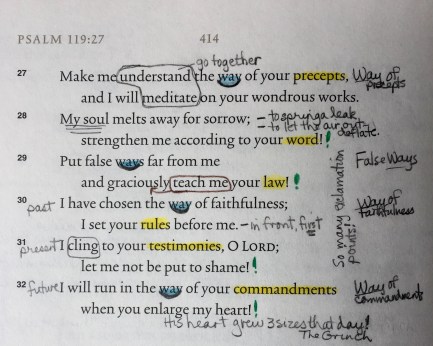
Verse 25
“My soul clings to the dust; give me life according to your word!”
David was struggling. For a reason we don’t know, he felt like he was going to die. His situation was so grim, he recalled the words of God that cursed Adam, “For you are dust, and to dust you shall return.” Yet from face down in the dirt, he asked God to breath life back into him. He knew the Word could do that. (“All scripture is God-breathed…” 2 Tim. 3:16) He could have asked for comfort or deliverance from trouble, but instead he prayed, “quicken me” (KJV); “revive me” (AMP); “give me new life” (NLV).
“It is a grand thing to see a believer in the dust and yet pleading the promise.” Spurgeon

Verse 26
“When I told of my ways, you answered me; teach me your statutes!”
While he was down in the dust, David talked to God about his “ways”, or the road he was on. He didn’t go to his advisors or his best friend to rehash his troubles. He went to God. His words might have come in the form of complaint, or request, or confession. Or all three rolled into one. He got an answer and it must have been something like, “There’s something for you to learn in all this” because David responded, “Teach me!”

Verse 27
“Make me understand the way of your precepts, and I will meditate on your wondrous works.”
David asked for clarity to see the difference between his ways and God’s ways. There’s usually a gap there. What a great prayer – “Help me understand Your ways.”
Meditating is sometimes compared to a cow chewing its cud. These animals have four stomaches! They chew a while, swallow, regurgitate it and chew some more, repeating the process until the nutrients have gone through all four chambers. This process is called “rumination” and it’s where we get the word “ruminate” (to ponder or think about). We may need to slow down in order to have time to mull over the truths in God’s Word.

Verse 28
“My soul melts away for sorrow; strengthen me according to your word!”
Similar to verse 25, David was feeling all the feelings. The word for “melts” means “to spring a leak.” His tears were draining him of vitality, drop by drop. Like a balloon slowly leaking air, he was becoming deflated and defeated. As he wept, David asked for God to give him strength. I admire him for feeling things deeply, yet not getting stuck in the emotion. Even in desperately trying situations, he seemed to find his way to God, knowing God was the only One who could help.

Verse 29
“Put false ways far from me and graciously teach me your law!”
There was his way (v. 26) and God’s way (v. 27); and then there was a false way. Perhaps David’s sorrow was connected to some kind of deceptive outside influence. Or maybe he came face to face with his own lies. (“The heart is deceitful above all things…” Jere. 17:9) David wanted nothing to do with a fake form of religion that denied his need for grace. Some commentators believe David was confronting his own sin in this section. “Repentance happens when we see our sin without making excuses. We dare not confuse regretting with repenting. Esau regretted. Saul regretted. Ahab regretted. Judas regretted. But none of them ever repented.” (Christopher Ash)

Verse 30
“I have chosen the way of faithfulness; I set your rules before me.”
Looking back at his previous words in v. 1-24, David was reminded of his commitments. “I will keep your statutes” (v. 8); “I will fix my eyes on your ways” (v. 15); “I will not forget your word” (v. 16). And here is another “way” — a faithful way in contrast to a false way. His only hope of staying the course was to return to the promises he had made earlier in his life and to put God’s word back in front of his eyes. As long as he had life, he was determined to choose the Lord.

Verse 31
“I cling to your testimonies, O Lord; let me not be put to shame!”
This statement is the pivot point in this passage. David let go of the dust of death he had been clinging to and reached out for the Lord of life. He broke through the sadness and misery by releasing it in the presence of the Lord and then clinging to the truth of God’s word. It’s a great exchange!

Verse 32
“I will run in the way of your commandments when you enlarge my heart!”
No longer face down in the dirt, David vowed to get up and run in the freedom of forgiveness. For the fifth time in eight verses, “the way” was his focus. He finally found the one that gave him room to run and space to grow in love.
David began this section by asking God to revive him according to the word. That renewal happened as he confessed, repented and turned toward God. His heart grew three sizes that day.

img_9890img_9891

Things I know for sure from this passage:

  • On days when I feel down in the dumps, I need to speak to God first about it.
  • When my spirit feels weak, strength is available in God’s Word.
  • I need to pay attention to what I am clinging to for security and significance.
  • Every day I have to choose which way I will go: faithfulness or falseness.
  • Running in freedom is better than lying in dust.

Next: Daleth

Stanza D

How is everybody doing? I’ve heard it said that the whole world is a little depressed right now. Do you feel it? God knows it’s hard to be us. Thankfully, we get a whole range of emotions in the Psalms that give us some insight into how to navigate the ups and downs of life.

David had his share of bad days and he wasn’t afraid to be honest about it. Green pastures and still waters were not on his mind as he composed this fourth stanza. However, in eight verses he went from wallowing in sorrow to a full heart. He started out clinging to dust and ended up clinging to God’s testimonies. How did he do it? Let’s see what we can learn from stanza D this week.

daleth

(Here’s a review of my self-imposed rules for re-writing each passage.)

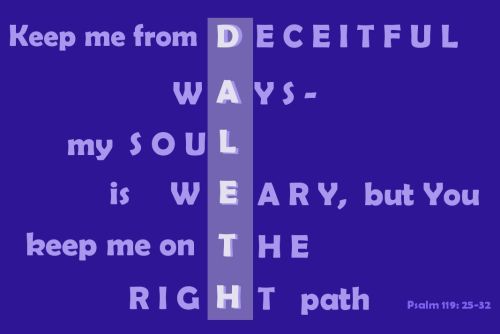
Psalm 119:25-32

Down at the bottom of the heap,
    I need Your word to renew me.

Describing my ways, You answered;
    now teach me what I need to learn.

Drill into me how Your law works,
    so I can chew on it in awe.

Deep inside I’m tired and sad;
    let Your word give me stamina.

Deceit must be put on the shelf;
    tenderly teach me Your precepts.

Determined to walk by Your side,
    I put Your laws front and center.

Deciding to stick with Your word,
    Lord, keep me from messing this up.

Delight comes with going full tilt;
    Your love makes my heart want to burst!

img_9879

Next: Long Song Study, part D