Long Song Study, part H

BibleStudy-1024x512

Teach us Your statutes, O Lord!

Psalm 119:57-64

Verse 57
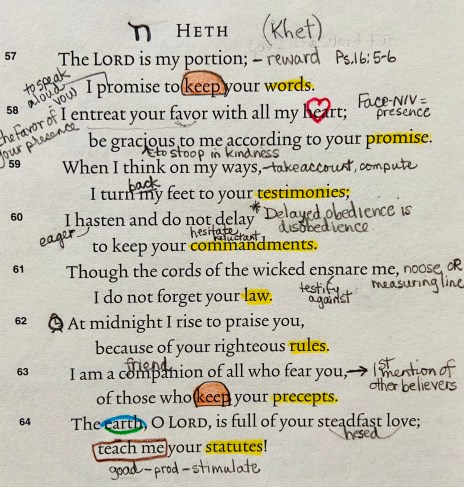
The Lord is my portion; I promise to keep your words.
The love David had for God’s word was rooted in his love for God. The Lord alone was enough for David. He trusted that God would always be sufficient and that’s what motivated him to make bold promises.
When the Israelites went into the Promised Land, each tribe was given an allotment of land — all except the Levites. The priestly tribe of Levi received no land, but instead, the Lord Himself was their portion. As believers, we are now “a chosen people, a royal priesthood” (1 Peter 2:9) and God gives us Himself as our inheritance, our reward. What more could we want? Our lack of trust implies that we don’t think He’s adequate for our needs or competent to care for us. In contrast, when we take God as our portion, we will love what He has to say and we will want to live by it.

Verse 58
I entreat your favor with all my heart; be gracious to me according to your promise.
Entreating someone’s favor (or seeking their face, as in the NIV) is about presence. When a child is trying to get the attention of an adult, the child wants that grownup to put down what they’re doing and look at him or her. In this psalm, David asked God for His gracious presence, perhaps in light of the big promise he made in verse 57. David knew he couldn’t pull off perfection, but because of grace, he didn’t need to.

Verse 59
When I think on my ways, I turn my feet to your testimonies.
Being in God’s presence caused David to contemplate where he was in life. When David did that, things were revealed that he needed to deal with. He was moved to repent and get back on track with the Lord. We, too, need to stop every once in a while to take account, check priorities, think about our “ways”, and turn our feet if they have taken us in the wrong direction.

Verse 60
I hasten and do not delay to keep your commandments.
I read a lot of parenting books when we were in the thick of raising children. One basic principle struck me – “Delayed obedience is disobedience.” In other words, when I allowed my kids to put off doing what I asked, I was actually teaching them to be disobedient. Often, I was communicating that they could put off obedience until mom got mad and raised her voice. I didn’t realize I was training them to wait for the blow-up. David had his share of parenting issues, but he seemed eager to be quick to obey God.
The word “delay” means to be hesitant or reluctant. How many times have I dragged my feet in response to God’s nudging, only to have the opportunity pass?

Verse 61
Though the cords of the wicked ensnare me, I do not forget your law.
David found himself surrounded by people who didn’t care about God and who put concentrated effort into undermining him. Doesn’t it seem like when you’ve made a renewed decision to trust and obey, it’s not long before something comes along to throw you off or pull you away? When we choose to be quick to follow God, we can be fairly certain that the enemy will also be quick to test our resolve. Like David, we need to keep God’s words before us, reminding us of the truth and giving us hope.

Verse 62
At midnight I rise to praise you, because of your righteous rules.
David may have gone to bed with thoughts of being ensnared by those wicked cords, but in the middle of the night, he battled back with praise. He reaffirmed the rightness of God’s ways and refused to succumb to fear. If I’m still awake at midnight, it’s probably because I’m feeling anxious about something. Praise has a way of cutting right through the lies of the enemy and making way for peace.

Verse 63
I am a companion of all who fear you, of those who keep your precepts.
So far, the main characters in this psalm have been David, God, and some occasional enemies. In verse 63 we get a glimpse of another group — David was not alone! He had friends! And they shared his love for God and His word! What a relief! A life of faith is never a solitary life, but always a life that includes fellowship, friendship and unified purpose. We need people around us who are also determined to live according to God’s Word — people we can count on to encourage us and spur us on toward love and good deeds. God’s people are meant to be part of our portion of blessing.

Verse 64
The earth, O Lord, is full of your steadfast love; teach me your statutes!
David began this passage reminding himself of God’s sufficiency for his own life. By the end, he saw the whole planet overflowing with God’s “hesed” love — that steadfast, long-suffering, merciful love. David found God to be more than sufficient, not just for him, but for the whole world.

There is no corner of the universe where His people can possibly be beyond His Covenant faithfulness, steadfast love, and care. Even though it does not always look like it, there is no God-forsaken square meter on earth. Even though the earth contains many wicked who are hostile to those who fear the Lord, it is not possible for a believer to be in any part of the created order which is not full of the Lord’s steadfast love.  ~ Christopher Ash
img_0002

Things I know for sure from this passage:

  • God is sufficient — I lack nothing.
  • Obeying quickly is a mark of spiritual maturity.
  • The Christian life is meant to be lived in community.
  • Daily reflection and repentance keeps me on the right track.
  • Evidence of God’s steadfast love is all around me.

Next: Heth

Stanza H

A, B, C, D, E, F, G, H! See how far we’ve come!
A new week, a new letter, a new Psalm 119 lesson.

Psalm 119:57-64

Having You is more than enough;
I vow to submit to Your word.

Hearts that seek bring us face to face;
I will take You up on Your grace.

Habits of mine should be looked at,
so I keep walking in Your ways.

Hurrying without dallying,
I will be quick to obey You.

Held down by evil confinement,
even then, I’ll think of Your law.

Hear me say, “Thank You” in the night;
I’m grateful for Your commandments.

Happy to befriend Your people,
I’ll love them because You love them.

Here on earth, Your love gushes out;
Lord, I am Your willing student.


IMG_9988

Next: Long Song Study, part H

G is for Go

Of course, “God” is the obvious choice for favorite word in the Bible.
But God is a broad topic,
way beyond my ability to condense into a meager blog post.
So I’m going to go with “go”.

go-button

The last directive Jesus gave the disciples before He ascended was,
Go and make disciples of all nations.” Matt. 28:19

Notice that He didn’t say,
“Gather in groups and wait for the nations to come to you.”

A few weeks ago, I wrote about that word, “come”.
It’s a good word. One of my favorites.
But it needs a partner.
We come. And then we go.

We come to Jesus with
our hopes and fears,
our requests and praises,
our failures and victories.
We come to join with the Body of Christ
to encourage and exhort,
to learn and unite,
to stimulate each other to love and good deeds.

We come, but then we go.
And then we come again.
And then we go again.
It’s like a dance.

Faithful Jewish worshipers had to walk up a steep incline as they approached Jerusalem for feasts and festivals. There were special songs assigned to this pilgrimage called “The Songs of Ascent” (Psalms 120-134). It would be like people from all over town walking up Oak Street, singing together on their way to church. (Can we please try that sometime?)

They came up to worship, but they knew after a few days they would have to walk back down and live out their faith in the every-day. The ebb and flow between coming and going gave balance to their lives.

Some of us need to remember to come — come to worship (even online worship!), come to Bible study, come to serve and do our part in the body of Christ.

Some of us need to remember to go — go into our small circles of the world, go with God’s word burning in our hearts, go see if someone we know wants to learn to be a disciple.

Let’s dance.

“The Lord will watch over your coming and going
both now and forevermore.”
Psalm 121:8

come and go

Next: Remembering Boppy

Zayin

Don’t get excited when you see the “Z” at the beginning of this letter.
We’re not even near the end of the Hebrew alphabet, my friends.
The journey from Aleph to Tav is rich with reward for those who endure!

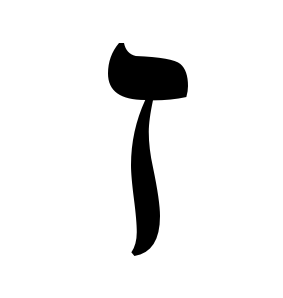
Zayin is the seventh letter in the Hebrew alphabet. Zayin has the same sound as “z” as in “zoo”. Every line in Psalm 119:49-56 starts with this letter. Zayin looks like this:

zayin2

Seven is an important number in the Jewish tradition, indicating perfection and completeness. The word “seven” appears over 500 times in the Bible, beginning with Genesis 2:2-3, “And on the seventh day God finished his work that he had done, and he rested on the seventh day from all his work that he had done. So God blessed the seventh day and made it holy, because on it God rested from all his work that he had done in creation.” Thus began cycles of seven that have been repeated ever since.

In the words of Jewish sages,
“All sevens are dear.”

It is no coincidence, then, that there is a seven tone scale — do, re, mi, fa, so, la, ti. There are seven colors in the rainbow and there are seven openings in our heads.

Oy veh.
I could go on and on, but that’s a blog post for another day.
Suffice it to say:
because Zayin is the seventh letter, it holds great significance.
For believers in Messiah Jesus, this significance is amplified.

Last week, we learned about the sixth letter “Vav”, which is connected to mankind because Adam was created on the sixth day. Zayin looks a lot like Vav, except it has a crown on its head, so this letter is a picture of a man with a crown. That’s our Jesus.

Zayin is also regarded as an image of a sword with the tip pointed down and the hilt on top. The sword also represents Jesus, our Overcomer, defeating death and sin. Now we have access to the “sword of the Spirit, which is the word of God.” (Eph. 6:17)

The Victor ascends and the sword turns into a royal scepter — “But of the Son he says, ‘Your throne, O God, is forever and ever, the scepter of uprightness is the scepter of your kingdom.'” (Heb. 1:8) King Jesus holds out His scepter to welcome us to the throne. “Let us then approach the throne of grace with confidence.” (Heb. 4:16)

The Hebrew word “remember” starts with the letter Zayin,
which is a theme in Psalm 119:49-56.

I need to remember
there is a crown,
and He’s wearing it.
There is a throne,
and He’s on it.
There is a sword,
and it’s sitting on my desk.

zayin

Next: My favorite word in the Bible that starts with “G”.

Long Song Study, part G

ps119

Let’s dig in to Psalm 119:49-56.

Verse 49
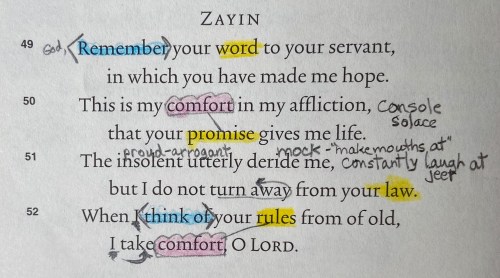
Remember your word to your servant, in which you have made me hope.
“Remember” is one of those words in Hebrew that goes above and beyond our meaning, which is “recalling to memory something forgotten”. That definition doesn’t work here, because God isn’t forgetful. He is infinite, omnipresent, omnipotent, omniscient, sovereign, incomparable. The Lord is not our Grandpa in the Sky who needs our reminders on how to run the world.
Instead, David was calling on God to take action on all that He promised in His word. To remember meant “to stretch out the arm to act.” In other words, David was waiting for a move of God and although delay was painful, he knew it did not nullify the promise. “It is the plan of God that the believer hold on in hope. God calls us to patient waiting.” (Christopher Ash) “Have no fear of failure, for the Lord has never forgotten a single promise to a single believer.” (Charles Spurgeon)

Verse 50
This is my comfort in my affliction, that your promise gives me life.
Where do you go for comfort? I’ve thought about that a lot during these past weeks of quarantine. Times of difficulty often unmask our idols. Is it favorite foods, mind-numbing TV, shopping online, sleep, reruns of sporting events? Or do I go to the life giving power of the Word? As believers, we can find comfort even in the midst of trouble, for Jesus has promised, “I will not leave you comfortless.” (John 14:18)

Verse 51
The insolent utterly deride me, but I do not turn away from your law.
There they are again, those pesky critics. To deride means, “to laugh at in scorn or contempt; scoff or jeer at.” That’s hard to take day after day. Yet, they did not get the upper hand with David because he did not turn aside from God’s way. That takes fortitude, but be assured, it still hurts to be laughed at, to be made fun of, to get the eye-roll, or to be belittled with disrespect. Even when you’re a king.

Verse 52
When I think of your rules from of old, I take comfort, O Lord.
Once again, we see how David directed his thoughts to bring himself comfort. Just as he asked God to remember His word, David also remembered the times God moved on his behalf. He rehearsed in his mind the many past rescues God provided for him and for the Israelites. This bolstered David’s confidence in his God as a Covenant Keeper. What experiences can you draw from as evidence of God’s care for you in the past?
I have dates written down next to certain verses in my Bible. For instance, “Dec. 1991, Marshfield Hospital” is written on the margin of Psalm 34; “Mar. 22, 1988 – Appointment to Jim Falls” is noted by Isaiah 58:11-12; “Mar. 2001 — waiting for Blake’s bypass surgery” is next to Psalm 27:13-14; “4-24-18, Ember Blake born” is beside Psalm 46:5. These are markers for me, helping me remember God’s faithfulness in the past, reminding me of His sure provision in the future.

Verse 53
Hot indignation seizes me because of the wicked, who forsake your law.
Although he dealt with his own group of naysayers, the thing that really got David hot under the collar was the way they dishonored God. According to Christopher Ash, “We too need to learn this indignation.” We tend to overlook others’ disregard for God’s Word, especially if they are really nice, decent, good people. We forget how serious rebellion against God is, and that “turning away from the written instruction God has given is a personal insult and an outrage against the Creator of the universe.”

Verse 54
Your statutes have been my songs in the house of my sojourning.
How did David cool down his hot indignation? By singing. He played music that lifted up the holy word of God. He sang songs that reminded him he was not at home in this world, but a pilgrim passing through it. Singing the very words of God is a form of worship that is full of power. Believing people have always been singing people. I have a playlist titled “Psalms” and every time I hear a song based on a psalm, I add it to the list. These are my songs “through the years of my earthly pilgrimage” (TLB). It’s a great soundtrack for life!

Verse 55
I remember your name in the night, O Lord, and keep your law.
One advantage of learning scripture songs is that they can pop into my head even in the middle of the night. That seems to be when I need them the most. During the night, my mind can be inundated with “what if” and “if only” and “why am I still awake?” David reminds us to remember (it’s a theme in this passage).
Remember Paul and Silas in jail in Acts 16? They sang hymns at midnight so loud that all the other prisoners heard them. Evidently, so did God. An earthquake shook the place, the doors flew open, and everyone’s chains came loose. That’s the power of songs in the night.

Verse 56
This blessing has fallen to me, that I have kept your precepts.
This verse must have been hard to translate, because it is expressed very differently across various versions. The ESV is printed here, but the NIV says, “This has been my practice: I obey your precepts.” I like that. This way of life takes some practice. We don’t learn it in a day. However, obedience becomes easier as we practice. And that results in blessing.

img_9973

img_9974

Next: Zayin

Stanza G

Gee whiz, this is week 7!
I can’t wait to see what God has in store for us
in Psalm 119:49-56.

Here’s a good study tip as we head into another week: watch for repeated words in a passage. If a word is used more than once or twice, it is probably emphasizing a theme or an important idea. Then ask yourself, “What does this word tell me about God?”

Psalm 119:49-56

Grant me the action You promised;
    I have pinned my hopes on Your word.

Great pain can lead to great comfort
    as Your words revive and restore.

Gangs surround and mock me all day;
    I stay on the path anyway.

Good guidelines from the good old days
    console me and make me feel safe.

Godless rebels make my blood boil
    when they blow off Your commandments.

Giving You praise is my theme song
    whether up or down, in or out.

Going to bed, I turn to You
    and resolve once more to obey.

Gladly I put into practice
    submitting my will to Your will.

img_9970

Next: Long Song Study, part G

F is for Free

Back in 2016 I wrote this:

I drove across town for a free cup of coffee. A new convenience store opened up and they are offering free coffee for a few days, along with lots of other promotions such as $1 worth of free gas, which is about three tablespoons. I figure if I drive a few miles to get the free coffee but use the squirt of free gas, I’m still ahead. I simply cannot turn down anything free. Except puppies and kittens.

Last week I extolled the word “eat” and savored the fact that God said to Adam, “You are free to eat from any tree in the garden…” (Gen. 2:16) Free to eat!

But there’s a “but”. Verse 17 goes on to say, “…but you must not eat from the tree of the knowledge of good and evil, for when you eat of it you will surely die.”

Freedom often works like that.

There is plenty of room for a wide variety of expression and purposeful action — in-between the guardrails of God’s wise boundaries. In Psalm 119:45, David reveled in the freedom of walking in wide spaces while at the same time celebrating the commandments that limited his liberty to do whatever he pleased.

Paul had to set the churches in Galatia straight on this.

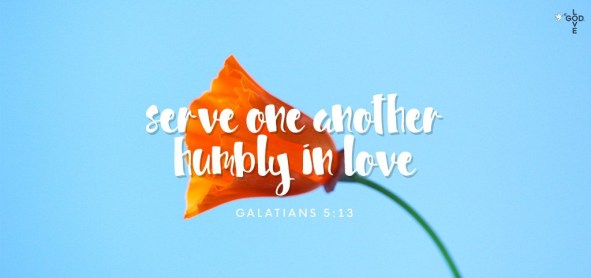
“You were called to be free.
But do not use your freedom to indulge the sinful nature;
rather, serve one another in love.” (Gal. 5:13)

Did you see that “but”? It’s a big one.

One more time:
“My friends, you were chosen to be free.
So don’t use your freedom as an excuse to do anything you want.
Use it as an opportunity to serve each other with love.”
(Contemporary English Version)

We are supposed to use our freedom to do the loving thing for others,
which may mean setting aside our individual desires for a season.
We are free to choose to yield our rights.
We are free to be selfless.

I don’t love doing Bible study on Zoom, or worshiping with a video on Facebook, or not hugging my grands. I don’t enjoy wearing a face mask at the grocery store, or postponing our family reunion, or singing Happy Birthday on FaceTime. I’m sad that I can’t gather with my church family on Sunday mornings. I grieve the loss of grad parties and weddings, Tommy Bartlett’s Water Show and baseball.

I miss going wherever I want, whenever I want, with whomever I want.

This pandemic is limiting me like never before.
I don’t like these constraints.
I want my freedom back.
But.

What if the most loving thing I can do right now is to set aside what I want?
What if I serve you best right now by yielding my rights?
What if this is opportunity, not oppression?

serve

“If the Son sets you free, you will be free indeed.”

My favorite word in the Bible that starts with “F” is FREE.

Vav

Wow! We’re on the sixth letter already — WAW!

Vav (also written as Waw) is the sixth letter in the Hebrew alphabet. Vav has the same sound as “v” as in “vine”. Every line in Psalm 119:41-48 starts with this letter. Vav looks like this:

vav

The meaning of the word “vav” is “hook”.
Can you see it?

The word “vav” is found only in Exodus, in reference to the tabernacle, where the curtains were to be hung from “silver hooks“. (Ex. 27:10, 11, 17) The tabernacle was the place where God lived while the Israelites traveled in the wilderness. Rabbis teach that in the same way, God now resides in the Torah. So scribes developed a system that made the sacred documents a reflection of the tabernacle by calling each page a “curtain” and at the top of each page is the letter “vav”, hooking the words to the parchment. (Side note: Every time a scribe copied the name of God onto a new scroll, he had to say a blessing and dip his pen in fresh ink.)

Just as a hook was used to connect the curtains in the tabernacle, the “vav” was seen as a connecting letter. When placed at the beginning of a word, the letter is read as “and”, such as “heaven and earth”. So within a sentence, “and” is the hook that connects two words. In the Hebrew text, every line of Psalm 119:41-48 starts with “vav”, or “and”, making it one long run-on sentence!

Because “vav” is the sixth letter in the Aleph-Bet, it is associated with the sixth day of creation, the day man was created. But because of sin (Jews believe the Fall happened on a Friday), the “vav”, or connection, between God and people was broken.

“So God in His goodness sent Jesus as the second Adam to reverse the curse in order to restore the connection between heaven and earth. Jesus died on the sixth day, a Friday, to make atonement for the sin of the first man and woman so the blessings we lost in Eden could be restored.” (Rabbi Jason Sibol)

Rabbi Sibol also points out that Jesus’ first miracle of turning water into wine mentions six stone jars. (John 2:6) That’s a detail that is easy to miss and we might think it’s unimportant. But there are no wasted words in the Bible. Six stone pots were filled to the brim to show that “Jesus came to restore the Lord’s original blessing for creation” — one for each day.

There’s one more thing you need to know about this letter.
The letter “vav” is not only seen as a hook, but also as a nail.
Can you see it?

The Messiah
was nailed to a cross to
reconnect
us
with
God.

“For there is one mediator
between God and human beings,
the man Jesus Christ.”

(1 Tim. 2:5) 

vav1

Next: My favorite word in the Bible that starts with “F”.

Long Song Study, part F

bible-study

It’s Bible Study Day! Let me encourage you to spend some time reading over Psalm 119:41-48 before perusing these humble comments. Sometimes when I study, I write down as many questions as I can about the passage. I might not be able to answer them all, but it gets me thinking!

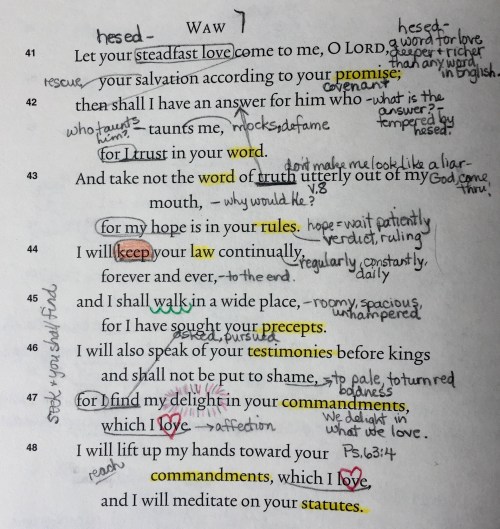
Verse 41
Let your steadfast love come to me, O Lord, your salvation according to your promise;
The word “steadfast” is a doozy. There is no word in the English language that can capture the depth and richness of its Hebrew meaning. But I’m going to try. The word “hesed” is translated as “steadfast love, lovingkindness, mercy, unfailing love, faithful love, loyal love; a long-suffering love that extends to the undeserving and even intervenes on their behalf”. Whew! That’s a mouthful — and a brainful. It shouldn’t surprise us that it’s hard to define God’s love. After all, it is longer, wider, deeper and higher than anything we can think or imagine.
Another way to define “hesed” is “Covenant love”. So in this verse, David was not asking for steadfast love and salvation; he was claiming it, according to the promise, or the covenant agreement made with God.

Verse 42
then shall I have an answer for him who taunts me, for I trust in your word.
King David had a group of negative critics. (We met them in verses 21-23.) It wasn’t a good idea to taunt the great Warrior-King, but some people just don’t know when to stop. Anyone in any kind of leadership position knows that there is always pressure because it’s impossible to please everybody. “It is precisely when we are squeezed by pressure that ministry grows. When there is no pressure, when our Christian service comes at no cost, it doesn’t grow.” (Christopher Ash)
We don’t know what answer David was going to dish back, but certainly it would be tempered by the “hesed” love that came to him from the Lord.

Verse 43
And take not the word of truth utterly out of my mouth, for my hope is in your rules.
David trusted in God’s words, but he didn’t completely trust his own. During a heated exchange, it’s easy to use exaggerations, accusations and speculations. What a good prayer: “Dear God, keep the truth in my mouth.” His hope wasn’t in a crushing comeback to silence his mockers. Instead, he was willing to wait patiently for God’s verdict.

Verse 44
I will keep your law continually, forever and ever,
David never threw up his hands and said, “I quit.” It seems like he never even took a day off from partnering with God. Clearly, he had some big failures, but his intention was to regularly, constantly and daily keep up his end of the deal all the way to the finish line.

Verse 45
and I shall walk in a wide place, for I have sought your precepts.
A few years ago, PB and I drove Beartooth Highway, 68 miles of curvy mountain road that winds its way through southwest Montana and northwest Wyoming. If guardrails hadn’t been on the side of those deep drop-offs, I would have crawled into the back seat and pulled a blanket over myself. I also would have missed the incredible vistas. It was a narrow road, but the guardrails made it seem safer.
We tend to think that rules constrain us and take all the fun out of life. In truth, they keep us from straying into dangerous areas and they minimize damage by keeping us in the safety zone. There is so much freedom within the secure limits of God’s good rules.

Verse 46
I will also speak of your testimonies before kings and shall not be put to shame,
As King of Israel, David must have had the occasion to show hospitality to rulers from other nations. He had status, power and wealth and realized his position could open up doors of opportunity to make much of his God. Freshly assured of God’s steadfast love and promise of salvation, David was emboldened to speak up and draw attention to Israel’s true King.

Verse 47
for I find my delight in your commandments, which I love.
Again, the love David had for God’s commandments might sound strange to our western ears. The Hebrew people were so well-known for their fervency and fondness for study of the Torah that they were called “people of the book”. The word “law” in our English Bibles would have been understood by the Hebrews as “guidance” or “teaching”. “What sounds like an onerous burden to us, sounds to them as if they are uncovering the very thoughts of God.” (Lois Tverberg)  Perhaps if we read the word “law” in the coming passages with the Hebrew connotation, we might come to love the law, too. As Spurgeon said, “We delight in what we love.”

Verse 48
I will lift up my hands toward your commandments, which I love and I will meditate on your precepts.
In another Psalm, David wrote, “Because your steadfast love is better than life, my lips will praise you. So I will bless you as long as I live; in your name I will lift up my hands.” (Psalm 63:3-4) Lifting up our hands is simply a biblical way to bless the Lord. There’s nothing radical or extreme about it. Just as children lift up their arms to loving parents to be hugged, lifting our hands is stretching ourselves toward Him. It is an act of love.
Lastly, in this section meditation is once again connected to delight. (See verses 15-16 and 23-24) The more we think about God’s words, the more delightful they become.

img_9954

Things I know for sure from this passage:

  • We have no reason to ever doubt God’s steadfast love for us. Ever.
  • When we seek God’s truth, we find not only truth, but also delight.
  • When God’s steadfast love comes to us, things happen: we keep His law, we walk in freedom, we speak of Him, we delight in Him and we lift up our hands to Him.
  • We can pray confidently for God to fulfill His promises to us.
  • “Let thy mercies come…” v. 41 in the King James Version — “mercies” are plural because we need so much and so many kinds.

For more about the Hebrew word “hesed” see:

Hesed: Love in the Long Term

Next: Vav

Stanza F

Welcome to week 6 of the Aleph-Bet series!

One thing that stands out to me while studying Psalm 119 is the deep love David seemed to have for the law, rules and commandments. I don’t know too many people who are head-over-heels about laws, rules and commandments. An insight from Lois Tverberg helped me understand this passion for the word from a Hebrew perspective.

    Christians may be surprised that the word “mitzvah”, meaning commandment, is positive rather than negative in Jewish culture. We think of commandments as burdensome regulations, but the usual Jewish usage of mitzvah is that it is an opportunity to do something good that God told you to do. The word is always used in a positive way, suggesting that doing what God has asked is a joy and a spiritual opportunity, not a burden.
The idea of “hiddur mitzvah” (beautifying the command) says that if God tells us to do something, we shouldn’t just do the minimum, but to perform it in the best way possible, sparing no expense or trouble. http://www.ourrabbijesus.com/articles/beautifying-gods-commands

Let’s beautify the commands of God this week by seeing them as opportunities to obey Him with excellence.

Psalm 119:41-48

Favor me with Your constant love
    and sure salvation, as promised.

Finally, my mockers will hear me,
    for Your word will not let me down.

Forfeit God’s good truth? Not these lips!
    I’ve pinned all my hopes on Your word.

Forever I will walk with You,
    always and forever. Amen.

Freely I will go through my days
    because I have found Your roadmap.

Faithfully I’ll speak up for You;
    I won’t be embarrassed at all.

Finding Your words are delightful,
    I love them more and more each day.

Farther I stretch, hands open wide,
    to grasp the heart of Your precepts. 

img_9953

Next: Long Song Study, part F