Long Song Study, part M

David made it through the low point, or “midnight of the psalm” in last week’s passage. In this section, his tone changes from despair and doubt to steady reliance on God’s words.

Psalm 119:89-96

Verse 89
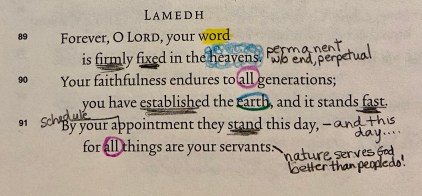
Forever, O Lord, your word is firmly fixed in the heavens.
Here is why it is worth our time to study the Bible: it’s going to last forever. Every moment we spend in the Word will be of value in eternity. The Bible is the only thing on this earth that is not temporary. It is a permanent fixture in heaven that we will recognize and rejoice in when we get there. 

Verse 90
Your faithfulness endures to all generations; you have established the earth, and it stands fast.
Just as the Word is firmly fixed in the heavens, so too, the faithfulness of the Lord is firmly fixed on the earth. Hundreds of generations of people have come and gone, and God has faithfully endured every one. Evidence of His faithfulness is everywhere. The hymn writer said it best:

Summer and winter, and springtime and harvest,
Sun, moon and stars in their courses above,
Join with all nature in manifold witness
To Thy great faithfulness, mercy and love.
(Great Is Thy Faithfulness, Thomas Chisholm)

Verse 91
By your appointment they stand this day, for all things are your servants.
David saw the sun rise every morning, the planets stay on their tracks, and the seasons turn in time. God had organized the universe with His creative word. This gave David confidence that if he held on to the Creator God and His creative words, he was secure.
David used every expression he could think of to drive this idea home. Verse 89: “firmly fixed”; verse 90: “established” and “stands fast”; verse 91: “stand” — they all mean the same thing. “The order and stability of the created work of God is guaranteed by the authority of the word of God. And therefore the believer who rests upon that word, rests upon firmness and will not fall into a pit.” (Christopher Ash) All of nature is serving the purposes of God, to show us His power and faithfulness.

Verse 92
If your law had not been my delight, I would have perished in my affliction.
Looking back on his period of suffering, David realized how close he came to giving up. And sometimes people do give up. For some, affliction can lead to destructive anger, bitterness and hopelessness.  For others, trials drive them deeper into the arms of God where His Word sees them through dark times. David understood that holding on to the word that was firmly fixed in creation was his only place of security.

Verse 93
I will never forget your precepts, for by them you have given me life.
Having come out on the other side of suffering, David had fresh appreciation for life. He would not soon forget the help and hope he received from God’s Word.
There are some verses I will never forget, because they spoke to my heart during difficult circumstances. Those words are marked in my Bible with a date in the margin. They stand as a testimony of God’s help when I was struggling. Spending regular time in the Word keeps me from forgetting His provision in the past and His promises for the future.

Verse 94
I am yours; save me, for I have sought your precepts.
David had given himself to God, so he knew he could continue to depend on God’s care. All believers have the seal, or mark, of the Holy Spirit, God’s sign of ownership. “Having believed, you were marked in Him with a seal, the promised Holy Spirit, who is a deposit guaranteeing our inheritance.” (Eph. 1:13-14) We belong to Him. Guaranteed. “You are not your own; you were bought at a price.” (1 Cor. 6:19-20)

Verse 95
The wicked lie in wait to destroy me, but I consider your testimonies.
His troubles weren’t over, but David had learned not to obsess about what his enemies were up to. He knew they were watching him, but David turned his attention from them to God’s testimonies. The wicked were lying in wait for David, but David was waiting upon God. It takes strength and resolve to keep our eyes on Jesus when under attack. It’s another three word prayer I whisper often — “Eyes on Jesus, eyes on Jesus, eyes on Jesus.”

Verse 96
I have seen a limit to all perfection, but your commandment is exceedingly broad.
As a bit of a perfectionist (Enneagram #1), I’m always bumping up against imperfection. What a relief to come to terms with the fact that perfection isn’t required or even expected. Spurgeon said, “He does not expect perfection in the creature, and, therefore, he is not disappointed when he does not find it.” God is different. He is limitless, bottomless, boundless, inexhaustible, immeasurable, and every other word in my thesaurus.
img_0286img_0285

Things I know for sure from this passage:

  • During times of uncertainty, I need the firmly fixed Word of God that stands fast.
  • Nature is constantly speaking to me of God’s faithfulness.
  • Delighting in God’s Word is a mark of spiritual maturity.
  • I am His and I can trust Him to take care of me.
  • Perfection belongs to God alone.

Next: Lamedh

Long Song Study, part L

PSALM-119-Master-V2-72dpi

This is the 11th week of the Long Song Study, which means, after part L, we are halfway through! Back in April, when I started this series, I wondered if anyone would stick with it. I wondered if I would stick with it. But here we are — 11 down, 11 to go.

Psalm 119:81-88

Verse 81
My soul longs for your salvation;
I hope in your word.
There’s a lot of longing in this section of Psalm 119. It is definitely the low point, or as Spurgeon said, “the midnight of the psalm.” David was not just wishing for better days; he had worn himself out with yearning for a rescue, even to the point of fainting. His struggle had gone on for so long, that his spiritual strength was faltering. So David lamented. He honestly expressed his anguish and asked the questions we all wrestle with when experiencing periods of suffering: When? How long? Why? As in verses 43 and 74, David’s hope came from the word of God. Paul wrote, “But if we hope for what we do not yet have, we wait for it patiently.” (Romans 8:25) David was running out of patience.

Verse 82
My eyes long for your promise;
I ask, “When will you comfort me?”
David could read the words of God’s promise and he believed them, but he couldn’t see them working on his behalf.  Time was ticking away and nothing seemed to be happening. For the first time in his long song, he asked questions. God’s comfort was something he had experienced many times in the past, but what about now? David was saying, “If You’re not going to save me right now, can’t You at least comfort me? Like, right now?” Instead of asking, “When will you deliver me?” David’s question revealed what he truly desired: God’s reassuring presence with him.

Verse 83
For I have become like a wineskin in the smoke,
yet I have not forgotten your statutes.
You probably don’t have an animal skin full of wine hanging in your chimney. It was common in David’s day, as the smoke added flavor and mellowed the new wine. However, if the heat became too intense or if the wineskin was left too long, the skin would dry and crack, ruining the contents. David felt he was coming dangerously close to cracking under the heat of persecution. He was burning out during this prolonged time of stress.
True to the biblical form of lament, it didn’t take David long before he turned his mind back to God
. Although at the moment he felt as if God had forgotten him, he would not forget God’s statutes. 

Verse 84
How long must your servant endure?
When will you judge those who persecute me?
Almost immediately though, the questions returned. Like David, we ask, “How much longer until this is over? On what date and time will You come through for me? If I knew when this trouble is going to pass, I would be able to gut it out.” But God does not often let us in on His timetable. Faithfulness and perseverance matter more to God than worldly success and ease.
Did you notice that something is missing in this verse? There are no “word” words here: law, word, precept, statute, commandment, etc. This is one of only five verses in the entire psalm that doesn’t refer to God’s word. Perhaps lingering too long on the questions fostered doubt and crowded out the Word.

Verse 85
The insolent have dug pitfalls for me;
they do not live according to your law.
David wasn’t just whining about minor offenses. He had legitimate enemies that were trying to take him out. He couldn’t reason with them about their malicious attacks because they had no basis for morality, living apart from God’s law. David was dealing with cruel and crafty deceivers who were intent on causing the kingdom and the king to fail. He had to watch his step, knowing land mines were everywhere, waiting to blow him up.

Verse 86
All your commandments are sure;
they persecute me with falsehood; help me!
In contrast to the pits that caused fear with every step, David reminded himself of the sure foundation and solid footing of God’s truth. Even so, he was near the end of his rope. His reputation was being sullied by a smear campaign based on lies. Things were spiraling down so David desperately prayed, “Help me.” It wasn’t the first time. “When I said, ‘My foot is slipping,’ your unfailing love, Lord, supported me.” Ps. 94:18

Verse 87
They have almost made an end of me on earth,
but I have not forsaken your precepts.
If this was it — if this was the way it was going to end for David — then his days on earth would be over, but it wouldn’t be his final chapter. David kept the promise of eternal life before him. He also knew “the grass withers and the flowers fall, but the word of our God endures forever.” (Is. 40:8) He hung on with incredible tenacity to the words of God, knowing he would take them with him into eternity. In troubling times, the Bible should be the one thing we cling to above all else. We can’t quit reading, memorizing, studying and meditating on God’s Word in times of hardship. It shouldn’t be the last resort. (Did you notice that big “but”?)

Verse 88
In your steadfast love give me life,
that I may keep the testimonies of your mouth.
There it is again — that “hesed” love: “steadfast love, lovingkindness, mercy, unfailing love, faithful love, loyal love; a long-suffering love that extends to the undeserving and even intervenes on their behalf”. David wasn’t eager to see the curtain come down on his time on earth. He wanted to live. Why? So he could clear his name? Or get his popularity back? Or see his persecutors judged? No! It wasn’t about him at all! David wanted to live so that he could make God’s name great, so that he could display the steadfastness of God’s character, and so that the Words of God could be exalted! 

img_0217

Things I know for sure from this passage:

  • God is not offended by our questions.
  • We need His presence more than His answers during times of suffering.
  • God’s Word provides stability, certainty, and steadiness.
  • Those who are hostile to God are often hostile to God’s people.
  • We are to stay faithful and leave the timing of things to God.

Next: Kaph

The Exodus Music recording of this section of Psalm 119 is especially beautiful. I’m a sucker for a cello accompaniment. You can feel the ache in David’s lament – take a listen!

Long Song Study, part J

The Bible doesn’t always tell us what we want to hear.
We tend to skip over those parts.
Not today.
Prepare your heart for Affliction, Round 2.

verse 76

Psalm 119:73-80

Verse 73
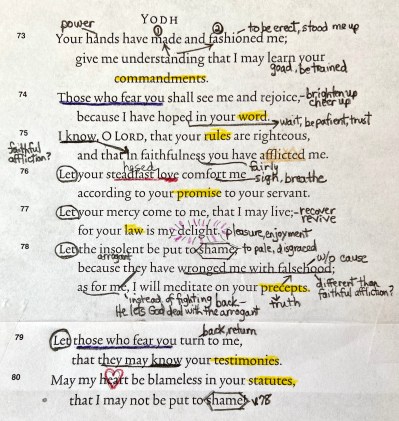
Your hands have made and fashioned me; give me understanding that I may learn your commandments.
We weren’t accidents. God’s hands made us. Then His hands shaped us — and that shaping is still going on. Affliction is one of those “shaping” experiences that either gets us “bent out of joint” or helps us learn and grow. Look at how intricately God fashioned our bodies — “He is prepared to take equal pains with the soul.” (Spurgeon) We need only to trust the hands of the Potter as He continues to shape us, and pray for understanding instead of becoming embittered.

Verse 74
Those who fear you shall see me and rejoice, because I have hoped in your word.
Here’s why. People are watching to see how we handle adversity. A suffering believer who doesn’t lose faith has a powerfully positive impact on others. Christopher Ash says it better than I can:

When they see me, afflicted but trusting, hurting and hoping, holding on to your word of promise, they too will rejoice and take courage…
When I see the living faith of a suffering believer, I am deeply encouraged to persevere myself…
It is good to hear of answers to prayer that change circumstances. But it is better to hear of answers to prayer that change people, so that they persevere in unchanged circumstances…
To be quite honest, I am not nearly so encouraged in my struggles as when I see a believer who is really going through hard times, and yet still holding on to the word of God. (Bible Delight)

I’ve known people who gave up on faith when their prayers didn’t stop the suffering and bring a miracle. I’ve known people who got their miracle healing, but still drifted away. And then I’ve known a mother of four young children sit in the front pew on the Sunday after her husband’s funeral. And every Sunday after that. Which one had an impact on my faith? Who inspired me to hang on?

Verse 75
I know, O Lord, that your rules are righteous, and that in faithfulness you have afflicted me.
Ouch. This verse stings a little. Perhaps it reveals that we have a faulty understanding of the point of affliction. We tend to think we need to “just get through” times of trial until everything is back to normal and we can continue on our merry way. We grit our teeth, power through, and get back on track with God when it passes. The Psalmist saw it differently. He saw his hardship as the concrete proof of God’s faithfulness!

Were He not faithful to His promise, He would not trouble to afflict me. For he does not willingly afflict; He afflicts because it is the only way to achieve His promise and to keep me walking in His way. The affliction is not the failure of God’s faithfulness, but precisely the expression of it. (Bible Delight, Christopher Ash)

Verse 76
Let your steadfast love comfort me according to your promise to your servant.
David wrestled with this, but instead of begging for the trial to be lifted, he asked for comfort from God’s hand while in it. He craved that “hesed” love during his time of trouble, claiming his right to it under the covenant, as a humble servant.

Verse 77
Let your mercy come to me, that I may live; for your law is my delight.
The King James Version says, “Let Thy tender mercies come unto me…” As Spurgeon stated, “He needed not only mercy, but mercies, and these must be of a very gracious and considerate kind, even tender mercies, for he was sore with his wounds.” David knew, as we should, that the mercy of God always comes. It comes especially easy for those who continue to delight in His Word.

Verse 78
Let the insolent be put to shame, because they have wronged me with falsehood; as for me, I will meditate on your precepts.
Although David desired his arrogant, proud persecutors to be publicly exposed and to receive just punishment, he didn’t take it on himself to carry out justice. He left that to God. Even in the days of King David, there was the spinning of lies to undermine leadership. It must have been so hard to refrain from retaliation. How did David do it? He meditated on the covenant promises and truth of God’s word.

Verse 79
Let those who fear you turn to me, that they may know your testimonies.
David turned his attention away from his accusers and toward his fellow believers. He asked to be an encouragement to his community of faithful followers. Christopher Ash asks important questions: “What happens when Christians turn to us? Do they see in us men and women who hope in the word of God, who walk his way, who in the midst of affliction have our hearts and minds filled with his testimonies rather than the lies of the world?” (Bible Delight) Are people impacted by our testimonies? Or do we keep our afflictions under wraps so no one has any idea of the pressures we’re facing, and therefore can’t rejoice in the inspiring example of our faith? What are we missing by refusing to be vulnerable and honest?

Verse 80
May my heart be blameless in your statutes, that I may not be put to shame!
The word “blameless” in Hebrew means “entire, with integrity”. One version says, “Let my heart be whole.” (Voice) Although we have sin natures and can’t be perfect before God, He provided a way for us to be “whole and holy” (Message) through Jesus Christ. We don’t need to worry about being put to shame when we are whole-heartedly living for Him.

img_0156

Things I know for sure from this passage:

  • The same God who created me is continuing to work in me.
  • I need to re-consider my understanding of affliction.
  • Comfort and delight are possible even during times of trial.
  • I am meant to have a positive effect on believers in my community.
  • Suffering teaches me things I couldn’t learn any other way.

Next: Yodh

Long Song Study, part I

bstud

The author of Psalm 119 (presumably David) wrote eloquently about the goodness of God’s law and his desire to keep it with all his heart. Occasionally he wrote about adversaries who were making his life difficult. In the next section, David took these two realities and put them together into one truth: God’s goodness is best known in affliction. “The affliction God gives is His good gift to His people…to draw us into, and keep us in, the Word.” (Christopher Ash)

Verse 65
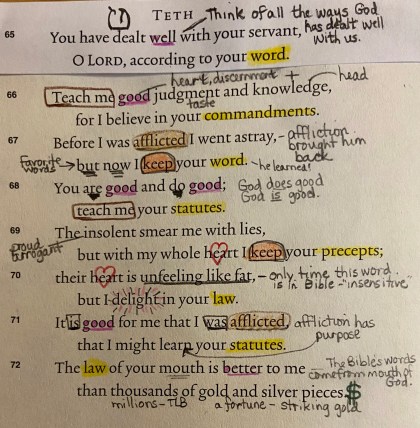
You have dealt well with your servant, O Lord, according to your word.
David began the ninth section of his long song by looking back and acknowledging the goodness of God in his life. He wasn’t referring to his extravagant palace, or his table of fine food, or his closet full of regal robes. David saw that the promises of God had proven to be rock solid words of truth that gave his soul both help and delight.

Verse 66
Teach me good judgment and knowledge, for I believe in your commandments.
Even though he had been walking with God for awhile, David stayed teachable. His experience of God’s goodness only made him want to know more, so he asked for knowledge and good judgment. The word “judgment” in this verse means “a taste for” — so David was asking God to put a craving for good and wise living in his heart. “Taste and see that the Lord is good,” David wrote in Psalm 34. The ability to discern, or “taste”, God’s goodness in the middle of suffering is a mark of spiritual maturity.

Verse 67
Before I was afflicted I went astray, but now I keep your word.
What was David’s affliction? Apparently, he was persecuted for staying loyal to God’s law and choosing the way of faithfulness. (See verses 21-23, 39, 42, 50-51, 61) Taking a stand to uphold God’s law in the face of persecution only made David more resolute to keep it. He saw affliction as the thing God used to bring him back into right relationship with Himself. When life was easy and comfortable, he didn’t sense his need for God.
C.S. Lewis said, “God whispers to us in our pleasures, speaks in our consciences, but shouts in our pains. It is his megaphone to rouse a deaf world.” God often uses times of trial to get our attention and bring us back to Him.

Verse 68
You are good and do good; teach me your statutes.
Because of the affliction, David had a new-found taste of God’s goodness that was present during his time of trial. In fact, David recognized how valuable it was, so he said, “If this is the only way for me to learn to walk in Your ways, then afflict me whenever You need to. Keep teaching me, whatever it takes.” David understood that if he never went through hard trials, he would never experience the depths of God’s goodness.

Verse 69
The insolent smear me with lies, but with my whole heart I keep your precepts;
Smear campaigns are nothing new, although with social media, our culture seems to have taken it to a new level. Keep in mind that David was experiencing this adversity because he took a stand for God’s law. We can get ourselves into all kinds of trouble on our own for saying and doing stupid things. Suffering for being a believer is different. The prosperity gospel teaching that God will give you a comfortable life and make you healthy and wealthy is a false gospel. If even Jesus learned obedience through suffering (Heb. 5:8), we should expect to as well.

Verse 70
their heart is unfeeling like fat, but I delight in your law.
“A greasy heart is something horrible,” said Charles Spurgeon. Yuck — I agree. This is the only place in the whole Bible this word is used, so different versions interpret this verse in various ways: “Their hearts are unfeeling, like blubber.” (CEB) “Their hearts are cold and insensitive.” (GW) “Their unfeeling hearts are hard and stubborn.” (NIRV) “Their heart is as fat as grease.” (ASV) It seems that too much ease causes heart disease and a greasy heart becomes proud and arrogant. Instead of delighting in the law, they were repelled by the law. Greasy hearts and living water don’t mix.

Verse 71
It is good for me that I was afflicted, that I might learn your statutes.
David saw that he was on the path to a greasy heart, too, until affliction did its good work in him. He would never have become a man who delighted in God’s word otherwise. He was convinced that the gracious hand of God was all over his trials because they trained him to walk in the ways of the Lord. Suffering and God’s goodness were not two separate experiences for David — they were closely tied and they compelled him to love the Word. Of course, it’s difficult to see the benefits of going through painful trials when in the midst of them. David only saw in retrospect that he was better for having gone through them.

Verse 72
The law of your mouth is better to me than thousands of gold and silver pieces.
Some people try to buy their way out of discomfort, inconvenience, and tests of faith. David realized that he couldn’t put a price on the lessons he learned in adversity. He may have been the wealthiest of kings, but the riches of God’s word were far more precious to him.

And so we have here a deep truth. No man will love his Bible until God has afflicted him. He may be intrigued by it. He may have an intellectual affection for it. He may have been brought up to have a cultural affinity with it, or an aesthetic love of its verbal resonances. But he will not delight in that word above all the wealth of the world until he has been afflicted, until he has felt the fragility of this world, this age, this mortal body. But when that happens he will cling to the word as the only tie to the age to come. ~Christopher Ash

img_0037

Things I know for sure from this passage:

  • When things are going good, we tend to wander away.
  • Those who wander too far for too long can become calloused and heartless.
  • God often uses difficulties to woo us back to Him.
  • Anything that drives us closer to God is good.
  • The word of God is priceless.

Next: Teth

Long Song Study, part H

BibleStudy-1024x512

Teach us Your statutes, O Lord!

Psalm 119:57-64

Verse 57
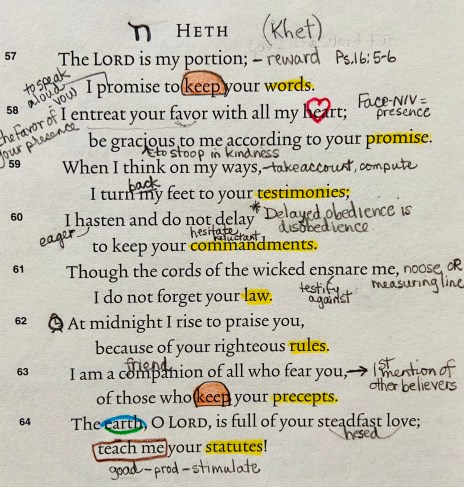
The Lord is my portion; I promise to keep your words.
The love David had for God’s word was rooted in his love for God. The Lord alone was enough for David. He trusted that God would always be sufficient and that’s what motivated him to make bold promises.
When the Israelites went into the Promised Land, each tribe was given an allotment of land — all except the Levites. The priestly tribe of Levi received no land, but instead, the Lord Himself was their portion. As believers, we are now “a chosen people, a royal priesthood” (1 Peter 2:9) and God gives us Himself as our inheritance, our reward. What more could we want? Our lack of trust implies that we don’t think He’s adequate for our needs or competent to care for us. In contrast, when we take God as our portion, we will love what He has to say and we will want to live by it.

Verse 58
I entreat your favor with all my heart; be gracious to me according to your promise.
Entreating someone’s favor (or seeking their face, as in the NIV) is about presence. When a child is trying to get the attention of an adult, the child wants that grownup to put down what they’re doing and look at him or her. In this psalm, David asked God for His gracious presence, perhaps in light of the big promise he made in verse 57. David knew he couldn’t pull off perfection, but because of grace, he didn’t need to.

Verse 59
When I think on my ways, I turn my feet to your testimonies.
Being in God’s presence caused David to contemplate where he was in life. When David did that, things were revealed that he needed to deal with. He was moved to repent and get back on track with the Lord. We, too, need to stop every once in a while to take account, check priorities, think about our “ways”, and turn our feet if they have taken us in the wrong direction.

Verse 60
I hasten and do not delay to keep your commandments.
I read a lot of parenting books when we were in the thick of raising children. One basic principle struck me – “Delayed obedience is disobedience.” In other words, when I allowed my kids to put off doing what I asked, I was actually teaching them to be disobedient. Often, I was communicating that they could put off obedience until mom got mad and raised her voice. I didn’t realize I was training them to wait for the blow-up. David had his share of parenting issues, but he seemed eager to be quick to obey God.
The word “delay” means to be hesitant or reluctant. How many times have I dragged my feet in response to God’s nudging, only to have the opportunity pass?

Verse 61
Though the cords of the wicked ensnare me, I do not forget your law.
David found himself surrounded by people who didn’t care about God and who put concentrated effort into undermining him. Doesn’t it seem like when you’ve made a renewed decision to trust and obey, it’s not long before something comes along to throw you off or pull you away? When we choose to be quick to follow God, we can be fairly certain that the enemy will also be quick to test our resolve. Like David, we need to keep God’s words before us, reminding us of the truth and giving us hope.

Verse 62
At midnight I rise to praise you, because of your righteous rules.
David may have gone to bed with thoughts of being ensnared by those wicked cords, but in the middle of the night, he battled back with praise. He reaffirmed the rightness of God’s ways and refused to succumb to fear. If I’m still awake at midnight, it’s probably because I’m feeling anxious about something. Praise has a way of cutting right through the lies of the enemy and making way for peace.

Verse 63
I am a companion of all who fear you, of those who keep your precepts.
So far, the main characters in this psalm have been David, God, and some occasional enemies. In verse 63 we get a glimpse of another group — David was not alone! He had friends! And they shared his love for God and His word! What a relief! A life of faith is never a solitary life, but always a life that includes fellowship, friendship and unified purpose. We need people around us who are also determined to live according to God’s Word — people we can count on to encourage us and spur us on toward love and good deeds. God’s people are meant to be part of our portion of blessing.

Verse 64
The earth, O Lord, is full of your steadfast love; teach me your statutes!
David began this passage reminding himself of God’s sufficiency for his own life. By the end, he saw the whole planet overflowing with God’s “hesed” love — that steadfast, long-suffering, merciful love. David found God to be more than sufficient, not just for him, but for the whole world.

There is no corner of the universe where His people can possibly be beyond His Covenant faithfulness, steadfast love, and care. Even though it does not always look like it, there is no God-forsaken square meter on earth. Even though the earth contains many wicked who are hostile to those who fear the Lord, it is not possible for a believer to be in any part of the created order which is not full of the Lord’s steadfast love.  ~ Christopher Ash

img_0002

Things I know for sure from this passage:

  • God is sufficient — I lack nothing.
  • Obeying quickly is a mark of spiritual maturity.
  • The Christian life is meant to be lived in community.
  • Daily reflection and repentance keeps me on the right track.
  • Evidence of God’s steadfast love is all around me.

Next: Heth

Long Song Study, part G

ps119

Let’s dig in to Psalm 119:49-56.

Verse 49
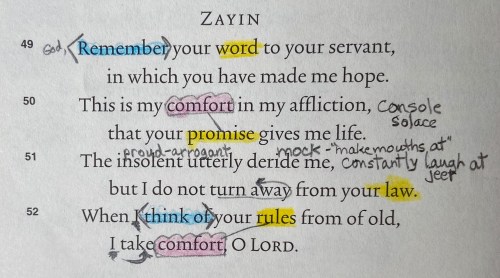
Remember your word to your servant, in which you have made me hope.
“Remember” is one of those words in Hebrew that goes above and beyond our meaning, which is “recalling to memory something forgotten”. That definition doesn’t work here, because God isn’t forgetful. He is infinite, omnipresent, omnipotent, omniscient, sovereign, incomparable. The Lord is not our Grandpa in the Sky who needs our reminders on how to run the world.
Instead, David was calling on God to take action on all that He promised in His word. To remember meant “to stretch out the arm to act.” In other words, David was waiting for a move of God and although delay was painful, he knew it did not nullify the promise. “It is the plan of God that the believer hold on in hope. God calls us to patient waiting.” (Christopher Ash) “Have no fear of failure, for the Lord has never forgotten a single promise to a single believer.” (Charles Spurgeon)

Verse 50
This is my comfort in my affliction, that your promise gives me life.
Where do you go for comfort? I’ve thought about that a lot during these past weeks of quarantine. Times of difficulty often unmask our idols. Is it favorite foods, mind-numbing TV, shopping online, sleep, reruns of sporting events? Or do I go to the life giving power of the Word? As believers, we can find comfort even in the midst of trouble, for Jesus has promised, “I will not leave you comfortless.” (John 14:18)

Verse 51
The insolent utterly deride me, but I do not turn away from your law.
There they are again, those pesky critics. To deride means, “to laugh at in scorn or contempt; scoff or jeer at.” That’s hard to take day after day. Yet, they did not get the upper hand with David because he did not turn aside from God’s way. That takes fortitude, but be assured, it still hurts to be laughed at, to be made fun of, to get the eye-roll, or to be belittled with disrespect. Even when you’re a king.

Verse 52
When I think of your rules from of old, I take comfort, O Lord.
Once again, we see how David directed his thoughts to bring himself comfort. Just as he asked God to remember His word, David also remembered the times God moved on his behalf. He rehearsed in his mind the many past rescues God provided for him and for the Israelites. This bolstered David’s confidence in his God as a Covenant Keeper. What experiences can you draw from as evidence of God’s care for you in the past?
I have dates written down next to certain verses in my Bible. For instance, “Dec. 1991, Marshfield Hospital” is written on the margin of Psalm 34; “Mar. 22, 1988 – Appointment to Jim Falls” is noted by Isaiah 58:11-12; “Mar. 2001 — waiting for Blake’s bypass surgery” is next to Psalm 27:13-14; “4-24-18, Ember Blake born” is beside Psalm 46:5. These are markers for me, helping me remember God’s faithfulness in the past, reminding me of His sure provision in the future.

Verse 53
Hot indignation seizes me because of the wicked, who forsake your law.
Although he dealt with his own group of naysayers, the thing that really got David hot under the collar was the way they dishonored God. According to Christopher Ash, “We too need to learn this indignation.” We tend to overlook others’ disregard for God’s Word, especially if they are really nice, decent, good people. We forget how serious rebellion against God is, and that “turning away from the written instruction God has given is a personal insult and an outrage against the Creator of the universe.”

Verse 54
Your statutes have been my songs in the house of my sojourning.
How did David cool down his hot indignation? By singing. He played music that lifted up the holy word of God. He sang songs that reminded him he was not at home in this world, but a pilgrim passing through it. Singing the very words of God is a form of worship that is full of power. Believing people have always been singing people. I have a playlist titled “Psalms” and every time I hear a song based on a psalm, I add it to the list. These are my songs “through the years of my earthly pilgrimage” (TLB). It’s a great soundtrack for life!

Verse 55
I remember your name in the night, O Lord, and keep your law.
One advantage of learning scripture songs is that they can pop into my head even in the middle of the night. That seems to be when I need them the most. During the night, my mind can be inundated with “what if” and “if only” and “why am I still awake?” David reminds us to remember (it’s a theme in this passage).
Remember Paul and Silas in jail in Acts 16? They sang hymns at midnight so loud that all the other prisoners heard them. Evidently, so did God. An earthquake shook the place, the doors flew open, and everyone’s chains came loose. That’s the power of songs in the night.

Verse 56
This blessing has fallen to me, that I have kept your precepts.
This verse must have been hard to translate, because it is expressed very differently across various versions. The ESV is printed here, but the NIV says, “This has been my practice: I obey your precepts.” I like that. This way of life takes some practice. We don’t learn it in a day. However, obedience becomes easier as we practice. And that results in blessing.

img_9973

img_9974

Next: Zayin

Long Song Study, part F

bible-study

It’s Bible Study Day! Let me encourage you to spend some time reading over Psalm 119:41-48 before perusing these humble comments. Sometimes when I study, I write down as many questions as I can about the passage. I might not be able to answer them all, but it gets me thinking!

Verse 41
Let your steadfast love come to me, O Lord, your salvation according to your promise;
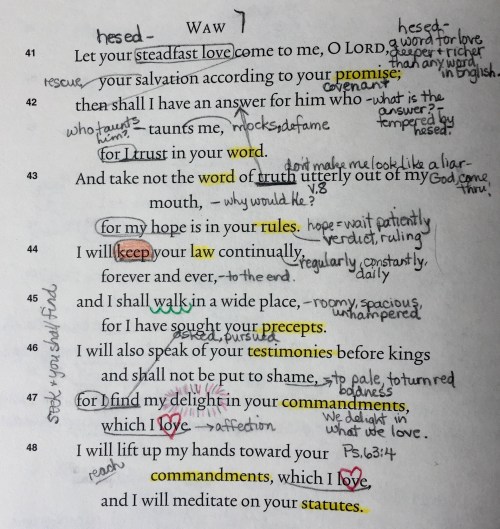
The word “steadfast” is a doozy. There is no word in the English language that can capture the depth and richness of its Hebrew meaning. But I’m going to try. The word “hesed” is translated as “steadfast love, lovingkindness, mercy, unfailing love, faithful love, loyal love; a long-suffering love that extends to the undeserving and even intervenes on their behalf”. Whew! That’s a mouthful — and a brainful. It shouldn’t surprise us that it’s hard to define God’s love. After all, it is longer, wider, deeper and higher than anything we can think or imagine.
Another way to define “hesed” is “Covenant love”. So in this verse, David was not asking for steadfast love and salvation; he was claiming it, according to the promise, or the covenant agreement made with God.

Verse 42
then shall I have an answer for him who taunts me, for I trust in your word.
King David had a group of negative critics. (We met them in verses 21-23.) It wasn’t a good idea to taunt the great Warrior-King, but some people just don’t know when to stop. Anyone in any kind of leadership position knows that there is always pressure because it’s impossible to please everybody. “It is precisely when we are squeezed by pressure that ministry grows. When there is no pressure, when our Christian service comes at no cost, it doesn’t grow.” (Christopher Ash)
We don’t know what answer David was going to dish back, but certainly it would be tempered by the “hesed” love that came to him from the Lord.

Verse 43
And take not the word of truth utterly out of my mouth, for my hope is in your rules.
David trusted in God’s words, but he didn’t completely trust his own. During a heated exchange, it’s easy to use exaggerations, accusations and speculations. What a good prayer: “Dear God, keep the truth in my mouth.” His hope wasn’t in a crushing comeback to silence his mockers. Instead, he was willing to wait patiently for God’s verdict.

Verse 44
I will keep your law continually, forever and ever,
David never threw up his hands and said, “I quit.” It seems like he never even took a day off from partnering with God. Clearly, he had some big failures, but his intention was to regularly, constantly and daily keep up his end of the deal all the way to the finish line.

Verse 45
and I shall walk in a wide place, for I have sought your precepts.
A few years ago, PB and I drove Beartooth Highway, 68 miles of curvy mountain road that winds its way through southwest Montana and northwest Wyoming. If guardrails hadn’t been on the side of those deep drop-offs, I would have crawled into the back seat and pulled a blanket over myself. I also would have missed the incredible vistas. It was a narrow road, but the guardrails made it seem safer.
We tend to think that rules constrain us and take all the fun out of life. In truth, they keep us from straying into dangerous areas and they minimize damage by keeping us in the safety zone. There is so much freedom within the secure limits of God’s good rules.

Verse 46
I will also speak of your testimonies before kings and shall not be put to shame,
As King of Israel, David must have had the occasion to show hospitality to rulers from other nations. He had status, power and wealth and realized his position could open up doors of opportunity to make much of his God. Freshly assured of God’s steadfast love and promise of salvation, David was emboldened to speak up and draw attention to Israel’s true King.

Verse 47
for I find my delight in your commandments, which I love.
Again, the love David had for God’s commandments might sound strange to our western ears. The Hebrew people were so well-known for their fervency and fondness for study of the Torah that they were called “people of the book”. The word “law” in our English Bibles would have been understood by the Hebrews as “guidance” or “teaching”. “What sounds like an onerous burden to us, sounds to them as if they are uncovering the very thoughts of God.” (Lois Tverberg)  Perhaps if we read the word “law” in the coming passages with the Hebrew connotation, we might come to love the law, too. As Spurgeon said, “We delight in what we love.”

Verse 48
I will lift up my hands toward your commandments, which I love and I will meditate on your precepts.
In another Psalm, David wrote, “Because your steadfast love is better than life, my lips will praise you. So I will bless you as long as I live; in your name I will lift up my hands.” (Psalm 63:3-4) Lifting up our hands is simply a biblical way to bless the Lord. There’s nothing radical or extreme about it. Just as children lift up their arms to loving parents to be hugged, lifting our hands is stretching ourselves toward Him. It is an act of love.
Lastly, in this section meditation is once again connected to delight. (See verses 15-16 and 23-24) The more we think about God’s words, the more delightful they become.

img_9954

Things I know for sure from this passage:

  • We have no reason to ever doubt God’s steadfast love for us. Ever.
  • When we seek God’s truth, we find not only truth, but also delight.
  • When God’s steadfast love comes to us, things happen: we keep His law, we walk in freedom, we speak of Him, we delight in Him and we lift up our hands to Him.
  • We can pray confidently for God to fulfill His promises to us.
  • “Let thy mercies come…” v. 41 in the King James Version — “mercies” are plural because we need so much and so many kinds.

For more about the Hebrew word “hesed” see:

Hesed: Love in the Long Term

Next: Vav

Long Song Study, part E

Psalm 119 (6)

It’s worth repeating:
God is not going to open our eyes
to understand a word
we have no intention of obeying.
(Christopher Ash)
So shall we get this straight right off the top?
Let’s set our hearts and minds
to work out the truths that God is working into us.
Are you with me?

Now, let’s get to work on Psalm 119:33-40!

Verse 33
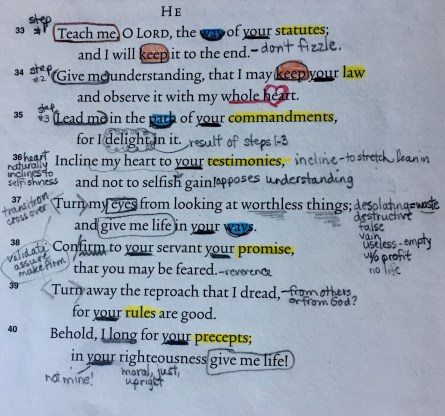
Teach me, O Lord, the way of your statutes; and I will keep it to the end.
The Lord is a teacher. He alone can instruct us. We live in a time with a plethora of good Bible teachers. Gifted communicators, scholars and commentators are only a click away. It’s easy to get dependent on them to take us by the hand and feed us. But even the best of them are like T.A.s (Teacher Assistants). We can certainly learn from good preaching and teaching, but let’s not bypass the Head Master and forfeit learning from the very Source. Ask God to teach you first, then get help from the T.A.s.

David decided how he was going to finish – not with a fizzle, but with a sizzle. He was going to stick with God until the very end, no matter what. It’s a good idea to settle that early on. The more we learn about our God, the easier it will be to finish strong.

Verse 34
Give me understanding, that I may keep your law and observe it with my whole heart.
This was step two in David’s program of discipleship. He needed a good Teacher, but he also needed the power to learn. Although David loved God’s word, he knew he needed God’s help to comprehend it. He asked God to move the law from his head to his heart.

Verse 35
Lead me in the path of your commandments, for I delight in it.
Step three was to put legs to David’s new understanding of God’s gracious teaching. A path is meant to be walked — this is the daily use of the things we learn, step by step. “Remark the order: first understanding, and then going; for a clear understanding is a great assistance towards practical action. Thou hast made me to know; now make me to go!” (Spurgeon) This process of being taught, gaining understanding and then working it into daily life is truly a delightful way to live.

Verse 36
Incline my heart to your testimonies and not to selfish gain!
David knew that “the heart is deceitful above all things…” (Jere. 17:9) Even new-found Bible knowledge and insight can lead to puffed up pride and self-absorption. It’s so important for us to lean in close to the Lord and watch out for ego-driven attention-seeking. Left unchecked, the human heart naturally inclines toward selfish ambition, so David was wise to say, “Bend me in Your direction instead.”

Verse 37
Turn my eyes from looking at worthless things; and give me life in your way.
Oh man. There’s no shortage of “worthless things” in our world. The word “worthless” encompasses these meanings: desolate, wasteful, destructive, false, vain, useless, empty and without profit. They aren’t necessarily bad things, just unworthy of our time. This verse begs the question: What am I looking at? According to my screen time report, I pick up my Iphone way too many times per hour. PB and I have watched a lot of TV in the past weeks of quarantine. Nothing wrong with that, but I can’t exactly say it’s been profitable.

Another question: What is NOT a worthless thing? The Bible tells us: Whatever is true, noble, right, pure, lovely, admirable, excellent, and praiseworthy. (Phil. 4:8) How about beauty, art, nature, people, God’s Word?

Last question: Isn’t it interesting that David didn’t pray, “Turn my mind from thinking about worthless things” or “Turn my desires from wanting worthless things”? Have you noticed how much David talks about the eyes? Go back and read verses 6, 15, 18, 37.

If the eyes do not see, perhaps the heart may not desire: at any rate, one door of temptation is closed when we do not even look at the painted bauble. Sin first entered man’s mind by the eye, and it is still a favorite gate for the incoming of Satan’s allurements; hence the need of a double watch upon that portal. (Spurgeon)

Verse 38
Confirm to your servant your promise, that you may be feared.
It’s okay to ask for reassurance and validation. David knew the promises of God, yet he needed a little boost of confidence. Perhaps he reviewed what he just wrote and was convicted by his lack of understanding, his bent toward selfishness, and his wandering eye. The promises were indeed for him, and being assured of that, David was moved to reverence for a God of such mercy and grace.

Verse 39
Turn away the reproach that I dread, for your rules are good.
Choosing God’s way doesn’t usually get a round of applause from the world. In fact, it’s more likely to bring scorn and contempt (see v. 22). David did not relish the criticism and negative press, but it didn’t make him question God’s goodness.

Verse 40
Behold, I long for your precepts; in your righteousness give me life!
David longed for God and he knew that immersing himself in the words of God would give him the intimacy with God for which he hungered. It’s one thing to long for the promises, but it takes maturity to long for the precepts. David echoed the words of Moses, “They are not idle words for you — they are your life.” (Deut. 32:47)

img_9912

Things I know for sure from this passage:

  • Focusing on worthless things will suck the life out of me.
  • I need to be careful about what enters the portal of my eyes.
  • God is pleased by a heart that is turned toward doing after the mind has turned toward knowing.
  • There’s a difference between knowing about something and understanding it.
  • I can ask the Holy Spirit to empower my good intentions.

Next: He

Long Song Study, part D

bstudy4

Today we’re going to look at Psalm 119:25-32,
which is the fourth section of this twenty-two part poem.
Yeah, we’ve got a ways to go.

Verse 25
“My soul clings to the dust; give me life according to your word!”
David was struggling. For a reason we don’t know, he felt like he was going to die. His situation was so grim, he recalled the words of God that cursed Adam, “For you are dust, and to dust you shall return.” Yet from face down in the dirt, he asked God to breath life back into him. He knew the Word could do that. (“All scripture is God-breathed…” 2 Tim. 3:16) He could have asked for comfort or deliverance from trouble, but instead he prayed, “quicken me” (KJV); “revive me” (AMP); “give me new life” (NLV).
“It is a grand thing to see a believer in the dust and yet pleading the promise.” Spurgeon

Verse 26
“When I told of my ways, you answered me; teach me your statutes!”
While he was down in the dust, David talked to God about his “ways”, or the road he was on. He didn’t go to his advisors or his best friend to rehash his troubles. He went to God. His words might have come in the form of complaint, or request, or confession. Or all three rolled into one. He got an answer and it must have been something like, “There’s something for you to learn in all this” because David responded, “Teach me!”

Verse 27
“Make me understand the way of your precepts, and I will meditate on your wondrous works.”
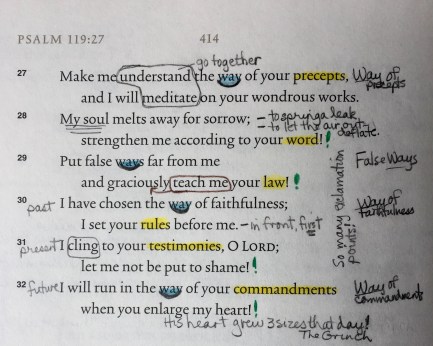
David asked for clarity to see the difference between his ways and God’s ways. There’s usually a gap there. What a great prayer – “Help me understand Your ways.”
Meditating is sometimes compared to a cow chewing its cud. These animals have four stomaches! They chew a while, swallow, regurgitate it and chew some more, repeating the process until the nutrients have gone through all four chambers. This process is called “rumination” and it’s where we get the word “ruminate” (to ponder or think about). We may need to slow down in order to have time to mull over the truths in God’s Word.

Verse 28
“My soul melts away for sorrow; strengthen me according to your word!”
Similar to verse 25, David was feeling all the feelings. The word for “melts” means “to spring a leak.” His tears were draining him of vitality, drop by drop. Like a balloon slowly leaking air, he was becoming deflated and defeated. As he wept, David asked for God to give him strength. I admire him for feeling things deeply, yet not getting stuck in the emotion. Even in desperately trying situations, he seemed to find his way to God, knowing God was the only One who could help.

Verse 29
“Put false ways far from me and graciously teach me your law!”
There was his way (v. 26) and God’s way (v. 27); and then there was a false way. Perhaps David’s sorrow was connected to some kind of deceptive outside influence. Or maybe he came face to face with his own lies. (“The heart is deceitful above all things…” Jere. 17:9) David wanted nothing to do with a fake form of religion that denied his need for grace. Some commentators believe David was confronting his own sin in this section. “Repentance happens when we see our sin without making excuses. We dare not confuse regretting with repenting. Esau regretted. Saul regretted. Ahab regretted. Judas regretted. But none of them ever repented.” (Christopher Ash)

Verse 30
“I have chosen the way of faithfulness; I set your rules before me.”
Looking back at his previous words in v. 1-24, David was reminded of his commitments. “I will keep your statutes” (v. 8); “I will fix my eyes on your ways” (v. 15); “I will not forget your word” (v. 16). And here is another “way” — a faithful way in contrast to a false way. His only hope of staying the course was to return to the promises he had made earlier in his life and to put God’s word back in front of his eyes. As long as he had life, he was determined to choose the Lord.

Verse 31
“I cling to your testimonies, O Lord; let me not be put to shame!”
This statement is the pivot point in this passage. David let go of the dust of death he had been clinging to and reached out for the Lord of life. He broke through the sadness and misery by releasing it in the presence of the Lord and then clinging to the truth of God’s word. It’s a great exchange!

Verse 32
“I will run in the way of your commandments when you enlarge my heart!”
No longer face down in the dirt, David vowed to get up and run in the freedom of forgiveness. For the fifth time in eight verses, “the way” was his focus. He finally found the one that gave him room to run and space to grow in love.
David began this section by asking God to revive him according to the word. That renewal happened as he confessed, repented and turned toward God. His heart grew three sizes that day.

img_9890img_9891

Things I know for sure from this passage:

  • On days when I feel down in the dumps, I need to speak to God first about it.
  • When my spirit feels weak, strength is available in God’s Word.
  • I need to pay attention to what I am clinging to for security and significance.
  • Every day I have to choose which way I will go: faithfulness or falseness.
  • Running in freedom is better than lying in dust.

Next: Daleth

Long Song Study, part C

bstudy1

Today we’re going to look at Psalm 119:17-24.
Open your Bible and let’s pray:
“Open my eyes, that I may behold wondrous things out of your law.”

Verse 17
“Deal bountifully with your servant, that I may live and keep your word.” 

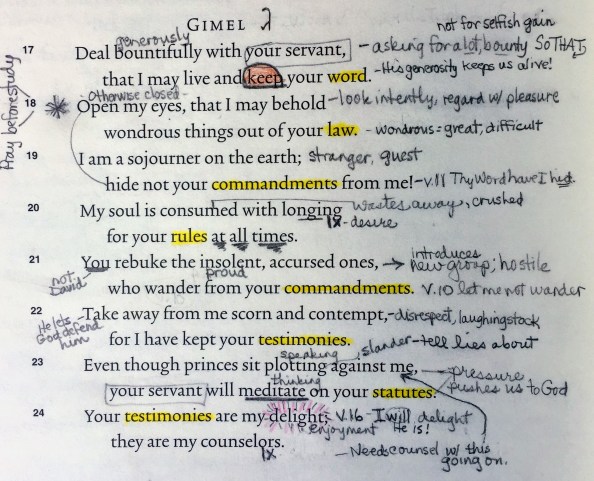
The psalmist begins this section by asking for a generous outpouring of blessing from God. Sometimes we forget that we are invited to “approach the throne of grace with boldness” (Heb. 4:13). But there’s more to it than marching up to God and demanding what we want. David asked with humility. He acknowledged that he was the servant, so he made his request with respect and reverence. Also, he wasn’t after a blessing so he could kick back and relax by the pool. He asked for God’s bounty so that he could live a long life of obedience that glorified the Lord.

Verse 18
“Open my eyes, that I may behold wondrous things out of your law.” 

This is a verse that should be on our lips whenever we open the Bible to study. Here is the result of God’s bounty — eyes to see wonders in the Word. The word “wondrous” means “great” or “difficult”. Raise your hand if you think there are some difficult passages in the Bible. (*Raising my hand high.) “The reason we do not understand the Bible is not primarily that we lack the necessary intelligence. The reason is that we are sinners, and we need God to open our eyes.” (Christopher Ash) Instead of saying, “Why didn’t God make things clearer in the Bible?” we should pray, “Open my eyes so I can see it clearly.” There are wonders in there and the Holy Spirit will illuminate them if we ask. 

Isn’t it interesting that David thought of the law as “wondrous”? The only scripture he had was the Torah — the first five books of the Bible. We’re talking Leviticus, Numbers and Deuteronomy here, folks. Genesis and Exodus have some exciting accounts, but still — what if that was the only Bible you had? Imagine a Bible without “Trust in the Lord with all your heart…” (Prov. 3:5), or “His mercies are new every morning…” (Lam.3:23), or “soar on wings like eagles…” (Isa. 40:31). The Psalms hadn’t been completed or compiled yet and the New Testament was centuries away from being written. “David felt sure that there were glorious things in the law; he had not half the Bible we do, but he prized it more than some men prize the whole.” (Spurgeon)

Verse 19
“I am a sojourner on the earth; hide not your commandments from me!”
Do you ever feel like you don’t fit in? Good! Earth is our temporary home — we’re not supposed to act like this is all there is. Even David, with his palaces and power and prosperity knew he was just passing through, which was another reason to store up eternal truth.

Verse 20
“My soul is consumed with longing for your rules at all times.”

Is your soul ever consumed with longing? Do you ever feel like you’re wasting away with desire? For rules? At all times? David certainly had an emotional connection with God’s Word. We (okay, I) tend to approach the Bible studiously by looking up definitions, original language and commentaries. If I’m not careful, I can easily slide into an academic exercise that results in head knowledge. After spending time in study, it’s important for me to look over what I’ve learned and pray it back to God. As I put the facts into my own words and talk them over with God, they make their way into my heart.

Verse 21
“You rebuke the insolent, accursed ones, who wander from your commandments.”
So far, this psalm has had two leading characters: the psalmist and God. Now we’re introduced to another group: adversaries who disregarded God and made David’s life miserable. This crowd defied God’s commands and they were proud of it. Instead of entering into a debate or calling them out publicly, David left the rebuking to God. He understood that his antagonists wandered far from God’s truth, so he didn’t expect them to act like believers.

Verse 22
“Take away from me scorn and contempt, for I have kept your testimonies.”

Things were bad enough that David asked for relief from the public rancor directed at him. Even three thousand years ago, people in positions of leadership had to deal with disrespect and derision. Again, David didn’t go on the offensive and shoot back a vitriol response to his opponents. He went to the Lord with his complaint: “Here I am, doing my best to obey your laws and still, I’m being attacked. What is up? It’s not fair!” (To which I say, “The fair comes to town once a year and the rest of the year it’s just not fair.”)

Verse 23
“Even though princes sit plotting against me, your servant will meditate on your statutes.”

Other prominent leaders were dragging David’s name through the mud with lies and false accusations. How did David respond? By keeping his mouth shut and keeping his mind on God’s truth. The pressure he felt on the outside made him press in closer to God, even though his request did not get him an immediate answer.

“The best way to deal with slander is to pray about it: God will either remove it or remove the sting from it. When we suffer from a libel it is better to pray about it than go to law over it, or even to demand an apology from the inventor. O ye who are reproached, take your matters before the highest court, and leave them with the Judge of all the earth.” (Spurgeon)

Verse 24
“Your testimonies are my delight; they are my counselors.”

In the midst of that kind of turmoil, David still found pleasure in the Torah. He promised to delight in the Lord’s statutes back in verse 16, and now he’s making good on that promise. The words of God helped him emotionally (my delight) and practically (my counselors).

img_9845

Things I know for sure from this passage:

  • There is no end to the wondrous treasure that is in the Bible. When we think we know all there is to know about a passage, there’s still more to uncover.
  • We don’t need God to give us more benefits as much as we need eyes to see what He has already given.
  • Going through times of trouble can serve to draw us closer to the Lord.
  • Instead of rescuing us from all our troubles, God often gives us a new perspective.
  • This world is not my home, I’m just a passin’ through.

Next: Gimel