Mem

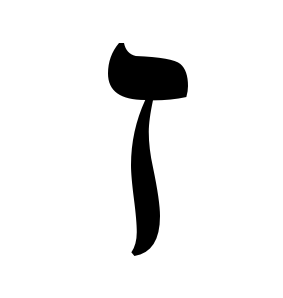
Mem is the thirteenth letter in the Hebrew alphabet. Mem has the same sound as “m” as in “mom”. Every line in Psalm 119:97-104 starts with this letter. Mem looks like this:

mem

As you can see, there are two forms of this letter. The open one on the right is used at the beginning or middle of a word. The closed one on the left is only used at the end of a word.

This letter is closely connected to water.
The Hebrew word for water looks like this:

water

See the open “Mem” followed by a “Yod” and finally the closed “Mem”? (Hebrew reads from right to left!) Some rabbis teach that the “Yod” in the middle is a drop of water within the word “water”.

Water is the most basic and important element in life. Sixty percent of our bodies are made up of water. The earth is 71% water. Without water, we can’t live more than three days. There is a Jewish saying, “There is no water but Torah.” Rabbis teach that the Torah is the most basic and important element in one’s spiritual life. Without the Torah, the Jew is like a fish without water — he couldn’t live.

Since “Mem” is the letter of water, it symbolizes the “spring” of wisdom found in the scriptures. Like an underground spring rises up from an unseen source, so does the spring of wisdom rise up from the mysterious Source that is God. http://www.hebrew4christians.com

Maybe that’s why David wrote about wisdom, understanding and insight in the “Mem” section of Psalm 119.

It’s easy to find Jesus in the 13th letter.
The Messiah is our Living Water.
He is the only one who truly satisfies our inner thirst for real life.
He is the most basic and vital of all elements in this world.
He is the Living Word and we cannot survive without Him.

spring

As the second half of the Hebrew alphabet reveals the life of faith in response to the good news of the gospel, so the letter “Mem” reflects the believer’s baptism. First we are taught (Lamed) and then we take a step of obedience by going into the waters (Mem) of baptism.

“Let anyone who is thirsty come to me and drink.
Whoever believes in me, as Scripture has said,
rivers of living water will flow from within them.”
John 7:37-38

mem2

Next: My favorite word in the Bible that starts with “N”.

Lamed

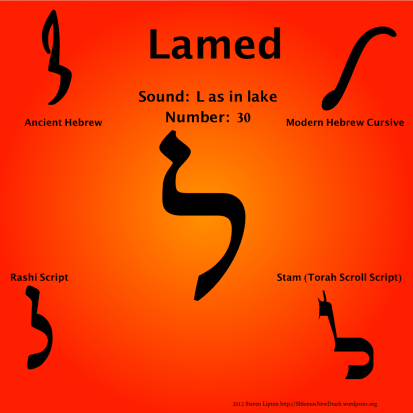
Lamed (also written as Lamedh) is the twelfth letter in the Hebrew alphabet. Lamed has the same sound as “l” as in “lake”. Every line in Psalm 119:89-96 starts with this letter. Lamed looks like this:

lamed“Lamed” is unique in the Hebrew alphabet because it is the tallest letter.
hebrew

Also, it is considered the central letter, or “heart” of the Hebrew alphabet.
By the way, the Hebrew word for “heart” starts with the letter “lamed”.

Heart = לֵב (lev)


The word “lamed” means to learn or to teach and it is first seen in the Bible in Deuteronomy 4:1, “Now, Israel, hear the decrees and laws I am about to teach you.” Learning has always been viewed as sacred to the Jewish people. It was a high calling for a man to become a Rabbi because it meant devoting his whole life to learning the Torah and teaching it to others. Every student’s goal was to move from knowledge to understanding to wisdom. Knowledge alone came up short without moving from the head to the heart. The wisest Rabbis were seen as head and shoulders above everyone else, just like the “lamed” rises above the other Hebrew letters.

In the Jewish tradition, learning wasn’t an end in itself, but found its purpose in action. The accumulation of knowledge was only of value if it spurred one to do something. James, Jesus’ brother, wrote about this idea in his letter.

“But be ye doers of the word,
and not hearers only,
deceiving your own selves.”

(James 1:22)

A true disciple, then, is both a learner and a doer,
one who “learns” in order to “do.”
Sometimes we need a little prodding to “learn” and “do”.
The “lamed” is shaped like a cattle prod,
which farmers used to direct their animals.
A little poke, a kick in the behind, or a spur in the side
motivates us to keep moving along.

Even though Jesus was a Teacher while He lived on earth, He also was a learner. “Son though he was, he learned obedience from what he suffered.” Heb. 5:8

Israel = יִשְׂרָאֵל (yisrael)

The name Israel starts with the smallest letter, “yod”, and ends with the biggest letter, “lamed”. Some scholars interpret this to mean that the nation of Israel may have started out small, but in the Last Days it will be higher than all the other nations, teaching them the truth about God and Jesus, the Messiah.

The first eleven letters of the Hebrew alphabet revealed the gospel. The second set of eleven letters will reflect the response of a believer and the walk of faith. It all starts with learning, being teachable, and recognizing the prodding of the Holy Spirit.

303310e4ae384c8430fc42ba5a7de858

Next: My favorite word in the Bible that starts with “M”.


Kaph

Kaph (also written as Kaf or Khaf or Chaf) is the eleventh letter in the Hebrew alphabet. Kaph has the same sound as “k” as in “kite”. Every line in Psalm 119:81-88 starts with this letter. Kaph looks like this:

kaph2

The word “Kaph” means “the palm of a hand” and is shaped like a hand curving around a cup to hold it. In the Old Testament, fathers would place their hands on their children’s heads when pronouncing a blessing. In the New Testament, Jesus often laid His hands on people who needed healing.

handbless1

Orthodox Jewish men wear a “kippah”, or a skull cap, that represents the palms of God’s hands (Kaph) resting on the head, as a protective covering for the mind, body and spirit.

“Kaph” is closely associated with the idea of “covering” as described in Exodus 33. When Moses said to God, “Show me your glory,” the Lord replied, “I will put you in a cleft in the rock and cover you with my hand (Kaph) until I have passed by.” (Ex. 33:22)

The word “cover” is the same word for “atonement”.
Can you see where this is going?
Jesus,
who is at the right hand of God,
provided covering
for our sins
through His blood.

God made clothes with His hands
out of animal skins for Adam and Eve.
He’s been covering for us ever since.

hands2

Hear Jesus’ last words on the cross:
“Father, into your hands I commit my spirit.” Luke 23:46

See Jesus’ hands, which bore the mark of sacrifice — and still do.
“Look at my hands and my feet. It is I myself!” Luke 24:39

Watch Jesus’ final act before ascending:
“When he had led them out to the vicinity of Bethany,
he lifted up his hands and blessed them.” Luke 24:50

We are safe in His hands.
“See, I have engraved you on the palms of my hands.” Is. 49:16

Next: My favorite word in the Bible that starts with “L”.


Yodh

Yodh (also written as Yod) is the tenth letter in the Hebrew alphabet. Yodh has the same sound as “y” as in “yes”. Every line in Psalm 119:73-80 starts with this letter. Yodh looks like this:

yodh

The Yodh is the smallest letter in the Hebrew alphabet.
It’s the one that looks kind of like an apostrophe.
hebrew
Yodh may be small, but it is the most used letter in Hebrew writings.
Every letter has a Yodh in it, making it the basis of the entire language.

Because the Yodh is used to form all the other letters, it represents God’s omnipresence. Rabbis took it even farther and said the Yodh was the single point from which all creation emerged. Yet because it is the smallest letter, it shows how God delights in using the weak and insignificant to demonstrate His power and glory.

Yodh is the first letter in the divine name of God — Yahweh
Yodh is the first letter in the Savior’s name — Yeshua (Jesus)
Yodh is the first letter in the name of the chosen people — Yisrael (Israel)

Take another look at the Yodh.
That pen stroke that curves down on the right is called a “jot”.
That tiny swoop up on the left side is called a “tittle”.
These are the smallest of markings and the reason why scribes bent over their parchments with their faces so close to their careful copy work. If one jot or tittle was missing, the whole scroll had to be buried and they had to start over.

That would be like throwing out a whole book
because one “i” didn’t have its dot
or one “t” wasn’t crossed.

Jesus talked about the Yodh.
In Matthew 5:18 Jesus said,
“Till heaven and earth pass,
one jot or one tittle
shall in no wise pass from the law, till all be fulfilled”.

In other words, every period and every comma in God’s Word has purpose and meaning. It’s all true and trustworthy, right down to the apostrophes. It contains no errors and it is guaranteed to come to pass just exactly as it is written. There is no changing it and no stopping its fulfillment. God is reliable, and so is His Word—every jot and tittle of it.

God’s meticulous and precise attention to detail is breathtaking. We see it in nature, in our physical bodies, and in His Word. The Yodh reminds us that He cares about the details of our lives, too. Even — especially — small, weak, insignificant people like you and me.

Next: My favorite word in the Bible that starts with “J”.


Teth

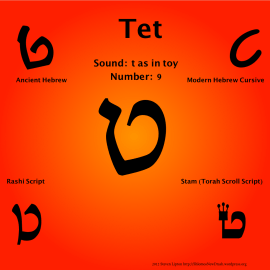
Teth (also written as Tet) is the ninth letter in the Hebrew alphabet. Teth has the same sound as “t” as in “trouble”, but it means “good, better, or best”. Every line in Psalm 119:65-72 starts with this letter. Teth looks like this:

teth

 There are two very different ways to interpret this letter.

First, it is a picture of an open container in which something good is hidden. The first use of the letter Teth is in Genesis 1:4, “God saw that the light was good (tov).” The world was birthed day by day and each new creation was declared to be good. Truly, God’s goodness is all around us, hidden in creation.

Some Rabbis teach that the letter represents the womb, where for nine months, something good is hidden. Therefore, as the ninth letter in the Aleph-Bet, it is connected with spiritual birth or renewal. In the New Testament, there are nine fruits of the Holy Spirit that are planted into the soil of all believers’ hearts. That seed is hidden until it produces fruit and grows as we continue to mature in Him. The Christian life is “pregnant” with God’s goodness.

The letter Teth also looks like someone bowing in prayer, opening their heart to God’s hidden treasures of the Holy Spirit and the Word. The left side of Teth is a Zayin, the seventh letter, that shows Jesus as the crowned man. Believers are portrayed on the right side, bowing before the Victorious Savior.

The second interpretation, in drastic contrast to the first, sees the letter Teth as the serpent, coiling into earth and injecting evil into the world. This strange duality in one letter makes a profound point.

“Will we choose to surrender our lives, offering ourselves as living sacrifices or will we inwardly rebel and live in selfish pride that marks the devil? (hebrew4christians.com)

“There is a famous optical illusion (shown below) which depicts both a beautiful young woman and an old woman with a wart on her nose. Some suggest that whichever image you first see indicates something about how you think and perceive the world. But, whether or not this is true of this image, it is a good illustration of the Teth. Like the image of the two women, Teth is the letter with two messages – two Judgments. And what you spiritually see in Teth is determined by your own personal experience and choice regarding Yahweh.

illusion

For those who choose Yahweh and abide in Him, the Fruits of the Holy Spirit are given – that is the JUDGMENT that we receive! Beautiful thought!

God is the Judge, but I decide what my judgment will be. He sets before me the choice – ‘I set before you this day blessing and cursing, life and death. Therefore choose life.’ (Deut. 30:19) The Teth shows the two-fold nature of Yahweh’s Judgment.” (www.lightedway.org)

What do you see when you look at Teth?

Open my eyes, that I may see Your goodness.

tet

Next: My favorite word in the Bible that starts with “I”.

Heth

Heth (also written as Chet, Khet and Het) is the eighth letter in the Hebrew alphabet. Heth has the same sound as “kh” as in “Bach”. It makes a gutteral sound, similar to clearing the throat. Every line in Psalm 119:57-64 starts with this letter. Heth looks like this:

heth

The first seven letters of the Hebrew alphabet introduce the story of the Gospel: The God-Man (Aleph — Jesus) came to earth to be master of the house (Bet) and to give the good gift of redemption (Gimel) to the poor and weak (Dalet). The Holy Spirit breath of life (He) came and connected God and man at the cross (Vav). Jesus overcame death and ascended to His throne where He rules and reigns (Zayin). Whew!

Heth begins a new series of seven letters which explains the walk of faith. How appropriate that the word “Heth” means “new beginnings” and “life”.

In the broadway musical “Fiddler on the Roof”, there is a celebration scene where all the men toast the engagement of Tevye’s daughter to Lazar Wolf. They sing,

“To life, to life, l’chaim!
L’chaim, l’chaim, to life!”

Chaim means life.
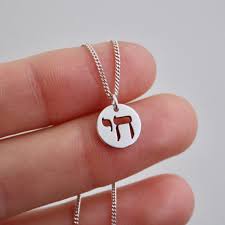
The word “chai” is a Hebrew symbol, often worn in jewelry.
It signifies new life — or resurrection life, for believers in Yeshua.

chai

“…they (wisdom and discernment) will be life for you,
an ornament to grace your neck.”
Proverbs 3:22

The shape of the letter Heth represents the doorposts and lintel that the Hebrews covered with the blood of a lamb at Passover (Exodus 12:7). Because of that act of obedience, the people were delivered from slavery in Egypt. The chains of bondage were broken and they entered into a new life of freedom.

Rabbis also teach that the Heth is a combination of Vav (representing man, who was created on the 6th day) and Zayin (the crowned Jesus, our King of Kings). The two letters are connected by a “yoke” across the top, picturing our relationship to the Lord as He leads and teaches us on our walk of faith. Jesus said, “Take my yoke upon you and learn from me.” (Matt. 11:29) Heth!!

Because Heth is the eighth letter, there are several biblical connections:

  • Hebrew boys were circumcised on the eighth day, starting their newborn lives under the Covenant promises of God.
  • New life on earth began after the flood with Noah, his wife, his three sons, and their wives — eight people.
  • God reaffirmed His covenant with Abraham eight times.
  • The Jewish “Feast of Tabernacles” was eight days long. In John 8:12, Jesus stood up on the eighth day and said, “If anyone is thirsty, let them come to me and drink. Whoever believes in me, as the Scripture has said, streams of living water will flow from within him.”
  • Abraham and Sarah named their baby boy Isaac, which means “laughter”. Isaac’s name is written with three Hebrew letters: Tsadhe (18th letter), Heth, and Qoph (19th letter). Tsadhe has a numeric value of 90 — the age of Sarah when Isaac was born; Qoph has a numeric value of 100 — the age of Abraham. God kept His promise that “between” the two of them would come forth a new life. That just makes me shake my head in awe and chuckle!

Which verses in the “Heth” section of Psalm 119 speak to you about ways you need to stay yoked to Jesus in your walk of faith?

het

Next: My favorite word in the Bible that starts with H.

Zayin

Don’t get excited when you see the “Z” at the beginning of this letter.
We’re not even near the end of the Hebrew alphabet, my friends.
The journey from Aleph to Tav is rich with reward for those who endure!

Zayin is the seventh letter in the Hebrew alphabet. Zayin has the same sound as “z” as in “zoo”. Every line in Psalm 119:49-56 starts with this letter. Zayin looks like this:

zayin2

Seven is an important number in the Jewish tradition, indicating perfection and completeness. The word “seven” appears over 500 times in the Bible, beginning with Genesis 2:2-3, “And on the seventh day God finished his work that he had done, and he rested on the seventh day from all his work that he had done. So God blessed the seventh day and made it holy, because on it God rested from all his work that he had done in creation.” Thus began cycles of seven that have been repeated ever since.

In the words of Jewish sages,
“All sevens are dear.”

It is no coincidence, then, that there is a seven tone scale — do, re, mi, fa, so, la, ti. There are seven colors in the rainbow and there are seven openings in our heads.

Oy veh.
I could go on and on, but that’s a blog post for another day.
Suffice it to say:
because Zayin is the seventh letter, it holds great significance.
For believers in Messiah Jesus, this significance is amplified.

Last week, we learned about the sixth letter “Vav”, which is connected to mankind because Adam was created on the sixth day. Zayin looks a lot like Vav, except it has a crown on its head, so this letter is a picture of a man with a crown. That’s our Jesus.

Zayin is also regarded as an image of a sword with the tip pointed down and the hilt on top. The sword also represents Jesus, our Overcomer, defeating death and sin. Now we have access to the “sword of the Spirit, which is the word of God.” (Eph. 6:17)

The Victor ascends and the sword turns into a royal scepter — “But of the Son he says, ‘Your throne, O God, is forever and ever, the scepter of uprightness is the scepter of your kingdom.'” (Heb. 1:8) King Jesus holds out His scepter to welcome us to the throne. “Let us then approach the throne of grace with confidence.” (Heb. 4:16)

The Hebrew word “remember” starts with the letter Zayin,
which is a theme in Psalm 119:49-56.

I need to remember
there is a crown,
and He’s wearing it.
There is a throne,
and He’s on it.
There is a sword,
and it’s sitting on my desk.

zayin

Next: My favorite word in the Bible that starts with “G”.

Vav

Wow! We’re on the sixth letter already — WAW!

Vav (also written as Waw) is the sixth letter in the Hebrew alphabet. Vav has the same sound as “v” as in “vine”. Every line in Psalm 119:41-48 starts with this letter. Vav looks like this:

vav

The meaning of the word “vav” is “hook”.
Can you see it?

The word “vav” is found only in Exodus, in reference to the tabernacle, where the curtains were to be hung from “silver hooks“. (Ex. 27:10, 11, 17) The tabernacle was the place where God lived while the Israelites traveled in the wilderness. Rabbis teach that in the same way, God now resides in the Torah. So scribes developed a system that made the sacred documents a reflection of the tabernacle by calling each page a “curtain” and at the top of each page is the letter “vav”, hooking the words to the parchment. (Side note: Every time a scribe copied the name of God onto a new scroll, he had to say a blessing and dip his pen in fresh ink.)

Just as a hook was used to connect the curtains in the tabernacle, the “vav” was seen as a connecting letter. When placed at the beginning of a word, the letter is read as “and”, such as “heaven and earth”. So within a sentence, “and” is the hook that connects two words. In the Hebrew text, every line of Psalm 119:41-48 starts with “vav”, or “and”, making it one long run-on sentence!

Because “vav” is the sixth letter in the Aleph-Bet, it is associated with the sixth day of creation, the day man was created. But because of sin (Jews believe the Fall happened on a Friday), the “vav”, or connection, between God and people was broken.

“So God in His goodness sent Jesus as the second Adam to reverse the curse in order to restore the connection between heaven and earth. Jesus died on the sixth day, a Friday, to make atonement for the sin of the first man and woman so the blessings we lost in Eden could be restored.” (Rabbi Jason Sibol)

Rabbi Sibol also points out that Jesus’ first miracle of turning water into wine mentions six stone jars. (John 2:6) That’s a detail that is easy to miss and we might think it’s unimportant. But there are no wasted words in the Bible. Six stone pots were filled to the brim to show that “Jesus came to restore the Lord’s original blessing for creation” — one for each day.

There’s one more thing you need to know about this letter.
The letter “vav” is not only seen as a hook, but also as a nail.
Can you see it?

The Messiah
was nailed to a cross to
reconnect
us
with
God.

“For there is one mediator
between God and human beings,
the man Jesus Christ.”

(1 Tim. 2:5) 

vav1

Next: My favorite word in the Bible that starts with “F”.

He

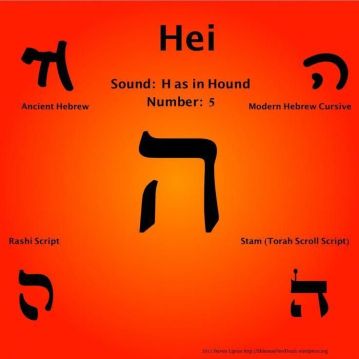
He (also written as Hey, Heh, or Hei)  is the fifth letter in the Hebrew alphabet. “He” sounds like “hay” and the letter has the same “h” sound as in “heaven”. Every line in Psalm 119:33-40 starts with this letter. He looks like this:

Hey

This one is a gem.

You know how it is on a cold day when you exhale and see your breath?
The letter “He” is considered the Divine Breath, the exhale of the Spirit.
“By the word of the Lord were the heavens made,
their starry host by the breath of his mouth.”
Psalm 33:6
God breathed out stars!

A few days later, God sculpted a mud-man and “breathed into his nostrils the breath of life.” (Gen. 2:7) It’s His breath (His “He”) in our lungs and it’s His Spirit (His “He”) in our souls that makes us living beings.

The letter “He” looks a lot like Dalet, but with something added. Jewish Rabbis taught that the arm from Aleph came over to be a part of Dalet, forming a new letter. Since Aleph represents God and Dalet represents broken humanity, what we end up with is a picture of God coming to live in the human heart, by means of the Spirit. “He” is an image of Dalet opening the door of the heart so the Spirit of God can indwell the believer.

There’s more!

Another definition of “He” is “Behold!” It sounds like an overwhelmed sigh, as if suddenly coming upon a panoramic view of a majestic sight. The God-Man (Aleph — Jesus) came to earth to be master of the house (Bet) and to give the good gift of redemption (Gimel) to the poor and weak (Dalet). Behold! (He) John the Baptist chose his words carefully: “Behold! The Lamb of God who takes away the sin of the world!” What an overwhelming, majestic sight! (Did you notice Psalm 119:40? “Behold!”)

Wait! There’s more!

God used the letter “He” to change people. Remember what happened to Abram? God renamed him Abraham — God breathed His life-giving Spirit into Abe and changed his name to show it. Sarai became Sarah, because adding the letter “He” at the end of a noun “feminized” it, allowing it to be “fruitful”. God’s announcement to Abraham that Sarai was being changed to Sarah was like a proclamation that she was no longer barren. In fact, it was believed that women needed the “H” sound in their names if they were going to be able to bear children, which gave Hagar a distinct advantage over Sarai. (Rachel didn’t have the letter “He” in her name, but Leah, Bilhah and Zilpah did.)

There’s still more!

According to Jewish tradition, the name of God is so holy it should never be written. Hebrew documents today still refer to God as “G-d”. The name of God as revealed in Genesis 1:1 is considered to be so sacred that it is never to be spoken aloud. This hallowed word is made up of four Hebrew letters: Yod, He, Vav, He.

Stay with me now. This is going to be good.

When Jesus was crucified, Pilate had a sign made that said, “Jesus of Nazareth, King of the Jews.” In Aramaic, (a form of Hebrew) that phrase consisted of four words. The first word started with the letter Yod, the second word started with He, the third word started with Vav and the fourth word started with He. Can you picture that? Pilate had a sign nailed to the cross that declared Jesus was the one true G-d. Yod, He, Vav, He.

No wonder the chief priests of the Jews protested to Pilate, “Do not write ‘The King of the Jews.'” In other words, “You cannot write the sacred, unutterable name of G-d and attach it to this man for the world to see.” But God’s will was for the world to see and to know that Jesus was and is the King of Kings. And He used an unbelieving Roman governor to carry out His will. The purposes of God cannot be thwarted.

Hallelujah! (That starts with “He”, too!)

Hei

Next: My favorite word in the Bible that starts with “E”.

If you need to review:
Aleph
Bet
Gimel
Dalet

Dalet

Dalet (also written as Daleth or Daled) is the fourth letter in the Hebrew alphabet. It sounds like our letter “D” as in “Dad”. Every line in Psalm 119:25-32 starts with this letter. Dalet looks like this:

Vector illustration of the Hebrew Letter Daleth

Remember from last week how Gimel meant “giver” and how that letter was a picture of a person with his foot stretched out in motion, running toward Dalet to give it gifts? The reason why Gimel was running toward Dalet is because “Dal” means poor, weak, or needy.” The God-Man (Aleph — Jesus) came to earth to be master of the house (Bet) and to give the good gift of redemption (Gimel) to the poor and weak (Dalet).

The word “Dalet” means “door” or “gate”. A door is a barrier that must be opened in order to go through to another place. It separates two spaces and has a threshold which must be crossed.

Jesus said:

I am the door. If anyone enters by me, he will be saved and will go in and out and find pasture. John 10:9

Jesus Christ is our means of crossing over from death to life, from darkness to light. But we must go through Him (I am the way… John 14:6). The Messiah is our Dalet, our portal to fellowship with God and eternal life. When a person believes in Jesus and accepts the gift of redemption, it’s like stepping over a threshold into a new life. (“He has crossed over from death to life.” John 5:24)

In Jewish tradition, the fourth letter of the aleph-bet is connected to the fourth day of creation. On day four, God separated the day from night by setting the sun, moon, and stars in the sky. They were to “serve as signs” (Gen. 1:14).

Every sunrise opens the door to a new day.
Each morning sun is a sign to us that Jesus is our source of Light.
“I am the light of the world.” John 8:12.

Every night the moon reflects the sunlight.
Each nighttime sky is a sign to us that darkness can’t prevail.
“The light shines in the darkness,
but the darkness has not overcome it.”
John 1:5

The Dalet-Door is open.
God is turning hearts toward His Son.
Could a global pandemic stir up a resurgence
of spiritual awakening and revival on the earth?
“Revive me according to your word.” Psalm 119:25

dalet

Next: My favorite word in the Bible that starts with “D”.