I like to read books about writing. And I’ve read a whole slew of them. I’ve noticed that they are beginning to sound the same, so I guess there’s only so much that can be said about the craft of writing. You just have to sit down and do it.
One author proposed that success as a writer was guaranteed if this bit of advice was followed:
Write 1000 words a day, five days a week, for the rest of your life.
This writing expert said it was the magic formula to honing the skills needed to be a real author. It didn’t matter what you wrote, or when you wrote, or how you wrote. Just punch out 1000 words every day.
I took the bait.
The first morning, I printed out a sheet with the expert’s lofty goal that would become my sure-fire path to success. I started typing. After a few hundred words, I began to panic. I didn’t have anything else to say. I typed out my grocery list, the weather report, and what I planned to eat for breakfast. I included the date (spelling out the numbers) and even typed “Word Count” for two more words. It was clear that I wasn’t going to be able to write 1000 words every day for the rest of my life.
So I knocked it down to 500 words, five days a week, for the rest of my life.
The second day, I got a late start and needed to get to an appointment, so I skipped my writing time. I decided to cut the “five days a week” down to a more manageable three days a week, for the rest of my life.
By the third day, I was a little ticked at the expert for bossing me around and telling me how to run my life, so I put my foot down and made my own rules.
Instead of setting unrealistic goals, I’ve decided to adopt King Solomon’s wise counsel:
“The Teacher searched to find just the right words, and what he wrote was upright and true.” Ecclesiastes 12:10
I am still a fledgling, unpublished, obscure writer, searching for the right words. But if I can find a few upright and true words along the way, I’ll be satisfied.
By the way, there are three hundred and ninety eight words in this blog post. Word Count. 400!
Sometimes I’m wrong for a long time. Like forty years.
That’s a long stretch to be off target.
Hoo-boy, was I ever relieved to see my error and fix my faulty thinking.
Being corrected is like leaving the chiropractor after being adjusted. Freedom in movement once again! Achy joints are released! Foggy brain is clearer! Spine is straighter!
Sometimes God has to put me on the table and give me a good adjustment. That happened recently as I read Hosea 10:12.
“Break up your fallow ground, for it is time to seek the Lord, until He comes and showers His righteousness on you.”
All this time I’ve misunderstood the words “fallow ground”.
I used to think fallow ground looked like this:
I mistakenly assumed this barren landscape represented my hard, dried up heart. I understood the command to break up the fallow ground as a call to repentance. I was supposed to invite the sharp blades of God’s plow to cut through the crusty surface. The sin I was harboring down deep needed to be rooted out.
It sounded painful.
Now I know better. This is actually what fallow ground looks like:
As it turns out, fallow ground is land that is plowed, but intentionally left alone for a period of time in order to restore its fertility and future fruitful production. It’s a season of rest in order to be revived.
You’d think a farmer’s daughter would have known this.
I’ve never been so happy to find out I was wrong.
My heart, I feared, was parched and spent. New life, it seemed, could not be found, Until, one day, I learned it meant, These dormant times are fallow ground.
A while ago, I had Mary and Martha write letters to each other. Putting myself in their shoes helped me see things with fresh insight.
Several years ago, I wrote a missive to Amos, the Old Testament prophet.
Dear old Amos was tending his sheep and trimming his sycamore trees one day when God called him to deliver some scathing words of judgment to the nations.
I grew up around lots of good farm folks, so in my imagination I see Amos as an older man in bib overalls. He doesn’t have a seminary degree, but he’s a faithful member of the church in town. Amos is a salt-of-the-earth citizen who loves God, his neighbors and the land. He obeys God’s call and goes out to announce judgment on Israel’s elites. He has to say some tough things to people who don’t appreciate it. They refuse to heed his warnings, but Amos the farmer warns them anyway.
After reading his book, I wrote him a letter.
Dear Amos,
Were you anxious to get back to the farm after all that prophesying? You delivered so many words full of condemnation and lament and warning. Did it take a toll on you? After all, shepherds are used to long and lonely days of quiet out on the range with no one to talk to but sheep. Was it a hard task, to be obedient to the call of God to speak His words to rebellious nations? But you did it, without arguing or procrastinating. You just did it. I bet you were oh-so glad to complete the task and get back to the farm.
I have marked many favorite lines from your book. I especially like that you ended with some hopeful words, much needed after the litany of doom and gloom. I’m sure it was a relief for you to sign off on a good note, using words like “raise up”, “repair”, and “restore”.
I guess it’s goodbye for now, Amos. I probably won’t be back for a while. You are an Old Testament minor prophet, and you know what that means — not the most popular of devotional readings. Thank you, dear sir, for being faithful to the Lord and obedient to His call. I admire you for standing up in a God-less culture and not backing off when they tried to shut you down. You spoke in your own gritty way on the Lord’s behalf. You said what had to be said, plain and simple, with no apology.
I hope you were able to return to your farm in peace. Blessings to you, brave trimmer of trees and courageous keeper of sheep.
PB asked this question every Sunday morning, and people usually responded with various prayer requests.
“Pray for my grandma who is having surgery this week.”
“Pray for the safety of those traveling during the holidays.”
“Pray for my co-worker who got bad news.”
One Sunday was different, though.
A member raised his hand and said, “My car got a big scratch along the side of it last week while in the church parking lot and it must have been someone here. I think whoever did that should come forward and fix it.”
After that, we called this special time during our worship service “Joys, Concerns and Accusations.”
I’ve been thinking about that word — joy. Following my Bible Reading Plan, I’m spending the next several weeks looking at scriptures that contain the word joy. I’m only two weeks in, but already I’ve noticed something surprising.
So far, the verses on joy also include words like these: pain, tears, grief, anguish, weeping, mourning.
Joy and sorrow seem to go hand in hand.
We will come rejoicing, bringing in the abundant harvest of sheaves only after we have sown seeds of tears. (Psalm 126:6)
We will experience seasons of painful labor and anguish, but eventually it will give way to the joyful birth of something new. (John 16:21)
Our tears of sorrow are not ignored or overlooked or wasted. They are seeds that sink into dark places but, in time, they will produce a harvest of joy.
I woke up this morning. My heart was beating. My blood was flowing. I was alive!
After being dead to the world in deep sleep for hours, my eyes opened and I arose from my bed.
This waking and rising that happens every 24 hours —
— it is resurrection practice!
— it is a daily reminder that He rose from deep death!
— it is a built-in rehearsal for the raising of our bodies that is to come!
— it is a re-enacting of the greatest victory ever won!
— it is an innate, indwelling circadian rhythm that stirs us to wake up!
— it is an opportunity to receive the breath of life for another day!
— it is an invitation to leave the darkness and walk in the light!
Lord, may we be awakened to the wonder of Resurrection and Life. Every day. May we rise up and revel in our own mini-resurrections. Every morning.
“Wake up, O sleeper, rise from the dead and Christ will shine on you.” Eph. 5:14
His heart beats, His blood begins to flow, Waking up what was dead a moment ago. And His heart beats, now everything is changed, ‘Cause the blood that brought us peace with God Is racing through His veins. And His heart beats.
He took one breath, And put death to death. Where is your sting, O grave? How grave is your defeat? I know, I know His heart beats.
I spent the first three months of this year on a long, leisurely stroll through the book of James. I have to say, he wore me out a little bit. There are 54 commands in 108 verses. James gave me a lot to think about. And a lot to put into practice. As the Bible Project video puts it, “The goal of James isn’t to teach theology. It’s to get in your business and challenge how you live.” Ouch!
I found that James also had his own unique way of putting things among the Bible writers. He used 54 words in his letter that aren’t used anywhere else in scripture. (Yes, I looked up all 1745 Greek words in James. I’m a nerd.)
I couldn’t help but wonder if James finished his letter with a hint of an autobiographical sketch. During Jesus’ earthly ministry, little brother James had wandered from the truth, not believing in Jesus as the Messiah. The end of his letter seems abrupt, perhaps because the words were so close to his heart.
“My brothers and sisters, if one of you should wander from the truth and someone should bring him back, remember this: whoever turns a sinner away from his error will save him from death and cover over a multitude of sins.” James 5:19-20
James’ “someone” was Jesus Himself, appearing to James after the resurrection. Jesus brought James back and he would always remember the day that he, a sinner, was turned away from his error. James would never forget the day he was saved from death and his multitude of sins was covered over by the blood of his brother, his Savior, Jesus.
As I close my notebook on James, I thought I’d end with a short note of thanks.
Dear James, Thank you for your letter, full of practical guidance. I appreciate your spirit of humility which comes from wisdom. You could have made yourself into a bit of a celebrity, having lived with Jesus all those years. You could have written a “tell-all” best seller about what He was really like. But instead, you kept the spotlight on Jesus and gave us instructions on how to live in order to give Him the most glory. You loved the church – that poor church in Jerusalem that struggled so much. You never quit, even in the face of persecution from the power-center in the Jerusalem temple. Well done. Good-bye for now, but your words will continue to take root and hopefully produce good fruit. I have hidden many of your words in my heart and will continue to meditate on them. I’m looking forward to meeting you one day, James. With Love, Dinah
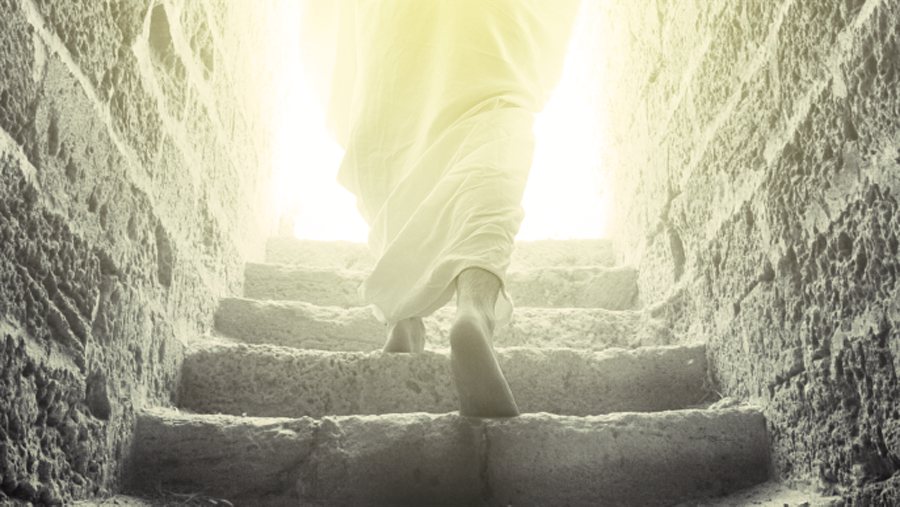
It has been said that Resurrection morning is the greatest comeback of all time.
Greater than a Hail Mary touchdown pass into the end zone with no time left on the clock.
Greater than a half-court shot swishing through the hoop as the buzzer sounds.
Greater than a walk-off home run with two outs in the bottom of the ninth.
It may seem to us like the resurrection was the greatest comeback victory in the history of the world.
Except it wasn’t.
The Resurrection was not a surprise finish, an unlikely upset, a come-from-behind rally.
This was in the playbook all along.
“The Lamb was slain from the creation of the world.” Rev. 13:8
“He chose us in Him before the creation of the world.” Eph. 1:4
“Inherit the kingdom prepared for you from the creation of the world.” Matt. 25:34
So, if we could go back before Genesis 1:1, before the creation of the world, there we would find the place and time set: Resurrection Day — Jerusalem, 33 A. D., early in the morning, Joseph’s tomb.
God doesn’t make comebacks because He’s always way ahead.
There is another date set: The Great and Glorious Day of Messiah’s Final Come Back, Mount of Olives, date and time unknown. Of course, we don’t know the date, but we know God knows. He’s known from the creation of the world.
This year, the Jewish Passover runs from April 5-13, which also coincides with the Christian Holy Week and Resurrection Sunday. The timing is perfect to learn a new Hebrew word: Dayenu.
Dayenu is a song of gratitude that is sung during the Passover Seder meal. It rehearses all the things God did for the Israelites during their deliverance from slavery in Egypt. Here are a few of the 14 verses.
If He had smitten their first-born, and had not given us their wealth, Dayenu, it would have been enough!
If He had given us their wealth, and had not split the sea for us, Dayenu, it would have been enough!
If He had split the sea for us, and had not taken us through it on dry land, Dayenu, it would have been enough!
If He had taken us through the sea on dry land, and had not drowned our oppressors in it, Dayenu, it would have been enough!
If He had drowned our oppressors in it, and had not supplied our needs in the desert for forty years, Dayenu, it would have been enough!
If He had supplied our needs in the desert for forty years, and had not fed us the manna, Dayenu, it would have been enough!
You get the idea. Dayenu means “It would have been enough!”
During this Holy Week, I’m singing my own version of Dayenu, with a twist.
If He had sweat drops of blood in the Garden, but had not taken the cup, it wouldn’t have been enough.
If He had taken the cup, but had not allowed the soldiers to arrest Him, it wouldn’t have been enough.
If He had allowed the soldiers to arrest Him, but had not worn the crown of thorns, it wouldn’t have been enough.
If He had worn the crown of thorns, but had not endured the whipping, it wouldn’t have been enough.
If He had endured the whipping, but had not been nailed to the tree, it wouldn’t have been enough.
If He had been nailed to the tree, but had not bled and died, it wouldn’t have been enough.
If He had bled and died, but had not risen on the third day, it wouldn’t have been enough.
But, He wore the crown, He drank the cup, Death took Him down, God raised Him up. And it is more than enough. Dayenu!
Do you know anyone who is happy-go-lucky? Someone who is in a good mood all of the time? An eternal optimist who always looks on the bright side? A person who might say to you, “Let’s turn that frown upside down”?
Me neither. If I did know someone like that, I’d probably be annoyed.
Joy doesn’t come naturally.
Instead, for believers in Christ, joy comes supernaturally, through the work of the Holy Spirit.
Joy is one of the fruits of the Spirit listed in Galatians 5:22-23 and according to my Bible Reading Plan for 2023, a word study on JOY is coming up next.
Let’s start with a working definition:
“Biblical joy is more than a happy feeling. It’s a lasting emotion that comes from the choice to trust that God will fulfill His promises.” (bibleproject.com)
Here is my 12 week plan to study a few of the scriptures in the Bible that are about joy. You are welcome to join me! Let’s plan for some joy!
April 10-14 — Psalm 126 April 17-21 — John 16:20-24 April 24-28 — Philippians 1:3-6, 2:1-2 May 1-5 — Psalm 92:1-5, 12-15 May 8-12 — 1 Peter 1:3-9 May 15-19 — 1 Thessalonians 1:4-8 May 22-26 — 2 Corinthians 7:2-7 May 29-June 2 — 2 Corinthians 8:1-7 June 5-9 — Psalm 47 June 12-16 — 1 Thessalonians 3:6-10 June 19-23 — 3 John 1-4 June 26-30 — Psalm 98
Melt the clouds of sin and sadness, Drive the dark of doubt away. Giver of immortal gladness, Fill us with the light of day. ~Henry van Dyke~















 a small drop of ink