Top Ten Books of 2025

“From Christmas night to New Year’s Eve,
We bless the space that’s in between.”
~Sandra McCracken

These “in-between” days are my favorite days of the whole year. There are enough leftovers to last a week, we don’t have to go anywhere, and a pile of new books is calling.

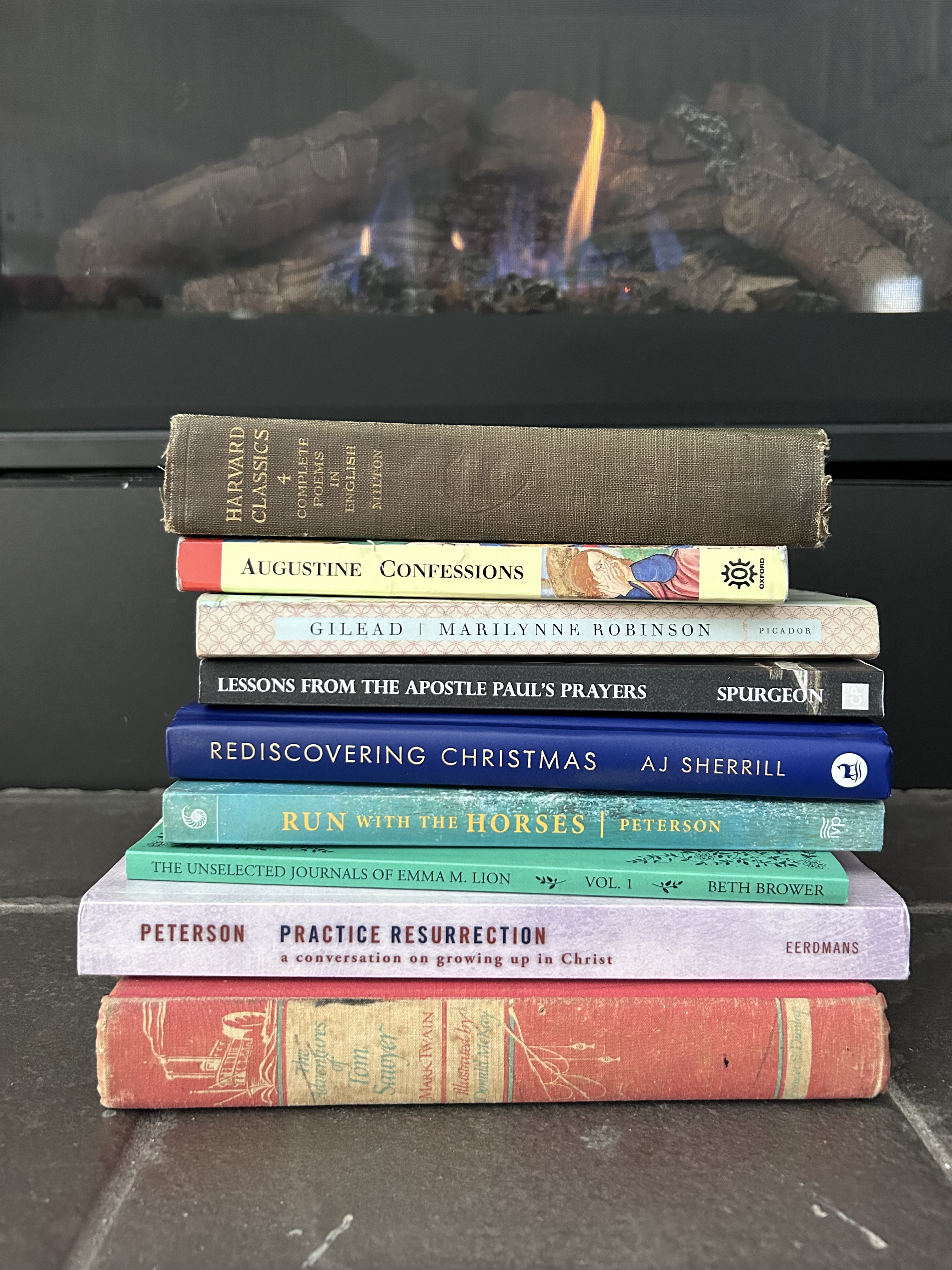
Here are my top ten books from 2025.

10. Run With the Horses, Eugene Peterson
I picked up this book while reading through the Old Testament book of Jeremiah. Peterson has a way of helping everything make sense. His words guided me to a better understanding of God’s Words. I also read his book Practice Resurrection along with Ephesians and the lights went on. Over and over. I wish he had written a companion volume to every book of the Bible.

9. Tom Sawyer and Huckleberry Finn, Mark Twain
I read Tom Sawyer out loud to PB and we listened to the audio of Huck Finn on a long road trip. Some of it made us cringe. Some of it made us laugh out loud. Twain has a way of saying things that catches you by surprise. Classics, but definitely not P.C.

8. Bonhoeffer: Pastor, Martyr, Prophet, Spy, Eric Metaxas
This was an in-depth look at Bonhoeffer’s life, from beginning to end. I listened to the audio version, which was almost 24 hours long. The German names were hard to keep track of—and the narrator pronounced Bonhoeffer as “Bon-hoof-er”—but there was no doubt about the man’s courage in the face of evil.

7. Confessions, St. Augustine
It’s hard to imagine what life was like between 354-430 A.D. Surprisingly, Augustine struggled in his lifetime with the same things we do in the 21st century. Thanks to 20 years of his mother’s prayers (he called himself “the son of my mother’s tears”) he became a follower of Christ and a leader in the early church. He had a lot to confess…

6. Lessons From the Apostle Paul’s Prayers, Charles H. Spurgeon
You might think reading a 19th century preacher’s sermons would be boring. Not if it’s C.H. Spurgeon. I have stars, arrows, and exclamations points in the margins. I have whole paragraphs underlined. I have returned to this book over and over since reading it in October and will keep it nearby so I can keep returning. I love Spurg.

5. Gilead, Marilynne Robinson
This was a re-read for me. I rarely go back to a book and read it over again, but this was a delight—like a visit with old friends. Discussing it with my neighborhood book club made it even richer. Something about two old pastors sitting on the porch talking, well, it makes my heart ache a little bit. Robinson has a way of making the ache feel comforting.

4. Right Ho, Jeeves, P. G. Wodehouse
I’ve been hearing for years about Wodehouse and how funny his books are, but comedic novels aren’t really my jam. Last year, PB and I tried out a subscription to Audible, so I downloaded every free offering they had before my subscription ran out. (I’m a cheapskate.) Listening to Jeeves and Wooster was a rollickingly good time. I now have “The P. G. Wodehouse Collection” which is 16 more hours of fun for the coming year.

3. Rediscovering Christmas, A. J. Sherrill
It’s not easy to find a book on Christmas that feels fresh and makes me say, “Huh, I never thought of that.” Some chapters landed better than others for me, but I came away with some new insights and deeper appreciation for the Nativity story and the characters within it. It was a good way to enhance the season.

2. The Unselected Journals of Emma M. Lion, Beth Brower
I can’t remember when I read a book that was more delightful! My daughter gave me Volume 1 in the series for my birthday. Then I bought Volume 2. Then I bought Volumes 3-8. Word has it that 25 volumes are being planned and I’m here for every one of them. The writing is so good—it draws you right into the world Bower has created. Reading for the fun of it! I’d almost forgotten what that’s like.

1. Paradise Lost, John Milton
On the opposite end of the reading spectrum from Emma M. Lion, is John Milton and Paradise Lost. This was the most impactful book I read this year. I thought I’d hate it. Written in blank verse, which means it doesn’t rhyme, every line has exactly ten syllables. And there are over 10,000 lines in this poem. I was sure it would take me all summer to slog through the renowned classic that had been dictated by a blind man in the 1600s. I gritted my teeth and was determined to get through this “masterpiece of English literature.” To my surprise, it took my breath away and I couldn’t put it down. Listening to a Hillsdale College lecture after each chapter helped a lot. But wow. It’s incredible.
”Books are the quietest and most constant of friends;
they are the most accessible and wisest of counselors,
and the most patient of teachers.”
~Charles W. Eliot

He Knows Where to Find Me

I went to a Christian writer’s conference last week. I didn’t post anything here because I was too busy learning how to be a Christian writer. I met a lot of very nice people and collected a stack of Christian writers’ business cards. I heard some very inspiring presentations and took notes in all the sessions. I pitched an idea for a book to three publishers and learned I need at least 10,000 followers before being considered as a prospective author.

Only 9,700 more to go.

Tim Challies (www.challies.com) was the keynote speaker. As my head was swimming with “10 Ways to Market Your Book” and “Why You Need to Grow Your Reach,” Tim spoke about things closer to my heart.

He encouraged us to resist the pull of popularity.
“The book business is a numbers-driven industry that is extremely competitive.
Be honored that anybody reads your words—that God gives you any readers.
Be content.”

He said success carries a heavy weight of responsibility.
“God expects more from those who have more gifts.
God’s giving of a little might be a gift saving you from yourself.”

He told us that developing character is more important than success.
“Don’t let your success rise above your sanctification.
Most of us don’t have the holiness to handle success.”


I am, indeed, very honored that you stop by here and read from time to time.
I don’t want the responsibility that comes with publishing success.
I’ve got my hands full working on growing godly character.
I am content.

Spurgeon said it best:
“When God wants you, He knows where to find you.
You need not go and push yourself to the front;
the Lord will bring you to the front when He wants you.
Oh, for grace to work on unobserved!”

Now I Know My ABCs

The Alphabet Song—it’s one of the first songs we learn as children.

We sing “A-B-C-D-E-F-G….”
before we know the sound each letter makes,
before we understand that letters can be combined to make words,
before we comprehend that words can be put together to make sentences,
before we grasp that sentences can create stories that can become books.
The letters of the alphabet are the building blocks of language.

The next time you go into a library or book store,
look at the plethera of books and think,
“Every word in every book on every shelf has used the same 26 letters.”

From Goodnight Moon to Paradise Lost
from People magazine to Encyclopedia Britannica.
All we have is 26 letters.
And endless combinations to make millions of words. 

The ancient Hebrew alphabet had 22 letters.
Back in 2020, I did a series on each of the letters in the Hebrew Aleph-Bet.
Every day, those blog posts are still read.
Every single day.
Five years later.
I don’t know who you are, but thanks for reading!
To make it easier to access, I created a category called “Hebrew Alphabet.”
May God bless the letters in both of our alphabets.


For further reading:
ABCs
Aleph
Bet


Brain Rot

Brain rot is the Oxford Word of the Year for 2024.
What does that say about us?

brain rot (n.) Supposed deterioration of a person’s mental or intellectual state, especially viewed as a result of overconsumption of material (now particularly online content) considered to be trivial or unchallenging.

Brain rot
beat out five other words that were under consideration for the honor:
demure
dynamic pricing
lore
romantasy
slop

The Newport Institute released a report outlining the dangers of this phenomenon. The academic paper concluded with a list of ways to prevent the alarming social trend that is causing our brains to disintegrate.

1. Don’t sit in front of screens all day.
2. Consider unplugging completely.
3. Go outside and take a walk.
4. Get a hobby.
5. Talk to real people face to face.

Does the fact that I had to use the internet to find out this information mean I’ve just succumbed to the prevalent rotting of our collective brains?

Wow.
I think we’re in trouble.

At least “slop” didn’t win.

slop (n.) Art, writing, or other content generated using artificial intelligence, shared and distributed online in an indiscriminate or intrusive way, and characterized as being of low quality, inauthentic, or inaccurate.

Whoo boy.

The Psalmist spoke for God in Psalm 81:11-12.
“My people would not listen to me,
so I gave them over to their stubborn hearts
to follow their own devices.”

Surely this isn’t referring to our devices. Or is it?

“Do not conform any longer to the pattern of this world,
but be transformed by the renewing of your mind.”
Romans 12:2

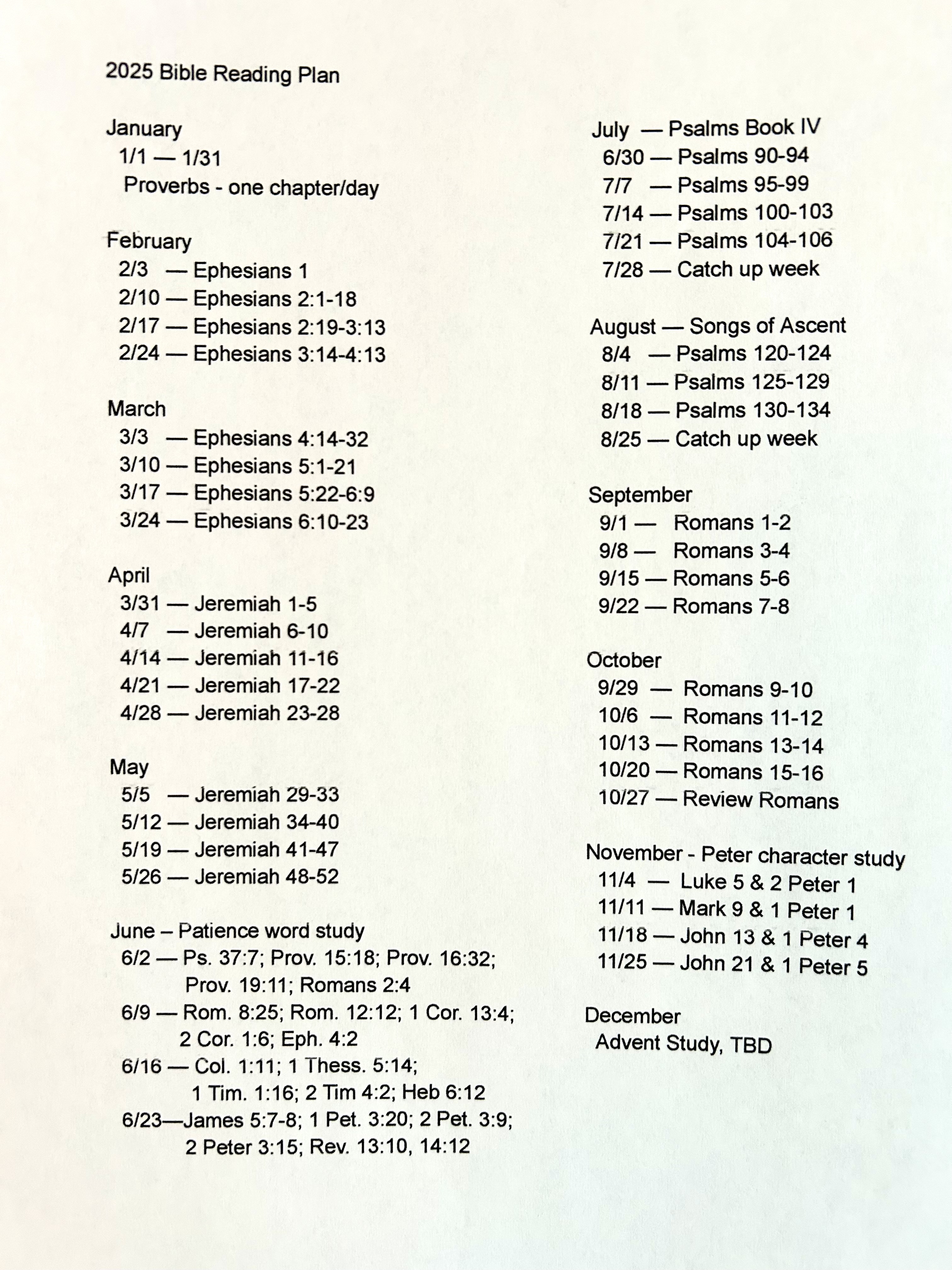
2025 Bible Reading Plan

This week between Christmas and the new year is my favorite week of the year. I like to look back over the notes I’ve made, read some old journal entries, and peruse the list of books I read. It’s a satisfying and somewhat solemn review of things I’ve learned and tried to process. It’s also a time to anticipate new growth in the coming year.

The schoolgirl in me loves a syllabus, a list of assignments, a program to carry out. Without a plan, I tend to wander and waver, making excuses and sliding through the weeks. So here is my 2025 plan. You are welcome to follow along!

I’m going to start 2025 with a read-through of Proverbs. Who doesn’t need wisdom when facing a new year? I will read one chapter a day for 31 days and pick one verse out of each day’s chapter to copy in my notebook, followed by a reflective sentence or two.

In February and March I will take a slow stroll through Ephesians, taking about 20 verses each week. I plan to read Eugene Peterson’s “Practice Resurrection” and “A Week in the Life of Ephesus” by David A. DeSilva during these two months.

Old Testament prophet Jeremiah will be my focus in April and May, reading 5-7 chapters per week. I have “Run with the Horses” on my book pile, which is another Eugene Peterson book, this one on Jeremiah.

In June, I will do a word study on Patience, the fourth fruit of the spirit as listed in Galatians 5. One verse for each day, Monday through Friday.

July and August will take me to Psalms. First, Book IV, which consists of Psalm 90-106. (Did you know the book of Psalms is divided into 5 books?) After that, I’ll soak in the special group of psalms called “The Songs of Ascent” (Psalms 120-134).

I’ll kick off the fall with Paul’s letter to the Romans, taking two chapters in each week (M-F) of September and October.

In November, I’m going to do a character study on Peter by reading four different accounts in the gospels along with his own words from his letters, 1 and 2 Peter.

The year will close with an Advent devotional of some kind.

Too much? Maybe.
Will I stick to it and complete it? Maybe.
Will this give me the nudge I need to keep plugging away
and give me a framework to pick back up if I fall off the plan? Absolutely.

May God bless the reading of His Word in 2025.

Thankful

One of my favorite authors is Wendell Berry. Our neighborhood book club just finished Hannah Coulter so I am enchanted all over again with Port William and all my dear fictional friends. They remind me of the good salt-of-the-earth people I grew up around—people who loved the land and who knew how to be neighborly. I’m thankful for Berry’s words in this season, and I’m basking in their beauty.

“You mustn’t wish for another life.
You mustn’t want to be somebody else.
What you must do is this:
Rejoice evermore. Pray without ceasing. In everything give thanks.*
I am not all the way capable of so much,
but those are the right instructions.”

Hannah Coulter

“I tremble with gratitude
for my children and their children
who take pleasure in one another.

At our dinners together, the dead
enter and pass among us
in living love and in memory.

And so the young are taught.”

Leavings: Poems

* 1 Thessalonians 5:16-18

Treasure

“Do not store up for yourselves treasures on earth,
where moth and rust destroy
and where thieves break in and steal,
but store up for yourselves treasures in heaven,
where neither moth nor rust destroys
and where thieves do not break in and steal.
For where your treasure is, there your heart will be also.”
Matt. 6:19-21

“Treasure” is my word for 2024.

I picked this word because Jesus used it in The Sermon on the Mount. He made a distinction between “treasures on earth” and “treasures in heaven.”

I want to make sure I’m collecting the right kind of treasures.
I want to check up on my heart and see what’s stored up in there.
I want to find out what is truly precious and what’s worth a rust bucket.

The Bible Project is doing a year-long series on The Sermon on the Mount. I am giddy about this. A whole year on three chapters! As I was perusing Jesus’ sermon in Matthew 5-7, my eyes kept going back to that one short passage. Like a magnet. That’s when I knew.

I’ll be on the lookout for the word “treasure” in the days ahead in songs, in books, in dreams and especially in the Word. A true treasure hunt!

Do you pick a word for the year? What is your word for 2024? 

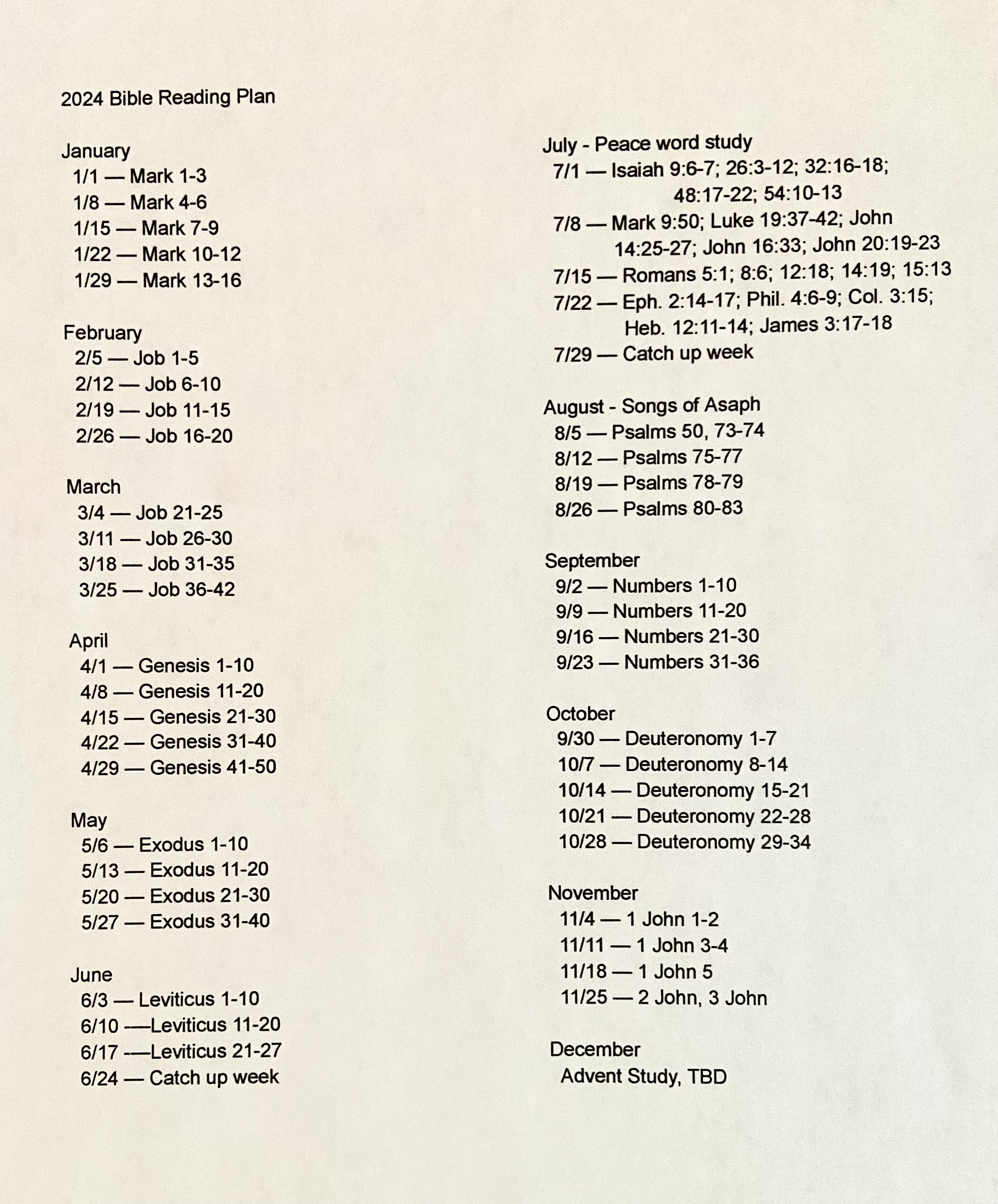
2024 Bible Reading Plan

Every year for the past 10 years, I have created my own Bible Reading Plan. There are lots of good ready-made plans available online that are perfectly fine. I just get a thrill out of making assignments for myself and anyone else who wants to come along!

The first half of the year is a true “reading” plan (not a “study” plan) with no deep dives into passages. This plan is set up for reading on Monday through Friday, with weekends for catch-up. The year begins with the gospel of Mark, and then a reading of the Old Testament book of Job.

I have been wanting to read through the Pentateuch (the first five books of the Bible, most of which Jewish boys in Jesus’ day had to memorize), so Genesis, Exodus and Leviticus will be next. I will be reading 10 chapters a week in a kind of “fly-over” to get the big picture. Numbers and Deuteronomy will be picked back up in the fall.

Past years have taught me to ease up a bit in the summer, so in July I will be doing a word study on peace (the third Fruit of the Spirit as listed in Galatians 5:22-23) and August will bring a look at the 12 Psalms written by Aseph (one of the Psalm writers). The year will wrap up with a reading of John’s letters (1 , 2, 3 John — not the Gospel of John).

May God bless the reading of His Word!

Books of 2023

I took a different approach in my reading life this year. Instead of setting a goal to read a certain number of books (I read 37 – of course I kept track), I created some categories in hopes of becoming a more well-rounded reader. I think it worked. I feel rounder.

1 book by Elizabeth Goudge — Genetian Hill by E. Goudge
I read a Goudge book every February. Her writing is full of English cottages and rose gardens and lovely language. I seem to need that in February. During the year, I look for copies at used book sales and shops. The musty smell and worn pages enhance the overall experience.

1 book by Eugene Peterson — Leap Over a Wall by E. Peterson
This book on the life of David and his relationships with various people was a great companion while I read through the Biblical record of David in 1&2 Samuel. Peterson communicates deep theology without being stuffy.

1 book on the Fruit of the Spirit: Joy — Aggressively Happy by Joy Marie Clarkson
Clarkson is delightful, funny and tells good stories. She’s also a realist: “Cultivating happiness takes grit, determination and a good sense of humor. It’s a lot of work.” One other book in this category: Choose Joy by Kay Warren.

1 book on prayer — Praying Like Monks, Living Like Fools by Tyler Staton
Staton is the director of the 24/7 Prayer Movement in the USA. He can write about the topic because the man is a pray-er. I needed his passionate words to give my prayer life a jolt.

1 old Christian classic — The Pilgrim’s Progress by John Bunyan (written in 1678) and Hinds’ Feet on High Places by Hannah Hurnard (written in 1955). I’ve read them both before, but I was given beautiful gift copies, so I read them again. And I’ll read them in the future. Classics.

1 English classic — Dr. Jekyll and Mr. Hyde by Robert Louis Stevenson
I’m a little embarrassed to admit that I haven’t read this iconic story until now. I picked it up because it was short (only 100 pages) and it fit my category. It’s kind of creepy and kind of cool and now I know what references to “Jekyll and Hyde” really mean.

1 book of poetry — The Word in the Wilderness by Malcolm Guite
Poetry is hard. Malcolm is here to help. This book contains a poem a day for the season of Lent and Easter. I read the poem each day, then read Guite’s explanation of the poem, then read the poem again and said, “Ahhhhhh. I get it now.” Poetry is wonderful.

1 book on nature — The Heart of John Muir’s World by Millie Stanley
Muir was the “Father of National Parks” and grew up in the mid 1800’s a few miles from where I live. He wrote, “Oh! that glorious Wisconsin wilderness!” I need to be reminded to open my eyes and take in all the natural glory right in my own backyard.

1 biography/memoir — All My Knotted Up Life: A Memoir by Beth Moore
Over the years I’ve done several Beth Moore Bible studies. Sometimes I love her, and sometimes I roll my eyes a little bit. Shame on me. You never know what a person has gone through in life. Her transparency and conversational style had me gobbling up this book in two days. Then I listened to her read the audio version. I also read the memoir Secret Thoughts of an Unlikely Convert by Rosaria Butterfield.

1 Jane Austen book — Mansfield Park by Jane Austen
I’ve read “Pride and Prejudice” several times, but now I’m making my way through her other books, one by one. Three down, three to go.

1 book on writing — Write Tight by William Brohaugh
I’m a sucker for books on the craft of writing. I’ve read so many they all are starting to sound the same. Basically, “sit down and write.” All right already.

1 Montana historical novel — The Whistling Season by Ivan Doig
My great grandparents homesteaded in Montana in the late 1800s and I’ve dreamed of living in Big Sky country ever since I was a little girl. I’ve read this title before, but PB and I listened to the audio book on our way to Montana in June. Pure delight! I also read Dancing at the Rascal Fair by the same author.

1 book on the church — Positively Irritating: Embracing a Post Christian World to Form a More Faithful and Innovative Church by Jon Ritner
This was my #1 book of 2023. It shook me up (in a good way) and caused me to think hard about church and culture in new, scary, and exciting ways. Ritner asserts that the church needs to pivot from being a “restaurant” (expecting people to come in and be served) to becoming a “food truck” (taking the gospel out to where people are). I can’t stop thinking about it.

Honorable Mention:
The Sound of Life’s Unspeakable Beauty by Martin Schleske
Secrets Of the Secret Place by Bob Sorge
On Getting Out of Bed by Alan Noble
David Rise by Mark Buchanan

May God bless your reading of books in 2024!

1001

I’m not a numbers girl.
Words hold much more allure for me.
But this one got my attention:
1000

This is my 1001st blog post.

It only took 13 years to reach this milestone. I don’t keep track, so it was a surprise when WordPress sent me a congratulatory email last week. It goes to show that if you keep plugging along day after day, month after month, year after year, the output piles up.

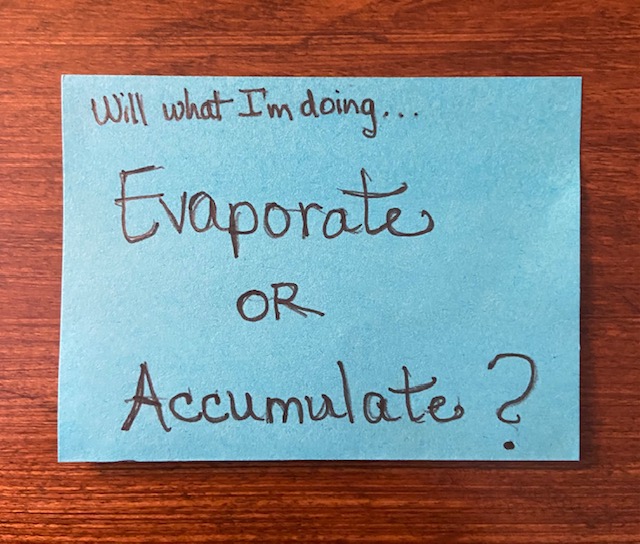
Five minutes can be spent working on something trivial or working on something life-changing. Most daily actions evaporate. Some accumulate.

James Clear, author of Atomic Habits

The floors I mopped yesterday, the dinner I made last night, the time I spent watching a baseball game on TV — those will evaporate.

The notes I took on Matthew 18 this morning, the prayers I prayed on the porch, the words put down in my journal — those will accumulate.

Much of what I do on a daily basis doesn’t last much longer than five minutes. (Clean floors and pot roast.) But if I can spend a moment or two, here and there, doing something significant, it adds up over time.

I’m not a numbers girl.
But this one got my attention.
305,509 words posted on this blog.
One at a time.
Accumulation.