Long Song Study, part Y

Sprinkled throughout the 119th Psalm is a phrase that David used often and it’s here in the last section twice: “according to your word”. That’s a good way to sum up David’s heart’s desire — he wanted to live his life in accordance with God’s Word. “According to” means “in agreement with”. This favorite phrase of David’s reminds us that a life of faith is agreeing with God more and arguing with God less.

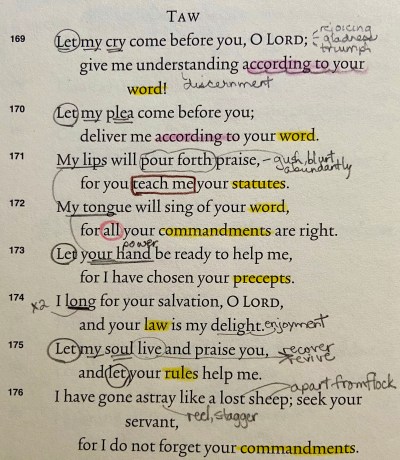
Verse 169
Let my cry come before you, O Lord;
give me understanding according to your word!
We don’t know if David was aware that this was his final entry in his long song. We also don’t know how old David was as he penned these words. Certainly he was an older man at this point, yet he was still crying out to God and asking for understanding. Not all cries are in desperation — the word used here can also mean “shouts of joy, singing, gladness”. That exclamation point might indicate a triumphant cry!
None of us will get everything all figured out this side of eternity. Albert Einstein said, “The more I learn, the more I realize how much I don’t know.” The key is to continue to seek understanding according to the Word. “To be given understanding means more than to be given cognitive content, it means to be changed inside.” (Christopher Ash)

Verse 170
Let my plea come before you;
deliver me according to your word.
David spent his whole life coming to God with his requests and he had seen the hand of God move on his behalf in mighty ways. Coming to the Lord for help was nothing new for David; it was completely natural for him. We shouldn’t expect to “out-grow” our need for God’s help. In fact, challenges often increase as we age, so developing the holy habit of coming before God with our needs is wise. 

Verse 171
My lips will pour forth praise,
for you teach me your statutes.
David followed his two prayer requests with two promises. The first was to praise God, out loud and profusely. The Hebrew word for “pour forth” means “to gush, blurt, flow abundantly”. After laying out his requests, David went directly into praise, probably before the understanding and deliverance arrived. This was also his holy habit — so many of his songs gush with exultant adoration. Again, it was natural for his lips to pour forth praise because it had been his life-long practice.

Verse 172
My tongue will sing of your word,
for all your commandments are right.
David’s second promise was to sing! Words of praise gave way to songs of praise. Charles Wesley wrote the hymn, “O For A Thousand Tongues to Sing” and the lyrics always make me smile. Here is Charles, wishing he had 1,000 tongues in his mouth so he could use them all to praise God. And here I am, having more than enough trouble with my one and only tongue. What would happen if I had 1,000 tongues? Yikes. The truth is, we can control how we use our tongues but it’s not easy. James wrote, “The tongue is a small part of the body, but it makes great boasts. Consider what a great forest is set on fire by a small spark. The tongue also is a fire, a world of evil among the parts of the body.” (Jam. 3:5-6) The Holy Spirit can redeem our tongues to be used for praise!

Verse 173
Let your hand be ready to help me,
for I have chosen your precepts.
The pendulum swings from praise to petition once more. It’s like David can’t make up his mind how to pray. I can relate. There is an unresolved tension that oscillates between good days and bad days, ups and downs, highs and lows. We praise Him, we cry out to Him. Over and over and over. But we have something David didn’t have — Jesus, a High Priest that sympathizes with our weaknesses and invites us to approach the throne of grace with confidence. (Heb. 4:15-16) Jesus proved that God’s hand is ready to help us. 

Verse 174
I long for your salvation, O Lord,
 and your law is my delight.
The longing David felt might have been for personal deliverance, but it also may have reached beyond that to the salvation God promised in the coming Messiah. Everything inside David yearned for the fulfillment of the covenant and the establishment of a kingdom that would last forever. David looked forward to the promise with faith, as did all the Old Testament saints. We are the blessed generations who get to look back on Messiah’s coming to purchase salvation while also looking forward to His glorious return. In the meantime, His Word is to be our delight.

Verse 175
Let my soul live and praise you,
and let your rules help me.
Years ago, I read this verse in the Message translation and wrote it in my NIV Bible. “Invigorate my soul so I can praise You well. Use Your decrees to put iron in my soul.” I love that! To invigorate means to infuse with life, energy, and vitality. That’s how I want to live — with Holy Spirit energy running through my veins, providing vital praise to my lips. That’s how I want to grow old — with Holy Spirit strength in my inner being, providing iron-clad endurance and faithfulness. 

Verse 176
I have gone astray like a lost sheep; seek your servant,
for I do not forget your commandments.
Wait. What? What just happened? Can we please lop off this last verse and end on a high note? No, we can’t. Because even though David affirmed his belief, he was aware of his frailty and his dependence on God’s grace. We are lost sheep — “Prone to wander, Lord I feel it.” But do not forget, God does seek after us, especially in His Word. 

I’m going to close David’s long song with a long quote from “Bible Delight” by Christopher Ash. You can skip it or read it later. However, his comments on this ancient psalm seem to speak right into our present world. 

   “As so often in the Bible, the end of the psalm is not the end of the story. If we think of the psalm as portraying the believer as a building under construction, this last verse is a reminder that the scaffolding is still in place. At the end of this psalm we are still in painful tension. This is how it is. This psalm will not be sung in the age to come.* But for now it is authentic Christian experience. This is so realistic.
‘How are you?’ ‘I really don’t know. I cannot work out whether I am in prayer or praise. I seem to feel both strongly and inconsistently.’ This is the authentic Christian response. There are two simpler responses; and neither of them is Christian. If I just say it is grim grim grim, that is not an authentic Christian response. And if I say it is great great great that also is not an authentic Christian response. The authentic response is to say I really don’t know. I am held by the word of God from a painful present to a glorious future. And that word brings into the present a foretaste of joy, hope, peace and praise. And the praise is all muddled up with the prayer. I don’t know whether to laugh or cry; and I do both at the same time. That is authentic Christian experience.
The people of God delight in the word of God, because this word alone ties us in the pain of the present to the glory of the future. May God help us sing it.”
img_0752

*Mr. Ash seems to think David will not be performing Psalm 119 on the New Earth. Darn. Oh well. He’s got a lot of other good songs and is probably writing more even now. I’m keeping my front row seat.

Next: Tav

Long Song Study, part W

treasure

This section of Psalm 119 is probably the most upbeat of all the stanzas. “If section 11 (Kaph — Verses 81-88) was the midnight of the psalm, this is the noonday. This section is trumpets all the way.” (Christopher Ash) In fact, it is the only section that does not contain a request. A quick mention of persecution gives way to soulful lyrics celebrating the wonders of God’s words.


Verse 161
Princes persecute me without cause,
but my heart stands in awe of your words.
Persecution in any form is never pleasant, but David wasn’t dealing with a crotchety neighbor or a disgruntled staff member. Heads of state (plural) were harassing him persistently for no apparent reason. It’s hard not to take it personally. It’s hard not to strike back. It’s hard not to fall into a depressed heap and quit. But. My. Heart. Stands. No matter what was happening on the outside, David was able to keep his interior life stable by focusing on God’s words. They were a constant source of inspiration that kept David’s heart fired up with love for God.

Verse 162
I rejoice at your word
like one who finds great spoil.
Here is a testimony to the power of the Word. With persecution all around, still David could rejoice as if he was the luckiest guy in the world. He felt like he stumbled onto a hidden treasure in a field, a treasure chest in the sand, a golden ticket on the sidewalk. The words “great spoil” mean “abundant booty” in the original language! As David put the Word squarely in front of him, joy was the first thing that sprang up, so he rejoiced. 

Verse 163
I hate and abhor falsehood, but I love your law.
The second result of setting his heart on God’s Word was renewed love for it. Could it be that the more we love the scriptures, the more we will have an aversion to lies and deception? Could it be that there is so much dishonesty and deceit in the world because there is no delight in or fondness for God’s laws? The living and active word of God has a way of straightening out our values and setting our loves in order. 

Verse 164
Seven times a day I praise you for your righteous rules.
As David found himself in the awesome presence of God’s words, he overflowed with praise. This third benefit wasn’t a one-and-done kind of experience, but it kept popping up all day long. As king, he didn’t have time to sit in long meditation or quiet solitude so he kept doing his kingly duties, yet his days were shot through with praise. Even during intense periods of persecution, he could continue to raise a hallelujah for the good words of the Lord.

Verse 165
Great peace have those who love your law; nothing can make them stumble.
Peace was the fourth thing David found as he considered the scriptures. Great peace. Peace that passes understanding. Lack of peace, or anxiety, causes all kinds of problems. It robs us of sleep, joy, and contentment. It leads us away from still waters and green pastures. It puts us on a road full of potholes and dangers lurking in the ditches. It makes us susceptible to the enemy’s attacks. But when peace reigns in our hearts, it takes the wobble out of our walk.

What a charming verse is this! It deals not with those who perfectly keep the law — for where should such people be found? — but with those who love it, whose hearts and hands are made to square with its precepts and demands. (Spurgeon)

Verse 166
I hope for your salvation, O Lord, and I do your commandments.
David discovered hope as he stood in awe of God’s words. This fifth link in the chain was what kept him going with an eye toward eternity.

The word of God brings the future into the present, because it ties us by a sure and certain hope to the age to come. It is the aroma of a banquet sensed in the air before the dining doors open. (Christopher Ash)

David was banking on better days ahead, but in the meantime, he would faithfully go about the business of being an obedient disciple.

Verse 167
My soul keeps your testimonies; I love them exceedingly.
When David talked about loving the Word, he wasn’t stingy with adverbs and adjectives. He didn’t just love God’s testimonies — he loved them exceedingly. The Hebrew word used there means “vehemently, wholly, speedily, diligently, mightily”. (I had to look up “vehemently”: “intensely passionate, strongly zealous”.) So there you go. David wound up his penultimate verse in his penultimate stanza with a strong affirmation of the place God’s Word had in his heart. He loved it. Exceedingly.  

Verse 168
I keep your precepts and testimonies, for all my ways are before you.
I’m so glad all my ways are not before you. That could be embarrassing. Can you imagine starring in your own reality TV show and having millions of viewers watch your every move? And then tweeting their judgmental criticism? It sounds like a nightmare. Not many of us would be comfortable with that much vulnerable transparency. But with God, it’s different. Our hearts are open books before our Maker, yet they are safe. God is for us, not against us. God is not mad at us, He’s mad about us. We can live before Him, in all our brokenness, with joy, love, praise, peace and hope. 

img_0741img_0742

Things I know for sure from this passage:

  • My awe should be reserved for God, and not spent on people.
  • Treasures are waiting for me in the scriptures, but it takes some digging.
  • Do I praise God seven times a day, or once every seven days?
  • I can never underestimate the greatness of God’s peace.
  • I can’t hide anything from God.

Next: Shin

Long Song Study, part V

At first glance, Psalm 119 may seem to be a bit repetitive. After all, it uses the same eight words (law, word, statutes, precepts, promises, judgments, testimonies, commandments) over and over and over. Ah, but if we’re bored by this, it might be more of a reflection on us. I give you Spurgeon:

Where we think we have a repetition of the same idea in this psalm we are misled by our neglect of careful study. Each verse is a distinct pearl. Each blade of grass in this field has its own drop of heavenly dew.

Let’s get our feet wet and go pearl hunting, shall we?

revive

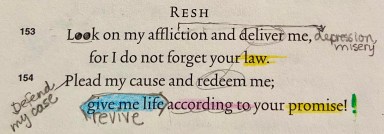
Verse 153
Look on my affliction and deliver me,
for I do not forget your law.
David is at the throne of God once again, asking for deliverance. It seems like he had a lot of enemies, doesn’t it? Before you start assuming he was dramatically exaggerating his affliction, keep in mind that every nation around Israel wanted to see it destroyed along with its King. Not only that, there was trouble right inside the royal palace, with several of David’s sons attempting to overthrow their father. Add in all the headaches of being the head of a government and the commander of an army. Oh, and don’t forget, David had numerous wives (eight are named, but there were many more) and at least 20 children. No wonder he felt afflicted (depressed, miserable). Somehow he was able to keep his head on straight and stay mindful of God’s commandments. Whereas affliction sometimes drives people away from God, it drove David closer to God.

It seems a strange thing that such a truly godly man, as David was, should have many enemies; but it was inevitable. The disciple cannot be loved where his Master is hated. (Spurgeon)

Verse 154
Plead my cause and redeem me; give me life according to your promise!
Perhaps David also had some legal trouble, because he used technical courtroom jargon in this verse. He was asking God to defend his case, to give him acquittal and declare him not guilty. God is the perfect defense attorney, as one of His names is “Wonderful Counselor”. “Give me life” is a recurring theme in this section of Psalm 119, and it means “revive me”. David knew the Word of God was his best source of revival.

Verse 155
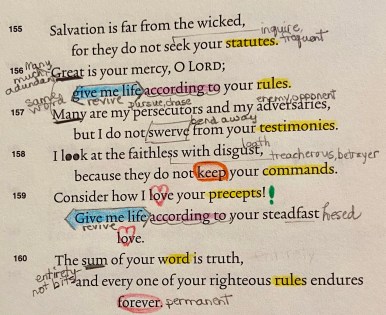
Salvation is far from the wicked,
for they do not seek your statutes.
The ungodly had no interest in the things of the Lord. They didn’t inquire about His ways, they didn’t darken the door of the temple, and they didn’t hang around with believers. Since they didn’t seek, they didn’t find. Yet David saw their disadvantage: they had no one to consider their affliction, they had no one to deliver them, and they had no one to plead their cause. They were difficult people to deal with, but David maintained a sense of sorrow over their lost condition.

Verse 156
Great is your mercy, O Lord;
give me life according to your rules.
When God’s mercy is truly and fully experienced, it is always a great thing. It is never stingy, always abundant. The Message version says, “Your mercies, God, run into the billions.” The King James Version says, “Great are thy tender mercies”. The magnificent mercy of God can be staggeringly overwhelming, so He is tender with them and us. David asked for the kind of mercy that would revive him in the midst of his present state of discouragement.

Verse 157
Many are my persecutors and my adversaries,
but I do not swerve from your testimonies.
“Many” is the same word that is used in verse 156 for “great”. As persecutors and adversaries grew in number, so also did the mercies of God. No amount of trouble can swallow up God’s tender mercy — there’s always more mercy than trouble. Still, a momentary lapse in faithfulness might be expected when crisis hits without warning. Yet David resolved not to slip off course, not to wander or waver from the truth.

Verse 158
I look at the faithless with disgust, because they do not keep your commands.
David saw what faithlessness looked like, and he didn’t want to have anything to do with that way of life. He viewed the godless as treacherous betrayers, living under the common graces of God while giving Him the cold shoulder. The revival David sought was already having an effect. As David Guzik points out, “This sensitivity towards sin and passion for the glory of God is entirely characteristic of the revival that the Psalmist prays for repeatedly in this section.” In other words, you are experiencing revival when 1) the sins you used to flirt with begin to make you terribly uncomfortable, and 2) the glory you used to enjoy begins to feel empty and you want God to be in the spotlight instead.

Verse 159
Consider how I love your precepts!
Give me life according to your steadfast love.
Look how far he’s come in seven verses! The beginning of this section says, “Consider my affliction” and now he says, “Consider my affection”. That’s real progress! David stated his love for God’s words, but he dared not use the same word for love that he attributed to the Lord. Only God loves with “hesed” steadfast love — He’s on a whole other level when it comes to love. David made his third request for revival based on that unique love, making it a sure thing. 

Verse 160
The sum of your word is truth, and every one of your righteous rules endures forever.
Every bit of God’s Word is truth. Every word, every letter, every comma, every period. Every “jot and tittle”. “The word of our God endures forever.” Isaiah 40:8

“The Scriptures are as true in Genesis as in Revelation, and the five books of Moses are as inspired as the four Gospels … There is not one single mistake either in the word of God or in the providential dealings of God. The Lord has nothing to regret or to retract, nothing to amend or to reverse.” (Spurgeon)

img_0736img_0737

Things I know for sure from this passage:

  • I am never alone in my troubles. God sees and helps.
  • The quickest way to revival is time in the Word.
  • New mercies are waiting for me every morning.
  • A mature faith swerves away from God’s Word less and loves it more.
  • The unchanging truth in the Bible is an anchor in a world of change.

Next: Resh

Long Song Study, part U

When my brother was a senior in high school, he got mononucleosis. During basketball season. And he was the starting point guard. One night when mom and dad were gone and I was supposed to be in bed, I heard loud talking in the living room. I tip-toed down the hall and put my ear to the door. My brother was praying, or rather, having it out with God. I’d never heard anything like that before. I was on holy ground. It was whole-hearted praying.

In this passage of Psalm 119, I feel the same way — like I’m eaves-dropping on David as he pours out his urgent pleas. Let’s put our ear to the door and listen to a man of God pray from his heart.

rise

Verse 145
With my whole heart I cry; answer me, O Lord! I will keep your statutes.
David didn’t ease into this part of his long song. He was desperate for God’s help and got straight to the point. Sometimes I pray (i.e. I read off my list of people to pray for while trying not to get distracted by the squirrels outside my window) and sometimes I PRAY (i.e. I get on my knees, put my head down, and cry actual tears while focusing on my great need and my great God). Desperation tends to make whole-hearted pray-ers out of us. We pray most honest prayers when we’re unconcerned about using highfalutin language, when we don’t measure the quantity of words used, and even when we aren’t worried about theology or doctrine. God hears our whole-hearted cries.

Verse 146
I call to you; save me, that I may observe your testimonies.
David cried out. Again. Once is rarely enough. It sounds a little like he’s playing “Let’s Make a Deal” with God. You answer me, I’ll keep Your statutes; You save me, I’ll observe Your testimonies. But David wasn’t trying to cash in on his obedience. The longing of his heart was to keep God’s word and walk in His ways. David needed rescue in order to continue serving God with his utmost.

Verse 147
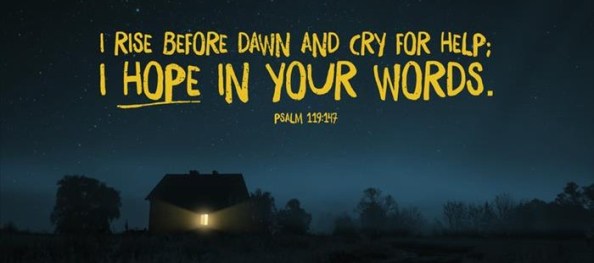
I rise before dawn and cry for help; I hope in your words.
We’ve seen how David prayed in verse 145 and what he prayed for in verse 146. Now we get a glimpse into when he prayed. It seems David was a morning person. “O Lord, in the morning you hear my voice.” (Ps. 5:3) “In the morning I will sing of your love.” (Ps. 59:16) In his time of trouble, he didn’t veer from his habit of early morning prayer. As Christopher Ash points out, “Real Christian experience is not occasional forays into the world of prayer”, but a life shaped by daily, consistent conversation with God.
David’s hope found its anchor in God’s promises, not in his own desires. He wasn’t straining to hear a “new revelation” from God. Instead, he stuck with the promises and pled for their fulfillment.

“How important it is to be clear on what He has and has not promised. How many Christians make shipwreck when suffering comes because they think God has broken a promise He never made in the first place. ‘It has shaken my faith,’ they say. But so often the faith that is shaken is a faith that God has promised me what I would like Him to have promised me. We must learn the promises, that we may plead the promises. We must study the promises, that they may shape our longings.” (Christopher Ash)

Verse 148
My eyes are awake before the watches of the night, that I may meditate on your promises.
This verse reveals how long David prayed — through the night. He cried out three times, and then, stayed awake all night meditating on God’s promise. That statement is surprising. My experience is to cry out three (or twenty) times and then stay awake all night fretting, worrying and stressing. What a waste of a sleepless night! David didn’t deny his problems, but he chose to meditate on His promises. All night long.

Verse 149
Hear my voice according to your steadfast love; O Lord, according to your justice give me life.
Why do toddlers cry out for “mama” and “dada” when they wake up in the night? The sound of a little one’s distressed voice brings a loving parent to the rescue. David was confident that his cry would activate that “hesed” love (“steadfast love, lovingkindness, mercy, unfailing love, faithful love, loyal love; a long-suffering love that extends to the undeserving and even intervenes on their behalf”) that God was famous for.

Loving-kindness is one of the sweetest words in our language. Kindness has much in it that is most precious, but lovingkindness is doubly dear; it is the cream of kindness. (Spurgeon)

The cream of kindness. Come on. So good.

Verse 150
They draw near who persecute me with evil purpose; they are far from your law.
I’m not sure we really understand the concept of true persecution. Unlike trouble we bring on ourselves, or inconveniences and irritations, biblical persecution “encompasses all the pressures that afflict the believer because he/she is a believer”. (Christopher Ash) And it always has evil intent, because of the great distance the persecutors are from God’s law. Make no mistake, the devil does draw near to attack believers. David felt the wickedness closing in.

Verse 151
But you are near, O Lord, and all your commandments are true.
Yay!! My favorite word in the Bible!  Evil was near, but God was nearer. All believers are in a “state of nearness” to the Lord based on the Covenant given to Moses on Mount Sinai and then signed, sealed and delivered by Jesus on the cross. According to Thomas Manton, “in addition to this ‘state of nearness,’ there are ‘special acts of nearness.'” By this he means that, in our experience, God is nearer to us at certain times than at others. Or perhaps there are times when we are just more aware of His nearness, His favor, His peace.

It’s worth noting that the word “near” in verse 150 is “qarab” which means “to approach for an unknown purpose” and the word “near” in verse 151 is “qarob” which means “to be approached by kindred, ally or neighbor”. Like a good neighbor…..God is there.

Verse 152
Long have I known from your testimonies that you have founded them forever.
Many times in his life, David experienced the “special acts of nearness”. There is a sweetness in growing older because His testimonies keep testifying to us over time. Confidence grows as we put the promises to the test. Although it is true that we are surrounded by evil in the world, there is a “truer truth” — God is near. And we find that truth by having regular times of nearness to God in the Word.

img_0702

Things I know for sure from this passage:

  • Desperate cries for help are an acceptable form of prayer.
  • There is something special about establishing morning prayer times.
  • I chose what to meditate on; worry is meditation on the negative.
  • Nothing can separate me from the nearness of God.
  • God’s love is rich and sweet and rises up when I am still.

Next: Qoph

Long Song Study, part T

study2

Every verse in this section of Psalm 119 starts with the Hebrew letter “Tsadhe” (more on that tomorrow). The letter means “righteous” — and that’s definitely the theme of this passage. A form of the word is used six times in eight verses. Let’s dig in!

Verse 137
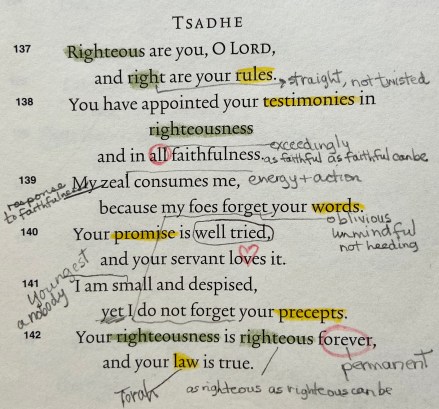
Righteous are you, O Lord, and right are your rules.
Righteous: upright, moral, virtuous, good, pure, true, just. Righteousness covers a lot of ground, but basically it boils down to perfect perfection, excellent excellence, faultless faultlessness. You get the idea — just keep on piling up the words. David made the connection that a righteous God would have to be the author of righteous laws, otherwise He wouldn’t be righteous. God’s perfect rightness was a great comfort to David, assuring him that God would always deal with him in the same way: uprightly, morally, with virtue and goodness, in purity, truth and justice.

Verse 138
You have appointed your testimonies in righteousness and in all faithfulness.
Moses is given credit for writing down the first five books of the Bible (the Pentateuch, or Torah). But David didn’t forget that every word was a result of divine authority, given to Moses by the direction of God. The Bible is not a smorgasbord that we get to pick and choose from according to our personal preferences and tastes.

It is not left to our choice whether we will accept them or not; they are issued by royal command, and are not to be questioned. God’s word is righteous and cannot be impeached; it is faithful and cannot be questioned; it is true from the beginning, and it will be true unto the end. (Spurgeon)

See that little word “all” before faithfulness? Like a balloon that keeps expanding with every breath blown into it, this expression means His faithfulness never explodes. It just keeps filling and filling until it’s as faithful as faithful can be.

Verse 139
My zeal consumes me, because my foes forget your words.
David’s certainty about the perfection of God’s law made him incredulous when he saw others dismiss it with contempt. It ate him up inside to witness his enemies utterly ignoring the commands of God Himself. David wasn’t personally offended, but burned with holy anger that God would be treated in such a way. I get it. It riles me up to observe professing Christians, who have been taught the truth, act like they have forgotten every bit of it.

Verse 140
Your promise is well tried, and your servant loves it.
Other versions use the words “very pure” and “thoroughly tested”, but I like the sound of “well tried”. Commands are to be obeyed, but promises are to be “well tried”. The Word can stand up to the test. That’s why David loved it so — it had been weighed and measured and NOT found wanting. In fact, “the more we try the promises, the surer we shall find them.” (George Horne)

Verse 141
I am small and despised, yet I do not forget your precepts.
David was the youngest of the eight sons of Jesse. That’s seven older, burly brothers. When Samuel was looking for a king to anoint in Jesse’s house, David wasn’t even considered a possibility by his father. Years later, as King of Israel, perhaps David still suffered from “Youngest Child Syndrome” — the littlest child overshadowed by a crowd of strong personalities. When David showed up on the front lines of the Philistine battle, his older brothers despised him for challenging Goliath. It’s hard to get over things like that. That’s conjecture, of course. Still, David didn’t blame God or use pain from the past as an excuse. Like David, we all have had past experiences that left us feeling insignificant and undervalued. And like David, we need to hold on to the truest, most reliable thing in life — God’s words.

Verse 142
Your righteousness is righteous forever, and your law is true.
David tried hard to establish the theme of righteousness in this passage. Here he started piling up the words: God is right and He is righteously righteous. He is righteous as righteous can be. And it’s not a temporary thing — it’s a forever-and-ever-amen thing. That truth gave David a firm foundation on which to stand.

Verse 143
Trouble and anguish have found me out, but your commandments are my delight.
It seems like a contradiction to have trouble and anguish alongside delight.

Only the one who is acquainted with the struggles of the spiritual life will understand the expression before us. Let the reader herein find a balance in which to weigh himself. Does he find, even when he is begirt with sorrow, that it is a delightful thing to do the will of the Lord? (Spurgeon)

Well? Are you begirt (surrounded) with stress and pressure? Can you still delight in the Lord? How does your scale read?

Verse 144
Your testimonies are righteous forever; give me understanding that I may live.
One more time, just in case you missed it, God’s words are righteous forever. Got it?

And so he rejoices in the sheer trustworthiness of the word of God. That the small, despised nobody, who burns with jealous anger for the honor of God, who endures trouble and anguish, may safely rest on this righteous word. (Christopher Ash)

img_0677img_0679

Things I know for sure from this passage:

  • When I say God is righteous, I’m not describing what He does, I am describing who He is.
  • God invites me to put His promises to the test.
  • Well tried promises lead to deeper love for the Word.
  • Even when trouble finds me, I can find delight in God’s words.
  • Studying God’s Word and gaining understanding adds life to my days.

Next: Tsadhe

Long Song Study, part S

bstud

Just when I think David might run out of things to say about God’s law, he comes up with more. In this section of Psalm 119, David used four words that aren’t found anywhere else in scripture. He even displayed his skills by making up a new word.

Verse 129
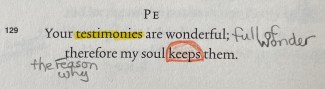
Your testimonies are wonderful; therefore my soul keeps them.
We’ve studied seventeen sections of poetry with one hundred and twenty-nine verses, and still David keeps finding new ways to extol God’s Word. “Wonderful” (pele) is a Hebrew word that means: extraordinary, astonishing, miraculous. This made me do a double-take. The Book that sits on my desk, the Book that I sometimes ignore and sometimes read over quickly, that same Book is a miracle. And it can do miraculous things in me. Of course, David wanted to keep testimonies that filled him with wonder.

Verse 130
The unfolding of your words gives light; it imparts understanding to the simple.
Again, David reached down deep for just the right word: unfolding. This is the only place in the whole Bible this word is used and it means “revelation”. I love the idea that when we open the pages of our Bibles, God begins to unfold truth and reveal His thoughts to us. He gives us clarity where there is confusion and illumination where there is fogginess. This isn’t just available to seminary students or Bible scholars, but also to the simple. (Can I get an “amen”?) It doesn’t take great intellect to understand God’s Word because it’s the Spirit’s work to activate our hearts and reveal truth. We can’t use the excuse that we’re not smart enough to understand the Bible. Smartness isn’t required.

light2

Verse 131
I open my mouth and pant, because I long for your commandments.
David compared himself to an animal that was running, open-mouthed, sucking in air, heart beating hard, muscles exerting themselves at full capacity, running for its life. That’s how hard David went after God’s Word. The word “pant” means “to inhale eagerly, breathless.” In other words, approaching the study of God’s commandments should take our breath away. And did you notice what David was yearning for? God’s commandments! Most of us long for God’s promises more that His laws. David’s longing pushed him to action. As Spurgeon points out, “Longing that is not acted upon is more wishing than longing. Never rest content with mere longings.”

Verse 132
Turn to me and be gracious to me, as is your way with those who love your name.
In this verse, David began a list of prayer requests. First, he asked God to turn toward him and second, to be gracious to him. David knew that the moment God faced him, mercy would be needed. But he also knew from experience that this was God’s way of doing things. We can come to the Lord every morning for a fresh batch of mercies. “His loving-kindness begins afresh each day.” (Lam. 3:23) It is His way.

Verse 133
Keep steady my steps according to your promise, and let no iniquity get dominion over me.
Another request by David — this time for steadiness in his spiritual journey. He wanted to stay firmly grounded in the Word. Many people want their steps directed by something else — their feelings or friends, circumstances or comforts. David reminded God of His promise to direct him because he was aware that small compromises could lead to becoming dominated by sin. Paul warned of the same thing, “Therefore do not let sin reign in your mortal body so that you obey its evil desires.” (Romans 6:12) Steady obedience is the key, perhaps something David learned the hard way.

“Oh, how we often stagger along! We do what is right, but we quiver and shake while we are doing it.” (Spurgeon)

Verse 134
Redeem me from man’s oppression, that I may keep your precepts.
Once he addressed his internal battle with sin, David looked at his external struggles and requested help with those, too. Man’s oppression came in many forms, including cruelty, injustice, slander, exploitation, lies. Need I go on? Those kinds of outside pressures wore David down and distracted him from focusing on God’s laws.

Verse 135
Make your face shine upon your servant, and teach me your statutes.
David, the wordsmith, took the word “light” that he used in verse 130 (“The unfolding of your words gives light”) and made up a new word by attaching the word “face”. When God turned His face toward David, he saw God’s favor shining out from it. “Light” and “shine” create a beautiful connection — follow me here. When we “unfold” the word of God and let His truth shine on us, it’s the same thing as the face of God shining His favor on us. When we open our Bibles, we’re as close as we can get to seeing God’s face. *Shiver*

Verse 136
My eyes shed streams of tears, because people do not keep your law.
David cried lots of tears. The word “streams” means “a channel of water” or “an irrigation canal.” You could say David cried a river. To make a point, he used an idiom to express his deep sorrow and anguish. What caused such emotion to rise up in David? He was sick at heart because everywhere he looked, people were blowing off God’s words. Because the people refused to listen, follow or obey, David wept. 
“One of the darkest signs of any age is when the people weep but little for sin.” William Swan Plumer

img_0602img_0603

Things I know for sure from this passage:

  • I need to seek forgiveness for a flippant attitude toward the extraordinary, astonishing, miraculous gift of God’s Word.
  • If I’m panting after something other than God, it may be an idol.
  • It’s hard to keep a steady walk with God when sin has a hold on part of my life.
  • When I open the pages of scripture, God’s light shines on me.
  • Hardness and pride will keep me from weeping over the brokenness of sin in the world.

Next: Pe

Long Song Study, part R

In the words of songwriter Bob Dylan,
“You’re gonna have to serve somebody.”
David may have been the king of Israel,
but he never forgot that he was the servant of God.

choose

Verse 121
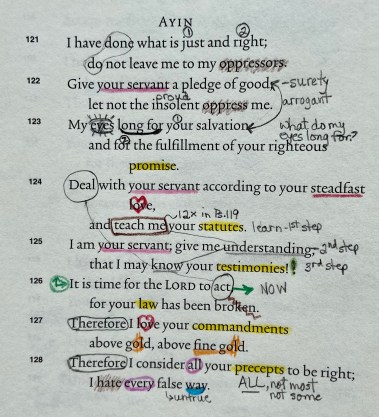
I have done what is just and right; do not leave me to my oppressors.
As ruler of Israel, King David could say with confidence that he had done his best to uphold justice and make honorable and ethical decisions. Therefore, he approached God with boldness and pled for deliverance. We come humbly to the throne of God when dealing with our sin, but when we are being unjustly accused, we can call on our Deliverer for rescue.

Verse 122
Give your servant a pledge of good; let not the insolent oppress me.
What is a “pledge of good”? Let’s get some help with this one.

To give a pledge means to take responsibility for someone else, perhaps for their debt…. It means you will guarantee the payment of my debt, if necessary by paying it yourself. (Christopher Ash)

So, David was asking for back-up, a promise from God to stand between him and his oppressors. The thing David asked for, we now have in Jesus.

David was praying for the cross. This prayer points forward hundreds of years later when God did just that, in the person of his Son; when he took responsibility for our debts, and nailed them to the cross. (Christopher Ash)

We now have Jesus, who stands between us and our Accuser, the devil. He interposed His precious blood to pay the debt we could not possibly pay. Hallelujah for living on this side of the cross!

Verse 123
My eyes long for your salvation and for the fulfillment of your righteous promise.
We have something David longed for: salvation and fulfillment of the promise. This verse makes me ask some questions, “What do my eyes long for? Am I yearning for the final consummation of the remaining promises? Have I set my heart, my mind and my eyes on things above and not on earthly things?”
“So we fix our eyes not on what is seen, but on what is unseen. For what is seen is temporary, but what is unseen is eternal.” (2 Cor. 4:18)

Verse 124
Deal with your servant according to your steadfast love, and teach me your statutes.
God always deals with us from a standpoint of love, specifically “hesed” love. His mercy comes in one of two ways: God either removes us from trouble or supports us in trouble. “God hasn’t promised temporal deliverance from every trial we encounter. He hasn’t promised us that we will live above the turmoil of this fallen world. He has promised to guard us from ultimate evil — the loss of Him. And He has promised to sustain us through seasons of lament by reviving our sense of His distinguishing love as revealed in His word.” (Stephen Yuille) And He promises to teach us, if we will only be teachable. David asked God to teach him twelve times in Psalm 119. There’s always more to learn.

Verse 125
I am your servant; give me understanding, that I may know your testimonies!
For a third time, David emphasized his position as a servant. Humbly he asked to be taught and then to take the next step — to gain understanding. A human teacher can present the material, lay out the facts, and write down the equations. But she can’t make a student understand all the nuances and underlying truths. God can do that. He can both teach us and give us spiritual insight which results in real knowledge. Which leads to real wisdom.

Verse 126
It is time for the Lord to act, for your law has been broken.
This might sound a bit audacious or a little bossy. But it’s not! This is the prayer of saints throughout time: “Your kingdom come!” “Come, Lord Jesus!” God actually loves it when we pray like that. Except we usually call for God to act on our behalf when we are personally hurt or in trouble. David was most concerned about God’s honor, not his own comfort. The king’s heart was broken because the commands of God were being broken. What makes your heart break? “Let my heart be broken for the things that break the heart of God.” (Bob Pierce)

Verse 127
Therefore I love your commandments above gold, above fine gold.
David was surrounded by people who despised God’s law. And what was his response? To love the words of God even more. “The more the pressure grows to abandon it, the more passionately and delightedly he embraces it. He is deeply loyal.” (Christopher Ash) The word for gold in Hebrew is “zahab”, which means “gold colored”. The word for fine gold in this verse is “paz” which means refined, pure, 24-karat gold. David valued God’s word more than all the shimmery, shiny, veneered things the world had to offer. Then he intensified his statement: God’s word meant more to him than the most pure and precious thing in creation.

Verse 128
Therefore I consider all your precepts to be right; I hate every false way.
When the secular, God-less culture begins to find fault with God’s Word, we can be all the more sure that God’s Word is right. “When confidence in God is counted vile, we purpose to be viler still.” (Spurgeon) You have to admire David for this: “he was a good lover and he was a good hater, but he was never a waverer.” (Spurgeon)

(You didn’t think I could get through a passage without a quote by Spurg, did you?)

img_0522

Things I know for sure from this passage:

  • If I want to hear someday, “Well done, good and faithful servant,” then I need to be a good and faithful servant today.
  • God Himself is willing to teach us, which is an act of great grace.
  • All of God’s precepts are right; not most, not some, not just the ones I agree with.
  • False ways are to be hated; not flirted with, not dabbled in, not excused.
  • Love for the Lord leads to love for His Word.

Next: Ayin

Long Song Study, part P

study

This section of Psalm 119 might be the most difficult one for me so far. It’s tempting to “clean up” scripture that seems a bit shocking or disturbing. I look up the Hebrew meanings, hoping to find a less harsh definition — something more pleasant. But it’s real and raw and right there in God’s Word. We have to deal with it!

Verse 113
I hate the double-minded, but I love your law.
Right off the bat, David started with a cringe-worthy word. Hate. It’s a hated word, especially in our present culture. I checked it out in Hebrew. It means “hate” as in “to hate”. There’s no way around it, folks. What is the object of this hatred? Double-minded people. I looked that up, too. This is the one and only time in the whole Bible this word is used (in Hebrew). It’s a word David was saving for this moment. It means “skeptical, doubtful, divided in thinking”. Also, “two-faced”, “double-dealing”, and “underhanded”.
James said it like this: “The one who doubts is like a wave of the sea that is driven and tossed by the wind; he is a double-minded man, unstable in all his ways.” (James 1:6,8) The Greek word James used is “di-psychos” = two-spirited, vacillating in opinion.

Or in the words of Aaron Burr,
“Don’t let them know what you’re against or what you’re for.”
Or in the words of Alexander Hamilton,
“If you stand for nothing, Burr, what’ll you fall for?”

Verse 114
You are my hiding place and my shield; I hope in your word.
In the midst of such inconstancy all around him, David turned to the stability of God and His word. God Himself was David’s safe place. He found shelter and protection in the Lord. It wasn’t the first time. “You are a hiding place for me; you preserve me from trouble.” (Psalm 32:7) Spurgeon said, “It is easy to exercise hope where we have experienced help.”

Verse 115
Depart from me, you evildoers, that I may keep the commandments of my God.
David was clear about who he could and could not hang around with. It’s hard to keep God’s commands when in the company of those who insist on evil behavior. Instead of leaving the scene of evil shenanigans, David sent them packing: “Get away from me! Leave me alone!” And he told them why. It is our right and our duty to kick out all sources of wickedness from our midst. “Evildoers make evil counselors, and therefore we must not sit with them.” (Spurgeon)

The distance he has in mind is more the avoidance of partnership than of physical proximity. He wants to avoid sharing their values and being infected by their fellowship. This cry points up an ongoing tension for believers who are in the world but must not let the world’s values get into them. As D. L. Moody is supposed to have said “The ship is in the sea; but woe betide the ship if the sea gets into the ship.” (Christopher Ash)

Verse 116
Uphold me according to your promise, that I may live, and let me not be put to shame in my hope!
In this verse and the following verse, David asked to be held up. The double-minded influences would try to bring him down, so he asked God to lift him above the rancor that sucked the life out of him. (Sound familiar?) Aware of the weakness in his own heart, David went to prayer, pleading for the grace of God. “David meant to keep the law of the Lord, but he first needed the Lord of the law to keep him.” (Spurgeon)

Verse 117
Hold me up, that I may be safe and have regard for your statutes continually!
Without the hand of God holding him, David questioned his physical safety and his spiritual fortitude. He didn’t want to be tossed by the winds of popular culture. Instead, he desired to maintain a steady gaze at God’s word — to develop a regular, consistent, daily time studying and meditating on the statutes.

Verse 118
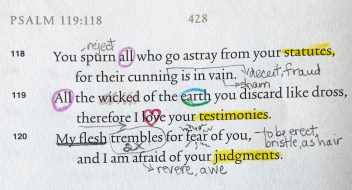
You spurn all who go astray from your statutes, for their cunning is in vain.
We know how David felt about double-minded people (v. 113), but here he seems to think God feels the same way. What happens to those who spurn (which means: to reject with disdain, scorn and contempt) God? Does He spurn them back?
Paul addressed this in his letter to the Romans.

Therefore God gave them over in the lusts of their hearts to impurity….because they exchanged the truth about God for a lie.” (Ro. 1:24) “For this reason God gave them over to dishonorable passions.” (Ro. 1:26) “And since they did not see fit to acknowledge God, God gave them over to a debased mind to do what ought not to be done.” (Ro. 1:28)

When we choose sin over the goodness of God, we spurn Him. No matter how sly or smart we think we are, that choice will always be futile. If we insist that sin is what we want, God will give us over to it. Thankfully, just as the Father let the Prodigal Son go to a far country to squander the inheritance, that same Father also ran to embrace him when the wayward child turned toward home.
Still, God’s judgment is certain. “Sooner or later, God will set his foot on those who turn their foot from his commands; it has always been so, and it will be so to the end.” (Spurgeon) 

Verse 119
All the wicked of the earth you discard like dross, therefore I love your testimonies.
Yep. God discards the wicked like dross.
Dross: waste matter, slag, or scum left over after melting metal in a furnace; something regarded as worthless or rubbish; impurity.
It may be that the things that are so highly valued in this world (fame, power, money, celebrity status) will become nothing but garbage in the next world. The testimonies of God, on the other hand, will be pure gold in eternity. “But who can endure the day of his coming? Who can stand when he appears? For he will be like a refiner’s fire.” (Malachi 3:2) “Pure gold put in the fire comes out of it proved pure; genuine faith put through this suffering comes out proved genuine. When Jesus wraps this all up, it’s your faith, not your gold, that God will have on display as evidence of his victory.” (1 Peter 1:7)

Verse 120
My flesh trembles for fear of you, and I am afraid of your judgments.
David shivered at the thought of God’s righteous judgment. He had goosebumps and the hair on his arms stood straight up. That’s a fitting reaction to God’s power. The word “afraid” means reverence and awe, so for the believer, it sounds like “awe”; for the unbeliever, who defies God with contempt, it will sound more like “AHHHHH”. As beloved children, we don’t need to feel dread or terror in the presence of God, only stupefaction (overwhelming amazement)!

img_0488img_0490

Things I know for sure from this passage:

  • Double-minded thinking is to be avoided, as it casts doubt and creates instability.
  • We are responsible to keep evil influence from entering our homes and our hearts.
  • God holds us up as we place our hope in Him alone.
  • I need to discard “dross” from my life and focus on investing in “gold”.
  • It is right and good to be awe-struck by God Almighty.

Next: Samekh

Long Song Study, part O

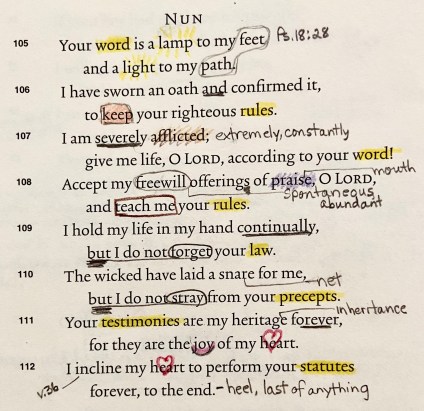
After extolling the wisdom of God’s Word in the previous section of Psalm 119, David made a decision to follow it. It was settled — he was determined to live according to God’s ways and words.

thy

Verse 105
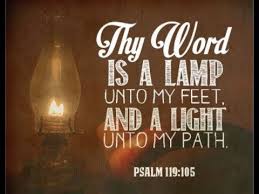
Your word is a lamp to my feet and a light to my path.
David thought of God’s word as light to help him see things he wouldn’t otherwise be able to see. Jerusalem didn’t have street lights in David’s day. If people ventured out at night, they carried a lantern to illuminate their path, helping them avoid open sewers or horse poop on the road. The lamp didn’t serve as a guide as much as it provided a way to keep from stumbling into the muck. This lamplight only was effective for the person who was up and moving on the path, not for the the one who was sitting on the couch wishing for direction. As Thomas Manton said, “It is not a light to our brains to fill us with empty notions, but a light to our feet to regulate our practice and to guide our actions.”

Verse 106
I have sworn an oath and confirmed it, to keep your righteous rules.
David had made a promise to carry the light of God’s Word throughout his course of life. That was a good move, but he knew he had to revisit that decision often and recommit himself to it regularly. Why did he swear on a stack of Bibles to stick with God? Because he knew himself — he could be stubborn, fickle and lazy. And he had a thing for beautiful women. Still, it was good to make a vow, even though he didn’t have the strength within himself to keep it perfectly. Paul prayed for New Testament believers with this idea in mind: “We pray for God’s power to help you do all the good things that you hope to do and that your faith makes you want to do.” (2 Thess. 1:11)

Verse 107
I am severely afflicted; give me life, O Lord, according to your word!
This determination to keep God’s righteous rules wasn’t based on an arrogant view of his own strength. As soon as he swore to live by God’s standards, he pled for God to give him grace to keep that promise. Affliction may have driven David to confirm his resolve. It’s hard to stay true when going through seasons of severe testing. “We need to remember that the Christian life always ends well, but it doesn’t always go well.” (Stephen Yuille) An initial decision to follow Jesus, especially when made publicly, helps us stay on course during difficult times that may come down the road.

Verse 108
Accept my freewill offerings of praise, O Lord, and teach me your rules.
There’s nothing more powerful that genuine, heart-felt praise in the face of severe affliction. David offered praise, not because he felt obligated or under constraint, but because he wanted to, of his own free will. He meant it. The word “freewill” implies a spontaneous and abundant outpouring from his mouth. In other words, he spoke his praise out loud, even while beset with troubles. His offering of praise was not required by Old Testament law and had nothing to do with payment for sin. It just bubbled up from a heart of love for his Lord. Once again, David humbly asked for continued instruction.

Verse 109
I hold my life in my hand continually, but I do not forget your law.
Evidently, David’s decision to commit himself to God was fraught with danger on a daily basis. That is still true today for believers in many parts of the world. Whether we are aware of it or not, there are always evil forces working against any believer’s resolve to follow righteousness. The life of faith is something we have to continually fight for. Even so, David kept God’s law in the forefront of his thinking. “While he carried his life in his hand, he also carried the law in his heart.” (Spurgeon)

Verse 110
The wicked have laid a snare for me, but I do not stray from your precepts.
Traps had been set to trip David up and take him down. Snares are tricky — they are hidden from view and meant to catch or entangle something unawares. No wonder David felt like he was being hunted; every move he made was risky. For the second time in two verses, David used my favorite word in the Bible — but. No matter what, David would not abandon God’s law or wander away from God’s truth.

lantern

Verse 111
Your testimonies are my heritage forever, for they are the joy of my heart.
In light of the daily pressure of snares and affliction, David turned his thoughts to eternity. He needed some joy, so he pinned his happiness on the everlasting nature of God’s word. He relished the thought of a “forever” where every promise would be fulfilled and peaceful joy would reign. He was able to get a taste of that joy by affirming his future inheritance.

Verse 112
I incline my heart to perform your statutes forever, to the end.
Back in verse 36, David wrote, “Incline my heart to your testimonies.” He was asking God to help him “stretch toward” and “lean in” to God’s word. Seventy-six verses later, David was taking hold of his heart and telling it where to lean. He took the long view and then reconfirmed his intention to stick it out to the end. To infinity and beyond.

I like this illustration by Stephen Yuille:

“We struggle with inordinate affection for this world. If I offer a three-year-old child a choice between a chocolate bar and a check for one thousand dollars, which will he choose? He will choose the chocolate bar. Why? He doesn’t see the big picture. He doesn’t see the future. He doesn’t perceive the value of the check in comparison to the chocolate bar. I fear many of us don’t perceive the difference between the temporal and eternal.”

img_0456

Things I know for sure from this passage:

  • It takes pre-determined resolve to finish well.
  • God sheds light on my path as I spend time in His Word.
  • Snares come in many shapes and forms: revenge, unforgiveness, lust, and pride, to name a few.
  • I need the light of the Lord to help me stay out of the muck of the world.
  • I must “incline” my heart, or make it lean, toward Jesus.

Next: Nun

Long Song Study, part N

David relied heavily on God and His word during his period of suffering. Study, meditation and obedience while under duress produced something in the psalmist — wisdom, understanding and insight. And a great love for God’s word.

“No man ever loved his Bible too much.”
William Swan Plumer

honey

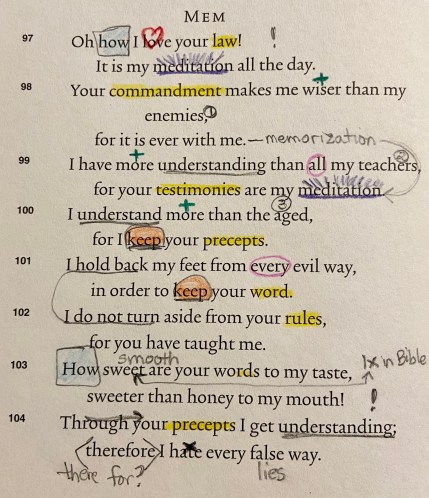
Psalm 119:97-104

Verse 97
Oh how I love your law! It is my meditation all the day.
It’s possible to study the Bible, obey the Bible and even teach the Bible, but not love the Bible. David’s love for the law came as a result of meditating on it. Remember, we’re not talking about some Eastern form of meditating — a kind of passive emptying of the mind. Christian meditation is active. It is thinking over and dwelling on the purposes and promises of God, “consciously performed in the presence of God, by the help of God, as a means of communion with God.” (James Packer) “David meditated on God’s word because he loved it, and loved it the more because he meditated on it.” (Spurgeon) He couldn’t get enough of it.
“This love for God’s word is a great proof of love for God. If a man says he loves God, but neglects His word, that love must be called into question.” (Christopher Ash)

Verse 98
Your commandment makes me wiser than my enemies, for it is ever with me.
David credited the law for giving him wisdom, beyond that of his enemies. We live in a difficult world and trying to navigate all the posts and tweets and opinions is nearly impossible on our own. The Bible gives us absolute access to the Architect and Creator. When we need to know how to think about an issue, we need to run to our Bibles where we can connect to God’s wisdom without limit.
How did David keep the commandments near him? Probably by memorizing portions of scripture. But it was also his duty, as the law stated, “When the king takes the throne of his kingdom, he is to write for himself on a scroll a copy of this law. It is to be with him, and he is to read it all the days of his life.” (Deut. 17:18-19) So King David had copied the entire Torah by hand and was charged with keeping it with him. That’s a good law. Maybe we should bring it back.

Verse 99
I have more understanding than all my teachers, for your testimonies are my meditation.
It’s good to learn from human teachers. I can name many that have impacted me over the years. (And they’re not all old dead guys.) David recognized he had an understanding that went beyond knowledge and again, he traced it back to his untiring commitment to soak in God’s word.

Verse 100
I understand more than the aged, for I keep your precepts.
Usually, older people are considered to be wiser, having learned from their life experiences. Usually. However, very smart, experienced people can still lack wisdom. It seems there is always a connection between understanding and obedience. David wasn’t just a hearer of the word, but also a doer. “He that excels in practice has the best understanding.” (Thomas Manton) Far from bragging about his great insight, David was extolling the wonder of God’s great wisdom and His ability to put it in a person’s head and heart.

Verse 101
I hold back my feet from every evil way, in order to keep your word.
David gets practical here. There are just some things that don’t mix with godly wisdom, like evil. Not that it’s easy. He had to make a conscious effort to hold back those feet of his from taking him the wrong way. The choice was before him: keep the word he had grown to love or chase after lies. “If we keep the good word, we must let go the evil.” (Spurgeon)

Verse 102
I do not turn aside from your rules, for you have taught me.
Compared to walking down evil paths, a little turning aside doesn’t seem like a big deal. That is what makes it such a subtle temptation. Turning aside from reading the Bible, praying, and fellowship can begin a slow slide away from the Lord. David wouldn’t do it.

Verse 103
How sweet are your words to my taste, sweeter than honey to my mouth!
When Jewish boys were six years old, they entered school at the local synagogue. On the first day of school, the rabbi would take a generous amount of honey and put it on each of the boys’ slates. Then the rabbi would tell the boys to lick it off as he quoted from Psalm 119, “May the words of God be sweet to your taste, sweeter than honey to your mouth.” The students’ first association with scripture was sweet, helping them understand that nothing was more enjoyable than receiving and tasting the Word of God. Many people are introduced to the Bible as a set of rules and commands, a list of dos and don’ts. Let’s add a bit of sweetness as we share the Word.

Verse 104
Through your precepts I get understanding; therefore I hate every false way.
The better we understand the heart of God in His law, the easier it is to see religion that’s fake. Hate is a strong word, but there’s a time and place for it. “It is well to be a good hater. Not a hater of living beings, but a hater of every false way. The way of self-will, of self-righteousness, of self-seeking, of worldliness, of pride, of unbelief, of hypocrisy — these are all false ways, and therefore not only to be shunned, but to be abhorred.” (Spurgeon)

img_0313

Things I know for sure from this passage:

  • Knowing a lot does not equal wisdom.
  • God’s Word has the power to make us wise people.
  • When we study the Bible, God Himself is our Teacher.
  • Meditating on God’s Word helps us keep His commands.
  • Wisdom is knowledge put to practical use, usually through obedience.

(Click here if you want to discover the difference between wisdom and knowledge!)

Next: Mem