Now I Know My ABCs

The Alphabet Song—it’s one of the first songs we learn as children.

We sing “A-B-C-D-E-F-G….”
before we know the sound each letter makes,
before we understand that letters can be combined to make words,
before we comprehend that words can be put together to make sentences,
before we grasp that sentences can create stories that can become books.
The letters of the alphabet are the building blocks of language.

The next time you go into a library or book store,
look at the plethera of books and think,
“Every word in every book on every shelf has used the same 26 letters.”

From Goodnight Moon to Paradise Lost
from People magazine to Encyclopedia Britannica.
All we have is 26 letters.
And endless combinations to make millions of words. 

The ancient Hebrew alphabet had 22 letters.
Back in 2020, I did a series on each of the letters in the Hebrew Aleph-Bet.
Every day, those blog posts are still read.
Every single day.
Five years later.
I don’t know who you are, but thanks for reading!
To make it easier to access, I created a category called “Hebrew Alphabet.”
May God bless the letters in both of our alphabets.


For further reading:
ABCs
Aleph
Bet


Tav

Tav is the twenty-second and final letter in the Hebrew alphabet. Tav (also written as “Taw”) has the same sound as “t” as in “tall”. Every line in Psalm 119:169-176 starts with this letter. Tav looks like this:

taw

The word Tav means “mark” or “seal” or “sign”. In the earliest Hebrew script, the letter tav was the shape of a cross, much like our English letter “t”.

tav

The last letter of the Aleph-Bet reveals Jesus in a powerful way. The first letter, “Aleph”, showed the God-man who came to be a bridge between heaven and earth. That bridge came in the shape of a cross, or “tav”. Jesus’ death on a cross was foreshadowed in the letters of the Hebrew alphabet. He is the Alpha and Omega, the Aleph and Tav.

When Aleph-Tav is seen together in one word in Hebrew scripture, it’s like a verification signature or seal of the Author. It appears in significant places in the Bible, but because it is not translatable, it is overlooked in our English translations. But the combination of Aleph-Tav is all over the Old Testament, about 7,000 times! The combination of the two letters is even found in the very first verse of the Bible, Genesis 1:1. The message of Jesus’ coming to earth and His death on the cross is embedded in the dawn of creation!

The word “tav” can be found in Ezekiel 9:4, where God put a mark (tav) on the foreheads of the people who opposed the worship of idols. The death angel was told, “Do not come near anyone who has the mark.” This same idea is in Revelation 22:4, “They will see his face, and his name will be on their foreheads.” Some believe that mark will be the Hebrew letters Aleph and Tav.

Tav also stands for “truth”.
The Hebrew word for truth is “emet” which is spelled
Aleph (The Creator)
+
Mem (gives His life)
+
Tav (on the cross).

The gospel is also easily seen in the word “Torah”,
which is spelled
Tav (the cross)
+
Vav (the nail)
+
Resh (the Captain, or Leader)
+
Hey (Behold!).

tavdagesh

Next: My favorite word in the Bible that starts with Y.

Shin

Shin is the twenty-first letter in the Hebrew alphabet. Shin (also written as “Sin” or “Sheen”) has the same sound as “sh” as in “shy”. Every line in Psalm 119:161-168 starts with this letter. Shin looks like this:

shin

Shin is one of the most important letters in the Hebrew aleph-bet for several reasons.

First, Orthodox Jews hang a mezuzah on the right doorpost of their front entrances. This decorative case contains a small scroll with a prayer on it and whenever someone goes out or comes in, they touch the mezuzah to remember the prayer: “Love the Lord your God with all your heart and with all your soul and with all your strength.” The letter Shin is engraved on all mezuzahs to represent 1) “El Shaddai”, a name for God which means “God Almighty”, 2) “Shema”, the prayer written on the scroll, and 3) “Shomer”, which means protection.

mazuzah

Second, God has written His name on His city, Jerusalem. An arial photograph of the Holy City reveals three valleys that create the shape of the letter Shin. God Almighty wasn’t kidding when He said, “In Jerusalem, I will put my Name forever.” (2 Kings 21:4)

map

And third, God has embedded His name in every human heart. The shape of the letter Shin mimics the structure of the human heart: the lower, larger left ventricle (which supplies the full body) and the smaller right ventricle (which supplies the lungs) are positioned like the lines of the letter Shin.

heart

Shin looks a bit like a flame and that’s no accident. The Hebrew word for “fire” is made up of the letters Aleph + Shin. God’s presence in the Old Testament was often seen as a flame. A burning bush drew Moses’ attention and a pillar of fire led the Israelites through the desert. When God gave Moses the Ten Commandments on Mt. Sinai, He descended on the mountain with flames, smoke and thunder. The Israelites celebrated that day every year with a holy feast called Pentecost.

Fifteen hundred years later, to the day, the Holy Spirit descended on believers with tongues of fire and the church was born. Fire purifies, burns off the dross, and provides heat and light.

One last thing: When the temple priests would give the Hebrew Priestly Blessing at the end of the service, they would lift their hands and make the sign of Shin while reciting, “The Lord bless you and keep you; the Lord make his face shine upon you and be gracious to you; the Lord turn his face toward you and give you peace.” (Num. 6:24-26)

blessing

As a child, Leonard Nimoy went to synagogue services with his grandfather. He was intrigued by this sign of “shalom” or peace. As Dr. Spock, Nimoy implemented the gesture on Star Trek to mean “live long and prosper”.

spock

Shalom!

Next: My favorite word in the Bible that starts with W.

Resh

Resh is the twentieth letter in the Hebrew alphabet. Resh (also written as Reish or Reysh or Rosh) has the same sound as “r” as in “rain”. Every line in Psalm 119:153-160 starts with this letter. Resh looks like this:

resh

Resh means “head”, as in leader, captain or beginning.

The letter’s shape represents someone bending over, just as we bend down to explain something to a child. In the same way, God bends toward us in order to bring His wisdom down to us in His Word. Because God is our “captain” or “leader”, we are to put ourselves under His authority, or headship.

That’s a problem for most of us.

More often than not we want to say,
along with poet William Ernest Henley,
“I am the master of my fate,
I am the captain of my soul.”

Another meaning for the letter Resh is “reason”, or our ability to think logically. Unfortunately, our heads often get in the way of our faith. We use our own human reasoning instead of trusting in the Lord with all our hearts. We tend to lean hard on our own understanding and fleshly logic. Many even use their God-given reasoning abilities to try to disprove God! Instead, our intellect was given to us to enable us to appreciate our Creator.

Resh comes toward the end of the alphabet because even the smartest academician needs something more than raw brain power. In fact, Resh comes after Tsadhe (righteousness) and Qoph (holiness) to show us that our reasoning needs to be led by righteousness and holiness, not the other way around. But when our brains are led by righteousness and holiness, our understanding will be a blessing.

reason

There’s a lot I don’t understand right now,
so I’ll gladly lean on God and let Him lead.

This world is a confusing place,
so I’ll go to His Word to get help sorting it out.

When I feel lost amid the many flawed theories that seem empty,
I’ll hang on to The Way, The Truth, The Life.

Next: My favorite word in the Bible that starts with V.

Qoph

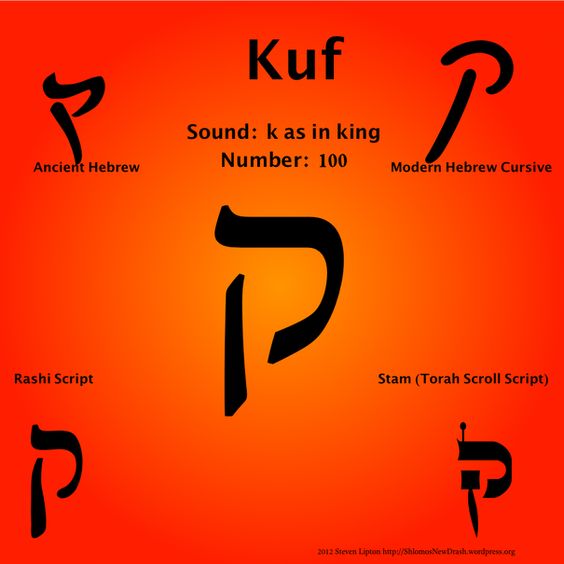
Qoph is the nineteenth letter in the Hebrew alphabet. Qoph (also written as “Kuf”, “Qof”, “Koof”) has the same sound as “k” as in “kite” or “qu” as in “queen”. Every line in Psalm 119:145-152 starts with this letter. Qoph looks like this:

qoph

The letter Qoph stands for the word holy, which means
“set apart for a sacred purpose”.

“God blessed the seventh day and declared it holy (Qadash).” Gen. 2:3

“Within the Temple, at one end, was the most sacred room—
the Holy of Holies” (Qodesh Ha-Qadashim). 2 Chron. 3:8

Holy, holy, holy (Qadosh, Qadosh, Qadosh) is the Lord of Hosts.” Isa. 6:3

holy-holy-holy

Qadash. Qodesh. Qadosh.
Holy. Holy. Holy.

In the Old Testament,
the tabernacle was Qodesh,
the altar was Qodesh,
the plates were Qodesh,
the utensils were Qodesh,
the furniture was Qodesh,
the anointing oil was Qodesh,
the incense was Qodesh.

Then Jesus came.
A Qodesh Person.
“We have come to know that you are the Holy One of God.” John 6:69

Then, somehow, His people were made Qodesh.
“We have been made holy through the sacrifice
of the body of Jesus Christ once for all.” Heb. 10:10

Then the church was born.
“You are a chosen people,
a royal priesthood,
a holy nation….”
1 Peter 2:9

And now we have the voice (Qol) of God in the
Holy Bible.

Thankfully, Qoph reminds us that holiness
is not something we must muster up within ourselves.
“Holiness is not the way to Christ,
Christ is the way to holiness.”
C. H. Spurgeon

kuf

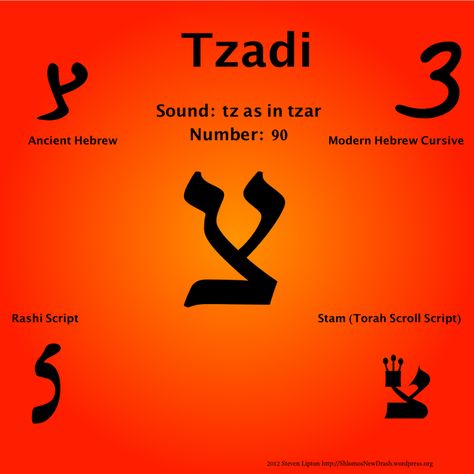
Tsadhe

Tsadhe is the eighteenth letter in the Hebrew alphabet. Tsadhe (also written as “Tsade” or “Tsadde” or “Tzadi” or “Tzadee”) has the same sound as “tz” as in “nuts”. Every line in Psalm 119:137-144 starts with this letter. Tsadhe looks like this:

Tsade

The left side of the letter “tsadhe” represents a humble and faithful servant bent in submission. On the right is a hand lifted up to God. Put those two things together and you have a righteous person. The word “tsadhe” means “righteous one”. Only the humble are truly righteous.

Let’s review the last few letters we have studied.

  • The letter samech – represents safeguarding and closure
  • The letter ayin — represents sight
  • The letter pe — represents speech

Then, after these three letters, comes the letter צ (tsadhe). This cluster of letters tells a story. A person, who safeguards and protects his eyes from evil things and protects his mouth and speech from saying bad things, will be a tsadhe, a righteous individual.

The Pharisees in Jesus’ day were intent on becoming “tsadik” — disciples of righteousness, by doing “tsadakah” — acts of righteousness. Jesus had a few words to say about that.

Be careful not to practice your righteousness in front of others to be seen by them. If you do, you will have no reward from your Father in heaven. So when you give to the needy, do not announce it with trumpets, as the hypocrites do in the synagogues and on the streets, to be honored by others. Truly I tell you, they have received their reward in full. But when you give to the needy, do not let your left hand know what your right hand is doing, so that your giving may be in secret. Then your Father, who sees what is done in secret, will reward you. (Matthew 6:1-4)

The highest form of righteous acts are those done in secret. Can you imagine having a trumpeter play “Reveille” every time you put your offering in the plate? That would get annoying.

trumpet

It’s hard to be righteous.
Trying to sustain righteousness on our own doesn’t work.
“All our righteous acts are like filthy rags.” (Isaiah 64:6)
(“Filthy rags” is most accurately translated as “menstrual cloths”.)
Selah.

Thankfully, we have a Righteous Savior
who not only forgives our filthiness,
but also imputes His righteousness onto us.
“God made him who had no sin to be sin for us,
so that in him we might become the righteousness of God.”
(2 Cor. 5:21)

That’s righteous good news.

tzadi

Next: My favorite word in the Bible that starts with “T”.

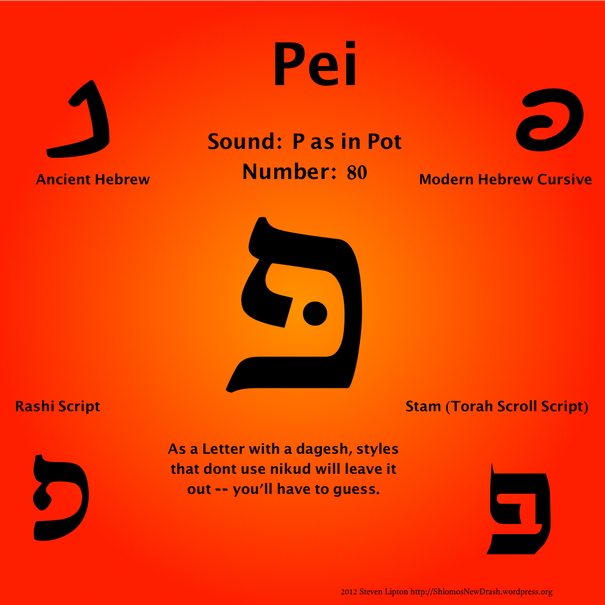
Pe

Pe is the seventeenth letter in the Hebrew alphabet. Pe (also written as Pey or Pei or Peh) sounds like “p” as in “pay”. Every line in Psalm 119:129-136 starts with this letter. Pe looks like this:

pe

The word “Pe” means “mouth” as in “I open my mouth and pant…” (Ps. 119:131) The definition doesn’t just pertain to a physical mouth, but also extends in meaning to “word,” “expression,” “vocalization,” and “speech”.

Genesis states that God created everything by the words of His mouth (Pe). The fact that the letter “Pe” has an opening on its left side shows us that God is still speaking.

Rabbis point out that “Pe” (mouth) follows the letter “Ayin” (eyes), suggesting the importance of seeing (understanding, having awareness) before opening the mouth. If this order is reversed, the result is mindless chatter. Heard any of that lately?

To put it another way:
Engage the brain before putting the mouth in gear.

On the path to discipleship,
learning how to control our words is paramount.
“The tongue has the power of life and death.”
(Prov. 18:21)

The timing of our words is vitally important.
“A well-spoken word at just the right moment
is like golden apples in settings of silver.”
(Prov. 25:11)

The tone we use when speaking is consequential.
“Gracious words are like a honeycomb,
sweetness to the soul and health to the body.”
(Prov. 16:24)

Let “Pe” remind us to make good use of our mouths —
to speak
golden-apple,
honey-sweetened
words of life.

pei

Next: My favorite word in the Bible that starts with “S”.

Ayin

Ayin is the sixteenth letter in the Hebrew alphabet. Ayin (also written as Ayen) has no sound of its own, but usually has a vowel associated with it. Every line in Psalm 119:121–128 starts with this letter. Ayin looks like this:
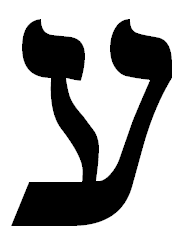
ayin

Like the first letter of the aleph-bet (Aleph), Ayin is a silent letter, so it represents an attitude of humility. The Ayin doesn’t speak, but it “sees” because it is the Hebrew word for “eye” and “to see”.

Rabbis teach that the letter Ayin shows two “eyes” at the top, portraying how Yahweh is able to see both sides of every situation. This letter reminds us that God is watching over us all the time. The eyes of the Lord represent His intimate knowledge about every part of our lives.

“The eyes of the Lord are everywhere,
keeping watch on the wicked and the good.”
(Proverbs 15:3)

In Psalm 119:120-128, David described himself as a servant three times (v. 122, 124, 125). The word servant starts with the silent letter “Ayin”, showing that our service to God and to others should be done without bragging about what we do or drawing attention to ourselves.

Jewish scholars love to find numerical connections in the scriptures. They point out that in Genesis 16, Hagar said, “You are the God who sees me. I have now seen the one who sees me.” The sixteenth letter plays big in the sixteenth chapter of the first book in the Torah.

Because we have two eyes, traditional Hebrews teach that everyone has one evil eye and one good eye, and we choose which one to use to interpret the world around us. Even Jesus used the idea of “good eyes” and “bad eyes” in the Sermon on the Mount.

The eye is the lamp of the whole body. If your eyes are good, your whole body will be full of light. But if your eyes are bad, your whole body will be full of darkness. Matthew 6:22-23

The meaning of this is easily lost on us because He was using an idiom, or a figure of speech, that was relevant in Jewish culture. (Like when we say, “It’s raining cats and dogs,” we don’t mean literal cats and dogs are falling out of the sky.)

In Jesus’ day, to have a “good eye” meant you were generous and open-hearted and to have a “bad eye” meant you were stingy and always chasing after money. Reading this passage in context, it makes sense. Just prior to these verses about eyes, Jesus talked about storing up treasure in heaven. Just after, He taught that we cannot serve both God and money. He wasn’t preaching about eyes! He was teaching about money! He was using an idiom that His audience completely understood. Be generous. Don’t be stingy.

“If we love others sincerely and have a generous spirit, our life will be full of light. If we think only of our own gain, turning a blind eye to the needs of others, our lives will be dark indeed.” (Listening to the Language of the Bible, Lois Tverberg)

The dual nature of our eyes means we need to “keep an eye” on our eyes. On one hand, we can have the eyes of our hearts enlightened by the Spirit. (Eph. 1:18) On the other hand, we have to constantly battle against “the lust of the eyes.” (1 John 2:16)

eyes

Oh be careful, little eyes, what you see.
For the Father up above is looking down in love,
So be careful, little eyes, what you see.

ayin (1)

Next: My favorite word in the Bible that starts with “R”.

Samekh

Samekh is the fifteenth letter in the Hebrew alphabet. Samekh (also written as Samech) has the same sound as “s” as in “saw”. Every line in Psalm 119:113–120 starts with this letter. Samekh looks like this:

samekh

Samekh is the only letter in the Hebrew alphabet that is enclosed. It is a complete circle that portrays how God completely surrounds and encompasses His people. We are upheld by the loving arms of the Father, whose surrounding presence is like a hug.

What have I to dread, what have I to fear,
Leaning on the everlasting arms?
I have blessed peace with my Lord so near,
Leaning on the everlasting arms.

tree

The circular nature of God is evident all over creation.
The planets orbit around the sun.
Tree trunks have concentric rings.
A pebble thrown in water makes circular ripples.
Sand dollars, acorn cups, the center of a daisy.
Onion rings, a slice across an orange, blueberries.
Rabbit droppings.
The cycle of seasons.
The circle of life.

ripples

Rabbis also teach that the “Samakh” is a picture of a strong support,
propping us up so we can weather the storms of life.
“Uphold me….” Psalm 119:116
“Hold me up….” Psalm 119:117
Jesus is our “Samakh”, our great Upholder.

“In Him all things hold together.” Col. 1:17

samach
Next: My favorite word in the Bible that starts with P.

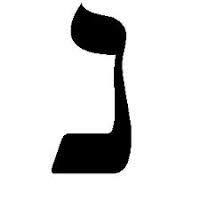
Nun

Nun is the fourteenth letter in the Hebrew alphabet. Nun (also written as “Noon”) has the same sound as “n” as in “nut”. Every line in Psalm 119:105–112 starts with this letter. Nun looks like this:

nun

“Nun” means “life” and is associated with a picture of a fish swimming in the water. Rabbis teach that “Nun” represents all movement and growth in life, like a fish darting in the water, but also as a new seed sprouting or a branch bearing fruit. It carries with it the idea of multiplying, continuing, perpetuating.

Last week, we learned that the letter Mem meant “water”, representing the waters of baptism for a new believer.  The energy of that new life in Christ is found in the letter Nun. It’s no wonder that the early church used the sign of a fish as a secret symbol of being a follower of Jesus.

When threatened by Rome in the first century, Christians used the fish to mark meeting places and to distinguish friends from foes. If a believer met a stranger in the road, he sometimes drew one arc of the simple fish outline in the dirt. If the stranger drew the other arc, both believers were assured of safe company. They knew they were both followers of the One who said, “I will make you fishers of men.” The early disciples understood the importance of multiplying in order to keep the gospel alive.

fish

The first mention of the word “Nun” in the Bible is in Exodus 33:11, in reference to Joshua, the “son of Nun.” Joshua was the one who led the Israelites into the Promised Land. Joshua was, literally,  the “Son of Life” — and a foreshadowed figure of Jesus, the coming Messiah, who will lead us into the promised land of eternity.

The Hebrew word for son is “ben.” The first letter is ב bet with a letter sound of “B” and a word picture of a house. The second letter is a nun נ with a word picture of life and a letter sound of “N”. These two letters together are a word picture of “life in the house.” In other words, the son perpetuates the life of the family; through the son, generations will continue.

“I will be a Father to you,
    and you will be my sons and daughters,
says the Lord Almighty.”
2 Cor. 6:18

We are the life in the house.

The life of faith is revealed in the second half of the Hebrew alphabet. First we are taught (Lamed) and then we take a step of obedience by going into the waters (Mem) of baptism. Nun shows us that the next step is to grow in the new life we have in Christ.

nun1

Next: My favorite word in the Bible that starts with “O”.