Long Song Study, part A

It’s Bible Study Day!
Since we can’t gather together in person right now,
let’s meet up here!

study

Psalm 119 is the longest chapter in the Bible, longer than some entire books of the Bible. Perhaps its length is meant to tip us off to a little secret: learning to walk with God in faith and obedience is not learned in a day. It takes a lifetime. So take God up on His gift of grace, and give yourself some, too.

This study will be more like a slow marathon than a speedy sprint. For those of us non-runners, it will be more like a stroll than a power walk. We’re going to stop and smell some rose-scented words as we saunter through the first eight verses.

Ready? Open up your Bible to Psalm 119. Let’s go!

Verse 1
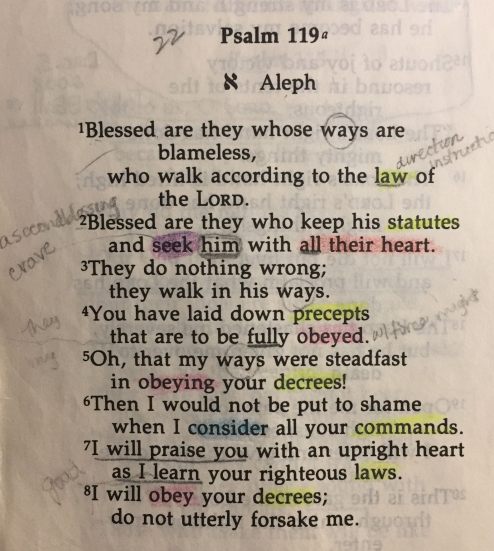
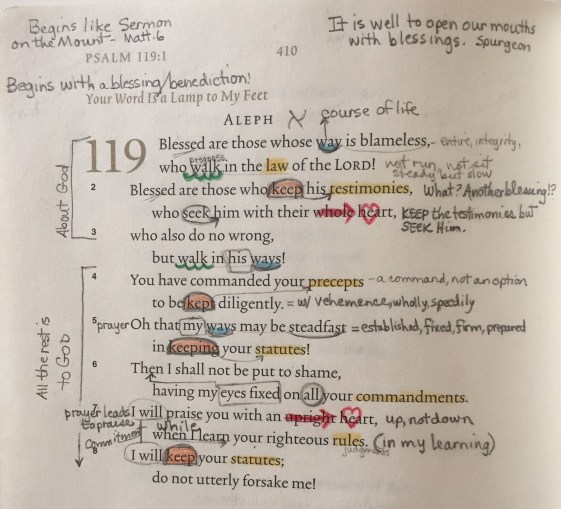
“Blessed are those whose way is blameless, who walk in the law of the Lord.”

How does this magnificent psalm begin? With a blessing! It sounds a lot like the first words Jesus spoke in His first public sermon: “Blessed are the poor in spirit…” The main idea is that there is great blessing in walking in the ways of the Lord.  All of the 175 verses that follow support that one key thought.
Notice it’s a walk, not a run, but also not a sit. We walk, which means there is steady progress, a quiet advance, a persistent continuance. No fast forward, no hurried quick-fix, no checklist with instant results. Also, no lazy bones, no couch potato procrastinating, no waiting for maturity to magically appear.

Verse 2
“Blessed are those who keep his testimonies, who seek him with their whole heart,”

Another blessing! This time it’s for keeping and seeking. “We must first get a thing before we can keep it. And in order to keep it well, we must get a firm grip on it.” (Spurgeon) So, we are to grab ahold of the scriptures and not let go. Keep His Word. But seek Him with all your heart. The Hebrew understanding of “heart” includes the emotions, the will, and the intellect. All of it.

Verse 3
“who also do no wrong, but walk in his ways!”

It’s not enough to refrain from doing wrong things. We are to pursue the right things! By seeking, we find out what His ways are, so that we can walk like Him.

Verse 4
“You have commanded your precepts to be kept diligently.”

At this point, the focus shifts from talking about God, to talking directly to God. And he never stops. The rest of the psalm is a prayer with praise and testimony sprinkled in.
Now we learn how the Word is to be kept: with diligence. The Hebrew word used here means “vehemently”, which is defined as zealously, ardently, strongly emotional, and intensely passionate. Is that how you feel about God’s Word?

Verse 5
“Oh that my ways may be steadfast in keeping your statutes!”

No wonder, then, that he immediately begins to confess his lack of zeal. He wishes he was farther along when it came to knowing and obeying God’s laws. That’s actually a good place to start, though. When we recognize all our best intentions and lofty goals often fall short, we are in a good position to ask God to provide a consistent desire for and love for the Word.

Verse 6
“Then I shall not be put to shame, having my eyes fixed on all your commandments.”

He doesn’t want to stand before God someday and have nothing to show for his life and be exposed as a fraud, as one who professed the name of God but did not fully live for Him. That would be embarrassing. How can we avoid that situation? Fix our eyes on God’s Word and let it do its work in us. Shame rises up when we compare ourselves to each other. Walking with God is not a competition so don’t worry about lagging behind or being out in front. Just keep walking with your eyes on Jesus.

Verse 7
“I will praise you with an upright heart, when I learn your righteous rules.”

Prayer leads to praise. We may have a long way to go, but we can give Him praise as we continue growing and learning. The more we learn about the Lord, the more we will want to praise Him.

Verse 8
“I will keep your statutes; do not utterly forsake me!”

A resolution is made: I will do this! He commits to keeping all the commandments. Whew! That’s impressive, but we all know willpower only takes us so far. Aware that he probably won’t measure up to such perfection, he appeals to God’s mercy. “Don’t give up on me!” And, of course, He never gives up on us. “Never will I leave you; never will I forsake you.” (Heb. 13:5)
img_9774

What do we know for sure from this passage?

  • There is a way that leads to a life of blessing.
  • We can choose to walk in that way, or not.
  • There are things we can do to stay on track: seek Him, keep His commands, fix our eyes on Him.
  • Walking with God is a lifelong process with some successes and some failures.
  • He walks with us and never gives up on us.

Please share your thoughts, insights, comments and questions! This is intended to be a conversation, not a monologue!

Stanza A

follow

Since most of us don’t read Hebrew,
and since I admire David’s use of his alphabet,
and since I am quarantined and have oodles of time,
I thought it would be fun to re-write David’s magnum opus.

Not to improve upon it, mind you. I find re-wording scripture is a challenging exercise because it forces me to process each word and try to match the meaning while using different expressions. You might want to read the original first (scroll down) — I guarantee it’s better.

Here are the rules:
1) Start every line of the eight verse sections with the same letter.
2) Stay true to the meaning.
3) Since David wrote with a poetic meter, keep each line to eight syllables.
4) Break the rules when necessary.

Here goes.

Psalm 119:1-8       

A blessing comes to the spotless;
   to those who walk in His footsteps.

Another for guarding the truth
   and a hearty pursuit of God.

All wrongdoing should be cut off
   in order to stay on His path.

Author of precepts and commands,
   You expect my obedience.

Alas, I am not consistent
   in keeping Your law in my grip.

Away with the shame of my sin;
   instead, my eyes rest on Your word.

Arise and make way for some praise,
   while I learn to follow Your rules.

Above all, I will stick with You.
   Please, please, please, don’t give up on me!

img_9767


*Next: a verse-by-verse study of Psalm 119:1-8.

The Long Song

The ancient Hebrew people loved their alphabet.

They viewed the 22 letters as gifts from Yahweh
and they believed that each of the characters
held special meaning about the coming Messiah.
Nobody used that alphabet better than King David.

hebrew

Although David was a mighty warrior and military leader, the man had a way with words. He had the heart of a poet and could write lyrics like nobody’s business. He was a true wordsmith who enjoyed playing with different styles and forms.

David became quite an expert at acrostic poems (he wrote at least seven of them), but you’d never know it by reading your English Bible. That’s because David wrote in Hebrew, with an alphabet that looks strange to our western eyes and sounds like someone clearing their throat to our western ears.

The queen of all acrostic poems is Psalm 119, which has 22 stanzas, each stanza having eight lines. In the first stanza, all eight lines start with the first letter of the Hebrew alphabet. In the second stanza, every line starts with the second letter, and so on.

It’s a triumph of creativity and craftsmanship.
It’s too bad we miss out on how cool it is. 

After finishing fifteen days worth of posts in the six verses of Psalm 23, I asked God, “So, what’s next?” I’m not sure if it’s a good sign or a bad sign that I feel drawn to the longest chapter in the Bible. But here we go. As long as we’re staying home, we might as well learn something.

Besides, Psalm 119 just might save your life.

George Wishart, a bishop in the 1600’s, was sentenced to death by hanging. As was the custom of the time, the condemned man was allowed to choose one psalm to be read aloud before dying. He chose Psalm 119, with its 176 verses, and before it was over, his pardon arrived and his life was spared.

God’s Word still wants to save our lives.

psalm 119

Flourishing with Sandra McCracken

The book of Psalms has the shortest chapter in the Bible (Psalm 117 — 2 verses) and the longest chapter in the Bible (Psalm 119 — 176 verses).  This book contains some of the most beautiful poetry ever written, although the 150 pieces were composed over 3,000 years ago as songs to be sung in worship.

Someday I hope to hear King David in concert singing the original scores. Until then, we are left with pages and pages of inspired lyrics. Song writers find the Biblical poetry irresistible because it lends itself so easily to melody. If I tried to set one to music, I’d definitely pick Psalm 117. 

Sandra McCracken came out with an album this year called “Psalms” and she’s fearless, because she tackled Psalm 119.  It’s my favorite track.  She captured the mood of this acrostic poem without using all 176 verses. Bless her.

I wondered why she used the word “flourishing” in the song and in the title, since it doesn’t appear in the Psalm.  I don’t know what got into me, but I sent her an email asking about it.  To my surprise and delight she graciously responded!  With her kind permission, here are Sandra’s comments and the song:

“The word ‘flourishing’ as connected to Psalm 119 feels like the heart of the passage, in that what it is to love and obey is not intended for the sake of rigidity, but abundant life.  Looking back at the idea of ‘shalom’ in Genesis, the word ‘flourish’ to me summarizes in a fresh way who and what we were made for, according to the good design of our Maker.”  

May her anointed music continue to flourish.

This week, this is my story, this is my song.

Flourishing (Psalm 119)

sandra