A Woman of Letters

I have no letters after my name.
No MSW, no PhD, no MDiv.
Just plain old me.
But, let me tell you, I’ve got letters.
Boxfuls of letters.

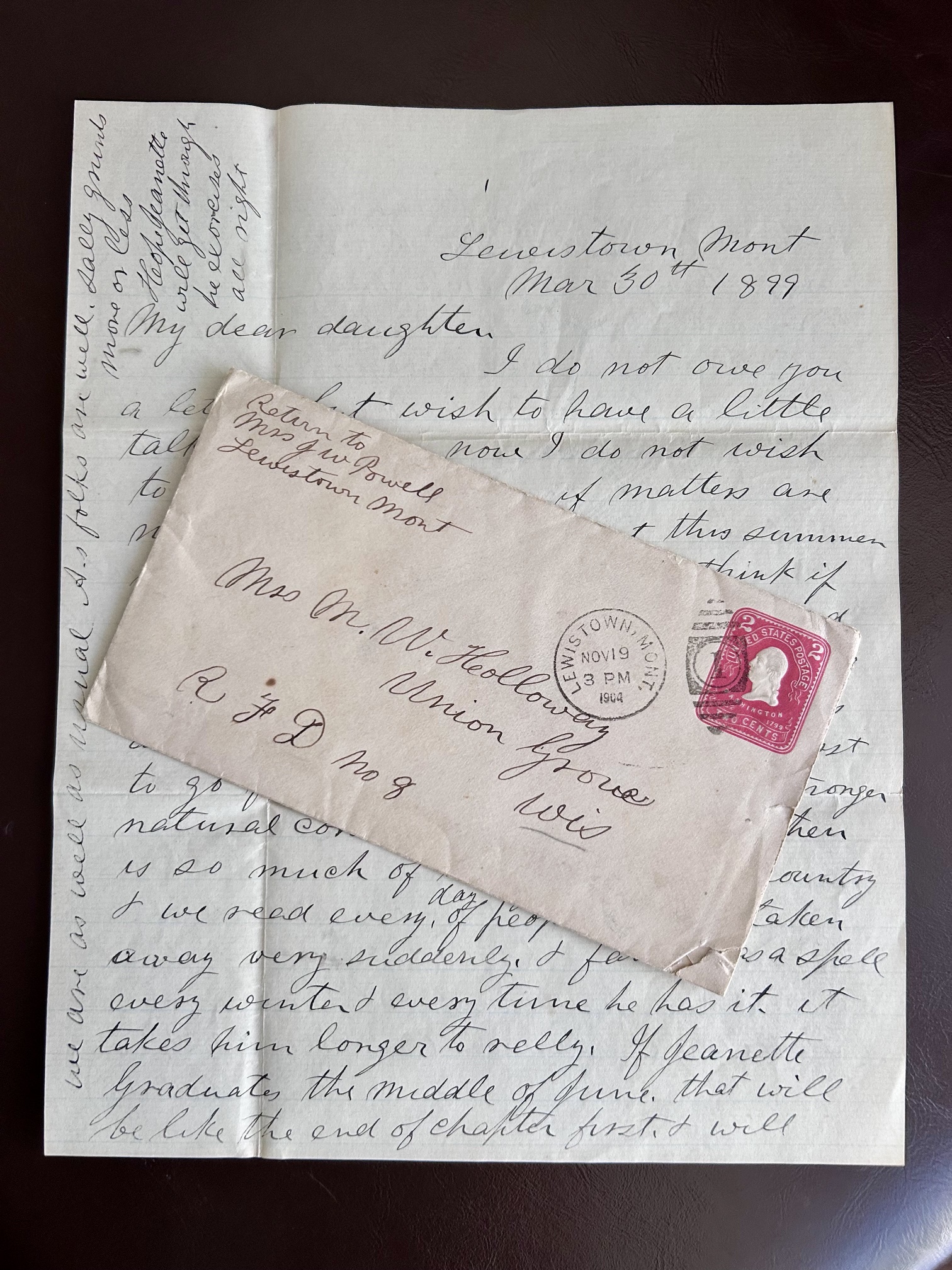
There is a box in my closet labeled “Montana Letters.” It is full of crinkly old papers covered with spidery long-hand penmanship. Somehow, these letters traveled from Montana to Wisconsin between 1899-1906, probably by train and wagon. They were written by my great-great-grandma Harriet to her daughter, my great-grandma, Kate. Faded two cents stamps on the envelopes are postmarked with a place and date. The letters were passed down from generation to generation and survived in musty basements for 120 years. I treasure them now, but at the time, they weren’t anything special. Just updates on the family, reports on how the crops were doing, and longings to see each other again.
But that’s not all.

I compiled all the letters my dad wrote to his parents during his Navy days aboard the USS Fanshaw Bay during WW2 and bound them into a book titled “Letters Home: 1944-1946.”

In another box, there are more envelopes secured by a rubber band. These are letters PB and I wrote back and forth as we were falling in love and anticipating marriage. They still smell like Emeraude perfume.

I have postcards my kids wrote home during their week at Camp Lucerne. “Mom, I forgot to pack socks so I’ve been wearing the same pair all week.”

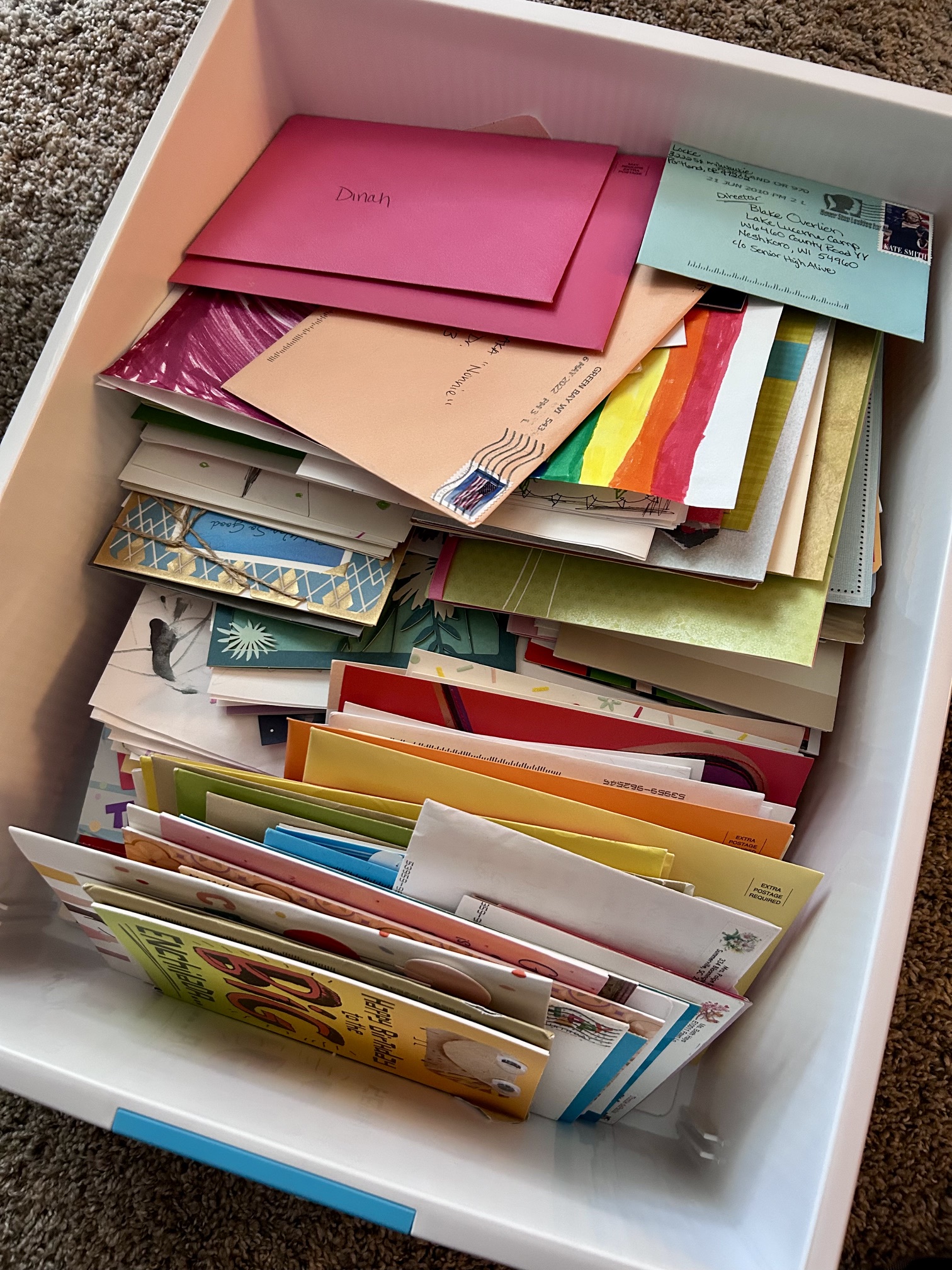
There are several plastic storage totes full of cards and notes I have received over the years from family and friends—the ones with a heart-felt message written by hand. They mean something, still.
God is the original writer, using His finger to inscribe words into a rock.
“He gave Moses the two flat stones on which he had written all his laws
with his own hand.”
Exodus 31:18


Twenty-one books of the Bible started as letters.
I’m grateful Paul didn’t have the option of texting or emailing his messages to the churches.

“Your very lives are a letter that anyone can read by just looking at you.
Christ himself wrote it—
not with ink, but with God’s living Spirit;
not chiseled into stone, but carved into human lives.”
2 Corinthians 3:3
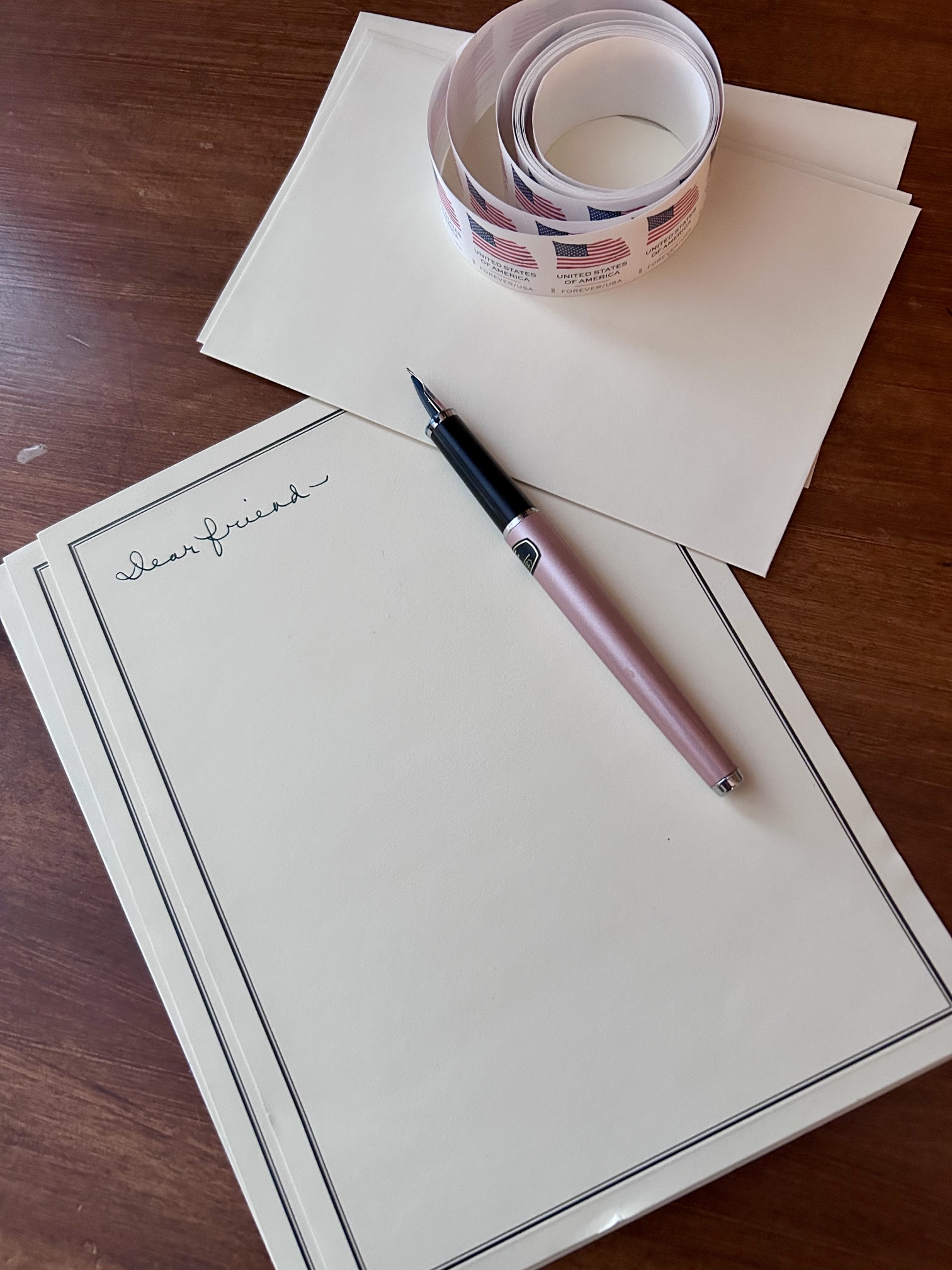
Are you inspired to write a real live letter?
Send me a message and I’ll give you my mailing address!
dinah.overlien@gmail.com


Multiple Choice

testWhen I was in college I fulfilled some General Education credit requirements by taking a Philosophy 101 class.  Here’s how it went down —

On the first day of class, the professor handed out a great big packet of notes — pages and pages of single spaced, perfectly outlined notes.  On the second day of class, the professor had us open the packet and follow along as he read the notes out loud.  Word for word.  Every day.  All semester.  So boring.

So why go to class, right?  I could have just read the notes myself, right?

Wrong.  Because our grade was based on attendance.

The tests were all True/False exams and we were free to use our wonderful packet of notes at will.  The prof even tipped us off as to what was going to be on the final exam.  There were no excuses for flunking his class.

I got an A but the only thing I learned was to stay away from Philosophy 102.

Moses spent forty years out in the desert school trying to teach a bunch of rebellious Israelites the rules.  He wrote five books of the Old Testament, making sure they had all the information they needed to have a good life in the Promised Land.  He reminded the people over and over again of who they were and whose they were.  Just before Moses died, he laid it all out there one more time and then told the people there would be a pop quiz.  It would be a one-question test, with the choice of two possible answers.  Then, just to be sure they didn’t mess up, He gave them the correct answer.

See, I set before you today

1) life and prosperity

2) death and destruction

(psst….. now choose life).

Deuteronomy 30:15, 19

  No excuses.

It Is Not Death to Die

it is not death

The title caught my eye.  “It Is Not Death to Die” — what an intriguing phrase.  I jotted the words down on a slip of torn-off notebook paper and stuck it in my pocket.  When pondering a thought, that’s what I do.  I seem to need to carry ideas in my pocket for awhile.  They roost in there, like a hen on her eggs, waiting for an insight to hatch.

Through the morning I argued with the short sentence that captured my thoughts.  Of course dying is death, I say to the paper in my pocket.  The final exhale, the last look before closing the eyes, the heartbeat halted — that’s death.  That’s what it is to die.  Right?

In the afternoon I had to know more.  A little research revealed the origin of the words.  In 1832, 60 year old Henri Abraham Cesar Malan wrote a hymn titled, “Non, Ce N’est Pas Mourir”.  Fifteen years later, George Bethune translated the French lyrics into English and the song found it’s way into 126 hymnals.  One hundred and sixty years later, Sovereign Grace Music recorded the hymn with a new tune.  I think Henri would approve.

By the evening, I was sitting at my piano singing a song that made its way from my pocket to my heart.  I got it.  Dying is not death in the sense that there is nothing more but blackness and non-existence.  Paul said that to be away from the body is to be at home with the Lord. (2 Cor. 5:8)  Jesus said, “The one who believes in me will live, even though they die.” (John 11:25)

It is life to die — more life than we can fathom.

The best of everything is yet to come.

This week, this is my song:

It Is Not Death to Die, Sovereign Grace Music