Well, the old well has served us well.
Don’t you love the English language?
Three uses of the word “well”—an interjection, a noun and an adverb—in one sentence.
But I’m not here to give an English grammar lesson.
I’m here to talk about wells: noun, plural.
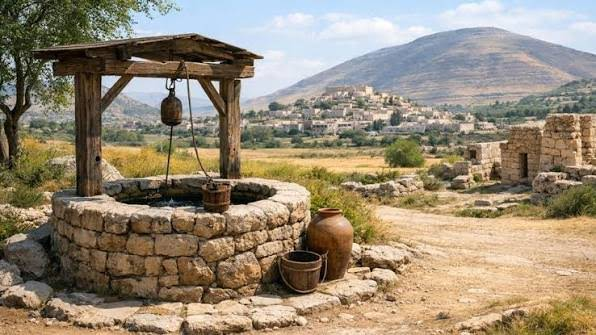
Well #1
Abraham told his servant to go find a wife for his son, Isaac. So the servant journeyed back to Abraham’s homeland and stopped by a well. He prayed, “Let the girl who offers to water my camels be The One.” Before he finished praying, Rebekah arrived and volunteered to water the camels.
“The girl was very beautiful.” Genesis 24:16
Well #2
Isaac’s son, Jacob, was traveling and stopped at a well for refreshment. Rachel came along with her father’s sheep and Jacob offered to water her animals. It was love at first sight and Jacob kissed Rachel right then and there. Then he cried.
“Rachel was lovely in form, and beautiful.” Genesis 29:17
Well #3
Moses was on the run from Pharaoh and landed in Midian, where he sat down by a well. Zipporah and her six sisters showed up with a flock of sheep. Some shepherds started to harrass them, so Moses drove them away and drew water for the sheep. Zipporah’s dad said, “Marry that man.”
“Zipporah was admired for her loveliness.” Midrash (early Jewish literature)
See the pattern here?
It seems all the pretty girls hung out at the local watering holes.
It seems meetings at wells were especially significant.
It seems to be the reason why Jesus had to go to Samaria.
Well #4 (One more)
Jesus was hot, tired and thirsty. He sat down by a well and waited for a divine meeting with a woman. When she came, they talked about living water and true worship. Jesus mentioned the six relationships she’d had with men. Then He told her He was the Messiah. She believed Him. (John 4)

Isaac, Jacob and Moses all found their wives by a well.
Then the Bridegroom Himself
came to a well to win the heart of a Samaritan woman.
Jesus was her #7 (the number of perfection).
You can’t make this stuff up. It’s too good.


