C is for Come

C is for COME.

“Come” is a word of invitation.
“We bid you to come and celebrate.”
“Hey, wanna come over?”

“Come” is a command.
“Come over here right now, young man.”
“Come and get it!”

“Come” is an action word.
“I’m coming!”
“Come along with us!”

God the Father is forever the gracious host.
Hear His invitation:

“Come now, and let us reason together.” Isa. 1:18
” Come, all you who are thirsty, come to the waters.” Isa. 55:1
“Come, follow me.” Matt. 4:19
“Come to me all you who are weary.” Matt. 11:28
“Come away with me to a quiet place.” Mark 6:31
“‘Come,’ he replied, ‘and you will see.'” John 1:39
“‘Come and have breakfast,’ Jesus said to them.” John 21:12

come

The Father’s hospitality is seen in the very beginning, in Eden, where He provided a perfect place for the flourishing of humankind. Adam and Eve were the first guests in God’s wonderland called earth. The serpent crashed the party, introducing evil and discord. Ever since, the call has gone out to all the image-bearers: Come.

The Father’s hospitality will be seen in the very end, where He will provide a new heaven and a new earth for whoever RSVPs to the invitation. “Whoever is thirsty, let him come; and whoever wishes, let him take the free gift of the water of life.” Rev. 22:17

To that I say, “Amen. Come Lord Jesus.”

My favorite word in the Bible that starts with C is COME.

Next: Sing Along

Gimel

Shalom!
(Shalom means “hello — peace to you”.)

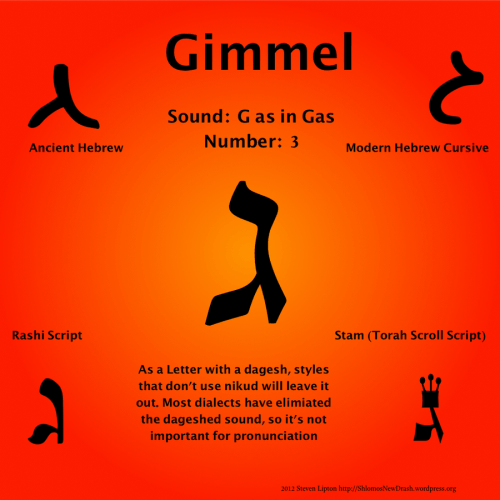
Gimel (also written as Gimmel) is the third letter in the Hebrew alphabet. It sounds like our letter “G” as in “God is good”. Every line in Psalm 119:17-24 starts with this letter. Gimel looks like this: gimel2

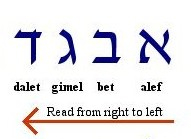
The Hebrew language is read from right to left across the page, which seems backward to us. There is a general rule in Judaism that the right side gets precedence because it represents strength. “The Lord’s right hand has done mighty things.” (Ps. 118:15) Even today, a father gives his children a blessing by putting his right hand on their heads.

So, the first four letters of the Aleph-Bet look like this:

abc

That’s important because it helps us see the story the Aleph-Bet is telling. God, in the form of Jesus (Aleph) is the God-Man reaching up to heaven and down to earth. The Son was sent to be master of the house (Bet).

Gimel means “giver” and the letter is a picture of a person with his foot stretched out in motion; the person is running toward Dalet to give it gifts. The Hebrew word for Redeemer starts with gimel, so Jews believed the Messiah would be the One who runs from the house to bestow redemption, chasing after poor sinners with lovingkindness. The Messiah came to give His life for the life of the world.

Another definition of gimel is “to lift up” and the animal associated with this letter is a camel, which was a beast of burden that carried goods across the known world. “Surely he has borne our griefs and carried our sorrows.” (Isa. 53:4) As a camel must bow down to let people get on, so Jesus made Himself low. (“He made himself nothing.” Phil. 2:7) But when the camel gets up, it lifts its rider, as Jesus was lifted up on the cross to bring us redemption. (“The Son of Man must be lifted up.” John 3:14)

In fact, the Hebrew word for Golgotha also starts with gimel, which is followed by a letter that means “shepherd”, followed by a letter that means “cross”. Golgotha = where the shepherd was lifted up on the cross. *shiver* 

Gimel’s motion serves as a reminder that we should keep running after the truth of God’s Word and to be givers of lovingkindness to those around us. We should always be quickly going toward those who are in need of help and lifting up. In this way, the third letter is identified with the third person of the Trinity: the Holy Spirit. As Jesus said, “But the Helper, the Holy Spirit, whom the Father will send in My name, will teach you all things.” (John 14:26)

Jesus told a parable of a prodigal son who left home after demanding his inheritance. After living it up and losing everything, he decided to go back home and offer to be a servant in his father’s house.

“But while he was still a long way off,
his father saw him and was filled with compassion for him;
he ran to his son,
threw his arms around him and kissed him.”
(Luke 15:20)

running

We have a Father who runs to us.
You can see Him right there in the third letter of the Aleph-Bet.

gimel

Shalom!
(Shalom also means “good-bye — peace to you”.)

Next: My favorite word in the Bible that starts with C.

Long Song Study, part C

bstudy1

Today we’re going to look at Psalm 119:17-24.
Open your Bible and let’s pray:
“Open my eyes, that I may behold wondrous things out of your law.”

Verse 17
“Deal bountifully with your servant, that I may live and keep your word.” 

The psalmist begins this section by asking for a generous outpouring of blessing from God. Sometimes we forget that we are invited to “approach the throne of grace with boldness” (Heb. 4:13). But there’s more to it than marching up to God and demanding what we want. David asked with humility. He acknowledged that he was the servant, so he made his request with respect and reverence. Also, he wasn’t after a blessing so he could kick back and relax by the pool. He asked for God’s bounty so that he could live a long life of obedience that glorified the Lord.

Verse 18
“Open my eyes, that I may behold wondrous things out of your law.” 

This is a verse that should be on our lips whenever we open the Bible to study. Here is the result of God’s bounty — eyes to see wonders in the Word. The word “wondrous” means “great” or “difficult”. Raise your hand if you think there are some difficult passages in the Bible. (*Raising my hand high.) “The reason we do not understand the Bible is not primarily that we lack the necessary intelligence. The reason is that we are sinners, and we need God to open our eyes.” (Christopher Ash) Instead of saying, “Why didn’t God make things clearer in the Bible?” we should pray, “Open my eyes so I can see it clearly.” There are wonders in there and the Holy Spirit will illuminate them if we ask. 

Isn’t it interesting that David thought of the law as “wondrous”? The only scripture he had was the Torah — the first five books of the Bible. We’re talking Leviticus, Numbers and Deuteronomy here, folks. Genesis and Exodus have some exciting accounts, but still — what if that was the only Bible you had? Imagine a Bible without “Trust in the Lord with all your heart…” (Prov. 3:5), or “His mercies are new every morning…” (Lam.3:23), or “soar on wings like eagles…” (Isa. 40:31). The Psalms hadn’t been completed or compiled yet and the New Testament was centuries away from being written. “David felt sure that there were glorious things in the law; he had not half the Bible we do, but he prized it more than some men prize the whole.” (Spurgeon)

Verse 19
“I am a sojourner on the earth; hide not your commandments from me!”
Do you ever feel like you don’t fit in? Good! Earth is our temporary home — we’re not supposed to act like this is all there is. Even David, with his palaces and power and prosperity knew he was just passing through, which was another reason to store up eternal truth.

Verse 20
“My soul is consumed with longing for your rules at all times.”

Is your soul ever consumed with longing? Do you ever feel like you’re wasting away with desire? For rules? At all times? David certainly had an emotional connection with God’s Word. We (okay, I) tend to approach the Bible studiously by looking up definitions, original language and commentaries. If I’m not careful, I can easily slide into an academic exercise that results in head knowledge. After spending time in study, it’s important for me to look over what I’ve learned and pray it back to God. As I put the facts into my own words and talk them over with God, they make their way into my heart.

Verse 21
“You rebuke the insolent, accursed ones, who wander from your commandments.”
So far, this psalm has had two leading characters: the psalmist and God. Now we’re introduced to another group: adversaries who disregarded God and made David’s life miserable. This crowd defied God’s commands and they were proud of it. Instead of entering into a debate or calling them out publicly, David left the rebuking to God. He understood that his antagonists wandered far from God’s truth, so he didn’t expect them to act like believers.

Verse 22
“Take away from me scorn and contempt, for I have kept your testimonies.”

Things were bad enough that David asked for relief from the public rancor directed at him. Even three thousand years ago, people in positions of leadership had to deal with disrespect and derision. Again, David didn’t go on the offensive and shoot back a vitriol response to his opponents. He went to the Lord with his complaint: “Here I am, doing my best to obey your laws and still, I’m being attacked. What is up? It’s not fair!” (To which I say, “The fair comes to town once a year and the rest of the year it’s just not fair.”)

Verse 23
“Even though princes sit plotting against me, your servant will meditate on your statutes.”

Other prominent leaders were dragging David’s name through the mud with lies and false accusations. How did David respond? By keeping his mouth shut and keeping his mind on God’s truth. The pressure he felt on the outside made him press in closer to God, even though his request did not get him an immediate answer.

“The best way to deal with slander is to pray about it: God will either remove it or remove the sting from it. When we suffer from a libel it is better to pray about it than go to law over it, or even to demand an apology from the inventor. O ye who are reproached, take your matters before the highest court, and leave them with the Judge of all the earth.” (Spurgeon)

Verse 24
“Your testimonies are my delight; they are my counselors.”

In the midst of that kind of turmoil, David still found pleasure in the Torah. He promised to delight in the Lord’s statutes back in verse 16, and now he’s making good on that promise. The words of God helped him emotionally (my delight) and practically (my counselors).

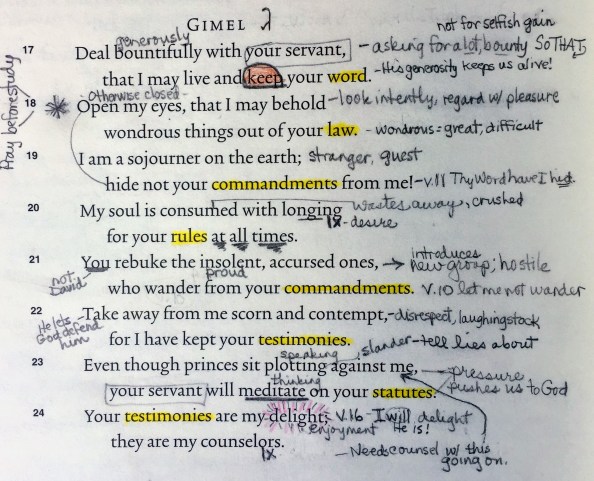
img_9845

Things I know for sure from this passage:

  • There is no end to the wondrous treasure that is in the Bible. When we think we know all there is to know about a passage, there’s still more to uncover.
  • We don’t need God to give us more benefits as much as we need eyes to see what He has already given.
  • Going through times of trouble can serve to draw us closer to the Lord.
  • Instead of rescuing us from all our troubles, God often gives us a new perspective.
  • This world is not my home, I’m just a passin’ through.

Next: Gimel

Stanza C

Psalm 119 is long, y’all.

I’m doing my best to keep these posts from getting too lengthy. I don’t want to overload you with information and get all lecture-ish on you. Just be glad Thomas Manton isn’t writing this series. Who is Thomas Manton, you ask? He was a Puritan preacher who lived from 1620-1677, but he does not make my list of favorite old dead guys.

Rev. Manton was famous for preaching 158 sermons on Psalm 119 — three sermons a week for a year. But that wasn’t enough for him. He went on to write a three volume work on Psalm 119 with 190 chapters — more than one chapter per verse — for a total of 2025 pages. Without the internet. It’s safe to say that I will not rival Manton’s word count.

Let’s start week three!
Only 19 more to go!
Are you with me?

woman hands on bible


Psalm 119:17-24

Consider being kind to me,
    so I can serve well and obey.

Continue to sharpen my eyes,
    to see wonders jump from your word.

Clearly I’m a stranger on earth,
    so don’t cover up the roadmap.

Consume my soul with deep desire
    for your laws, all day, every day.

Come down hard on the prideful ones,
    on those who veer off with disdain.

Cast off from me their hateful jeers,
    as I resolve to stay the course.

Crown princes gather to shame me,
    but I will think only of you.

Counsel me with your commandments,
    and I will delight in them all.

img_9841

Verse 18 is a good one to memorize and use as a prayer at the beginning of your Bible study time. Why not put it to memory this week?

ABC Confession

Remember the post “Praying the Alphabet”  from two weeks ago? Several people have told me how much that has helped them and I’m so glad. I find I need to discover new ways to give thanks because I tend to get in a rut and say the same things over and over. “Thank you, God, for my family and friends, my house and food and clothes, and for Your love.” I wonder if God gets bored listening to me. Using the alphabet forces me to be grateful for some things I wouldn’t have thought of otherwise. “Thank you, God, for my Arms, for Babies, and for Cheese…”

2

We’ll end this week’s study by putting a twist on using the alphabet to help us in another aspect of prayer.

The Day of Atonement, or Yom Kippur, was considered the most important high and holy day in the Jewish faith. It was the one day each year when the high priest went into the Holy of Holies to ask for forgiveness on behalf of the Israelites. A rope was tied to the ankle of the high priest, just in case he died in the presence of God, so he could be dragged out of the inner chamber. Approaching the mercy seat was serious business.

Still today, Yom Kippur includes a 24 hour fast and day-long services at the synagogue. Leading up to the Day of Atonement, there are ten days of introspection and repentance for sins, both individual and corporate. Ten days is a long stretch to keep coming up with sins to confess, so according to Jewish tradition, they use the Aleph-Bet to guide them in their penitence.

Atonement18_MS_Header_01

When asked why the confession of sins was to be done in alphabetical order, Rabbi Yizak of Vorki (1779–1848) answered, “If it were otherwise, we should not know when to stop beating our breasts. For there is no end to sin, and no end to the awareness of sin, but there IS an end to the alphabet!” 

I confess that my confessions sound just as repetitive as my thanksgivings sometimes do. “I’m sorry, Lord, for eating too much, for general laziness, and for using snarky, sarcastic words. Again today.” Ho-hum. Perhaps alphabetizing my transgressions will force me to be sorry for some things I wouldn’t have thought of otherwise. “Forgive me, Lord, for my Attitude, for being Bossy, for Criticizing the way PB makes the bed…”

Now I see why there are ten days to prepare for the Day of Atonement. Thank goodness it only comes around once a year. At least I know that when I finally get to confessing my lack of zeal, I can stop. Until next time.

If you need to catch up:
Monday – Stanza B
Tuesday – Long Song Study, part B
Wednesday – Bet
Thursday – B is for But

Bet

Ready for your Hebrew lesson?
I bet you are!

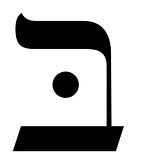
Bet (also written as Beth/Beit) is the second letter in the Hebrew alphabet, or Aleph-Bet. It sounds like our letter “B.” Every line in Psalm 119:9-16 starts with this letter. Bet looks like this:

hebrew-beth

Bet means “house.”
For example, Beth – lehem means “house of bread.”
The letter signifies a house with the front door opened.

See the roof on top?
We can’t see the heavens that are beyond our world.
The highest heavens belong to the Lord,
but the earth he has given to man. Ps. 115:16

See the floor on the bottom?
God built us a house with a solid foundation.
In the beginning you laid the foundations of the earth. Ps. 102:25

See the wall behind on the right?
We can’t see what came before the creation of our world.
Where were you when I laid the earth’s foundation? Job 38:4

See the open door on the left?
For now, the way is open to the future – a new heaven and a new earth.
Behold, I will create new heavens and a new earth. Isa. 65:17

Now let’s look for Jesus in the letter “bet.”

This letter has the distinct honor of being the first letter of the first word in the Hebrew Bible. (“In the beginning” in Hebrew is “B’resheet.”) This reveals that God created the world because He wanted to dwell in a house with us. In Jewish culture, the father’s house was given to the first-born son.

See where we’re going here?

God sent His Son, Jesus, to be the master of this house. The Messiah was the fulfillment of the promise made to King David, “The Lord Himself will establish a house…that will endure forever.” (2 Sam. 7:11, 16) Christ Himself is the Chief Cornerstone and all believers are members of the household of faith. (Eph. 2:19-20) We are, even now, living stones being built into a spiritual house. (1 Peter 2:5)

One more thing.

“There are many stories as to why Bet is the first letter of the Hebrew Bible and not Aleph, which is the first letter of the Hebrew alphabet. While some say it was due to Aleph’s humility, another theory explains that God decided to start the Bible with the letter Bet in order to show man that he did not know the first thing about how the world works!” (hebrewtoday.com)

To reflect that understanding, all ancient Jewish literature written as commentary on God’s Word begins on page two (beit); the first page is left blank, to show that we can’t assume to know how the beginning began.

So when Jesus said “I am the Alpha and the Omega,” He was saying “I was here before the beginning of creation, before Bet, before the house was built.”

Selah.
That’s Hebrew for “stop and think about that for awhile.”

bet 

Next: My favorite word that starts with “B”.

Long Song Study, part B

bstudy

Today we’re going to dive into Psalm 119:9-16. Go get your Bible!

Some scholars believe that David wrote this long psalm bit by bit, over the course of his lifetime. In the first section, he saw that there was blessing for those who walked in the ways of the Lord. Perhaps he was looking up to older men who modeled a walk with God. He stated his willingness to learn and his desire to be steadfast. In the second installment, David started by asking a really good question.

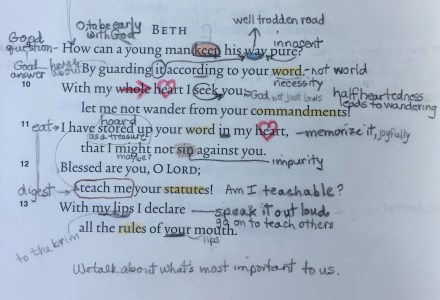
Verse 9
“How can a young man keep his way pure? By guarding it according to your word.”

“How can a young man keep his way pure?” Kudos to David for even asking this question. Not many young people contemplate purity. It seems he knew the answer to his own question: “By guarding it according to your word.” David understood that he had to guard his way and his only hope of succeeding was to live by the Word. The word “guard” means “to hedge about, to surround, to protect or be careful about”.
So, there are things we need to keep guarded, like our thoughts and emotions. And there are things we need to guard against, like worldly influence and temptation. The Word has the power to do both. But it takes intention. “The narrow way was never hit upon by chance.” (Spurgeon)

Verse 10
“With my whole heart I seek you, let me not wander from your commandments!”

Sometimes we believers get mixed up about what to seek. We attempt to try to live according to a checklist of virtuous behaviors. We set out to be good, seeking some kind of perfection through self-righteousness. David knew he had to set his whole heart on seeking God, not just obedience to His laws, because half-heartedness would result in straying from the Lord. David made it his priority to seek God in the place where He could be found — in the Word.
How do we wander? 1) By neglecting prayer, Bible reading, and corporate worship; 2) By chasing after frivolous entertainment; 3) By indulging in careless thoughts and temptations. The shocking reality is, if we’re not actively seeking God, then we’re wandering from God. We don’t have time to be wanderers.

Verse 11
“I have stored up your word in my heart, that I might not sin against you.”

David may have been young, but he had been taught well. Young Jewish boys memorized large portions of the Torah (the first five books of the Bible), so he had a rich storehouse from which to draw. Notice David didn’t say “I should store up” or “Someday I’ll try to store up”. Nope, he already did, and that was going to help him keep his way pure.

Verse 12
“Blessed are you, O Lord; teach me your statutes!”

Even though he had stored up the words, David needed instruction to be able to understand and follow through on the commands. Simply knowing the law wasn’t enough. He had to learn to love it and live by it.
Ten more times in this long song David asked God to teach him, indicating that he never felt like he knew it all, even as he got older. He stayed teachable.

Verse 13
“With my lips I declare all the rules of your mouth.”
You don’t have to ask me twice to tell you about my grandchildren. Get me started and I will bubble over with delight as I talk about them. We tend to talk the most about the things that are most important to us. For David, that topic was God’s law. It wasn’t something he just thought about — he talked about it. Out loud. With his lips. Our love for God and His Word should be spoken of in a way that attracts others. You’ve probably heard the quote, “Preach the gospel, and if necessary, use words.” Well, I’m sorry folks, but words are necessary. If the Lord is important to us, we won’t be embarrassed to talk about Him.

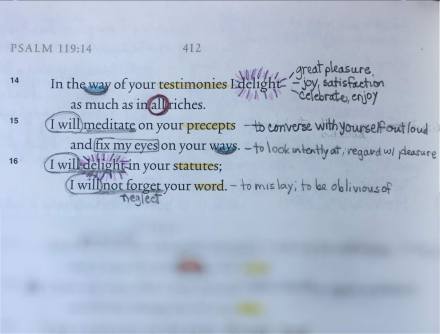
Verse 14
“In the way of your testimonies I delight as much as in all riches.”
The Bible wasn’t boring to David. It was something he enjoyed with great pleasure. He thought of it as hidden treasure just waiting to be dug up. David wouldn’t trade the richness of God’s Word for a whole pile of money.
Jewish rabbis call Psalm 119 “a love song to Torah” and they actually kiss the scrolls of scripture before and after each reading in the synagogue. “When a human being kisses a leather bound sheaf of paper, the loving essence of the gesture penetrates into the realm of the non-material. The kiss reaches deep, beyond paper and ink, into the meaning of the words in the Torah… The Torah is, so to speak, the lips of God.” (Dr.Michael Chighel)

Verse 15
I will meditate on your precepts and fix my eyes on your ways.”
David concluded this stanza with another set of “I will” statements. Biblical meditation is nothing like the eastern religion type that sits in silence, empties the brain and hums “om”. The word “meditate” means “to converse with yourself out loud; to murmur or mumble to oneself.” If memorizing scripture is like eating it, then meditating is like digesting it, with the goal of internalizing it and letting it transform us from the inside out. “Our hearts are naturally cold, but meditation makes them hot, causing them to boil with love for God and His word.” (J. Stephen Yuille) Meditation increases the pleasure of reading and studying God’s Word and helps us keep our eyes fixed on His ways.

Verse 16
“I will delight in your statutes; I will not forget your word.”
Some versions say, “I will not neglect your word.” Ouch. Neglect: to pay no attention or too little attention to; disregard or slight through indifference or carelessness. Let’s commit, along with the psalmist, to give the Word our full attention instead of being haphazard, hit-or-miss, or slipshod.
“Men do not readily forget that which they have treasured up (v. 11), that which they have meditated on (v. 15), and that which they have often spoken of (v. 13).” (Spurgeon)
img_9834

img_9835

What do we know for sure from this passage?

  • What we store up in our hearts is going to make its way to our lips.
  • If we don’t take seriously the need to guard our way, we might wander away.
  • There is power in the spoken Word, whether it’s to others or ourselves.
  • God and His Word are delightful.
  • We’re never too old to learn to walk in His ways, but there’s a great advantage in starting young.

What do you think?

Next: Bet

Stanza B

Are you ready for another week of study on Psalm 119? Let’s go!

thy word

It’s obvious that the author of this psalm thought long and hard about this poem before he sat down to write it. I admire how organized it is, with its alphabetical structure and even numbered stanzas. He definitely was showing off his love for the Hebrew language. Only a skillful writer could make each section sound fresh, even though he used the same eight words over and over.

Have you noticed the “word” words?
law
word
statutes
precepts
promises
judgments
testimonies
commandments

Each one has a slightly nuanced meaning, but when it comes down to it, they all mean the scriptures, or the Bible. One of these eight words is used in all but five of the 176 verses, yet it doesn’t seem redundant. That’s some crazy good writing. It’s a lot harder than it looks, I’m finding out. I dare you to try it.

Psalm 119:9-16

By what means can one remain pure?
    Only by staying in the Word.

Bent on pursuing You, I search.
    Keep me from wandering off track.

Because I have stored up Your words,
    I hope I won’t sin quite so much.

Boundless praise unto You, O God!
    Instruct me in all of Your ways.

Blurting out, I go on and on,
    repeating the words that You said.

Bursts of joy flow as I follow;
    I feel like I hit the jackpot.

Bless me as I chew on Your words
    and ponder what everything means.

Best of all, Your words thrill my heart.
    I vow not to be a slacker.

img_9786

“The Word became flesh and lived for a while among us.” John 1:14

What happens when you substitute Jesus’ name for “word” words?

ABCs

Here’s a little something for you to ponder over the weekend!

“In the beginning God created the heavens and the earth.” Gen. 1:1

Follow me now.
This will blow your mind.

What did God create before He created our beginning?

I see that blank look.
Ok, I’ll tell you.

Words.
Language.
The ABCs.
Or, more accurately, the Aleph, Bet, Gimels.

IMG_9747

In order for God to speak the words, “Let there be light,” there had to be a language human beings could understand, speak, and write. We can’t be sure Hebrew was the first language. (Things got scrambled up at the Tower of Babel.) But we can be sure that the ancient 22 letter Hebrew alphabet derived from some form of the original language.

Think about it.

Adam was created with the ability to comprehend God’s words.
“Rule over the fish and birds and creatures.”
“The plants are yours for food.”
“Except that one tree.”

Adam was created with the ability to use his language to name the creatures.
“Dog.”
“Lion.”
“Yellow-bellied sapsucker.”

Adam was created with the ability to write down a historical record.
“This is the written account of Adam’s line.” Gen. 5:1

Adam was formed from the dust of the ground,
fashioned by the hand of God,
and filled with the breath of life.
Adam came with words.

According to Rabbinic tradition, the letters of the Hebrew alphabet were considered to be the “primordial building blocks of all creation.” One teacher went so far as to say that “if the letters were to depart even for an instant, all of creation would become absolute nothingness.” (Rabbi Shneur Zalman of Liadi, 1745-1812)

So, take away the ABCs, and we’ve got nothing.
Is your mind blown?

“In the beginning was the Word.”
John 1:1

Aleph

I’m going full nerd-mode now.
We’re gonna learn Hebrew.
Don’t be scared.
It’ll be fun.

Most Bibles have a heading before every eight-verse section of Psalm 119 (although paraphrased versions might not). Each of the twenty-two stanzas of this psalm are introduced by a letter of the Hebrew alphabet, in order from A to Z, or more accurately, from Aleph to Tav.

Aleph looks like this:aleph

According to Jewish tradition,
each letter was divinely created by God
and contains revelation about the Messiah.
Do you see Jesus in the letter Aleph?
He’s in there.

See that diagonal line in the middle?
It’s a position of humility.
“Taking the very nature of a servant…he humbled himself.” Phil. 2:7-8

See that arm reaching up to the right?
It shows His deity, His connection to the divine realm.
“Who being in very nature God…” Phil. 2:6

See that arm reaching down to the left?
It shows His humanity, His connection to the earthly realm.
“…did not consider equality with God something to be grasped.” Phil. 2:6

 This is a dramatic picture of Jesus with two outstretched arms,
one to His heavenly Father, one to us.
He is the link between heaven and earth.

Wait. There’s more.

Despite the fact that Aleph, a consonant, is the first letter in the Hebrew alphabet, it is a silent letter. It takes on the sound of a vowel, depending on the marks attached to it. There is a story in Jewish folklore that says all the letters of the alphabet came before the Lord to give reasons why they should be the first letter of the first word in the Torah, or Bible. All except for Aleph. The Lord asked Aleph why it didn’t come and Aleph explained that it was silent and had nothing to say. So the Lord honored Aleph’s humility and placed it at the beginning of all the letters.

Wait. There’s more.

Jesus said, “I am the Alpha and the Omega,” which is the Greek way of saying, “I am the Aleph and the Taw.” Like the humble letter, Jesus came in humility as a human being and suffered in silence.

“He was oppressed and afflicted, yet he did not open his mouth;
he was led like a lamb to the slaughter,
and as a sheep before her shearers is silent,
so he did not open his mouth.”
Isaiah 53:7

“Then Pilate asked him,
‘Don’t you hear how many things they are accusing you of?’
But Jesus make no reply, not even to a single charge —
to the amazement of the governor.”
Matt. 27:13-14

So God the Father honored His Son’s humility and gave Him His rightful place.

“Therefore God exalted him to the highest place
and gave him the name that is above every name.”
Phil. 2:9

And that’s just the first letter.

aleph (1)

Next: My favorite words.