Keep the Peace

I’ve been reading Bible verses on peace throughout the month of July. (See 2024 Bible Reading Plan) It’s been good for my soul. Those familiar verses reminded me of things I knew but needed to hear again.

Philippians 4:6-7 was the most familiar one on my list as it was one of the first scriptures I memorized back in my high school days. I still have to recite it in the King James version.

“Be anxious for nothing; but in every thing by prayer and supplication with thanksgiving let your requests be made known unto God. And the peace of God, which passeth all understanding, shall keep your hearts and minds through Christ Jesus.”

Such a classic verse.
I heartily recommend putting it to memory,
in the version of your choice.

I thought I knew that verse backward and forward, but as always, there’s more.

It was the word “passeth” that got me. Other versions say “transcends.” It means “to surpass, to rise above, to excel, to be superior in rank.”

Here’s what I wrote in my notebook that morning:

Superior in rank. Hmmm. In the military there are levels of authority, like Sergeant, Lieutenant, Captain, Major, Colonel, General. Some soldiers surpass or rise above the others and move up in rank. Each step up calls for added respect. The Sergeant can’t walk into the General’s office and tell him what to do. The Sergeant must comply with the General’s commands.

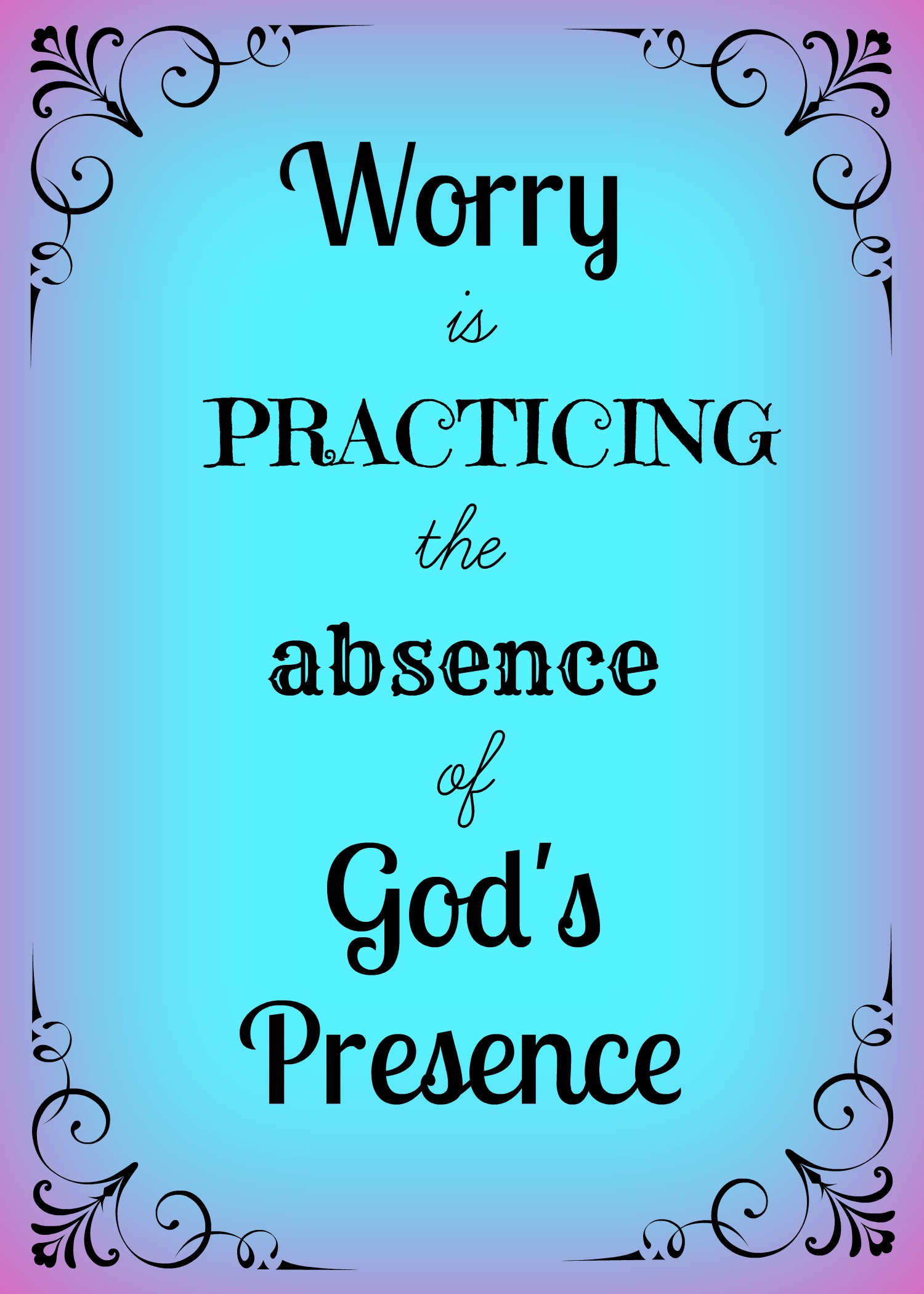
My anxiety is the Sergeant. God’s peace is the General. God’s peace outranks my anxiety—my anxiety has no authority to overrule the peace of God. I just need to keep the order of command. I need to tell my worries and fears that they are not in charge and it is not within their jurisdiction to dictate my thoughts. In fact, those pesky worries need to stand at attention, give a crisp salute and say, “Sir, yes, sir” to the commanding officer, a.k.a. King of the Universe, a.k.a. Prince of Peace.

“Don’t fret or worry. Instead of worrying, pray. Let petitions and praises shape your worries into prayers, letting God know your concerns. Before you know it, a sense of God’s wholeness, everything coming together for good, will come and settle you down. It’s wonderful what happens when Christ displaces worry at the center of your life.” ~ The Message


Spinning

“Consider how the wild flowers grow. They do not labor or spin. Yet I tell you, not even Solomon in all his splendor was dressed like one of these.” Luke 12:27

When my brother was in college, he rode his bike from Wisconsin to Texas. I’m not talking about a motorcycle here — I’m talking about a 10 speed bicycle. He and two buddies pedaled 970 miles in June of 1972 to attend a Christian conference for young, radical “Jesus people”.  It was worth it, though, because he came home with a great girl and married her six months later.

bike wheel

I don’t know much about long distance travel on a bicycle. My cycling experience is more like the monotony of pedaling a stationary exercise bike in the basement. I can pedal all the livelong day and never get anywhere.

That’s what worry looks like.

Lots of energy and sweat for no progress.

Lots of fussing and exertion, but no destination.

Lots of spinning, but the same old scenery.

When I l give in to anxiety, I’m riding the wrong bike.

It’s time to come up out from the cellar, pump up my tires and feel the wind in my face.

That’s what trust looks like.

bike

Worrywart

“And who of you by worrying can add a single hour to his life?”  Matthew 6:27

The year I turned 40, a wart grew on my face.  No kidding.  Since my birthday was close to Halloween, I figured all I needed was a black pointy hat and I was in business.  Now, that’s some way to be welcomed to middle-age-hood.  I tried all the old wives’ tale remedies, to no avail.  I bought every product known to Wal-Mart, but no luck.  I finally went to a doctor to have it frozen and removed.  That’s where I found out a wart is actually a viral infection, often tied to stress.  How’s that for motivation to unload some of that anxiety?

The term “worrywart” intrigues me.  It’s defined as, “an habitual worrier”.  I’ve heard people say, “Oh, I guess I’m just a worrywart!”  like it’s a title of which to be proud.  But who would honestly want to be labeled as a wart of any kind?

According to the dictionary, the word originated in 1930.  America was in the Great Depression, Al Capone was on the loose, and most citizens wanted the Prohibition laws repealed.  I guess there was plenty to worry about.  The term has Old English roots from the word “worryguts” which means “a person who tends to worry about insignificant matters.”  Our guts do seem to take a hit when we’re in the habit of worrying.

I think Jesus was making a point: worry doesn’t add a centimeter to our height or an hour to our day.  In fact, all of our anxieties tend to weigh us down and steal away our time.  And turn us into warts.

Not To Worry

“Therefore, I tell you, do not worry…”  Matthew 6:25

This week our Bible study is taking a good look at worry.  I’m kinda worried about it, actually.  How am I supposed to teach a lesson on not worrying?  Can a person really learn to keep from being worried in this life?  After all, we live in a worrisome world.  Right?

Worry: to torment oneself with or suffer from disturbing thoughts; fret.  The original Greek meaning of the word means to choke, to strangle, to drown.  Not a pretty picture.  So why do we do it?

In preparation for the study, I asked the Lord to show me what it is I worry about.  I gave Him full permission to set off sirens and flash blinding lights every time I worried.  Here’s what I found out: most of it was stupid stuff.  I wasn’t tormenting myself with thoughts about the weak economy, or the state of education in America or the plight of the homeless.  My fretfulness didn’t have anything to do with the war in the Middle East or the victims of natural disasters.  My worries were either outlandish scenarios that ballooned into tragedies in high-def 3-D living color (what if I swerve to miss a deer and the van goes down into a swampy ravine and nobody finds me for three days and by then the fish have eaten off my face and I am unrecognizable……); or my worries were along the lines of, “Did I put the milk away after having my Honey Nut Cheerios this morning?”

Sometimes I have worthwhile worries, usually involving the kids: are they happy?  are they making good choices?  are they brushing and flossing?  Or there are marital worries: will we grow old together?  will he always find me attractive?  will he remember to take out the garbage?

But Jesus didn’t put worries and cares into categories.  There was no designation for imaginative worries or stupid worries or noble worries.  He lumped them all together and said, “Do not worry.”  Period.  Let’s think about it this week.  What do you worry about?  Is it possible to NOT worry?