Rest Assured

It’s the first day of spring.

It doesn’t look like it.
It doesn’t feel like it.
But it’s the truth.
And I believe it.

Now faith is the assurance of things hoped for,
the conviction of things not seen.
Hebrews 11:1

Recently I was with a friend who expressed a concern. She was worried about her faith. Did she have enough? What if she didn’t? How would she know? What would happen if she came up short? From her perspective, it didn’t look like she had enough faith. And it didn’t feel like it.

We talked it over and I reminded her that it doesn’t take much. God is happy to work with a tiny amount of faith, even as small as a mustard seed. (Matthew 17:20) She was quiet for a few moments, then said, “Well, then……..I guess I’m ok.” Yes, my dear, you are ok.

We all need a little reassurance from time to time.
We’re in good company.

When God called Moses to deliver the Israelites from bondage in Egypt, Moses was a bundle of doubts and fears. “Who am I?” “What if…?” “Suppose…?” “Why? Why? Why?” He finished with, “Please send someone else.” (Exodus 3-5)

When God called Gideon to lead an army against his enemies, Gideon whined, “But, why…?” “But, how…?” “But…me?” Then he put God through a string of tests, just to be absolutely sure he heard from the Almighty correctly. (Judges 6)

Even John the Baptist had his doubts. John—who introduced Jesus as “the Lamb of God, who takes away the sin of the world.” (John 1:29) John—the one who witnessed a voice from heaven declaring, “This is my Son, whom I love; with him I am well pleased.” (Matt. 3:17) This same John sent a message to Jesus, “So, are you the one or should we look for someone else?” (Matt. 11:2)

These heroes of the faith needed assurance. They hadn’t gone off the rails or shipwrecked their long-held beliefs. They just needed to be reminded of truth they already knew down deep.

On those days when doubts and fears creep in,
turn to the Word of Truth.
And rest assured.

Today is the first day of spring.
It doesn’t look like it.
It doesn’t feel like it.
But it’s the truth.
And I believe it.

Roommates

When PB and I were raising four small children, we lived in a three bedroom house. You’d think that the two boys would’ve bunked up together and the two girls would’ve been roomies. But somehow, the oldest sibling talked the other three into sharing a room so she could dwell in peace and quiet all by herself. She had some strong negotiating skills.

Later, when we moved into a four bedroom house, there was more maneuvering among the sibs. Not surprisingly, once again the oldest managed to nab a private room. Every so often, the other three would switch around, depending on who was annoying whom.

I thought of this when reading Numbers 2 this week. (See my Bible Reading Plan.)

The twelve tribes of Israel needed to get organized. They had just been delivered from 400 years of slavery and it would take some time for them to learn how to make their own decisions. So God divided them into groups and told them where to set up camp.

That’s where it gets interesting.

Which families should camp together?
Which ones should be kept farther apart?
God had a brilliant plan.

The tabernacle was smack-dab in the middle of the camp, with the Levites surrounding it. Then God picked three tribes to set up on the east side of the camp, three tribes on the west, three on the south, and three on the north.

The families of Judah, Issachar and Zebulun were assigned the east side of the encampment. These boys were full brothers, all sons of Leah. These tribes would be the first to march out when the camp moved.

Across the way, on the west side, the full-blooded sons (and grandsons) of Rachel were together. They were the youngest of Jacob’s boys and dearly beloved by their father. Remember Joseph and the amazing technicolor dream coat? Baby brother Benjamin camped out with Joseph’s sons Ephraim and Manasseh.

Situated on the south were the tribes of Reuben and Simeon, sons #1 and #2, whose mother was Leah. Gad was placed with them even though he was a half-brother, the son of Leah’s maid.

And last but not least were the tribes of Dan, Asher and Naphtali encamped on the north end. They were the middle children, all sons of the maids belonging to Leah and Rachel. These families brought up the rear when marching out.

The arrangement was so well thought out. God knew exactly where each tribe should be and who they should be with. He knew who should take the lead and who should bring up the rear. The Israelites didn’t question the plan or try to trade places. They let God organize them.

These kinfolk were going to spend a lot of time in the desert together.
Picking the right campmates was crucial to keeping family harmony.
And nobody got a tent to themselves, except maybe Moses.

Lead the Follower

It’s frustrating for leaders when followers don’t follow very well.

Moses was an A+ leader, but those stiff-necked Israelites were D- followers, at best.

They grumbled, they whined, they rebelled.

Leading is tough when you have to hogtie your tribe and drag them, kicking and screaming all the way.

Across a desert.

For forty years.

OY.

But what if we flip that thought:

It’s frustrating for followers when leaders don’t lead very well.

What if there are people who would be willing to step out in faith, if only there was someone to take them by the hand and say, “Let’s go!”?

How long before followers are expected to do a little leading?

Jesus’ first words to the disciples were, “Come, follow me.”

His last words were, “Go and make disciples.”

The best leaders still follow…..

and the best followers, lead.


Promised Land

I have always felt bad that Moses didn’t get to enter the Promised Land.  After all, he did spend 40 grueling years with a bunch of stiff-necked people in a desert.  Because of one little incident, Moses was disqualified and didn’t even get to reach his little toe over into the land of promise.

Evidently when God says, “Speak to the rock before their eyes and it will pour out its water,” and instead you speak to the people (“Listen, you bunch of rebels…”) and hit the rock not once, but twice – you’ve crossed the line.  Moses lost it, and God was dishonored in front of a million Israelites.  Frustration can push you over the edge sometimes.

Just before Moses died, God had him climb a mountain (again) and allowed him a panoramic view of the Promised Land.  Oh, how Moses must have longed to see the 40 year mission to its completion and lead a glorious march into Canaan.  But, a glimpse was all he got.  Which is why my heart skipped a beat when I read Mark 9:4, “And there appeared before them Elijah and Moses, who were talking with Jesus.”

Jesus had led Peter, James and John up a high mountain.  Suddenly, as Jesus began to transform before their eyes, Moses and Elijah appeared.  And where were they?  Smack dab in the middle of the Promised Land, that’s where!  By God’s grace, Moses finally made it!  Sure, it was 1,400 years later, but how sweet of God to allow Moses to stand on that mount with the King of Kings and Lord of Lords.

“He who began a good work in you will carry it on to completion until the day of Christ Jesus.” Philippians 1:6

Up and Down Mt. Sinai

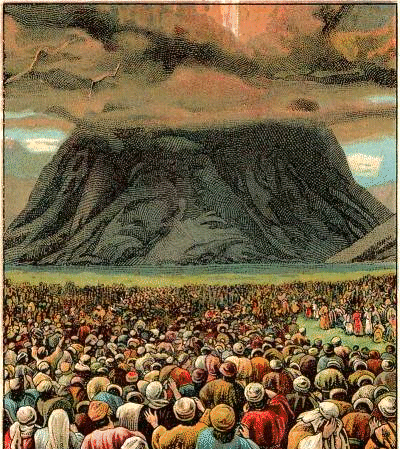
In the midst of the thunder, lightning and smoke of Exodus 19, there is a rather amusing side story.  I love it when the Bible strikes my funny bone; God does display a great sense of humor from time to time.

In this scene, Moses has led the Israelites to Mt. Sinai, the place God had told Moses at the beginning of his adventure to come and meet up.  Now, Mt. Sinai is no Mt. McKinley, but it was still a good mile and a half hike to the top.  The Israelites set up camp at the base of the mountain and 80 year old Moses started to climb.  He was probably keeping his eye open for any burning bushes during his ascent, since that’s how God spoke to him the last time he was in the vicinity.

Moses “went up to God” (v.3) and sure enough, God had a message for Moses to take to the people.  So, Moses “went back” (v.7) and delivered the message.  Then Moses took the people’s answer “back up to the Lord” (v.8).  God was pleased and gave Moses another message for the people.  After Moses “had gone down” (v.14), it wasn’t long before God “called Moses to the top of the mountain, so Moses went up” (v.20).  Are you picturing this?

Here’s the funny part.  Moses had just made his third trek up Mt. Sinai and God’s first words to him were, “GO DOWN and bring Aaron up” (v.24).  Up and down, up and down, up and down.  Isn’t that just the way it feels sometimes?  But Moses spoke not a grumblin’ word; instead the Scripture says, “So Moses went down” (v.25).

Aside from the fact that Moses must have been in pretty good shape for an 80 year old, what do you think was going through Moses’ mind as he went up and down that mountain three times?  Bible study ladies (and anybody else that wants to chime in) think about it this week and post your comments!

**Please see post titled “Mt. Sinai Mystery” published on October 19, 2012

Grumbling

Our women’s study is currently working through the book of Exodus.  This week we read about all the grumbling going on by the Israelite people in the wilderness. (Exodus 16)   One month after the dramatic parting of the Red Sea and deliverance from slavery, they looked back at the good old days in Egypt with nostalgia.  “There we sat around pots of meat…”   So when the food supply ran out, the grumbling began.  They grumbled against Moses and accused him of leading them out into the desert to starve them all to death.  But God heard all the complaining and took it personally.  Moses told the people, “You are not grumbling against us, but against the Lord.”

After coming down pretty hard on those wilderness wanderers, I began to wonder if I ever grumbled.  If?  Boy, was I in for a rude awakening.  The experiment began as I heard PB’s alarm go off at 4:45 a.m.  Now, I’m an early riser, but my hubby’s Friday morning routine is too extreme even for me.  Grumble.  An hour later, I went into the bathroom to find the toilet paper roll was empty.  Grumble.  When I came out to the kitchen, my son’s midnight snack debris was all over the counter.  Grumble. 

The toaster was set too high and my english muffin burned…..the dishwasher needed unloading……one of the socks I put on had a hole in it……grumble, grumble, grumble.  And I hadn’t even left the house yet.  Oh my.  Oh my goodness.  I wasn’t even close to being without food and water in the middle of a desert.  And was God taking my complaints to heart?  Are my murmurings, when I come right down to it, really a way to gripe against the One who is supposed to be in charge of the world?

Try it.  I dare you.  Keep track of how many times you grumble for a day.  Then try walking around in a desert for 40 years.

Pick Me

After the last post, and pondering how Mary responded to God’s message, I’ve been wondering how other people in the Bible reacted to a word from the Lord. For instance, Joseph. There is not one recorded word in the scriptures from the mouth of Joseph. In fact, almost every time he’s mentioned, he’s sleeping. God speaks to Joseph four times, each time in a dream. God is always telling Joseph to “get up”. To Joseph’s credit, what follows is, “so he got up” — but not a word. He must have been the strong silent type.

Now, take Moses. God speaks to him from a burning bush about delivering the Israelites from slavery in Egypt. After giving God four reasons why he is not the man for the job, Moses finally just spits out, “O Lord, please send someone else to do it.” It reminds me of trying to find someone to teach the Junior High Sunday school class.

Then there’s Isaiah. God said, “Whom shall I send?” and Isaiah is like the kid in the back row of the 3rd grade classroom who desperately wants to be the first one to give the answer to the teacher. Isaiah shoots his hand up in the air and almost falls out of his seat, saying “Ooo, oo, oo, me! Send me!!! Pick me!!!” God must have loved that. Especially after dealing with Moses.

Demure Mary, quiet Joseph, reticent Moses, enthusiastic Isaiah – God used them all, regardless of the adjective before their name.

Singin’

I love musicals. My favorite all-time movie is “Singin’ in the Rain”. It makes me want to break out into a spontaneous song and dance routine while grocery shopping or gassing up the van. Except, unlike the movies, where everyone suddenly joins in with perfect four-part harmony and synchronized dance step sequences, I would be afraid of having to explain my behavior to a police officer. But, oh, to live in a world where people bust out with a show tune and it snowballs into a real show stopper, right there in the check out line. What a fine world that would be.

Music is a powerful force. Just try to imagine living without music. One of the best things about a song is how it can transport you back to a place and time. For instance, when I hear James Taylor’s “Smiling Face”, I’m sitting in my dorm room writing a letter to my future husband. I was falling in love with his smiling face even though we were four states away from each other. That song reminds me of those carefree days and the excitement of a future out there somewhere.

Maybe that’s why the last thing Moses did before climbing a mountain to die, was to teach the Israelites a song. He knew a sermon wouldn’t be remembered after he was gone, and he had already given his share of commandments. But a song…a song would stick with them. So, he composed a song, a very long song, and taught it to the whole assembly of Israel. (Deuteronomy 32) Imagine a 120 year old man standing before a nation, delivering the performance of a lifetime. It would not be forgotten. It would be sung and re-sung for generations. A reminder of their heritage, of their glory days, of their God and His faithfulness.

Moses’ song must have been a good one, because, as it turns out, it will continue on in the last days. (Revelation 15:2-4)  Maybe my dream of being in a spontaneous outburst of song and dance isn’t that far away.