To James With Love

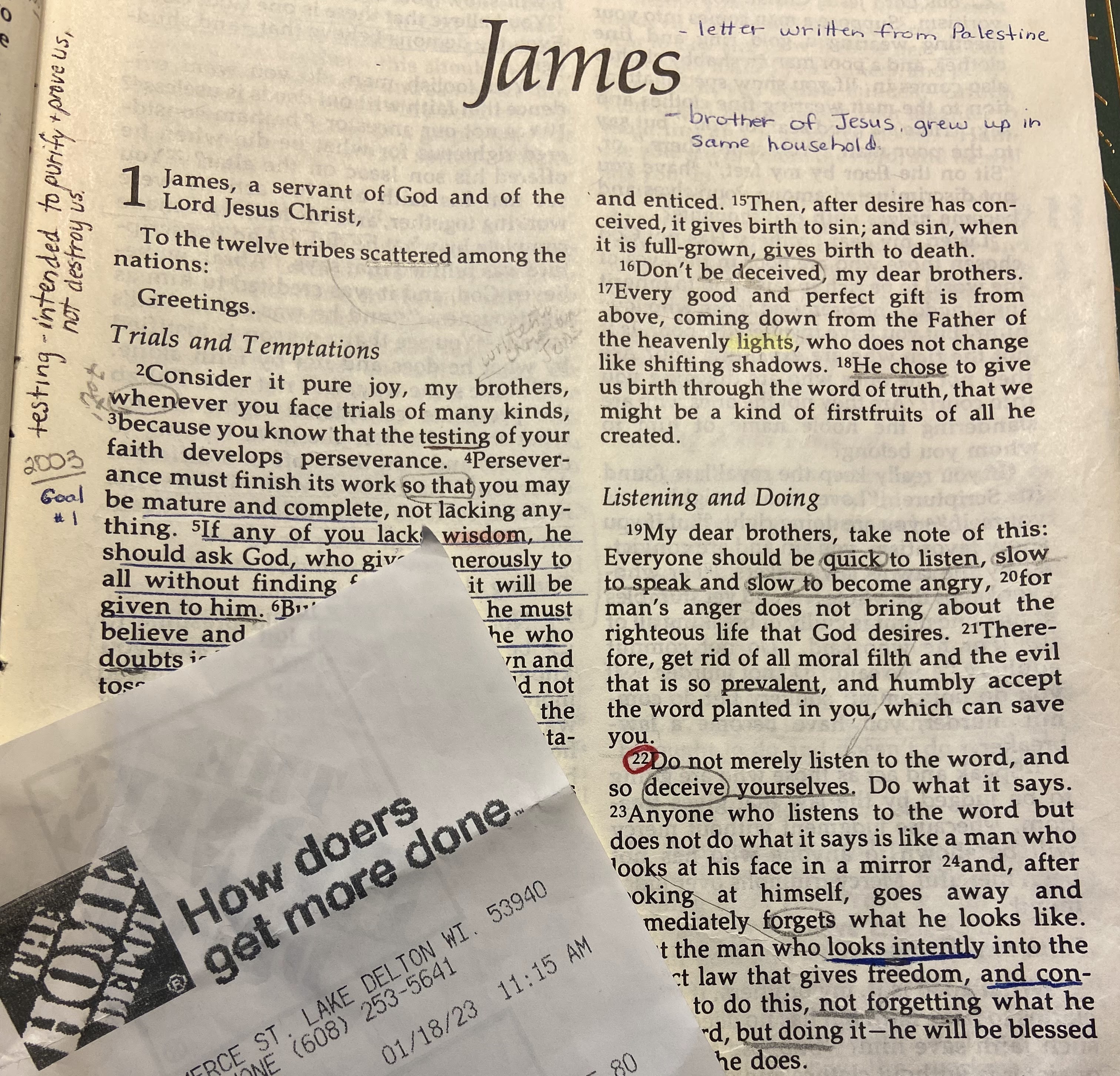
I spent the first three months of this year on a long, leisurely stroll through the book of James. I have to say, he wore me out a little bit. There are 54 commands in 108 verses. James gave me a lot to think about. And a lot to put into practice. As the Bible Project video puts it, “The goal of James isn’t to teach theology. It’s to get in your business and challenge how you live.” Ouch!

I found that James also had his own unique way of putting things among the Bible writers. He used 54 words in his letter that aren’t used anywhere else in scripture. (Yes, I looked up all 1745 Greek words in James. I’m a nerd.)

I couldn’t help but wonder if James finished his letter with a hint of an autobiographical sketch. During Jesus’ earthly ministry, little brother James had wandered from the truth, not believing in Jesus as the Messiah. The end of his letter seems abrupt, perhaps because the words were so close to his heart.

“My brothers and sisters, if one of you should wander from the truth and someone should bring him back, remember this: whoever turns a sinner away from his error will save him from death and cover over a multitude of sins.” James 5:19-20

James’ “someone” was Jesus Himself, appearing to James after the resurrection. Jesus brought James back and he would always remember the day that he, a sinner, was turned away from his error. James would never forget the day he was saved from death and his multitude of sins was covered over by the blood of his brother, his Savior, Jesus.

As I close my notebook on James, I thought I’d end with a short note of thanks.

Dear James,
Thank you for your letter, full of practical guidance. I appreciate your spirit of humility which comes from wisdom. You could have made yourself into a bit of a celebrity, having lived with Jesus all those years. You could have written a “tell-all” best seller about what He was really like. But instead, you kept the spotlight on Jesus and gave us instructions on how to live in order to give Him the most glory. You loved the church – that poor church in Jerusalem that struggled so much. You never quit, even in the face of persecution from the power-center in the Jerusalem temple. Well done.
Good-bye for now, but your words will continue to take root and hopefully produce good fruit. I have hidden many of your words in my heart and will continue to meditate on them.
I’m looking forward to meeting you one day, James.
With Love,
Dinah

The Undoing of Doers

PB often addresses the dynamic of faith + works by using the illustration of a man in a rowboat. One paddle is called “faith” the other paddle is called “works”. What happens when he uses only one paddle? He goes in circles, of course. The two oars must work in tandem to get anywhere.

There’s a danger in encouraging believers to start doing.
They might overdo it.
They might become undone.

There’s great temptation to jump into all manner of good activities, worthy causes, and virtuous projects. Because there are so many needs in this world, we have no shortage of options. Deserving programs and service organizations are longing for people to step up and contribute. So why do intentions that begin with enthusiasm and energy often fizzle out? Is it possible to have so many irons in the fire, that we’re putting out the fire?

Three questions come to mind as I read James’ exhortation to “be doers”.

  1. Every good idea is probably a good idea, but is every good idea a God idea? Am I concocting a noble list of good deeds and then sallying forth with the words, “Come along with me, God. I hope You can keep up!”?
  2. Is swinging like a pendulum between periods of great faith and seasons of good deeds effective? Am I just changing paddles and the direction of my circle? Is it possible to strike a balance of doing good deeds with great faith?
  3. Am I confusing the command to “be a doer of the Word” with “being a doer”? In the book of James alone, there are 54 imperatives, or commands. For example:
  • “Be quick to listen, slow to speak and slow to become angry.” (James 1:19) Am I being a doer of those words?
  • “Look after orphans and widows in their distress.” (James 1:27)
    Do I know any lonely children or widows I could help out?
  • “Don’t criticize and speak evil about each other.” (James 4:11)
    Are my words honoring my brothers and sisters in Christ?

I don’t need to join a club or create an Excel spreadsheet or work myself into a tizzy of activity. I need to listen for the voice of my Good Shepherd saying, “This is the way, walk in it.” And then walk in it.

So many questions. And here is one more from former U. S. Senate Chaplain Peter Marshall:

“I wonder what would happen if we all agreed to read one of the Gospels until we came to a place that told us to do something, then went out to do it, and only after we had done it, began reading again?”

Perhaps James is saying,
“Yes, let’s be doers.
Let’s just make sure
we’re doing
what God wants,
at God’s pace,
in God’s strength.”


Doers Get More Done

The management team at Home Depot must have read the book of James.
Their advertising slogan sounds downright Biblical.

James had a lot on his mind when he sat down to write a letter to the twelve tribes scattered among the nations. Suddenly free from the burden of Mosaic law, the new Christian community still needed some guidance on how to live this redeemed life in Christ. Brother James put down into succinct words a handbook of sorts: “How to Live Like a Christian”. Or maybe he was preaching to himself.

James kicked off his letter with a section on unbelief and doubt, testing and trials, and temptation. Were these topics top-of-mind because he had firsthand experience with them? Did James struggle with anger, an uncontrolled tongue, selfish ambition? Was he a good religious Jewish boy who went through the motions, but found religion worthless?

These were the things on James’ mind as he composed his letter.
The remedy?

Be doers of the word, and not hearers only, deceiving yourselves. James 1:22

Yes, we need to hear the Word, read the Word, sing the Word, pray the Word, preach the Word, memorize the Word, and meditate on the Word. But the way to inject real vitality into our spiritual lives is to be a doer of the Word.

Another James — James Moffat, Scottish Bible scholar — had something to say about this pithy, convicting verse.

When the sermon is done, it is not done;
something remains to be done by the hearers.

Perhaps this should be painted on the inside frame of our church doors, making it the last thing we see as we leave.

When the Word has been read,
and the sermon has been said,
and the songs have been sung,
the doing isn’t done, it’s begun.

Sweet Baby James

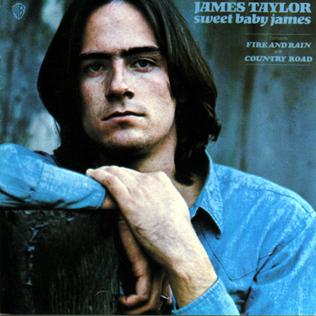
Back in 1970, James Taylor wanted to give his newborn nephew and namesake something special, so he wrote the babe a lullaby. That song, “Sweet Baby James” was the title track for the album that catapulted Taylor to fame and fortune. He still sings the song at the end of almost all his concerts. “Sweet Baby James” ended up being pretty sweet for Uncle James.

I’ve been humming that song because my Bible Reading Plan for 2023 kicked off with a stroll through the book of James. Before diving into the first chapter, I had to stop and think about the writer of this letter. Who was he? Why did he write it? To whom did he write?

The book of James was written by Jesus’ half-brother. No other book of the Bible was written by someone who knew Jesus as a child or who lived in the same house as teenagers.* The two boys grew up together, played together, did chores together. They probably shared a bedroom, or bed, or mat. Three more brothers were added to the family and at least two sisters. (Mark 6:3) That had to have been one lively household.

We are not given a peek into the early home life of Joseph and Mary’s family, so we are left with conjecture and holy imagination. However, it couldn’t have been easy for James to follow Jesus, the Son of God, in birth order. Having the sinless one as an older brother might have been challenging.

None of Jesus’ younger half-siblings were part of His earthly ministry. They are rarely mentioned in the gospels and when they are, it isn’t in the best light. “When his (Jesus’) family heard about this, they went to take charge of him, for they said, ‘He is out of his mind.'” (Mark 3:21)

It appears that not one of Jesus’ brothers or sisters were at the execution of their oldest sibling. From the cross, Jesus entrusted his mother Mary into the care of John, the disciple.

Then, in Acts 1:14, there’s a breakthrough. “They all joined together constantly in prayer, along with the women and Mary the mother of Jesus, and his brothers.” His brothers! James even got a one-on-one encounter with his brother after the resurrection. (1 Cor. 15:7)

By the time James wrote his handbook on how to live like a Christian, he had fully accepted Jesus’ Messiahship, calling Him “our glorious Lord Jesus Christ” (James 2:1) . Not once did James portray Jesus as anything less than Lord. There were no old childhood memories dredged up. The division in the family over Jesus’ ministry was not mentioned. The words “Mom always loved you best,” were never recorded. James saw the glory and he became a believer and leader of the early church.

James’ death is not recorded in the New Testament, but historians believe he was either stoned to death or beaten to death with a club. All for love of his Brother, the Savior.

Are you reading along with me?
What has James been teaching you?

*I stand corrected. James is not the only book of the Bible that was written by someone who knew Jesus as a child or who lived in the same house as teenagers. The short book of Jude was also penned by a half-brother of Jesus. I’m so grateful for someone who not only reads, but also checks up on me! Thanks, friend!