T is for Time

time

Due to lack of time this week, I will not be posting on “T is for Time”.

I had great plans —
— to reflect on the words of the wisest man, Solomon.
“There is a time for everything.” (Eccl. 3:1)
— to ponder the words of King David.
“My times are in Your hands.” (Ps. 31:15)
— to think over the words of Jesus.
“It is not for you to know the times or dates.” (Acts 1:7)
— to consider the words of Paul.
“Make the best use of your time.” (Eph. 5:16)
— 
to contemplate the words of Jim Croce.
“If I could save time in a bottle.” (Not really)

But I ran out of time.

One of the things I’m most looking forward to on the New Earth is
no clocks, no schedules, no timers buzzing, no deadlines,
no time limits, no delays, no due dates, no cut off point,
no being late, no calendars, no hurry, no push to finish.

We’ll have all the time in the (new) world.

clock

Tsadhe

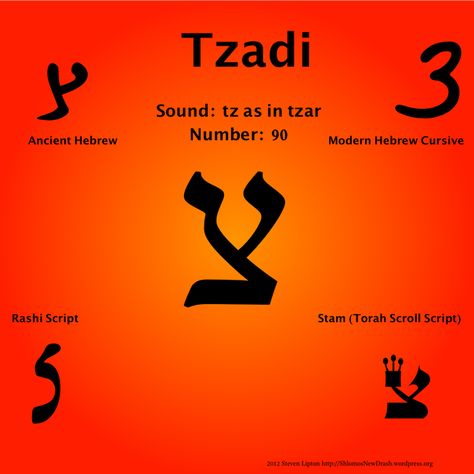
Tsadhe is the eighteenth letter in the Hebrew alphabet. Tsadhe (also written as “Tsade” or “Tsadde” or “Tzadi” or “Tzadee”) has the same sound as “tz” as in “nuts”. Every line in Psalm 119:137-144 starts with this letter. Tsadhe looks like this:

Tsade

The left side of the letter “tsadhe” represents a humble and faithful servant bent in submission. On the right is a hand lifted up to God. Put those two things together and you have a righteous person. The word “tsadhe” means “righteous one”. Only the humble are truly righteous.

Let’s review the last few letters we have studied.

  • The letter samech – represents safeguarding and closure
  • The letter ayin — represents sight
  • The letter pe — represents speech

Then, after these three letters, comes the letter צ (tsadhe). This cluster of letters tells a story. A person, who safeguards and protects his eyes from evil things and protects his mouth and speech from saying bad things, will be a tsadhe, a righteous individual.

The Pharisees in Jesus’ day were intent on becoming “tsadik” — disciples of righteousness, by doing “tsadakah” — acts of righteousness. Jesus had a few words to say about that.

Be careful not to practice your righteousness in front of others to be seen by them. If you do, you will have no reward from your Father in heaven. So when you give to the needy, do not announce it with trumpets, as the hypocrites do in the synagogues and on the streets, to be honored by others. Truly I tell you, they have received their reward in full. But when you give to the needy, do not let your left hand know what your right hand is doing, so that your giving may be in secret. Then your Father, who sees what is done in secret, will reward you. (Matthew 6:1-4)

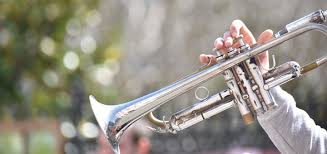
The highest form of righteous acts are those done in secret. Can you imagine having a trumpeter play “Reveille” every time you put your offering in the plate? That would get annoying.

trumpet

It’s hard to be righteous.
Trying to sustain righteousness on our own doesn’t work.
“All our righteous acts are like filthy rags.” (Isaiah 64:6)
(“Filthy rags” is most accurately translated as “menstrual cloths”.)
Selah.

Thankfully, we have a Righteous Savior
who not only forgives our filthiness,
but also imputes His righteousness onto us.
“God made him who had no sin to be sin for us,
so that in him we might become the righteousness of God.”
(2 Cor. 5:21)

That’s righteous good news.

tzadi

Next: My favorite word in the Bible that starts with “T”.

Long Song Study, part T

study2

Every verse in this section of Psalm 119 starts with the Hebrew letter “Tsadhe” (more on that tomorrow). The letter means “righteous” — and that’s definitely the theme of this passage. A form of the word is used six times in eight verses. Let’s dig in!

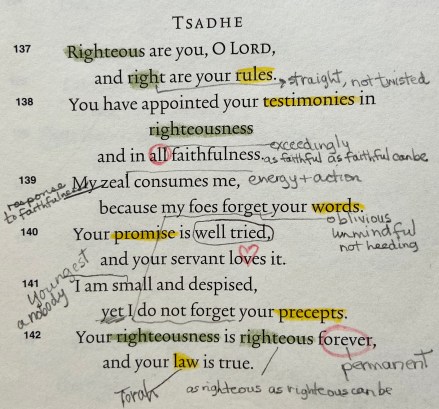
Verse 137
Righteous are you, O Lord, and right are your rules.
Righteous: upright, moral, virtuous, good, pure, true, just. Righteousness covers a lot of ground, but basically it boils down to perfect perfection, excellent excellence, faultless faultlessness. You get the idea — just keep on piling up the words. David made the connection that a righteous God would have to be the author of righteous laws, otherwise He wouldn’t be righteous. God’s perfect rightness was a great comfort to David, assuring him that God would always deal with him in the same way: uprightly, morally, with virtue and goodness, in purity, truth and justice.

Verse 138
You have appointed your testimonies in righteousness and in all faithfulness.
Moses is given credit for writing down the first five books of the Bible (the Pentateuch, or Torah). But David didn’t forget that every word was a result of divine authority, given to Moses by the direction of God. The Bible is not a smorgasbord that we get to pick and choose from according to our personal preferences and tastes.

It is not left to our choice whether we will accept them or not; they are issued by royal command, and are not to be questioned. God’s word is righteous and cannot be impeached; it is faithful and cannot be questioned; it is true from the beginning, and it will be true unto the end. (Spurgeon)

See that little word “all” before faithfulness? Like a balloon that keeps expanding with every breath blown into it, this expression means His faithfulness never explodes. It just keeps filling and filling until it’s as faithful as faithful can be.

Verse 139
My zeal consumes me, because my foes forget your words.
David’s certainty about the perfection of God’s law made him incredulous when he saw others dismiss it with contempt. It ate him up inside to witness his enemies utterly ignoring the commands of God Himself. David wasn’t personally offended, but burned with holy anger that God would be treated in such a way. I get it. It riles me up to observe professing Christians, who have been taught the truth, act like they have forgotten every bit of it.

Verse 140
Your promise is well tried, and your servant loves it.
Other versions use the words “very pure” and “thoroughly tested”, but I like the sound of “well tried”. Commands are to be obeyed, but promises are to be “well tried”. The Word can stand up to the test. That’s why David loved it so — it had been weighed and measured and NOT found wanting. In fact, “the more we try the promises, the surer we shall find them.” (George Horne)

Verse 141
I am small and despised, yet I do not forget your precepts.
David was the youngest of the eight sons of Jesse. That’s seven older, burly brothers. When Samuel was looking for a king to anoint in Jesse’s house, David wasn’t even considered a possibility by his father. Years later, as King of Israel, perhaps David still suffered from “Youngest Child Syndrome” — the littlest child overshadowed by a crowd of strong personalities. When David showed up on the front lines of the Philistine battle, his older brothers despised him for challenging Goliath. It’s hard to get over things like that. That’s conjecture, of course. Still, David didn’t blame God or use pain from the past as an excuse. Like David, we all have had past experiences that left us feeling insignificant and undervalued. And like David, we need to hold on to the truest, most reliable thing in life — God’s words.

Verse 142
Your righteousness is righteous forever, and your law is true.
David tried hard to establish the theme of righteousness in this passage. Here he started piling up the words: God is right and He is righteously righteous. He is righteous as righteous can be. And it’s not a temporary thing — it’s a forever-and-ever-amen thing. That truth gave David a firm foundation on which to stand.

Verse 143
Trouble and anguish have found me out, but your commandments are my delight.
It seems like a contradiction to have trouble and anguish alongside delight.

Only the one who is acquainted with the struggles of the spiritual life will understand the expression before us. Let the reader herein find a balance in which to weigh himself. Does he find, even when he is begirt with sorrow, that it is a delightful thing to do the will of the Lord? (Spurgeon)

Well? Are you begirt (surrounded) with stress and pressure? Can you still delight in the Lord? How does your scale read?

Verse 144
Your testimonies are righteous forever; give me understanding that I may live.
One more time, just in case you missed it, God’s words are righteous forever. Got it?

And so he rejoices in the sheer trustworthiness of the word of God. That the small, despised nobody, who burns with jealous anger for the honor of God, who endures trouble and anguish, may safely rest on this righteous word. (Christopher Ash)
img_0677img_0679

Things I know for sure from this passage:

  • When I say God is righteous, I’m not describing what He does, I am describing who He is.
  • God invites me to put His promises to the test.
  • Well tried promises lead to deeper love for the Word.
  • Even when trouble finds me, I can find delight in God’s words.
  • Studying God’s Word and gaining understanding adds life to my days.

Next: Tsadhe

Stanza T

Instead of counting how many weeks we’ve been at this (this is week 18!), let’s start a countdown. Only five more weeks and the Long Song study will be done! The finish line is in sight. Let’s finish this race!

Psalm 119:137-144

Totally perfect — that’s You, Lord;
     and Your commands are right on, too.

Talk about handing out great rules!
     I trust them with my heart and soul.

Tired out by my own fervor,
     I’m appalled that some blow You off.

Tested and tried and verified,
     Your promises are dearly loved.

Though I am deprived and picked on,
     I call to mind Your wise counsel.

Truth is found in all of Your laws;
     Your goodness never expires.

Trouble comes at me from all sides,
     but I won’t let it steal my joy.

Timeless and flawless are Your words,
     so teach me how to live by them.

img_0674img_0675

Next: Long Song Study, part T

Five Shirts

When PB saw the Six Dresses I made for our granddaughters,
the pressure was on to come up with something special for our grandsons.
Opa did not disappoint.
He designed five T-shirts for the boys.

img_0662

img_0663

What in the world does “Barnebarn” mean, you ask?
“Grandchild”, of course.
In Norwegian.
Perfect.

S is for Said

God is a talker.
In the first chapter of the Bible, we read the phrase “God said” eleven times.
We literally have the very words that God spoke.
At our fingertips.
In quotations.
Selah. (Hebrew for “stop and think about that for a while.”)

said

God’s people are talkers, too.
The word “said” is found 3, 071 times in the scriptures.
Words are the method of choice to get the gospel out to the nations.

world

For those of us who are not such great talkers, there’s a promise:
“The Holy Spirit will give you the words to say at the moment when you need them.” Luke 12:12

Psalm 119 was David’s long love song about the
extraordinary,
astonishing,
miraculous
record of what God said.

Musicians have been writing songs about the same thing ever since.

Back in 1975, the Heritage Singers recorded an album. The group was made up of men dressed in powder blue leisure suits and women wearing puffy sleeved maxi dresses. Ah, the 70s. Their big hit was titled, “God Said It, I Believe It, That Settles It For Me”. Pretty good theology.

Going back farther, in the 1700s, a song was published by an anonymous lyricist identified only as “K”. Pastor John Rippon included it in a compilation of hymns he put together for his church. “K”, whoever you are, thanks for writing such masterful words.

How firm a foundation, ye saints of the Lord,
Is laid for your faith in His excellent Word!
What more can He say than to you He hath said,
To you who for refuge to Jesus have fled?

What more can He say than to you He has said?
He said it, I believe it.

My favorite word in the Bible that starts with “S” is SAID.

Pe

Pe is the seventeenth letter in the Hebrew alphabet. Pe (also written as Pey or Pei or Peh) sounds like “p” as in “pay”. Every line in Psalm 119:129-136 starts with this letter. Pe looks like this:

pe

The word “Pe” means “mouth” as in “I open my mouth and pant…” (Ps. 119:131) The definition doesn’t just pertain to a physical mouth, but also extends in meaning to “word,” “expression,” “vocalization,” and “speech”.

Genesis states that God created everything by the words of His mouth (Pe). The fact that the letter “Pe” has an opening on its left side shows us that God is still speaking.

Rabbis point out that “Pe” (mouth) follows the letter “Ayin” (eyes), suggesting the importance of seeing (understanding, having awareness) before opening the mouth. If this order is reversed, the result is mindless chatter. Heard any of that lately?

To put it another way:
Engage the brain before putting the mouth in gear.

On the path to discipleship,
learning how to control our words is paramount.
“The tongue has the power of life and death.”
(Prov. 18:21)

The timing of our words is vitally important.
“A well-spoken word at just the right moment
is like golden apples in settings of silver.”
(Prov. 25:11)

The tone we use when speaking is consequential.
“Gracious words are like a honeycomb,
sweetness to the soul and health to the body.”
(Prov. 16:24)

Let “Pe” remind us to make good use of our mouths —
to speak
golden-apple,
honey-sweetened
words of life.

pei

Next: My favorite word in the Bible that starts with “S”.

Long Song Study, part S

bstud

Just when I think David might run out of things to say about God’s law, he comes up with more. In this section of Psalm 119, David used four words that aren’t found anywhere else in scripture. He even displayed his skills by making up a new word.

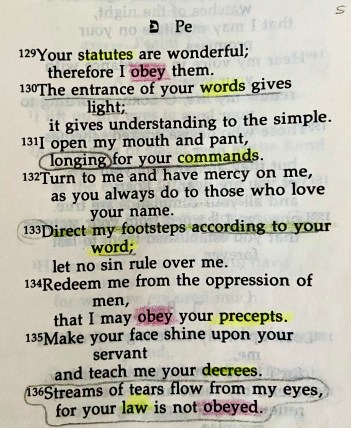
Verse 129
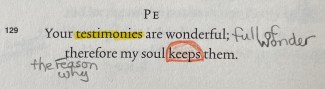
Your testimonies are wonderful; therefore my soul keeps them.
We’ve studied seventeen sections of poetry with one hundred and twenty-nine verses, and still David keeps finding new ways to extol God’s Word. “Wonderful” (pele) is a Hebrew word that means: extraordinary, astonishing, miraculous. This made me do a double-take. The Book that sits on my desk, the Book that I sometimes ignore and sometimes read over quickly, that same Book is a miracle. And it can do miraculous things in me. Of course, David wanted to keep testimonies that filled him with wonder.

Verse 130
The unfolding of your words gives light; it imparts understanding to the simple.
Again, David reached down deep for just the right word: unfolding. This is the only place in the whole Bible this word is used and it means “revelation”. I love the idea that when we open the pages of our Bibles, God begins to unfold truth and reveal His thoughts to us. He gives us clarity where there is confusion and illumination where there is fogginess. This isn’t just available to seminary students or Bible scholars, but also to the simple. (Can I get an “amen”?) It doesn’t take great intellect to understand God’s Word because it’s the Spirit’s work to activate our hearts and reveal truth. We can’t use the excuse that we’re not smart enough to understand the Bible. Smartness isn’t required.

light2

Verse 131
I open my mouth and pant, because I long for your commandments.
David compared himself to an animal that was running, open-mouthed, sucking in air, heart beating hard, muscles exerting themselves at full capacity, running for its life. That’s how hard David went after God’s Word. The word “pant” means “to inhale eagerly, breathless.” In other words, approaching the study of God’s commandments should take our breath away. And did you notice what David was yearning for? God’s commandments! Most of us long for God’s promises more that His laws. David’s longing pushed him to action. As Spurgeon points out, “Longing that is not acted upon is more wishing than longing. Never rest content with mere longings.”

Verse 132
Turn to me and be gracious to me, as is your way with those who love your name.
In this verse, David began a list of prayer requests. First, he asked God to turn toward him and second, to be gracious to him. David knew that the moment God faced him, mercy would be needed. But he also knew from experience that this was God’s way of doing things. We can come to the Lord every morning for a fresh batch of mercies. “His loving-kindness begins afresh each day.” (Lam. 3:23) It is His way.

Verse 133
Keep steady my steps according to your promise, and let no iniquity get dominion over me.
Another request by David — this time for steadiness in his spiritual journey. He wanted to stay firmly grounded in the Word. Many people want their steps directed by something else — their feelings or friends, circumstances or comforts. David reminded God of His promise to direct him because he was aware that small compromises could lead to becoming dominated by sin. Paul warned of the same thing, “Therefore do not let sin reign in your mortal body so that you obey its evil desires.” (Romans 6:12) Steady obedience is the key, perhaps something David learned the hard way.

“Oh, how we often stagger along! We do what is right, but we quiver and shake while we are doing it.” (Spurgeon)

Verse 134
Redeem me from man’s oppression, that I may keep your precepts.
Once he addressed his internal battle with sin, David looked at his external struggles and requested help with those, too. Man’s oppression came in many forms, including cruelty, injustice, slander, exploitation, lies. Need I go on? Those kinds of outside pressures wore David down and distracted him from focusing on God’s laws.

Verse 135
Make your face shine upon your servant, and teach me your statutes.
David, the wordsmith, took the word “light” that he used in verse 130 (“The unfolding of your words gives light”) and made up a new word by attaching the word “face”. When God turned His face toward David, he saw God’s favor shining out from it. “Light” and “shine” create a beautiful connection — follow me here. When we “unfold” the word of God and let His truth shine on us, it’s the same thing as the face of God shining His favor on us. When we open our Bibles, we’re as close as we can get to seeing God’s face. *Shiver*

Verse 136
My eyes shed streams of tears, because people do not keep your law.
David cried lots of tears. The word “streams” means “a channel of water” or “an irrigation canal.” You could say David cried a river. To make a point, he used an idiom to express his deep sorrow and anguish. What caused such emotion to rise up in David? He was sick at heart because everywhere he looked, people were blowing off God’s words. Because the people refused to listen, follow or obey, David wept. 
“One of the darkest signs of any age is when the people weep but little for sin.” William Swan Plumer

img_0602img_0603

Things I know for sure from this passage:

  • I need to seek forgiveness for a flippant attitude toward the extraordinary, astonishing, miraculous gift of God’s Word.
  • If I’m panting after something other than God, it may be an idol.
  • It’s hard to keep a steady walk with God when sin has a hold on part of my life.
  • When I open the pages of scripture, God’s light shines on me.
  • Hardness and pride will keep me from weeping over the brokenness of sin in the world.

Next: Pe

Stanza S

There are more English words beginning with the letter “s” than any other letter of the alphabet. According to a two second Google search, there are exactly 76,816 “s” word entries in the dictionary. Well then, given the number of words I have to choose from, this should be fun.

Psalm 119:129-136

Sensational are Your commands;
     I want to submit to them all.

Shining light spills out of each page;
     I’m slow, but You get through to me.

Similar to a panting dog,
     I long for a drink from the Word.

Spare me the spanking I deserve,
     but let Your grace reign, like always.

Show me how to walk by Your word
     so sin doesn’t boss me around.

Save me from cruel injustice,
     so I can stay in step with You.

Smile down on Your humble servant;
    I’m ready and willing to learn.

Some days I can’t keep from sobbing,
     when I see open rebellion.

img_0600

Next: Long Song Study, part S

Six Dresses

This summer I pulled out my sewing machine.
It’s been a while.
I thought about the dresses I made for my girls when they were little.
Then I thought about my little granddaughters.
So I made six dresses.

img_0553

As I sewed, I prayed for their six little hearts.
“Help them to pin their hopes and dreams to You.”
“When things are coming apart at the seams, help them turn to You.”
Hem them in by Your love, before and behind.”
“Give them the desire to gather together with other believers.”
Finish off their rough edges so they don’t unravel.”
“Help them not be afraid to go against the grain of culture.”
“Protect them from developing unfair biases.”
“Help them give grace to people who needle them.”
“May they live according to the pattern set in scripture.”
“Give them Your strength to iron out their problems.”

img_0552

May the Word that is sown (sewn?) into their hearts
take root and produce fruit (and pink flowers!).
Amen.