Song and Dance

In what seems like many lifetimes ago, I was a college student working toward a degree in vocal music. I learned how to round my vowels and breathe from my diaphragm. I learned the solfeg system and how to recognize half-diminished seventh chords. I modulated and transposed and notated. I practiced the harmonic minor scale, the pentatonic scale and the whole-tone scale. In my senior recital I sang Bach in English, Faure in French, and Puccini in Italian.

The music degree required two years of piano instruction. I had taken years of piano lessons as a youngster, even though I begged my parents to let me quit. I even went so far as to safety-pin notes to my mom and dad’s bedsheets so when they turned down the covers one night, they were faced with a barrage of petitions, such as “Please let me quit piano,” and “I hate piano lessons,” and “Just because my sister took piano lessons doesn’t mean I should have to.”
They did not give in.
And I’m so glad.

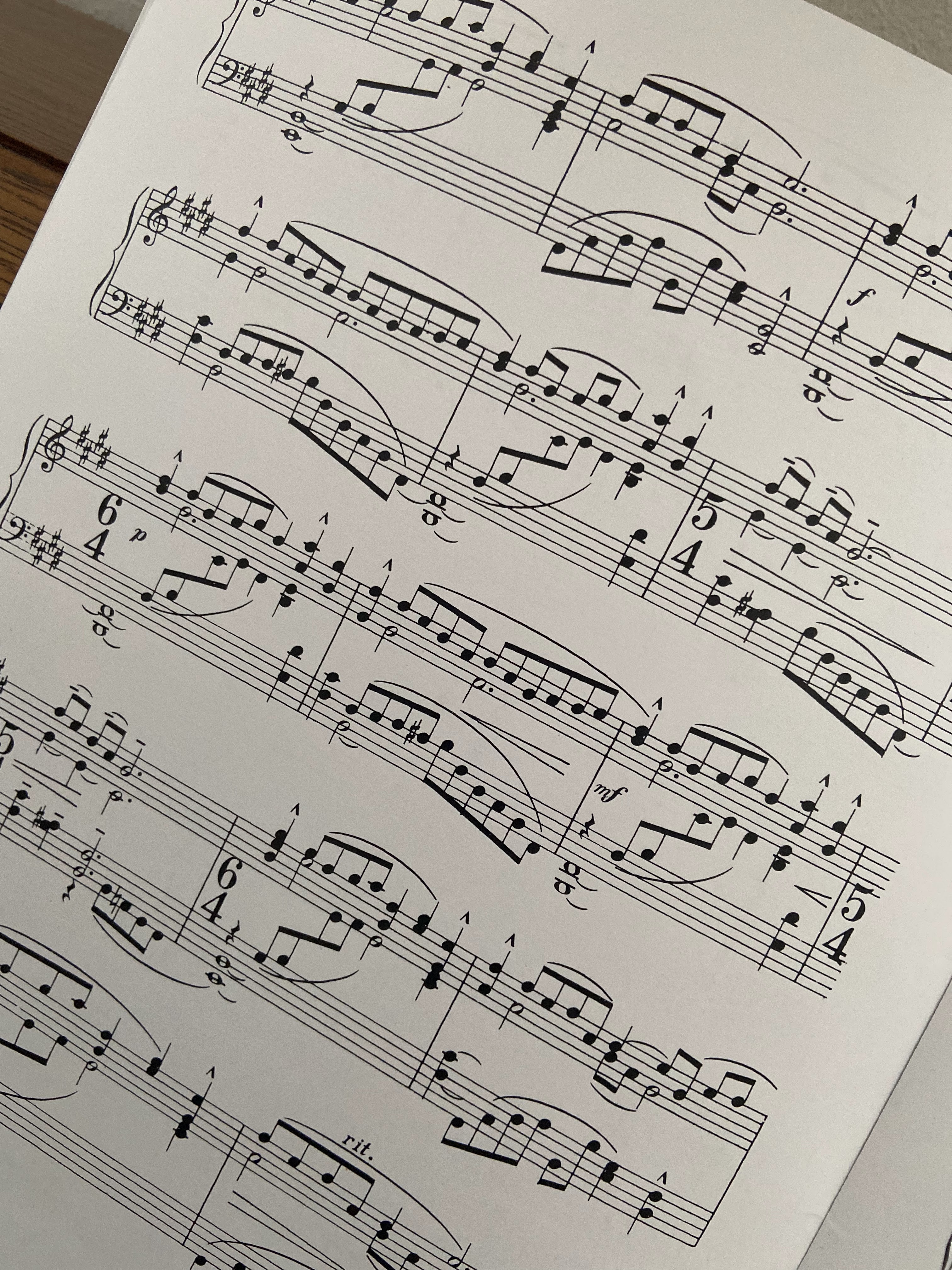
I had a fantastic piano teacher in college named Mrs. Grill. I never once was tempted to pin notes to her bedsheets. I didn’t want to quit taking lessons from her, even after graduation. She pushed me beyond what I thought were my limits—I was convinced I couldn’t play music with sharps. Flats were no problem, but sharps? No way. Until Mrs. Grill assigned me Canciones Y Danzas by Federico Mompou.

Not just one sharp, not two, not three, but four sharps. And I learned to play the piece! And memorize it! And perform it in a recital! Dear Mrs. Grill. I couldn’t have done it without her.

One of my goals for 2024 is to play Mompou’s “Song and Dance No. 5” once again. Right now, I’m stumbling and bumbling my way through it. Right hand alone, then left hand alone, then slowly together. I may never play it with the same confidence I had over 40 years ago. But then, I don’t have Mrs. Grill encouraging me every week.
I’m learning the joy of doing something just for the love of it—not to pass a class or fulfill requirements or even perform for an audience. Sometimes I still need to be pushed beyond what I think is possible. On the other side of practicing scales and finger exercises, there is delight.

The Psalmist said, “But his delight is in the law of the Lord and on His law he meditates day and night.” (Psalm 1:2) The disciplines of regular prayer and scripture reading can seem to drag on, but then suddenly, there are days when it is pure delight.

Don’t stop. Keep walking (and practicing) every day.

A Small Drop of Tea

These frigid, dreary days of midwinter can be challenging.

Some of us slowly plug away at winter projects in the basement, take an afternoon nap, and heave great sighs of general antsy-ness.

Some of us slowly type away on writing projects on the computer, read English novels, and heave great sighs of contentment.

To inject a little joy into our hum-drum days, I’ve started a new tradition—tea time.

Between 2:30 p.m. and 3:00 p.m., (depending on the length of the nap) the tea kettle goes on, the tea biscuits come out, and PB humors me by being a good sport. It’s a fun little break in the day. I don’t make him lift his pinky finger or speak in an English accent (although I want to so badly). He would rather be in the woods or in the garage or…. probably anywhere else, but alas, the wind chill is dangerous and the garage is not heated. So he’s stuck inside with me, drinking Hot Cinnamon Spice Tea and munching on shortbread biscuits.

I think it’s absolutely lovely.

I think he secretly likes it.

Bema

My spell-check is trying to change Bema to Beam, but I have overcome. I have no thoughts to share on beams, but I do have something to say about the Bema.

What’s a “Bema”? Glad you asked. Here comes a history lesson.

The places of worship back in Jesus’ day looked nothing like our modern churches. In 1st century Israel, every village had a synagogue. And every synagogue had a Bema.

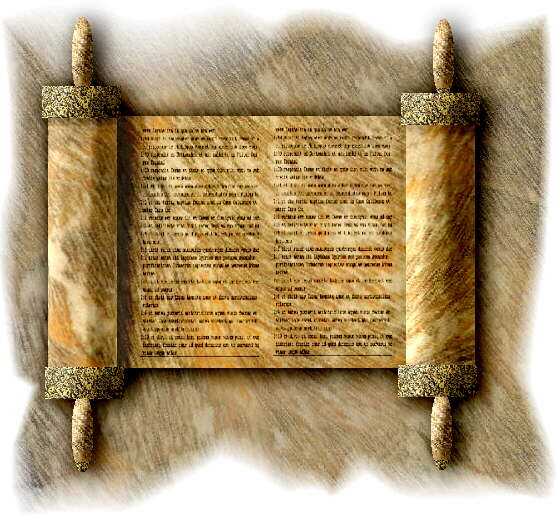
Synagogues were large, fairly plain spaces, where Jewish people gathered to worship Yahweh. Around the edges of the room were benches, like mini-bleachers, made of stone. Important people sat on the benches, while the common people sat on the floor, which was usually made of dirt or flagstone. In the center of the room was a small, slightly raised platform called the Bema. In the middle of the platform was a pedestal on which one of the Torah scrolls was placed. (Torah = the first five books of the Old Testament.) Someone would step up onto the Bema and read the Word of the LORD to the congregation.

On the Sabbath, the community came and gathered around the scriptures. The Word of God took center-stage. Because people were sitting in a circle around the Bema, they were able to look each other in the eyes. Each one could contribute to the discussion that followed the reading, although if a rabbi or special guest was in attendance, he was invited to speak.

As the disciples took the gospel to the Gentiles, many of the early Christians were Greek. Over time, the Greek influence was seen in Christian churches that were designed to accommodate larger groups, with a stage in front and rows of seats for an audience. As more time passed, the Bema was replaced by a pulpit. Worship consisted of sitting passively, looking at the back of others’ heads while professionals led from the stage. While scripture was still an important part of the worship service, most of the time was spent listening to one person expound. In Colonial America, a minister’s sermon could last several hours.

This may sound radical, but what if we went back to looking more like a synagogue than a theater? What if everyone came to worship ready to contribute? What if we beamed (!) a spotlight on the Bema?

It’s a crazy idea.

Your Word is a lamp to my feet and a light to my path.
Psalm 119:105

Treasure

“Do not store up for yourselves treasures on earth,
where moth and rust destroy
and where thieves break in and steal,
but store up for yourselves treasures in heaven,
where neither moth nor rust destroys
and where thieves do not break in and steal.
For where your treasure is, there your heart will be also.”
Matt. 6:19-21

“Treasure” is my word for 2024.

I picked this word because Jesus used it in The Sermon on the Mount. He made a distinction between “treasures on earth” and “treasures in heaven.”

I want to make sure I’m collecting the right kind of treasures.
I want to check up on my heart and see what’s stored up in there.
I want to find out what is truly precious and what’s worth a rust bucket.

The Bible Project is doing a year-long series on The Sermon on the Mount. I am giddy about this. A whole year on three chapters! As I was perusing Jesus’ sermon in Matthew 5-7, my eyes kept going back to that one short passage. Like a magnet. That’s when I knew.

I’ll be on the lookout for the word “treasure” in the days ahead in songs, in books, in dreams and especially in the Word. A true treasure hunt!

Do you pick a word for the year? What is your word for 2024? 

2024 Bible Reading Plan

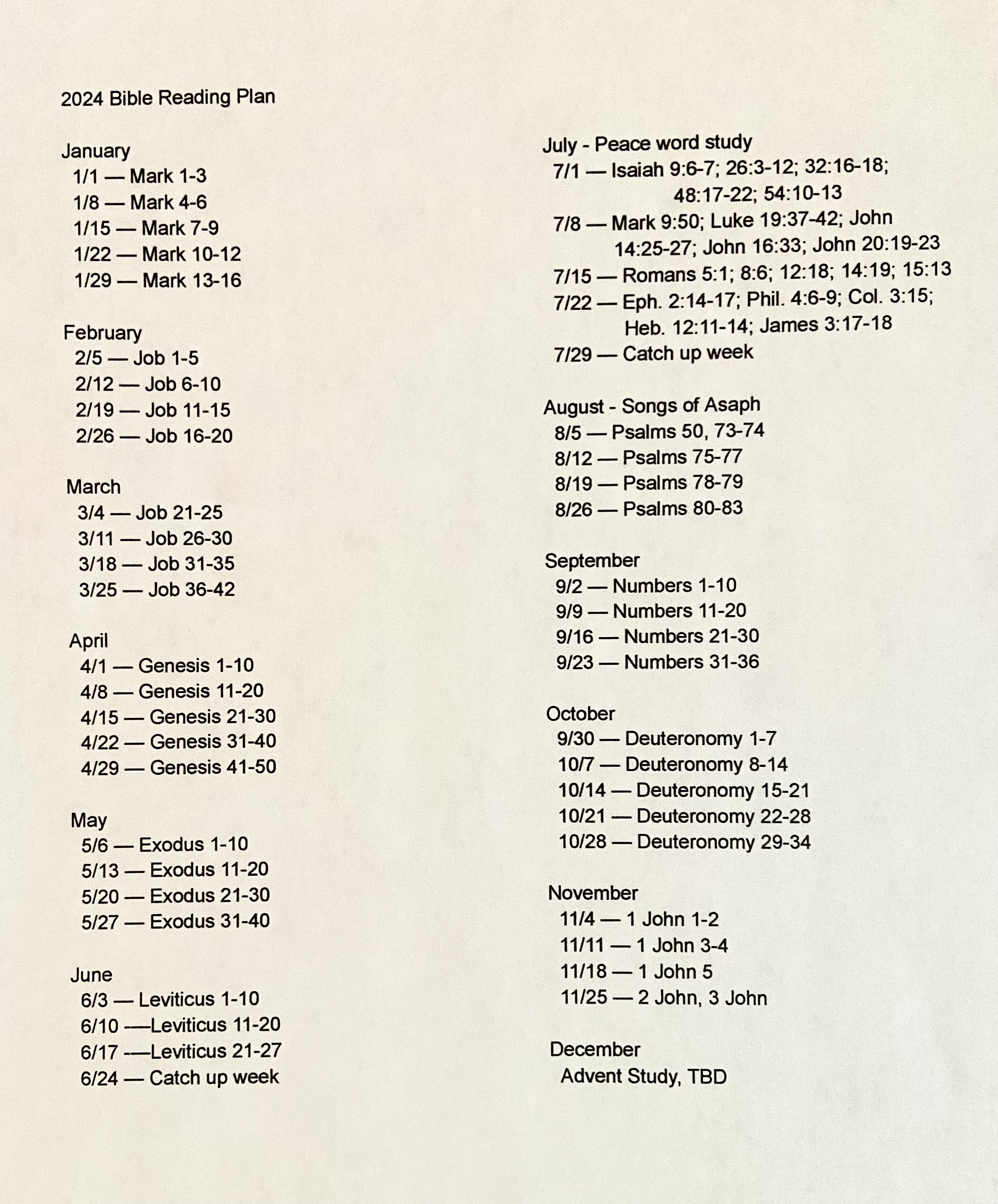
Every year for the past 10 years, I have created my own Bible Reading Plan. There are lots of good ready-made plans available online that are perfectly fine. I just get a thrill out of making assignments for myself and anyone else who wants to come along!

The first half of the year is a true “reading” plan (not a “study” plan) with no deep dives into passages. This plan is set up for reading on Monday through Friday, with weekends for catch-up. The year begins with the gospel of Mark, and then a reading of the Old Testament book of Job.

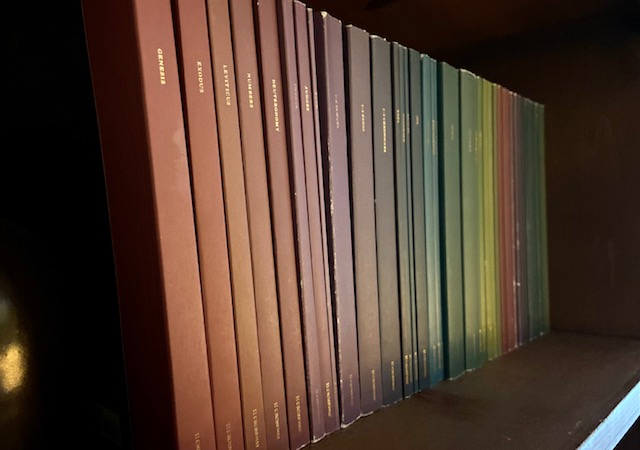
I have been wanting to read through the Pentateuch (the first five books of the Bible, most of which Jewish boys in Jesus’ day had to memorize), so Genesis, Exodus and Leviticus will be next. I will be reading 10 chapters a week in a kind of “fly-over” to get the big picture. Numbers and Deuteronomy will be picked back up in the fall.

Past years have taught me to ease up a bit in the summer, so in July I will be doing a word study on peace (the third Fruit of the Spirit as listed in Galatians 5:22-23) and August will bring a look at the 12 Psalms written by Aseph (one of the Psalm writers). The year will wrap up with a reading of John’s letters (1 , 2, 3 John — not the Gospel of John).

May God bless the reading of His Word!

Out with a Bang

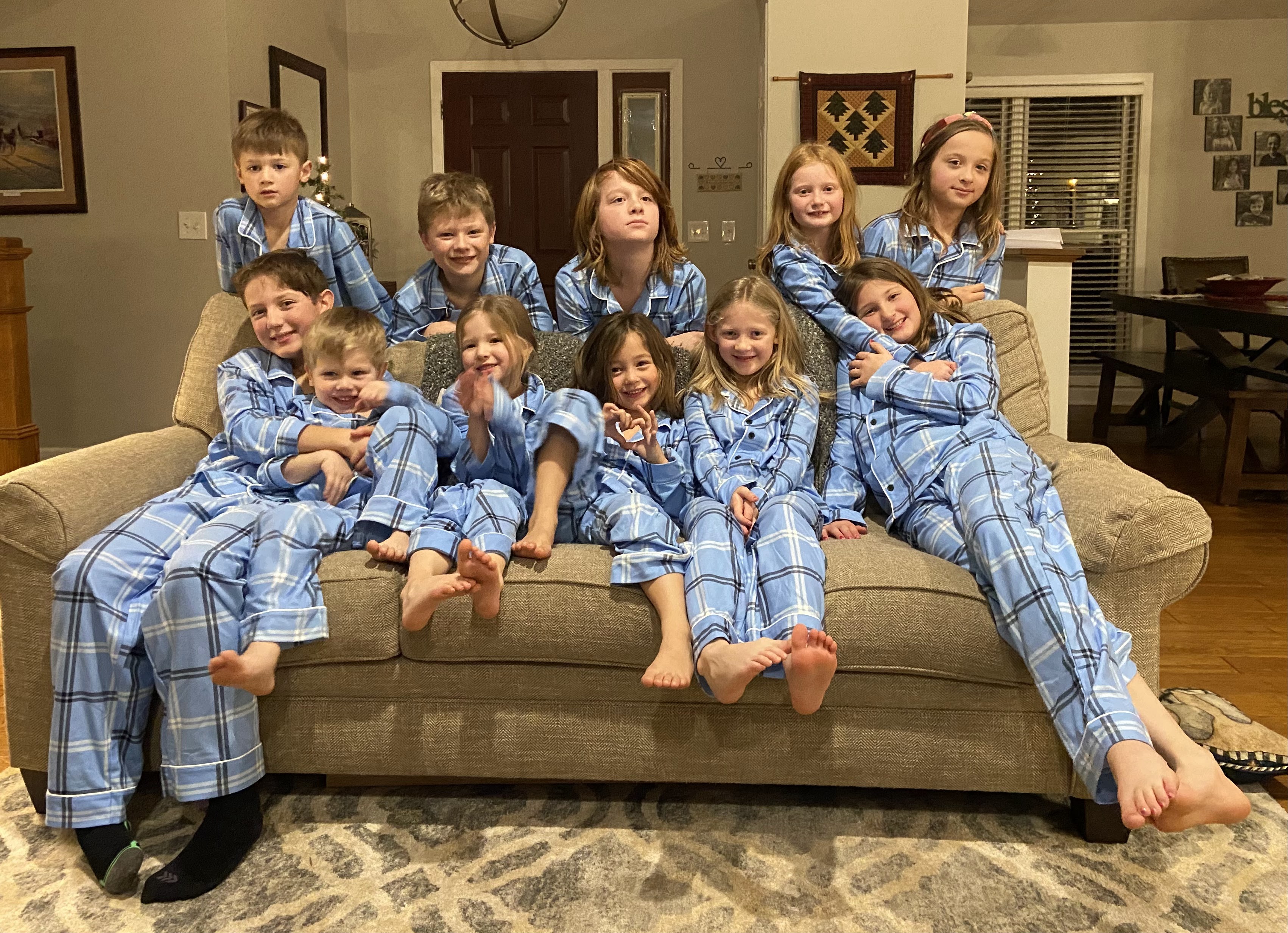
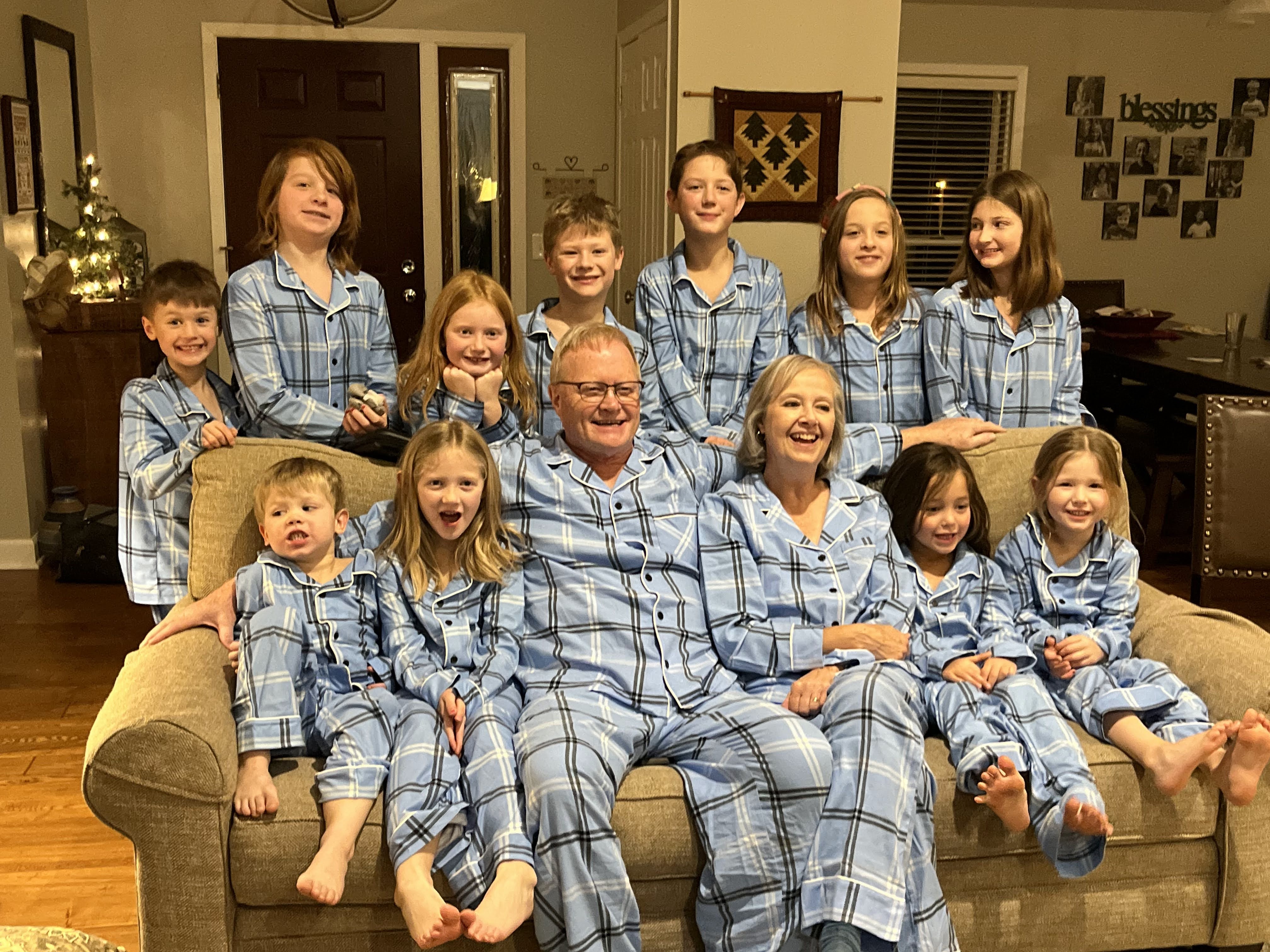
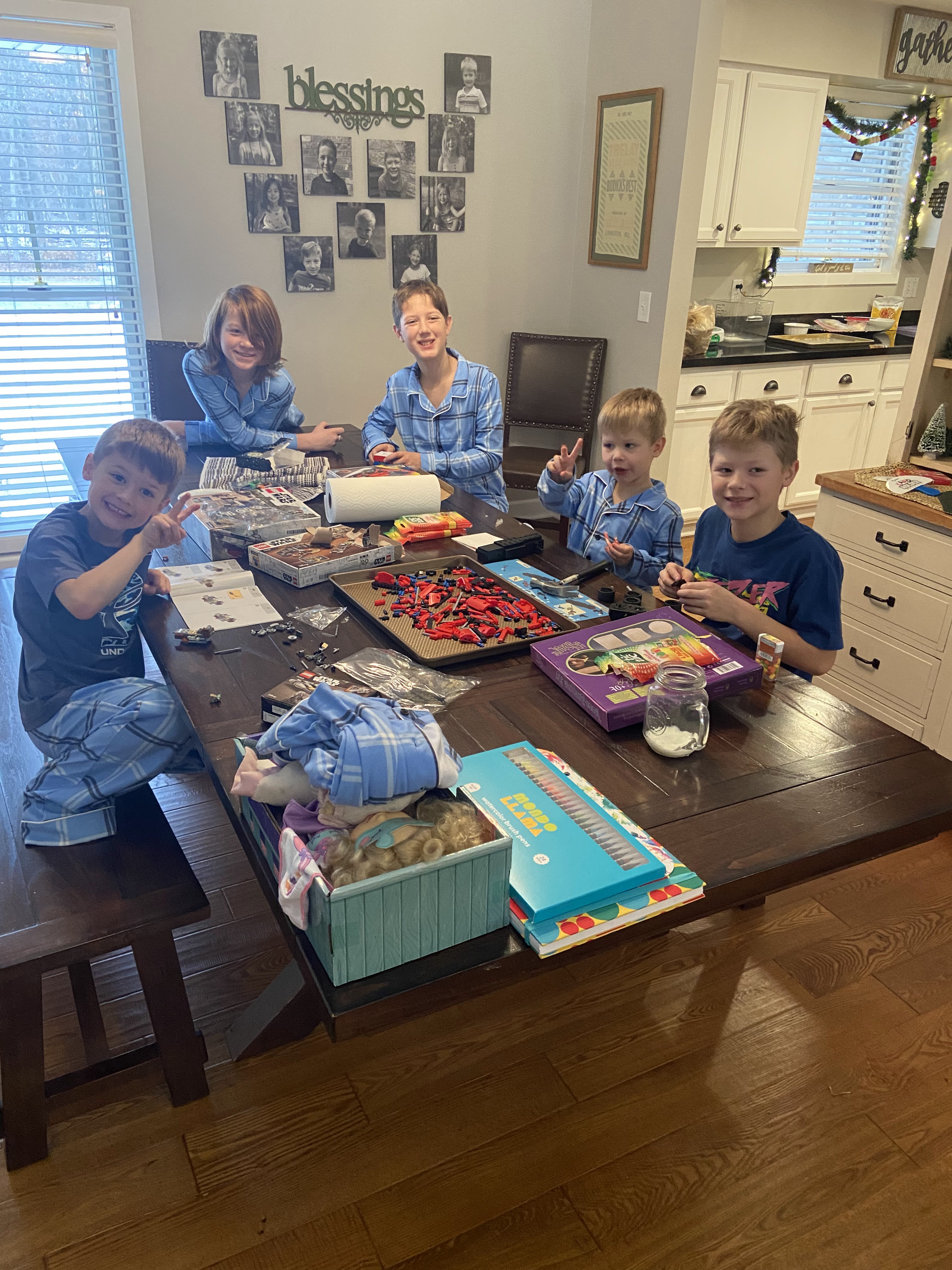
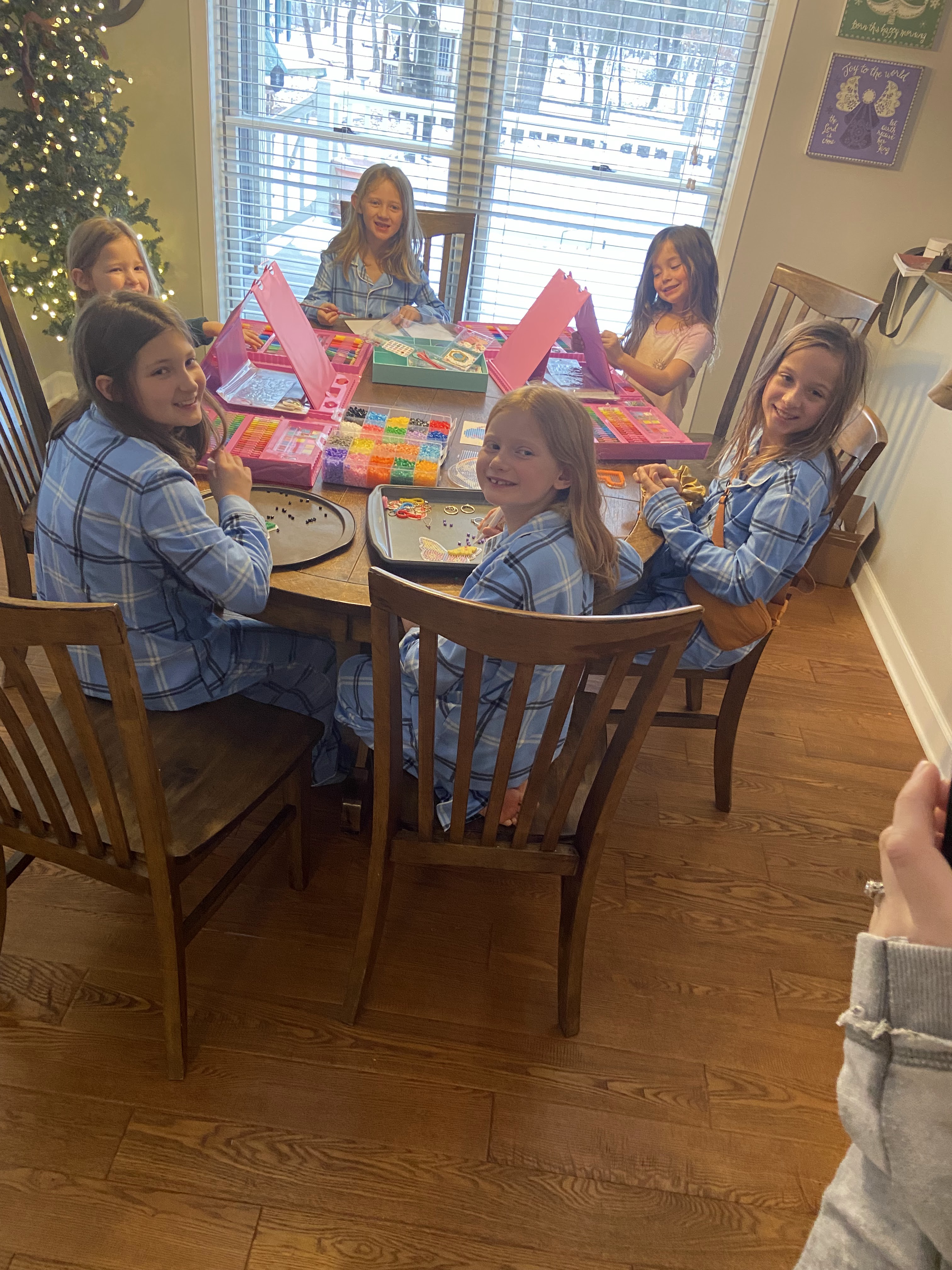
We celebrated Christmas with the whole gang on Dec. 29-30, ending the year with a bang. These guys made some serious noise (very early in the morning) and cleared out the cookie and caramel stash in no time (sorry for all the sugar, parents). After opening presents, they all got to work on their new stuff. Each year I marvel at these young humans that are growing and becoming interesting, intriguing, and unique individuals.

Opa and Nonnie surprised the kiddos with matching jammies.

The 2024 Bible Reading Plan will be posted tomorrow!
Happy New Year’s Eve!

Books of 2023

I took a different approach in my reading life this year. Instead of setting a goal to read a certain number of books (I read 37 – of course I kept track), I created some categories in hopes of becoming a more well-rounded reader. I think it worked. I feel rounder.

1 book by Elizabeth Goudge — Genetian Hill by E. Goudge
I read a Goudge book every February. Her writing is full of English cottages and rose gardens and lovely language. I seem to need that in February. During the year, I look for copies at used book sales and shops. The musty smell and worn pages enhance the overall experience.

1 book by Eugene Peterson — Leap Over a Wall by E. Peterson
This book on the life of David and his relationships with various people was a great companion while I read through the Biblical record of David in 1&2 Samuel. Peterson communicates deep theology without being stuffy.

1 book on the Fruit of the Spirit: Joy — Aggressively Happy by Joy Marie Clarkson
Clarkson is delightful, funny and tells good stories. She’s also a realist: “Cultivating happiness takes grit, determination and a good sense of humor. It’s a lot of work.” One other book in this category: Choose Joy by Kay Warren.

1 book on prayer — Praying Like Monks, Living Like Fools by Tyler Staton
Staton is the director of the 24/7 Prayer Movement in the USA. He can write about the topic because the man is a pray-er. I needed his passionate words to give my prayer life a jolt.

1 old Christian classic — The Pilgrim’s Progress by John Bunyan (written in 1678) and Hinds’ Feet on High Places by Hannah Hurnard (written in 1955). I’ve read them both before, but I was given beautiful gift copies, so I read them again. And I’ll read them in the future. Classics.

1 English classic — Dr. Jekyll and Mr. Hyde by Robert Louis Stevenson
I’m a little embarrassed to admit that I haven’t read this iconic story until now. I picked it up because it was short (only 100 pages) and it fit my category. It’s kind of creepy and kind of cool and now I know what references to “Jekyll and Hyde” really mean.

1 book of poetry — The Word in the Wilderness by Malcolm Guite
Poetry is hard. Malcolm is here to help. This book contains a poem a day for the season of Lent and Easter. I read the poem each day, then read Guite’s explanation of the poem, then read the poem again and said, “Ahhhhhh. I get it now.” Poetry is wonderful.

1 book on nature — The Heart of John Muir’s World by Millie Stanley
Muir was the “Father of National Parks” and grew up in the mid 1800’s a few miles from where I live. He wrote, “Oh! that glorious Wisconsin wilderness!” I need to be reminded to open my eyes and take in all the natural glory right in my own backyard.

1 biography/memoir — All My Knotted Up Life: A Memoir by Beth Moore
Over the years I’ve done several Beth Moore Bible studies. Sometimes I love her, and sometimes I roll my eyes a little bit. Shame on me. You never know what a person has gone through in life. Her transparency and conversational style had me gobbling up this book in two days. Then I listened to her read the audio version. I also read the memoir Secret Thoughts of an Unlikely Convert by Rosaria Butterfield.

1 Jane Austen book — Mansfield Park by Jane Austen
I’ve read “Pride and Prejudice” several times, but now I’m making my way through her other books, one by one. Three down, three to go.

1 book on writing — Write Tight by William Brohaugh
I’m a sucker for books on the craft of writing. I’ve read so many they all are starting to sound the same. Basically, “sit down and write.” All right already.

1 Montana historical novel — The Whistling Season by Ivan Doig
My great grandparents homesteaded in Montana in the late 1800s and I’ve dreamed of living in Big Sky country ever since I was a little girl. I’ve read this title before, but PB and I listened to the audio book on our way to Montana in June. Pure delight! I also read Dancing at the Rascal Fair by the same author.

1 book on the church — Positively Irritating: Embracing a Post Christian World to Form a More Faithful and Innovative Church by Jon Ritner
This was my #1 book of 2023. It shook me up (in a good way) and caused me to think hard about church and culture in new, scary, and exciting ways. Ritner asserts that the church needs to pivot from being a “restaurant” (expecting people to come in and be served) to becoming a “food truck” (taking the gospel out to where people are). I can’t stop thinking about it.

Honorable Mention:
The Sound of Life’s Unspeakable Beauty by Martin Schleske
Secrets Of the Secret Place by Bob Sorge
On Getting Out of Bed by Alan Noble
David Rise by Mark Buchanan

May God bless your reading of books in 2024!