Ten Thousand Thunders

One of the goals I set for myself this summer is to read “Paradise Lost” by John Milton. It’s an epic poem, first published in 1667 and considered to be Milton’s masterpiece. Written in blank verse, which means it doesn’t rhyme, every line has exactly ten syllables. And there are over 10,000 lines in this poem. I thought it would take me all summer to slog through this renowned classic.

But I can’t put it down.

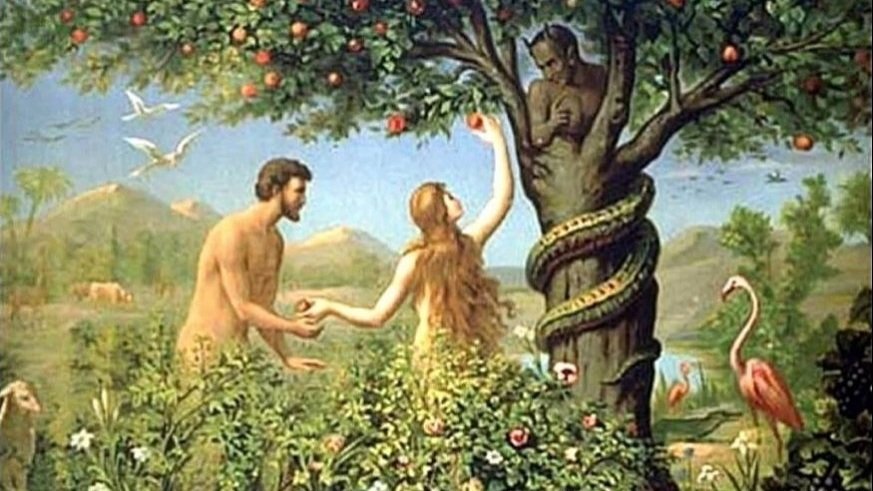
The poem tells the story of the war in heaven, the expulsion of Lucifer with one-third of the rebellious angels, and the temptation and fall of humans in Eden.

The other day, I had to put it down because I was weeping.
I had no idea this archaic poem would move me so much.

Here’s the scene:

As the war in heaven between the holy angels and the fallen angels raged on, God called on the great Son to enter the fray. Jesus roared into the battle on a “fierce chariot” with “burning wheels” that shook all of heaven. In His right hand He grasped “ten thousand thunders.” With one look at the Son, the demons “withered all their strength.” They were driven like a herd of goats to the “crystal wall of heaven” where opening wide before them was the “wasteful deep, a monstrous sight that shook them with horror.” But with the Almighty Son closing in on them, they chose to jump—”headlong themselves they threw down to the bottomless pit. Nine days they fell.”

Here’s my thought:

Milton’s depiction of the Son of God in all His power and glory was breathtaking. His account of the decisive and complete victory over evil gave me goosebumps. But what brought me to tears was the realization that Jesus could have shaken earth with ten thousand thunders, but instead chose to withhold His power and submit to death, even death on a cross. For love of you and me.

I know what happens next, but I can’t wait to see how Milton describes it.

Best of 2024

“I do not want to just read books;
I want to climb inside them and live there.”

~Unknown

I’ve climbed inside some great books this year–47 to be exact. Picking my top ten won’t be easy, but here goes.

10. The Dean’s Watch, Elizabeth Goudge
I read one Goudge book every year for the sheer enjoyment of it. The English countryside in her captivating stories is a perfect escape for me in February. There’s always transformation, redemption, and beauty, but never in a formulaic way. This is a good one to climb into.

9. Water From a Deep Well, Gerald L. Sittser
I’m a church-girl, but I didn’t know much about the sweep of church history. It may sound boring, but Sittser made it come alive starting with the early Christian martyrs and moving through the desert saints, the monastic movement, the mystics, the medieval laity, the reformers, and evangelicalism. We stand on the shoulders of centuries of faithful believers.

8. David’s Crown, Malcolm Guite
Guite wrote a sonnet for every one of the 150 psalms with a creative twist. The last line of each psalm is the first line of the following psalm and this pattern is woven throughout the book. Then the last line of Psalm 150 is the first line of Psalm 1. So cool. He’s a true wordsmith.

7. The Bartender’s Tale, Ivan Doig
This is a rollicking-good story set in Montana in 1960. Doig’s characters are so well developed and the settings so masterfully described that reading his books only feeds my fantasy of living in Montana. Talking about this novel with my neighborhood bookclub made it even better. Plus, snacks were served.

6. The Re-Set, Jeremy Riddle
I listened to the audio version of this book. Riddle read his own words with such passion and conviction, I was brought to tears more than once. He had some hard things to say about the state of worship in the modern church, but always with a heart of love. I’ve given this book to every worship leader I know.

5. The Storied Life, Jared C. Wilson
Jared Wilson is “Author-in -Residence” at Midwestern Seminary which means his job is to write stuff. After publishing 26 books, he wrote a book on how to write books. I don’t know if I have a book in me, but I’ll definitely use his wise words to propel me into 2025 with fresh inspiration.

4. The Last Battle, C. S. Lewis
I read “The Chronicles of Narnia” to PB this year. The last page of the last book gives me goosebumps every time. Narnia is a treasure.

3. Kristin Lavransdatter, Sigrid Unset
I wanted to read a book set in another country, so I picked a 1,124 page novel about a Norwegian woman in the 1300’s. I’ve never read medieval literature, or Scandinavian history or a book that’s more than 2″ thick. I new experience for me—and I liked it.

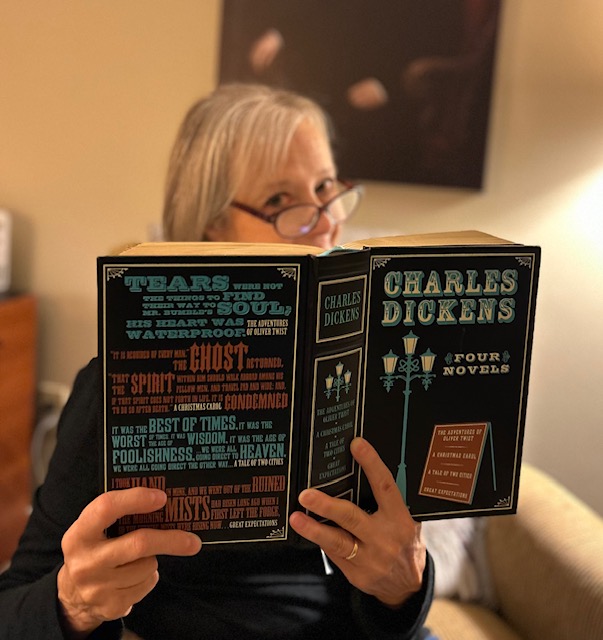
2. A Christmas Carol, Charles Dickens
PB and I immersed ourselves in Dickens this Christmas. We watched the 2009 animated film with Jim Carrey as Scrooge. We read “A Christmas Carol” together. We took the free course from Hillsdale College, which consisted of six delightful lectures by a literature professor. Then we watched “The Man Who Invented Christmas”—the story of the journey that led Dickens to write his Christmas masterpiece. God bless us everyone.

1. Trusting God in the Darkness, Christopher Ash
This was the book that impacted me the most this year, which I read while studying the book of Job. Themes of suffering, loneliness and despair were gently dealt with in Ash’s book. Every single page has sentences underlined or notes written in the margin. It’s too good to say any more about it. When you’re ready to wade into deep waters, get a copy and read it slow.

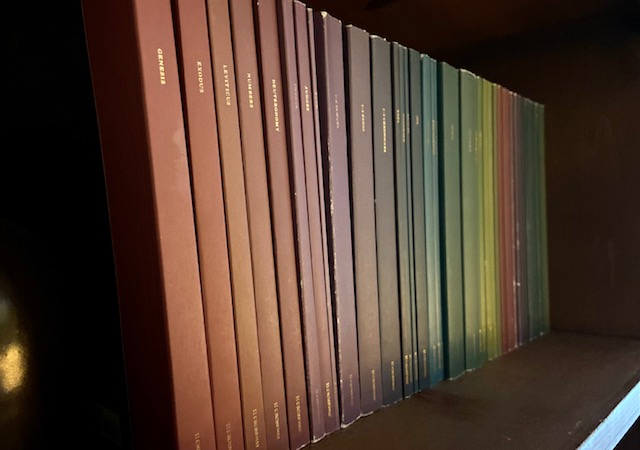
Honorable Mention: volumes 1 and 2 of the Harvard Classics.

Here are two other “Best of” lists:

Movies/TV shows

  • Jonathan and Jesus, Prime documentary
  • Mr. Bates vs. The Post Office, PBS
  • Yesterday, Netflix movie
  • Music by John Williams, Disney + documentary
  • Young Woman and the Sea, Disney+ movie

Podcasts

  • Bible Project, Sermon on the Mount series
  • Church of the City New York, Jon Tyson
  • Living on the Edge, Chip Ingram
  • What It’s Like To Be, Dan Heath
  • The Cause, Rob Pirie

Climb into a good book in 2025!

Further Up and Further In

Back when we were homeschooling, my favorite part of the day was the afternoon read-aloud time. I loved picking out great stories and doing all the “voices” of the characters. The kids would sprawl out on the living room carpet and color or draw or build Lego creations while I read. “One more chapter, pleeeease” was music to my ears.

I missed afternoon read-aloud time when the kids grew up and left the nest. So I decided to read to PB. My dear husband is always a good sport when it comes to my ideas, God bless him. As it turns out, he loved it as much as the kids did. And I still get to do “voices.”

I was shocked when he admitted that he had never read The Chronicles of Narnia by C. S. Lewis, so we started book one last January. This week, we finished book seven. Please understand that instead of “one more chapter, please” I now hear soft snores after a few pages. It’s slow going.

The characters were a real test of my various voice inflections. King Tirian got a British accent while the Dwarfs spoke with a Scottish brogue. Shift, the Ape, had a Texas drawl and Puzzle, the donkey, was given a Bronx dialect. Puddleglum had an “Eeyore-ish” sound and Rishda was gravelly and sinister. Of course, for Aslan, I tried my best to imitate Liam Neeson and I took it up a few octaves for Reepicheep.

“The Last Battle” is my favorite book in the series. I couldn’t hold back the tears at the end when Aslan came leaping down the mountain, “like a waterfall of power and beauty.” When the children said goodbye to the Shadowlands, I had to stop reading for a minute. PB didn’t quite know what to do.

As the beloved characters go further up and further in,
the reader knows what this is all about.
This is heaven, Eden restored, the Golden Gates opened.

“Isn’t it wonderful?” said Lucy. “Have you noticed one can’t feel afraid, even if one wants to? Try it. “By Jove, neither one can,” said Eustace after he had tried.

The further up and the further in you go, the bigger everything gets. The inside is larger than the outside.”

The Chronicles end with this magnificent paragraph—

And for us this is the end of all the stories, and we can most truly say that they all lived happily ever after. But for them it was only the beginning of the real story. All their life in this world and all their adventures in Narnia had only been the cover and the title page: now at last they were beginning Chapter One of the Great Story which no one on earth has read: which goes on forever: in which every chapter is better than the one before.

Some of the finest words ever written.
Pass the tissues.

In case you’re wondering what’s up next for PB:

Classic Adventure

PB and I took a little road trip.
We didn’t go very far.
We weren’t gone for very long.
That’s our kind of adventure.

We went to a band concert in a park.
We toured a breathtaking religious site.
We walked through a historical homestead.
We overlooked a river at flood stage from a bluff.
We ate steak and shrimp at a good old fashioned supper club.

The highlight, for me, was a stop at the largest used book store in the state, with over half a million books.

Be still, my heart.

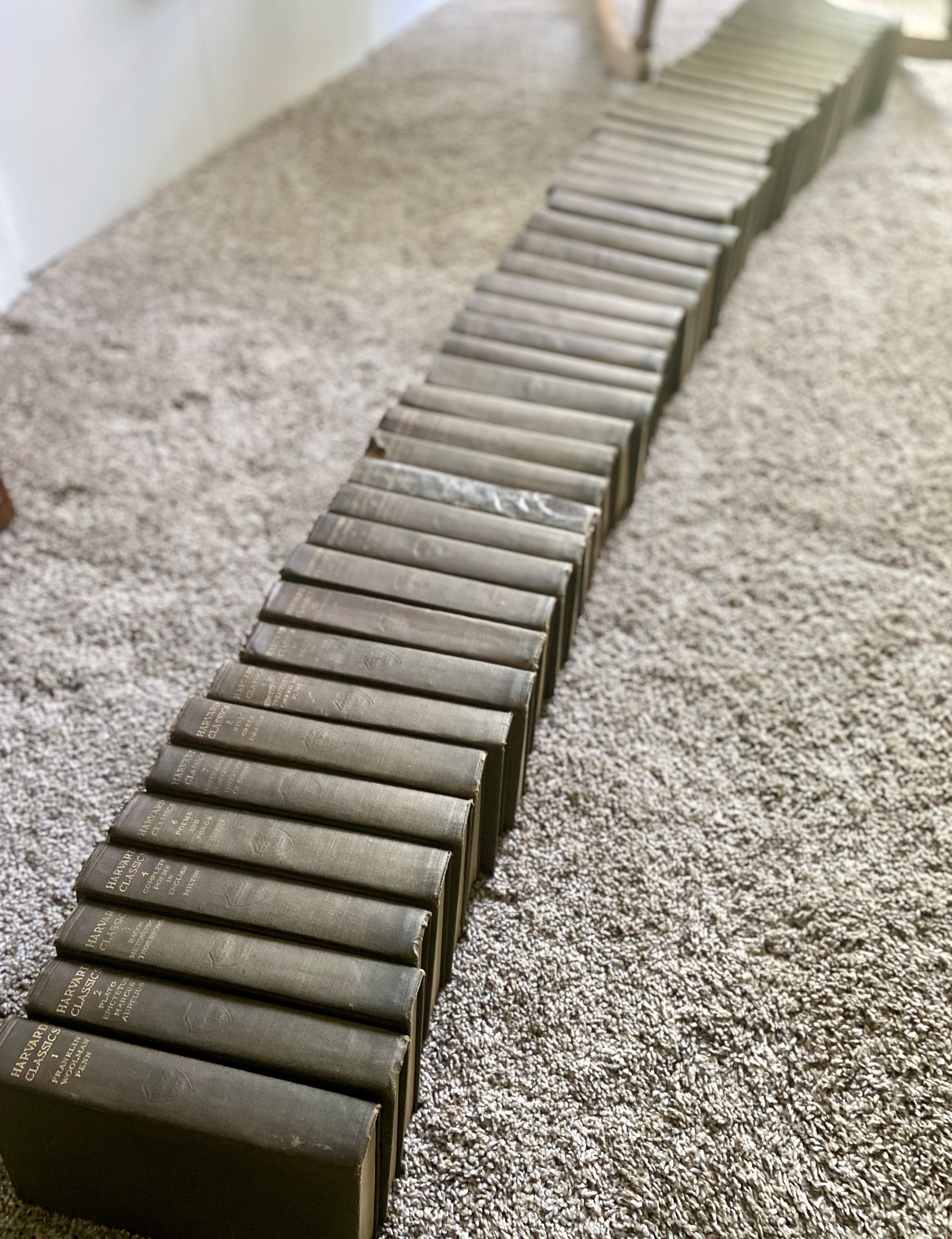
After perusing dusty titles for the better part of an hour, I stumbled on a treasure—literally. A stack of volumes on the floor tripped me up. And I’m so glad they did.

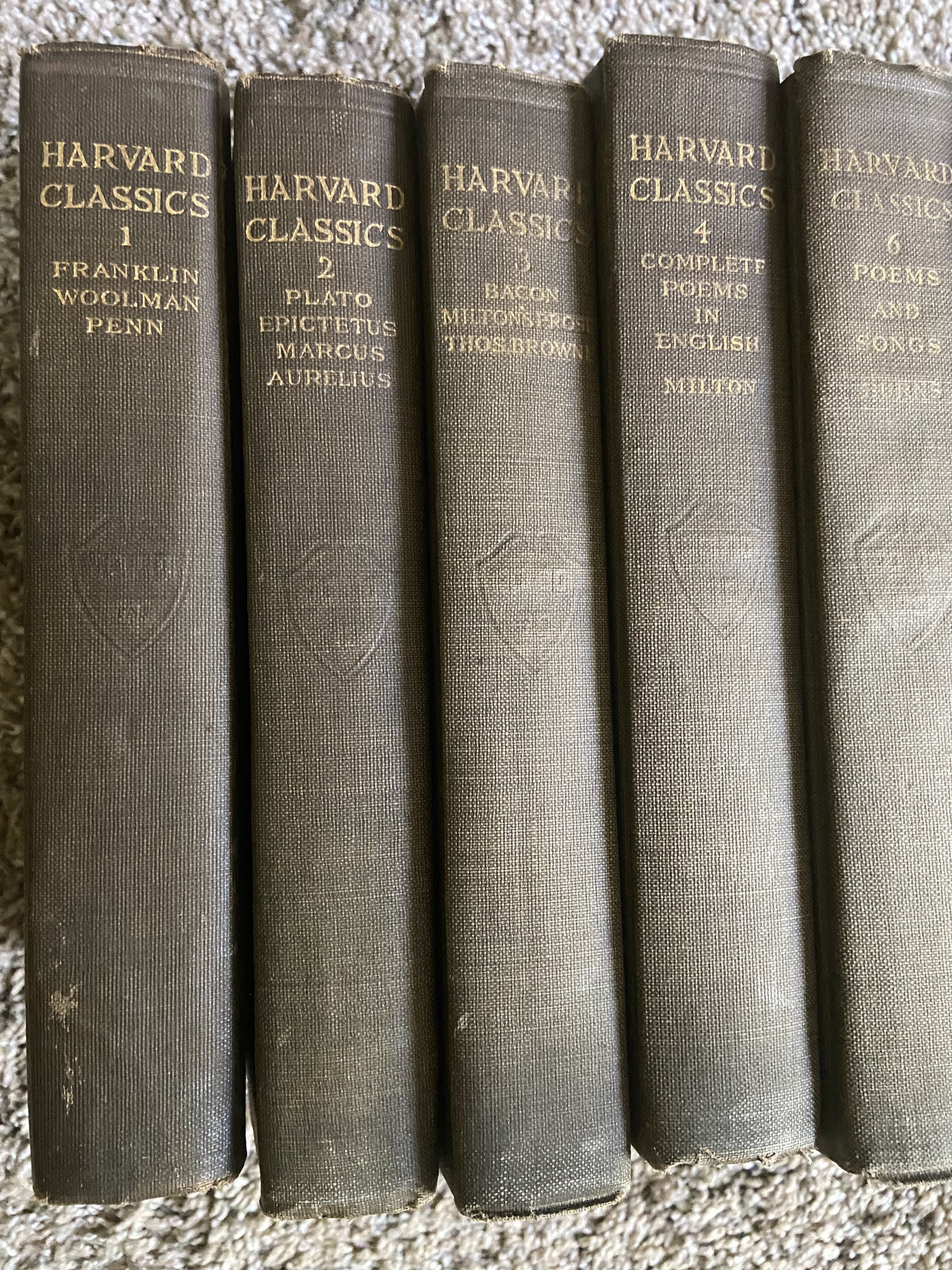
The Harvard Classics were compiled in 1909 by Charles W. Eliot, Harvard University President. He proposed that anyone who would commit to reading this “Five-Foot Shelf of Books” would be exposed to the greatest works ever written and be duly educated.

Sign me up.

The complete 50-volume set is available on Amazon—for $1300. The new books have shiny fake-leather covers and clean, crisp pages.

In that used bookstore I found my treasure at 95.4% off the Amazon price! The covers were faded and the pages were musty. Perfection!

It took me a while to track down PB in that gigantic maze of a bookstore. But when I did and he saw the glimmer in my eye, he knew. A treasure at a bargain price cannot be denied. Now I just need him to put up a five-foot long shelf in my office.

I’m hoping to open Dante’s Divine Comedy or Chaucer’s Canterbury Tales and find a few hidden $20 bills from 1909. Even if I don’t, the true treasure is the joy of reading and learning from the old books.

Volume 1, here I come.

Books of 2023

I took a different approach in my reading life this year. Instead of setting a goal to read a certain number of books (I read 37 – of course I kept track), I created some categories in hopes of becoming a more well-rounded reader. I think it worked. I feel rounder.

1 book by Elizabeth Goudge — Genetian Hill by E. Goudge
I read a Goudge book every February. Her writing is full of English cottages and rose gardens and lovely language. I seem to need that in February. During the year, I look for copies at used book sales and shops. The musty smell and worn pages enhance the overall experience.

1 book by Eugene Peterson — Leap Over a Wall by E. Peterson
This book on the life of David and his relationships with various people was a great companion while I read through the Biblical record of David in 1&2 Samuel. Peterson communicates deep theology without being stuffy.

1 book on the Fruit of the Spirit: Joy — Aggressively Happy by Joy Marie Clarkson
Clarkson is delightful, funny and tells good stories. She’s also a realist: “Cultivating happiness takes grit, determination and a good sense of humor. It’s a lot of work.” One other book in this category: Choose Joy by Kay Warren.

1 book on prayer — Praying Like Monks, Living Like Fools by Tyler Staton
Staton is the director of the 24/7 Prayer Movement in the USA. He can write about the topic because the man is a pray-er. I needed his passionate words to give my prayer life a jolt.

1 old Christian classic — The Pilgrim’s Progress by John Bunyan (written in 1678) and Hinds’ Feet on High Places by Hannah Hurnard (written in 1955). I’ve read them both before, but I was given beautiful gift copies, so I read them again. And I’ll read them in the future. Classics.

1 English classic — Dr. Jekyll and Mr. Hyde by Robert Louis Stevenson
I’m a little embarrassed to admit that I haven’t read this iconic story until now. I picked it up because it was short (only 100 pages) and it fit my category. It’s kind of creepy and kind of cool and now I know what references to “Jekyll and Hyde” really mean.

1 book of poetry — The Word in the Wilderness by Malcolm Guite
Poetry is hard. Malcolm is here to help. This book contains a poem a day for the season of Lent and Easter. I read the poem each day, then read Guite’s explanation of the poem, then read the poem again and said, “Ahhhhhh. I get it now.” Poetry is wonderful.

1 book on nature — The Heart of John Muir’s World by Millie Stanley
Muir was the “Father of National Parks” and grew up in the mid 1800’s a few miles from where I live. He wrote, “Oh! that glorious Wisconsin wilderness!” I need to be reminded to open my eyes and take in all the natural glory right in my own backyard.

1 biography/memoir — All My Knotted Up Life: A Memoir by Beth Moore
Over the years I’ve done several Beth Moore Bible studies. Sometimes I love her, and sometimes I roll my eyes a little bit. Shame on me. You never know what a person has gone through in life. Her transparency and conversational style had me gobbling up this book in two days. Then I listened to her read the audio version. I also read the memoir Secret Thoughts of an Unlikely Convert by Rosaria Butterfield.

1 Jane Austen book — Mansfield Park by Jane Austen
I’ve read “Pride and Prejudice” several times, but now I’m making my way through her other books, one by one. Three down, three to go.

1 book on writing — Write Tight by William Brohaugh
I’m a sucker for books on the craft of writing. I’ve read so many they all are starting to sound the same. Basically, “sit down and write.” All right already.

1 Montana historical novel — The Whistling Season by Ivan Doig
My great grandparents homesteaded in Montana in the late 1800s and I’ve dreamed of living in Big Sky country ever since I was a little girl. I’ve read this title before, but PB and I listened to the audio book on our way to Montana in June. Pure delight! I also read Dancing at the Rascal Fair by the same author.

1 book on the church — Positively Irritating: Embracing a Post Christian World to Form a More Faithful and Innovative Church by Jon Ritner
This was my #1 book of 2023. It shook me up (in a good way) and caused me to think hard about church and culture in new, scary, and exciting ways. Ritner asserts that the church needs to pivot from being a “restaurant” (expecting people to come in and be served) to becoming a “food truck” (taking the gospel out to where people are). I can’t stop thinking about it.

Honorable Mention:
The Sound of Life’s Unspeakable Beauty by Martin Schleske
Secrets Of the Secret Place by Bob Sorge
On Getting Out of Bed by Alan Noble
David Rise by Mark Buchanan

May God bless your reading of books in 2024!

My Top Books of 2022

‘Tis the season for book lists. I’ll join the party.

To be honest, 2022 wasn’t a great reading year for me. Maybe it had something to do with a major life change (retirement), but I had a hard time focusing and concentrating. Maybe it was because I kept picking bad books. All I know is, I gave up on more books than ever before. I managed to plow through 28 books this year, which is about half of my usual. Here are my top five.

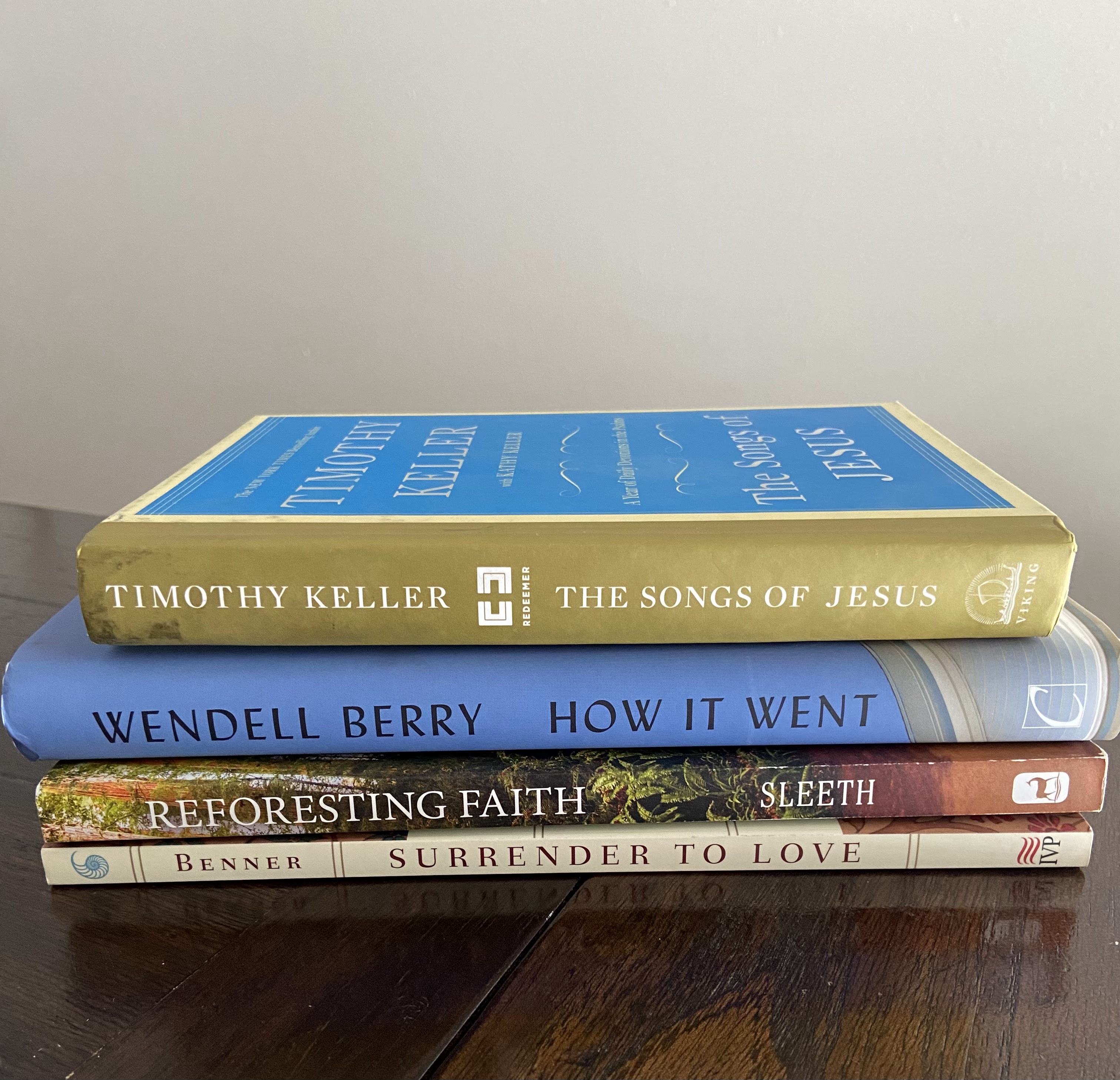
5. Surrender to Love, by David Benner
My word for 2022 was “hesed”, the Hebrew word for love. I thought to myself, “I’m going to learn how to love. I’m going to become a more loving person. I’m going to get this love thing down.” Then I read Surrender to Love and everything shifted. My quest to become a better lover had to start with learning how to be a better receiver of the Father’s love. When I tried to imagine God thinking about me, I usually assumed He was somewhat frustrated and disappointed. I began contemplating the fact that God bursts with love for me, and that love swells in His heart when He thinks of me. I don’t know if I got any better at loving other people this year, but I did find a deeper appreciation for the length, width, depth and height of His love for humans, including me.

4. Reforesting Faith, by Matthew Sleeth
Trees were a major theme for me this year. I read books about trees, I listened to podcasts about trees, I listened to sermons on trees. And I spent a lot of time walking in the woods. I read Matthew Sleeth’s book in January and thought about it all year. He points out, “Other than God and people, the Bible mentions trees more than any other living thing. There is a tree on the first page of Genesis, in the first psalm, on the first page of the New Testament, and on the last page of the Revelation. Every significant theological event in the Bible is marked by a tree.” His comparison of human lungs and tree roots still blows my mind.

3. Deeper, by Dane Ortlund
Dane Ortlund’s book, Gentle and Lowly was my 2020 book of the year, so I was eager to read his next offering. It did not disappoint. He addresses the broad idea of what it means to grow in faith and mature in Christ. Then he gives practical advice on how to do that without becoming formulaic. I turned many of his ideas into prayers: “Lord, help me to trade in my snorkel and face mask for scuba gear that takes me down into the depths I’ve never peered into before.” (I can’t find my copy. If I lent it to you, could I please have it back?!) 🙂

2. How It Went, by Wendell Berry
My absolute favorite fiction book series is Wendell Berry’s Port William novels. I read all of them in 2017 and it was pure joy. I’ve been thinking about re-reading the series, just because I miss the characters and Berry’s way of writing about them. So imagine my delight when I saw a new addition! I couldn’t push the “Buy Now” button fast enough. At 88 years old, Berry still has the ability to write words that make me ache and smile all at once.

1. The Songs of Jesus, by Tim Keller with Kathy Keller
My 2022 book of the year is The Songs of Jesus: A Year of Daily Devotions in the Psalms. This book saved my life this year. I’ve never spent an entire year in one book of the Bible, but God knew this was exactly what I would need in 2022. The Psalms became my anchor, my refuge, my strength. Along with reading the short passage, reflection and prayer each day, I made notes and highlighted key words in my Illuminated Scripture Journal book. But mostly I prayed the psalms. They gave me words I didn’t have, expressed emotions I was afraid to feel, and taught me the language of praise.

As Dane Ortlund states in Deeper, “The Psalms are the one book in the Bible addressed to God. In it God takes us by the hand and gives us words to speak back to Him.” The Psalms did indeed take me deeper into the heart of God. They will continue to be my lifelong companions.

I discovered more resources that kept pouring the richness of the Psalms into my heart and mind.

  • In The Lord I Take Refuge podcast, by Dane Ortlund
  • Hidden Streams podcast, by Chad Bird
  • Treasury of David, Charles Spurgeon’s commentary on the Psalms
  • Music by The Corner Room, The Psalms Project, Poor Bishop Hooper and many others

“We cannot bypass the Psalms. They are God’s gift to train us in prayer that is comprehensive and honest. That’s it: open your Bibles to the book of Psalms and pray them — sequentially, regularly, faithfully, across a life-time. This is how most Christians for most of the Christian centuries have matured in prayer. Nothing fancy. Just do it.” — Eugene Peterson, Answering God

Here’s to a prosperous reading year in 2023!
Sing some songs of Jesus in the year ahead!

Resources
My Word for 2022
Be Like a Tree
Tree of Life
Fruitless
10 Things I Learned in January
The Bible Project, Tree of Life series: https://bibleproject.com/explore/video/tree-of-life/
Inexpressible: Hesed and the Mystery of God’s Lovingkindness, by Michael Card

Favorite Books of 2020

Most people are ready to say, “So long!” to 2020.
It did seem so long.

Still, I can’t resist a look back at one of the most unique years of my life. In the midst of uncertainty, loss and grief, there were some surprising gifts. So, during these closing days of 2020, I’ll be sharing some of those good things — starting, of course, with books. I read 50 books this year. Here are my faves:

1. The Chronicles of Narnia
I started off the year by reading through the seven volume series by C. S. Lewis. I was familiar with “The Lion, the Witch and the Wardrobe”, but have never read the whole series. Fantasy isn’t my forte, but Lewis created a world that drew me in. I cried when Aslan bounded down the mountain in the final scene. The series was written for children, but it is deep and rich enough for any adult.

2. The Scent of Water
Elizabeth Goudge was a British author who wrote novels set in English towns with flowery descriptions of gardens and cottages. I found, tucked within her stories, bits of wisdom that have stuck with me. I kept stopping to jot down lines that made me sigh with satisfaction.

“Lord have mercy. Thee I adore. Into Thy hands. These are three necessary prayers and they have three words each. Not difficult to remember. If in times of distress you hold to these you will do well.”

In mid-February, little did I know “times of distress” were around the corner. I was grateful for those three three-word, necessary prayers in the months to come.

3. Dark Clouds, Deep Mercy: Discovering the Grace of Lament
Most of us don’t know how to lament very well. There’s a right way to do it, and Mark Vroegop walks us through it in this book. After losing a child, Vroegop traveled into dark clouds and then found his way back to deep mercy. The Psalms gave words to his suffering and he encourages us to be honest about our pain on the way to healing.

4. Reading the Bible with Rabbi Jesus and Walking in the Dust of Rabbi Jesus
These two books by Lois Tverberg were extremely helpful in understanding Jesus’ Jewishness and middle eastern culture in general. There are some things in the Bible that seem strange to my American mindset, but make perfect sense when put in the context of New Testament Jewish understanding. Tverberg’s insights made the gospels come alive with meaning.

5. The Golden Alphabet
While preparing to write a series of blog posts on Psalm 119, I stumbled on this gem by Charles Spurgeon. Psalm 119 is the longest chapter in the Bible, taking about 12 minutes to read. Spurgeon’s verse by verse commentary takes 9 hours and 45 minutes to read. However did he do it with no internet?

6. All Things New: Heaven, Earth, and the Restoration of Everything You Love
John Eldredge writes in a way that makes me want to put the book down and applaud at the end of each chapter. Especially when it comes to imagining the possibilities that awaits us in eternity. If you think heaven is one long boring church service and all we do is sit around strumming harps, this book will rock your world.

7. Keep Going: 10 Ways to Stay Creative in Good Times and Bad
I love Austin Kleon’s little books of pep talks. They are simple, profound and can be read in an afternoon. They contain a combination of funny drawings, poetry and good advise. Like this:

“How to Be Happy”

8. The Old Man and the Sea
I wanted to read at least one classic this year and this title by Ernest Hemingway was available at the library. It was also skinny — only 128 pages. I had another reason for reading this book. I remember my mother tucking me in at night and saying, “Bed, you are my friend,” which was supposedly a quote by Santiago, the old Cuban fisherman. She was close (“And bed, he thought. Bed is my friend. Just bed, he thought. Bed will be a great thing”). Now it makes me wonder if sometimes at night, my mother felt exhausted, like she fought with the biggest fish in the ocean all day.

9. The Nature Fix: Why Nature Makes Us Healthier, Happier and More Creative
This book wasn’t an easy read and (full disclosure) I skimmed some of it. Written by Florence Williams, a journalist from Washington D.C., it’s full of reports on studies done on the effects of spending time in natural surroundings. I figured nature was good for us, but I didn’t know HOW good. According to this book, it’s more important than we think. She included enough personal stories to keep me interested, but in the end, the scientific findings were what stuck with me. We need nature.

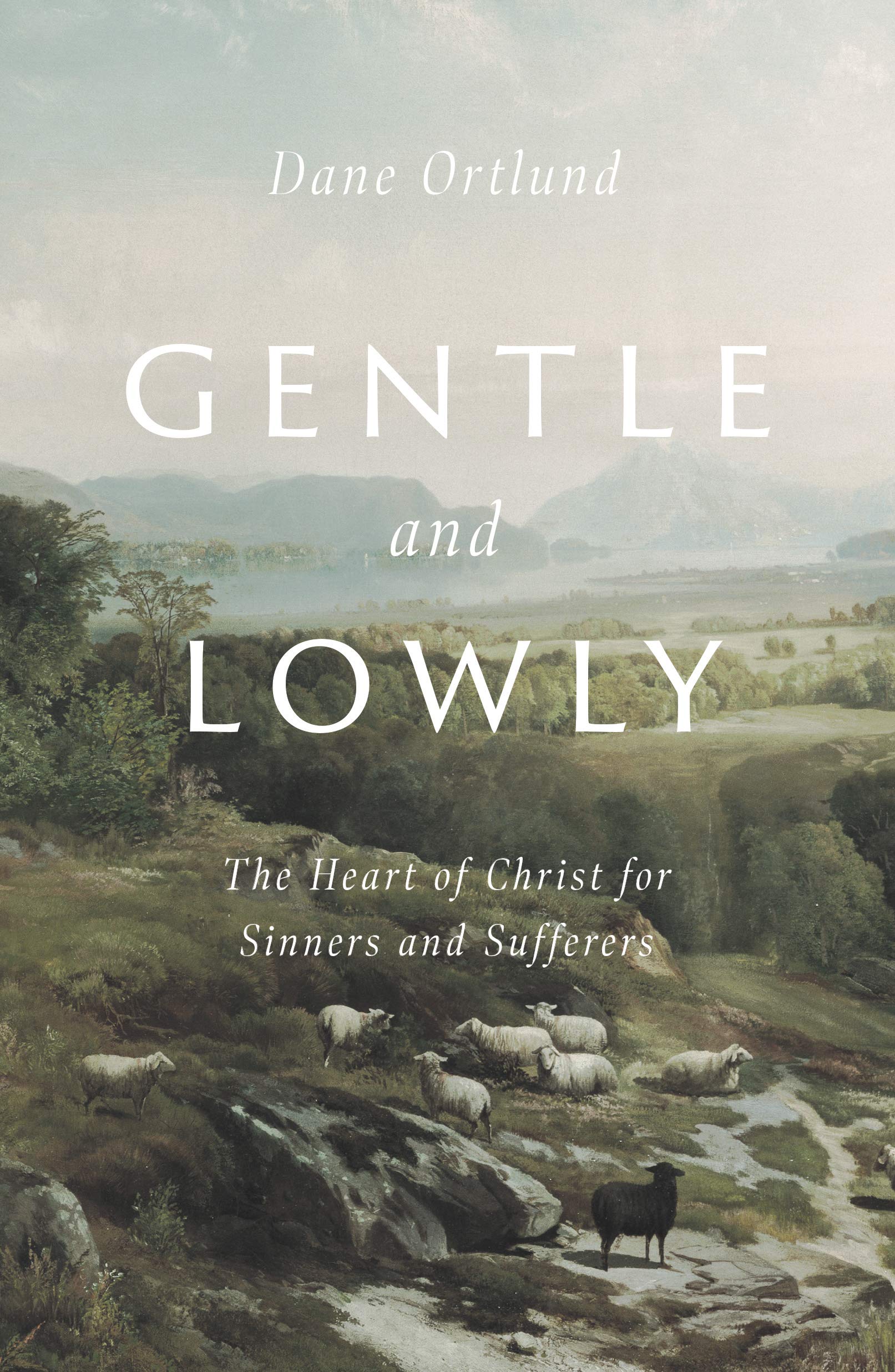
10. Gentle and Lowly: The Heart of Christ for Sinners and Sufferers
Dane Ortlund’s thoughtful and meditative book was my #1 book of the year. This look at the heart of Christ made me think about things I’ve never thought about before. It showed me things about Jesus I’ve never noticed before. The chapters were short, but packed with many, many underline-able sentences. I will be carrying this one with me into the new year, reading it again so I can discover more things to think about and underline everything I didn’t the first time through.

Here’s to a good reading year in 2021!

My Top Books of 2019

img_9412

Here are a few of my favorite books from 2019.

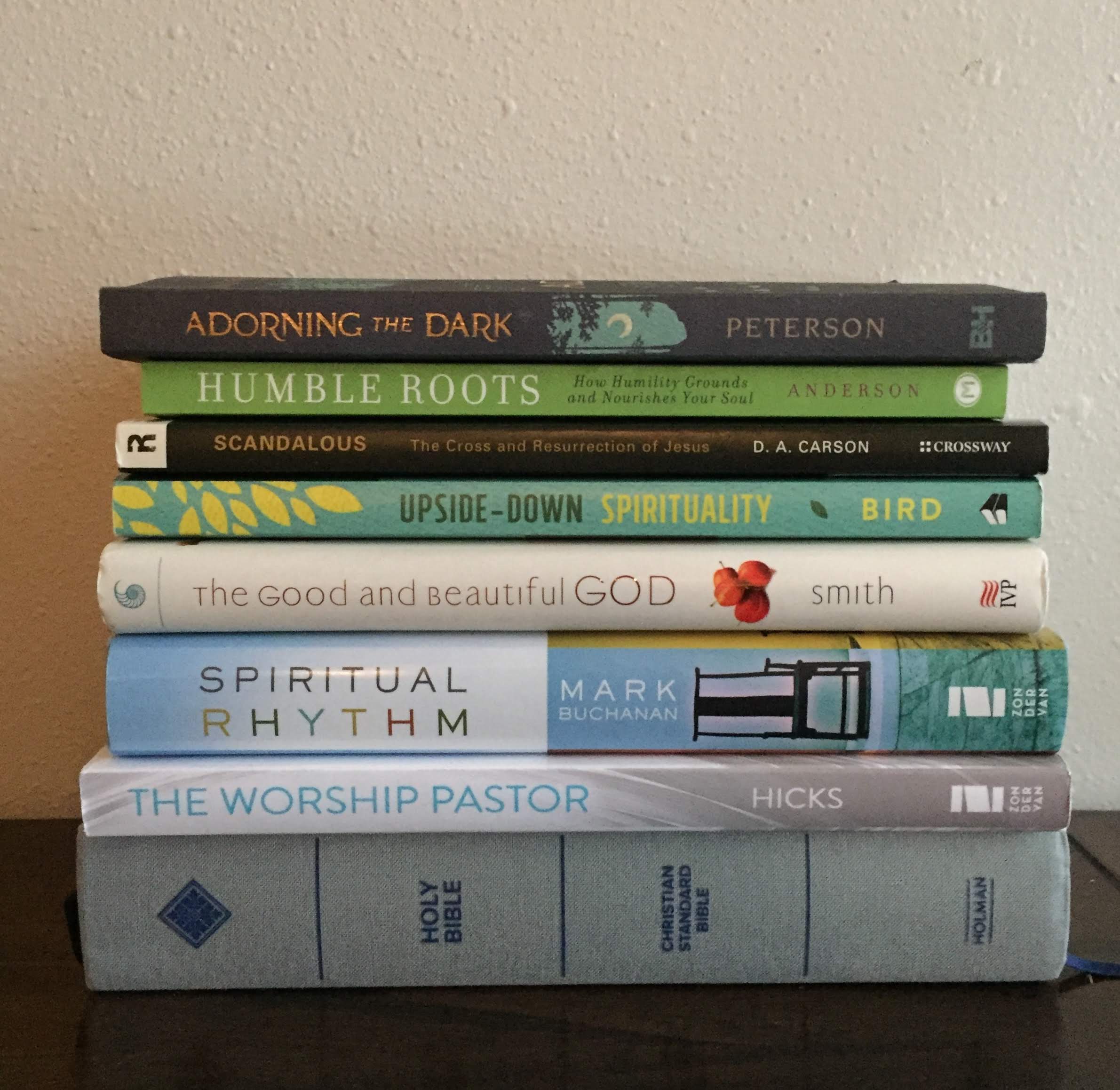
1. Holy Bible, God
I read the whole thing cover to cover in 58 days. This was a “reader’s” version which had no chapter or verse numbers, so it read like a story. I was amazed at how that changed the reading experience.

2. The Worship Pastor: A Call to Ministry For Worship Leaders and Teams,
Zac Hicks

Zac Hicks was the speaker at a conference I attended in March. I used his book as a basis for our worship team devotions for the rest of the year. He expanded my understanding of what it means to be a worship leader.

3. Spiritual Rhythm: Being With Jesus Every Season of Your Soul,
Mark Buchanan

I would read anything Mark Buchanan writes, but this topic is near and dear to my heart so I gobbled it up. He used the seasons of the year to connect with the ups and downs of our spiritual lives. As always, he tells great stories while weaving in solid truths.

4. The Good and Beautiful God: Falling in Love with the God Jesus Knows, James Bryan Smith
We all probably have some skewed ideas about God that we’ve picked up along the way. Smith looks at what Jesus had to say about God to help straighten out our misconceptions. After all, “the most important thing about a person is what they think about God.” He is good and beautiful.

5. Upside-Down Spirituality: The 9 Essential Failures of a Faithful Life, Chad Bird
Bird is another really engaging writer that a friend introduced me to this year. He’s an ex-pastor, ex-seminary professor and current truck driver who challenges his readers to continue the upside-down, countercultural way of life that Jesus presented in the gospels.

6. Scandalous: The Cross and Resurrection of Jesus, D. A. Carson
I borrowed this book because of one chapter I wanted to read in preparation for leading our women’s Bible study. Then I read the whole thing. It’s a book of theology for non-theologians like me who just want to better understand the scandalous cross of Christ.

7. Humble Roots: How Humility Grounds and Nourishes Your Soul,
Hannah Anderson

Another borrowed book from a friend — a community of book lovers is a beautiful thing. I loved the way she used a garden theme to show how to cultivate humility, something sorely lacking in our contemporary culture.

8. Adorning the Dark: Thoughts on Community, Calling and the Mystery of Making, Andrew Peterson
My gold medal book of the year. If you are at all interested in community, creativity, art, and connecting with the Creator, read it. Just read it. Peterson is a gifted writer, songwriter, singer, teacher, publisher, filmmaker and grace-filled lover of beauty. His work is a treasure.

Of the 38 books I read this year, I did manage to squeeze in 12 works of fiction: Dickens, Austen and C. S. Lewis being my favorites.

What were your top reads in 2019?

~She reads books as one would breath air, to fill up and live.~
Annie Dillard

The Long Winter

My oldest grandson just turned 7 and he’s starting the magical journey through the “Little House” series of books by Laura Ingalls Wilder. Seeing those books on my shelf bring back memories of long afternoons, reading aloud while the kids colored or played with Legos. Now I read aloud to PB, until I hear soft snores from his side of the bed. Reading aloud is still one of my favorite things to do, especially on days like today.

The 2019 version of “The Long Winter” doesn’t quite measure up to Laura Ingalls’ prairie blizzards that started in October and continued until April. Day after day of forty below temps and snow that piled up to the rooftops created real hardship in the late 1800’s.

If we run out of milk, I can go a few blocks to Kwik-Trip and pick up a gallon.
I don’t worry about getting lost in a whiteout blizzard on my way to the barn.

If the north wind howls, I can flip a switch and turn on the fireplace.
I don’t sit for hours and twist hay into sticks to feed the cookstove.

If the snow piles up, I can start up the snowblower.
(Well, PB can start up the snowblower.)
I don’t have to shovel a path to the outhouse.

If all the businesses in town close, I can survive on what’s in my pantry.
I don’t worry about the supply train and my dwindling tin of flour.

Really, people.
We have it so good.
Snow is an inconvenience, not a threat to our existence.
Look out the window and say a prayer of thanks
that you’re not twisting hay into sticks for cookstove fuel.
Go read chapter 19 of “The Long Winter” this afternoon,
and rejoice.

IMG_7407

My Top 5 Books of 2018

At the end of the year, I like to go back and look over the list of books I read in the past twelve months. Since 2004, I’ve been keeping a list of the titles of every book I’ve read, reread, or ditched. Here are the five books that meant the most to me in 2018.

IMG_7138

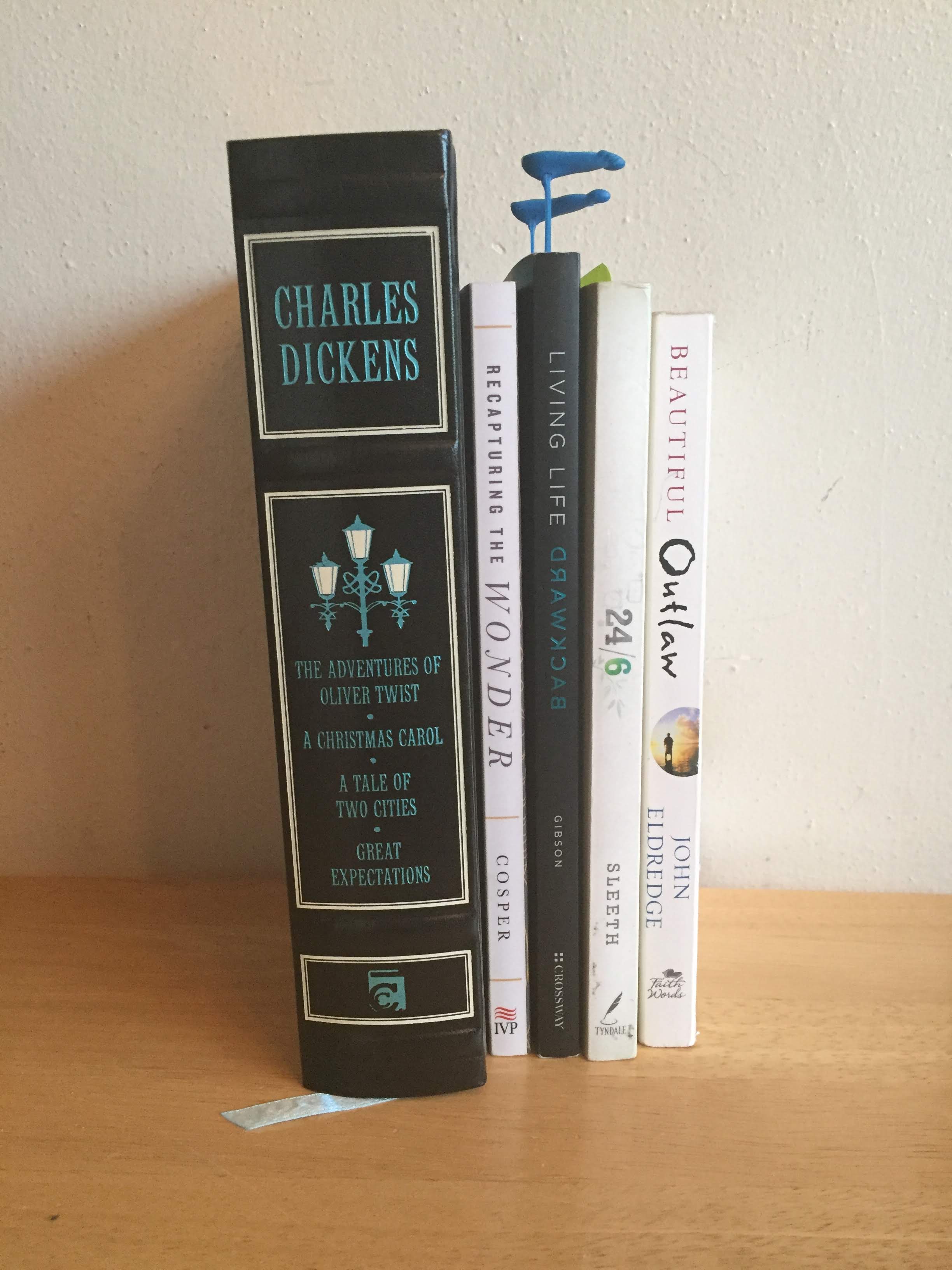
1. The Adventures of Oliver Twist, by Charles Dickens
I’ve seen the movie “Oliver” and can sing “Consider Yourself” with a British cockney accent, but I hadn’t read Dickens until this past year. The old classics make you work hard, but, oh, the reward. The language is deep and rich and weighty. As usual, the book is better than the movie. (Although I did stop to hum “Food, Glorious Food” on page nine.) Dickens’ style is so unique; the chapter titles were sometimes almost as long as the chapters.

Chapter XXXVI: Is a Very Short One, and May Appear of No Great Importance In its Place, But it Should Be Read Notwithstanding, as a Sequel to the Last, and a Key to One That Will Follow When its Time Arrives

I’m glad I didn’t live in Victorian England, but it was a lovely visit and I’ll definitely return to Dickens in 2019.

2. Recapturing the Wonder, by Mike Cosper
I received this book as a birthday gift in 2017, but didn’t get beyond the first few pages before putting it on the shelf. In December of 2018, I picked it up and wondered what was wrong with me before. This is a gem of a book. I learned a valuable lesson — sometimes a book isn’t ready for me and sometimes I’m not ready for it. Books are patient and don’t mind waiting for the right time.

“Life with God is an invitation into a world where most of what makes sense to you crumbles. It’s far richer than you imagined, far less orderly and sensible, and far more mysterious. Like Job, once you begin to see the wonder of it, you find yourself awestruck and, somehow, satisfied.”

3. Living Life Backward: How Ecclesiastes Teaches Us to Live in Light of the End, by David Gibson
I read this book in preparation for a Bible study on Solomon. I needed help with Ecclesiastes which is fairly dark and pessimistic. Gibson changed my whole perspective on Solomon’s reflection of his wayward life. This book shakes up the current culture’s view of what it means to live “the good life.” Thinking about death is actually supposed to help us pay attention to our limitations as human beings and embrace life as the wondrous gift it is.

“Life is not about the meaning that you can create for your own life, or the meaning that you can find in the universe by all your work and ambitions. You do not find meaning in life simply by finding a partner or having kids or being rich. You find meaning when you realize that God has given you life in his world and any one of those things as a gift to enjoy.”

4. 24/6, by Matthew Sleeth, MD
I read this book a couple years ago, but revisited it while doing research on the Sabbath. Dr. Sleeth makes a strong case for something called rest and literally prescribes a 24 hour break every week in order to maintain physical, mental and spiritual health.

“In the 24/7 world, we ‘pencil’ friends in on the calendar. These loose commitments frequently fail to materialize. We have the best of intentions, but intentions don’t build relationships. Filling in every Sunday on our calendar with ‘FOR THE LORD’ in permanent ink changes our perspective. Honoring a Sabbath every week makes us more committed and serious about our relationship with the Lord. This is even more crucial today, when things travel as fast as the speed of light. God designed us to spend one day a week at the speed of stop.”

5. Beautiful Outlaw: Experiencing the Playful, Disruptive, Extravagant Personality of Jesus, by John Eldredge
This is my gold medal book of the year. I read it in April and I’m still thinking about it. In exploring the personality of Jesus, Eldredge uses words like “fierce”, “scandalous” and “beautiful”. This book helped me step beyond the Sunday-school Jesus that is meek, mild and melancholy. I love the descriptions of Jesus laughing, turning over tables, and grilling fish on the beach for the boys.

“We actually come to think that service for Jesus is friendship with him. That’s like a friend who washes your car and cleans your house but never goes anywhere with you — never comes to dinner, never wants to take a walk. We are meant to love the man himself, know him intimately. First things first. Love Jesus.”

May your reading life in 2019 be especially rich and satisfying!

“There is more treasure in books
than in all the pirate’s loot on Treasure Island.”
Walt Disney