Thankful

One of my favorite authors is Wendell Berry. Our neighborhood book club just finished Hannah Coulter so I am enchanted all over again with Port William and all my dear fictional friends. They remind me of the good salt-of-the-earth people I grew up around—people who loved the land and who knew how to be neighborly. I’m thankful for Berry’s words in this season, and I’m basking in their beauty.

“You mustn’t wish for another life.
You mustn’t want to be somebody else.
What you must do is this:
Rejoice evermore. Pray without ceasing. In everything give thanks.*
I am not all the way capable of so much,
but those are the right instructions.”

Hannah Coulter

“I tremble with gratitude
for my children and their children
who take pleasure in one another.

At our dinners together, the dead
enter and pass among us
in living love and in memory.

And so the young are taught.”

Leavings: Poems

* 1 Thessalonians 5:16-18

Big Shoulders

When our four kids were little and we were homeschooling, we took advantage of the November election to teach them about government. We studied the three branches, the political parties and the candidates running for office. We visited the state capitol and met our representative. We wrote letters to the President and the Governor, assuring them of our prayers and asking for their pictures. We learned the Pledge of Allegiance and said it together every morning.

The night before the election, one of the presidential candidates made a stop in a town nearby. We bundled up the kids and stood outside for an hour before finally seeing the top of the hopeful politician’s head. In the distance. For a split second.

But the atmosphere was electric — that political rally rivaled any big sporting event. There was music and a cheering crowd and people holding up signs. We got swept up in the frenzy.

The next morning, as the kids were eating breakfast, our seven year old asked who won the election. When I said that our candidate lost, he put his little head down on the table and started to cry. PB and I looked at each other with wide eyes. Maybe we overdid it. I had to convince the broken-hearted boy that the world was not coming to an end.

It’s easy to get swept up and lose eternal perspective.
But here’s some good news today—
the government is on His shoulders. (Isaiah 9:6)
He’s got big shoulders.
We’re not made to carry such a heavy load.
Our shoulders aren’t strong enough.

Worldly governments will one day come to an end.
But here’s more good news—someday,
“of the increase of His government and peace there will be no end.”
Isaiah 9:7

What’s in a Name?

Mahershalalhashbaz—how would you like to have that name?

The prophet Isaiah and his wife choose this name for their baby boy. It means “Quick-To-The-Plunder-Swift-To-The-Spoil.” The birth of this son was part of a prophecy. Before the little guy could say “Mama” or “Dada,” Assyria was predicted to invade and punish Damascus and Samaria. The army from the north would be Maher-Shalal-Hash-Baz. (Isaiah 8)

I hope they called him Baz for short.

Names are important. It’s one of the biggest decisions parents make at the birth of a child. PB and I thought long and hard when picking our kids’ names. We gave each one a middle name that had family connections, but also sounded good should they become famous. Katie Sims. Samuel Bradley. Anna Somers. Jacob Daniel. (Not to be confused with Jack Daniels.)

Names in the Bible always mean something.
Nowhere is that more clear than in the first pages of Genesis.

The first ten generations that would become Jesus’ line of ancestry are listed in Genesis 5. Whoo-boy. In what looks like a boring list of weird names, there is a message that’s just too good to miss. Get ready for goosebumps.*

Here’s the list of generations in the family tree:

  1. Adam—means “human” or “man”
  2. Seth—means “appointed”
  3. Enosh—means “mortal”
  4. Kenan—means “sorrow”
  5. Mahalalel—means “the blessed God”
  6. Jared—means “shall come down”
  7. Enoch—means “teaching”
  8. Methuselah—means “his death shall bring”
  9. Lamech—means “the despairing”
  10. Noah—means “relief” or “comfort”

Now string it all together.

Man is appointed to mortal sorrow but the blessed God shall come down teaching. His death shall bring the despairing relief and comfort.

That’s not a coincidence.
That’s Jesus, right there in Genesis 5.
That’s pretty wonderful.

“Open my eyes that I may see wonderful things in your law.”
Psalm 119:18

*Thanks to “Bible Bookclub Podcast” for this insight.

Unoffendable

Please don’t be offended by this blog post.

Did that statement make you cringe or get tense?
Relax.
I’m not going to go there.
There’s enough shrill shouting and sarcastic stabbing going on.

I’m just here to offer a tip.
These days are not the most pleasant.
Election years seem to bring out the worst.

We can join the fray
and punch away
OR
we can cast doubt
and check out
OR
we can be mature Christ-followers
and lead the way by being unoffendable.

If you’re like me, you need some help with this.

I read the book Unoffendable by Brant Hansen every four years.
I’m not telling you what to do.
That would be offensive.
But I’d love it if you read this book.

The dedication page reads like this:
To all those who want grace for themselves
but struggle to extend it to others.

Wait: that’s everybody.

My favorite chapter is “Everyone’s An Idiot But Me.”

We’re all in this together.
Let’s see if we can rise to the challenge.

“Do you do foolish things?
Do you think you are better than others?
Do you plan evil?
If you do, put your hand over your mouth and stop talking!”
Proverbs 30:32

Tuit

My father-in-law used to carry a couple of these in his pocket.

As a pastor, they often came in handy in conversations like these:
“Pastor, life is so busy, I just haven’t given faith much thought.”
“Son, you shouldn’t put off something this important.”
“I know. I will someday, when I get around to it.”

Then, with a twinkle in his eye,
my father-in-law would reach into his pocket,
pull out a coin-sized wooden disk and hand it to his friend.

“Here. Now you have a round tuit.”

The only thing I regularly carry around in my pocket is lip balm. But Deuteronomy 17:18-20 is making me think I should add another item.

My Bible reading plan has me wading through the laws that Moses laid down for Israel. Right in the middle there is a curious paragraph titled “The King.” It has three points:

  • When you ask for a king, make sure you pick an Israelite. (Which they did in 1 Samuel 9:1)
  • Don’t let your king amass lots of horses, lots of wives and lots of gold. (Oops. According to 1 Kings 10-11, King Solomon broke all three of those rules.)
  • When the king takes the throne, he is to write for himself on a scroll a copy of the law. It is to be with him, and he is to read it all the days of his life.

On coronation day, the king had a royal duty to copy the entire law by hand and keep it close at all times. The reigning Sovereign was required by law to read the scriptures every single day. That’s a pretty good law.

Maybe this week I’ll copy a verse or two out of the Bible
and keep it in my back pocket.

That is, if I get around to it.

Begats

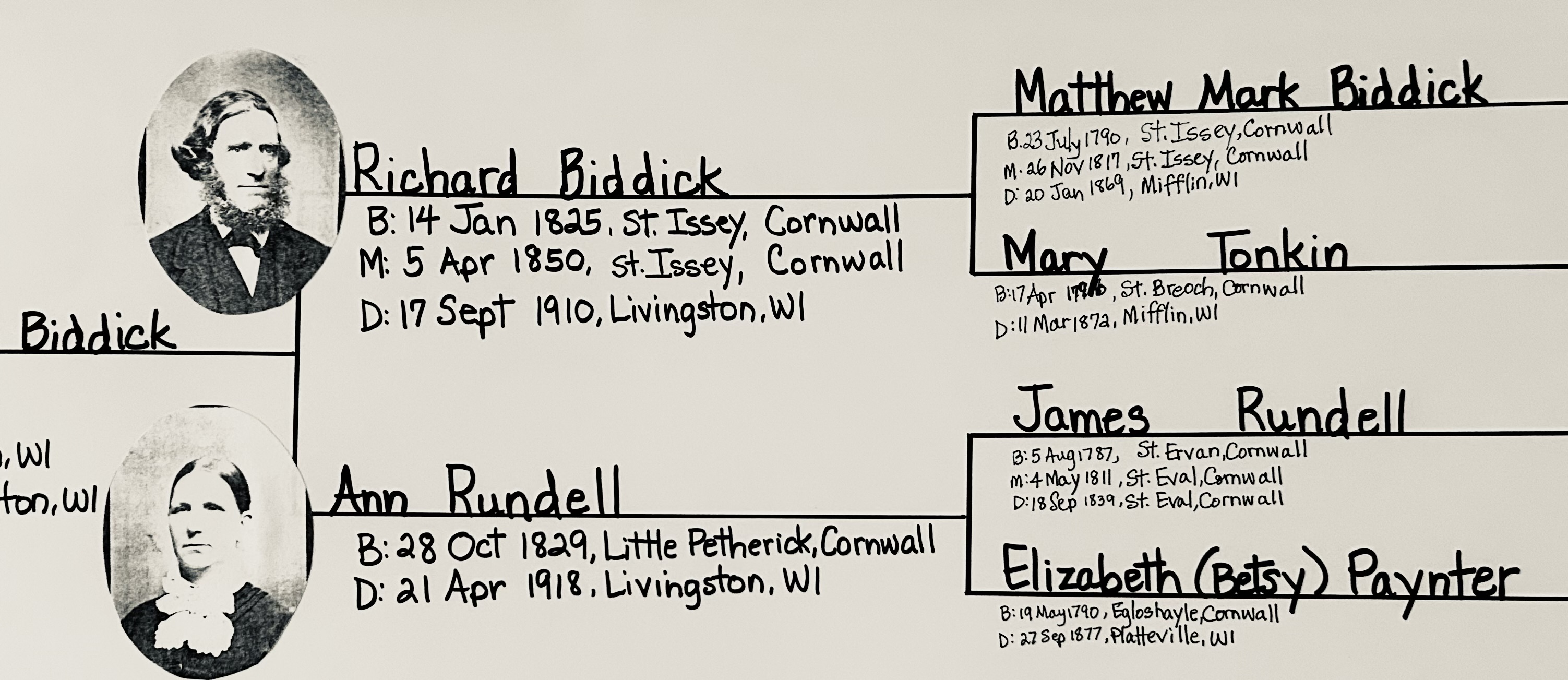
Matthew and Sarah begat Matthew II.

Matthew II and Mary begat Richard.

Richard and Ann begat Adolphus.

Adolphus and Amelia begat Elmer.

Elmer and Ada begat Roger.

Roger and Elinor begat ME!

This is the account of my family line.
These were real people who lived real lives in the real world.

I love Herman’s mustache and Margaret’s no-nonsense look.
I like the twinkle in John’s eyes and Elizabeth’s fancy hat.

If one of these couples had not met and married,
the whole family tree would come tumbling down.

For example, in the mid 1800’s in Cornwall, England, Matthew and Mary took their 9 children to the beach for a Sunday picnic. As it happened, James and Betsy and their 14 children were also at the beach that day. Out of that chance meeting on the rocky shores of Cornwall, four of Matthew and Mary’s kids married four of James and Betsy’s kids.

Just think, if Richard or Ann hadn’t felt like going to the beach that day, Ann would never have fallen for Richard’s wavy hair and Richard wouldn’t have noticed Ann’s dark, mysterious eyes.

Maybe my love for family trees is the reason why I never skip the genealogy chapters in the Bible. Genesis 5:1 says, “This is the written account of Adam’s line.”

Adam begat Seth, who begat Enosh, who begat Kenan, who begat Mahalalel, who begat Jared, who begat Enoch, who begat Methuselah, who begat Lamech who begat Noah. This may seem like a yawner, but there is treasure galore in this chapter.

These were real people who lived real lives in the real world.
This line of begats would one day lead to Jesus—
the snake head-crusher,
the only begotten Son,
the second Adam,
the Messiah.

Power Outage

Due to this morning’s power outage in our neighborhood,
I am not posting today.

Well, I guess I am posting.

I’m posting a post to say I’m not posting.

This is totally an excuse.

I just didn’t write anything this week.

Thank you to the tree that fell down on the power line at 2:45 a.m.

My power to create seems to be having a temporary outage, too.

I needed this:

I just received an email from the utility company—
power has been restored.

Me too, Lord.

“He restores my soul.”
Psalm 23:3

Dear Diary

I love to read other peoples’ diaries.

I may or may not have snuck a peak at a few over the years, but mostly I read other people’s published work. I once read all the diaries and letters of Anne Morrow Lindbergh and by the end, I felt like we were BFFs.

There’s nothing like a glimpse into the dark recesses of someone else’s heart and soul.

Keeping diaries is as old as time. In Genesis 5:1 we find, “This is the written account of Adam’s line.” In the next chapter we read, “This is the account of Noah.” Turn a few pages and there is another: “This is the account of Shem, Ham and Japheth, Noah’s sons.” And it continues on and on. Somebody was writing all this stuff down.

After the children of Israel were delivered out of Egypt, they wandered around the desert for 40 years. Even this was documented right there in Numbers 33.

“They left Kibroth Hattaavah and camped at Hazeroth.
They left Hazeroth and camped at Rithmah.
They left Rithmah and camped at Rimmon Perez….”

Not exactly riveting reading.
Why is this important enough to garner a whole chapter in the Holy Book?

Because God commanded Moses to record the stages in their journey. (Numbers 33:2)

Each of the 41 campsites in the desert was part of their story. Some places were memorable—like that campground with twelve springs and seventy palm trees (nobody forgot that place). Some were featureless and mundane. But they were real places where real people camped out and real people lived and died. The list of campsites in Numbers 33 is a testimony to the move of God in their lives.

Moses did a lot of writing for God,
but he was one of many who were called to use the gift of words.

God told Isaiah—
“Take a large scroll and write on it with an ordinary pen.” Is. 8:1
God told Jeremiah—
“Write in a book all the words I have spoken to you.” Jer. 30:2
God told Ezekiel—
“Write these down…so that the people may be faithful.” Ez. 43:11
An angel bellowed at the Apostle John,
“Write this down!” Rev. 21:5

I’m here to say
everyone should record the stages in their journey,
like Moses did.

I know, I know—
not everybody likes to write.

I’m only suggesting that you are an interesting person with a life story that might be more riveting than you think. You don’t have to report on every place you pitched a tent, but a few thoughts written down in a spiral notebook that reveal a little of your heart have the potential to impact future generations.

“Let this be written for a future generation,
that a people not yet created
may praise the Lord.”

Psalm 102:18

Evening and Morning

Sometimes newborn babies get their mornings and evenings mixed up. They sleep all day and stay awake all night. This behavior often cycles back around when those babies turn into teenagers.

Most of us operate on the concept that the day begins when we wake up in the morning. As daylight disappears into the darkness of night, we perceive that the day is done.

But that’s not the way God sees it.

At the end of each of the six days of creation God said,
“And there was evening and there was morning—” in that order.

God wasn’t mixed up. That’s the way He intended it.

Based on Genesis 1, the Jewish Sabbath begins on Friday night at sundown, because that is the start of the new day. If we were to adopt this evening—morning format, the first thing we would do at the start of every day is go to bed. Rest. Do nothing. Trust that the world will carry on without us for a few hours. Then, we would continue the day by getting up and working, being productive, taking care of business.

Adam was created on the sixth day and given the assignment of tending a garden. But the new man didn’t get right to work the next day because the seventh day was for rest, declared to be holy. The first thing Adam did was rest and enjoy creation. God set it up this way because we have great value in His eyes based on who we are—created by God in His own image—not because of what we do. He loved us before we could accomplish anything.

Culture shouts:
“Get to work. Be efficient. Create output.”

God says,
“Start with rest. Trust Me to take care of you. Then go and do.”

It seems backwards.
Or maybe we’re the ones who have our days and nights,
I mean, nights and days, mixed up.

Evening, morning and noon, I will pray.
Psalm 55:17

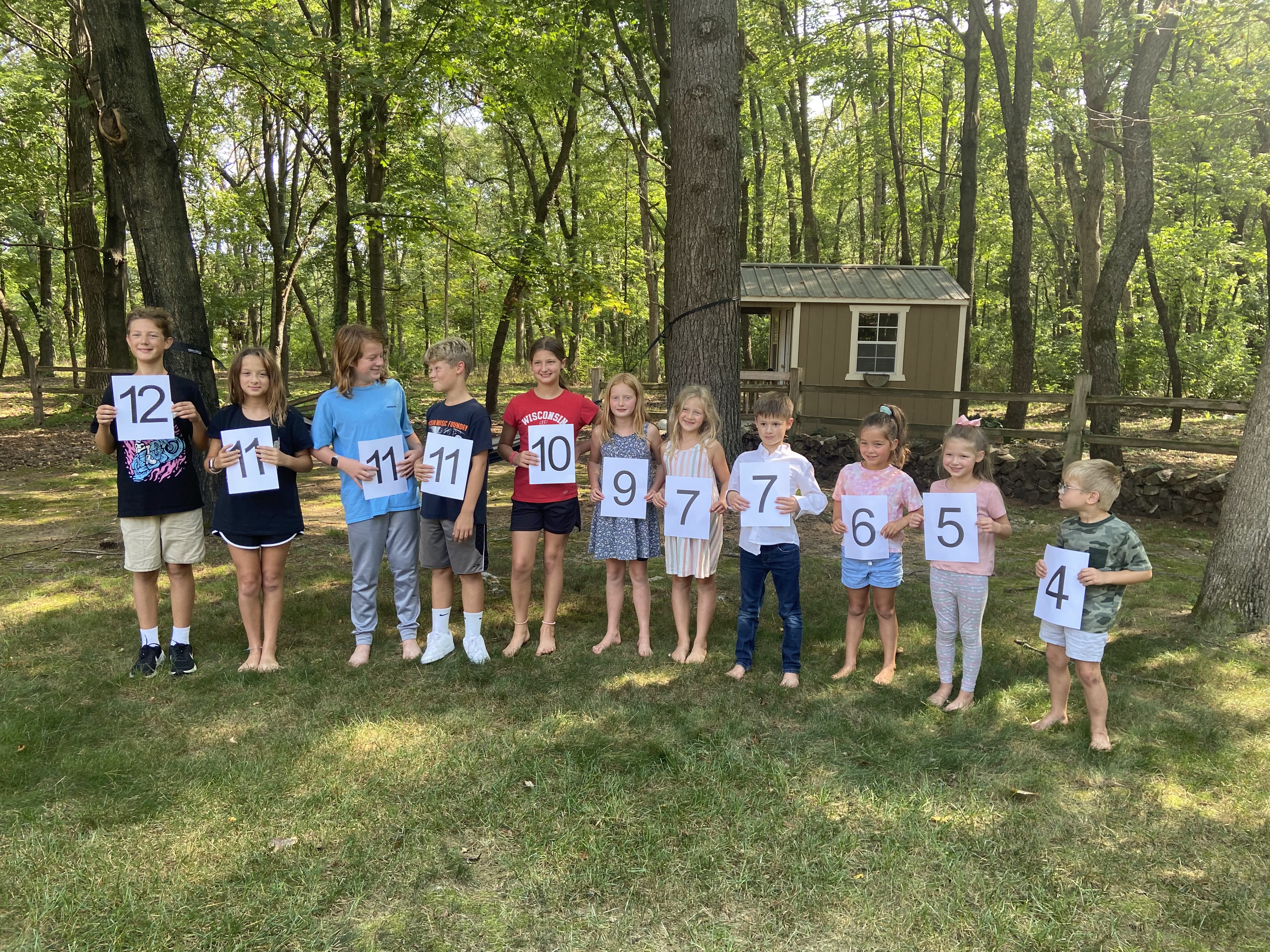
Grandkid Lineup

They are another year older, a few inches taller, and increasingly delightful.

Lord, make known to them the path of life and fill them with joy in Your presence. Psalm 16:11

Surround them with Your favor as a shield. Psalm 5:12

Keep them as the apple of Your eye and hide them in the shadow of Your wings. Psalm 17:8

Oh Lord, hear the prayers from this Nonnie’s heart. Amen.