Gall

“They came to a place called Golgotha.
There they offered Jesus vinegar to drink,
mixed with gall;
but after tasting it, he refused to drink it.”
Matthew 27:34

See that knobby thing growing on that tree branch? It’s a gall. Galls are any kind of abnormal growth on a plant. They can be caused by insect infestation, bacteria or viruses, injuries or irritations.

I never paid much attention to those weird lumps before.
Now I see them everywhere.

Vinegar or wine infused with wood from a gall produces bitter tasting painkiller. It was offered to Jesus on the cross but he refused to take it. Christ was determined to take on the full force of our sin and drink the cup of suffering to the dregs without anesthesia. It had to be vinegar and gall because 1,000 years before the crucifixion, King David wrote,

“They put gall in my food and gave me vinegar for my thirst.”
Psalm 69:21

Why all this talk about galls?
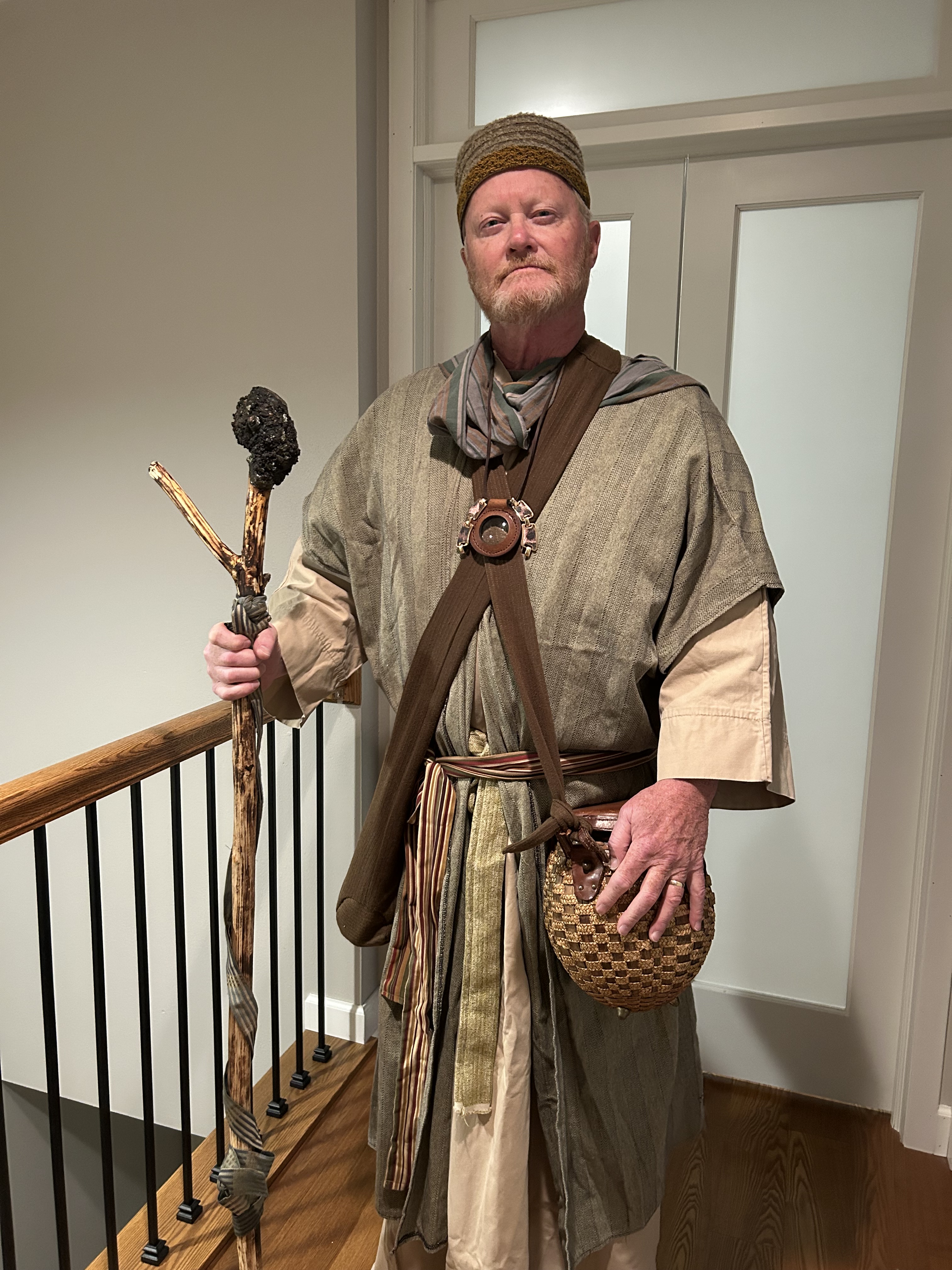
PB has been chosen to be an extra on “The Chosen.”
He goes to Utah soon for three days of filming crowd scenes for season six.

I’m not sure he’ll pass as a Jewish rabbi, but perhaps he could be a bedouin sheep-herder from the far northern reaches. Or an Anglo-Saxon merchant with Viking blood carrying lutefisk and lefse from the North Sea.

I bet he’ll be the only one on the film set with a gall on his walking stick.

Were You There?

Good Friday was quite an event in PB’s dad’s church. Seven pastors from local congregations gathered to preach on the seven last words of Jesus from the cross. Each speaker was allowed ten minutes. But if you know anything about pastors, you know ten minutes doesn’t cut it.

That service was a marathon—
a true experience of long-suffering.
It definitely was not the day to volunteer for nursery duty.

In between each message there was a hymn or special music. One year, a man with a deep baritone voice sang an old hymn with incredible depth of emotion.

Were you there when they crucified my Lord?
Oh – Ooohhh – Oh.
Sometimes it causes me to tremble, tremble, tremble.
Were you there when they crucified my Lord?

As his voice soared, my heart trembled.
For a moment, I was there.

I still find myself there, in the cast of characters that were eye-witnesses:
Malchus and Pilate and Barabbas;
Simon of Cyrene, the centurion, and the thief;
the Pharisees, Joseph of Arimathea, and Mary Magdalene.

As Holy Week approaches, I’m preparing a series of ten reflections called “Were You There?” I’ll post five of them here, from Monday, April 7 through Friday, April 11, and five more the following week, ending on Good Friday.

Come with me over the next two weeks
and see if you can’t find yourself there, too.

Rest Assured

It’s the first day of spring.

It doesn’t look like it.
It doesn’t feel like it.
But it’s the truth.
And I believe it.

Now faith is the assurance of things hoped for,
the conviction of things not seen.
Hebrews 11:1

Recently I was with a friend who expressed a concern. She was worried about her faith. Did she have enough? What if she didn’t? How would she know? What would happen if she came up short? From her perspective, it didn’t look like she had enough faith. And it didn’t feel like it.

We talked it over and I reminded her that it doesn’t take much. God is happy to work with a tiny amount of faith, even as small as a mustard seed. (Matthew 17:20) She was quiet for a few moments, then said, “Well, then……..I guess I’m ok.” Yes, my dear, you are ok.

We all need a little reassurance from time to time.
We’re in good company.

When God called Moses to deliver the Israelites from bondage in Egypt, Moses was a bundle of doubts and fears. “Who am I?” “What if…?” “Suppose…?” “Why? Why? Why?” He finished with, “Please send someone else.” (Exodus 3-5)

When God called Gideon to lead an army against his enemies, Gideon whined, “But, why…?” “But, how…?” “But…me?” Then he put God through a string of tests, just to be absolutely sure he heard from the Almighty correctly. (Judges 6)

Even John the Baptist had his doubts. John—who introduced Jesus as “the Lamb of God, who takes away the sin of the world.” (John 1:29) John—the one who witnessed a voice from heaven declaring, “This is my Son, whom I love; with him I am well pleased.” (Matt. 3:17) This same John sent a message to Jesus, “So, are you the one or should we look for someone else?” (Matt. 11:2)

These heroes of the faith needed assurance. They hadn’t gone off the rails or shipwrecked their long-held beliefs. They just needed to be reminded of truth they already knew down deep.

On those days when doubts and fears creep in,
turn to the Word of Truth.
And rest assured.

Today is the first day of spring.
It doesn’t look like it.
It doesn’t feel like it.
But it’s the truth.
And I believe it.

Watch Your Mouth

When I was a senior in high school, there was a group of sophomore boys who followed me around like puppy dogs. They were like little brothers and I considered it my responsibility to keep them on the straight and narrow path. We had a lot of fun together—their company saved me from dateless Friday nights and girlfriend-drama.

My self-appointed mission was to clean up their mouths. Every time a curse word was spoken in my presence, I admonished them with the words, “Watch your mouth.” Unfortunately, my big-sisterly advice only seemed to make them swear more. They loved getting my dander up and died laughing at my predictable reaction to their unwholesome talk. Upon my high school graduation, my groupies presented me with a t-shirt emblazoned with—you guessed it—WATCH YOUR MOUTH. I was quite touched.

The Apostle Paul knew some people who needed similar advice.
“Let no unwholesome talk come out of your mouths,
but only what is helpful for building others up
according to their needs.” Eph. 4:29

The word “unwholesome” is used in only two other ways in the Bible.
1) As rotten, putrid fruit (“No good tree bears bad fruit.” Luke 6:43)
2) As stinky, dead fish (“They threw the bad fish away.” Matt. 13:48)

This makes me think about my own word choices.
Or maybe I should say, my own choice words.
Do I only say what is helpful?
Do my words build others up?
Am I mindful of their needs?

I sure wish I still had my t-shirt from 1977.
I need the reminder to watch my mouth.

Don’t let even one rotten word seep out of your mouths.
Instead, offer only fresh words that build others up when they need it most.
That way your good words will communicate grace to those who hear them.
Ephesians 4:29, The Voice

Puzzled

PB bought me a 1000 piece puzzle for Christmas. It’s a picture of us with 11 of the most wonderful people on the face of the earth. I love every one of them with all my heart.

But I did not love this puzzle.

img_9951

We started out strong.
Eyes, noses, smiles and toes went together without a hitch.

The background took more effort. Once that was complete, the only part left was thirteen pairs of identical pajamas. We were faced with two drawers filled with blue plaid puzzle pieces. PB stopped coming over to the table at this point. I slowed down dramatically. Until.

Until a piece fell on the floor and I noticed a row of letters on its backside. Angel choirs sang from heaven as the truth dawned on me. I quickly flipped all the pieces over, lined up the letters, and snapped them together with ease. PB wandered over to the table to see what I was so happy about. In no time, we had that stinkin’ puzzle done.

img_9959-1

There’s a lesson here.
When things don’t seem to be working
and you can’t figure out your next move,
get a new perspective.

The answers might be right there on the flip side.

img_9953-1

“So we fix our eyes not on what is seen, but on what is unseen.
For what is seen is temporary, but what is unseen is eternal.”
2 Corinthians 4:18

My Funny Valentine

Years ago, PB and I decided to forego giving each other Valentine cards, candy, and flowers. This was a mutual agreement. He didn’t like the pressure of being appropriately romantic and I didn’t like getting the Visa bill in March. However we did not want to be stingy or stodgy, so we came up with a better plan.

When February 14th rolls around, we go to Walmart and peruse the array of Valentine cards. Each of us picks one, shows it to the other, and puts it back on the rack. We might even give each other a little kiss right there in aisle three, and then walk out of the store hand in hand.

This year, I threw a wrench into the system. When cleaning out my desk drawers, I found a lovely red envelope with a brand new card inside. It was a Valentine purchased years ago and never delivered. The message was perfect for PB, so I decided to break protocol.

So we went to Walmart and I hovered close by to make sure he passed up the $10 cards, keeping him in the vicinity of the $1.98 variety.

My only request was that it be written in English.

PB is my funny valentine.
I need his humor.
It does my heart good.

“A cheerful heart is good medicine.”
Proverbs 17:22

One Great Sentence

Once, somebody wrote a whole novel using one long sentence. Since it’s written in Czechoslovakian I can’t confirm. However, that book inspired English author Jonathan Coe to pen a novel composed of one 13,955-word sentence spanning 416 pages. Impressive, right? Maybe not. My sixth grade English teacher would have been all over that with a red pen.

In my opinion, the best run-on sentence ever is found in Ephesians chapter one, where Paul expounds—in Greek—for twelve verses without a period. The English translation, thankfully, divvies up the passage into eight sentences.

Bible scholar E. Nordon called it “the most monstrous sentence conglomeration I have ever met in the Greek language.”

Eugene Peterson said, “Who can resist this marvelous, tumbling cataract of poetry?”

img_9919

Monstrous or marvelous? That depends on if you’re an English teacher or if you are a friend who enjoys listening to a loved one who is so excited about a topic that they just can’t stop talking and you can’t get a word in edgewise but it’s ok because you don’t really have anything to add so you simply nod your head and smile the whole time. <Gasp>

The Apostle Paul wasn’t writing a term paper to the Ephesians.
He was communicating such astounding truth
that he couldn’t stop to come up for air.

I’m taking a little bit at a time
so I don’t hyperventilate.

img_9920-1

“It is by grace you have been saved.” Ephesians 2:5

My Bible Reading Plan has me on a slow stroll through Ephesians during February and March. You’re invited to walk with me!

Pay Attention

It has been said that time is our most precious commodity.
I beg to differ.
What’s more precious than time, in our modern world?

Our attention
and advertisers are willing to spend billions of dollars to capture it.

A 30-second commercial during the Superbowl costs $8,000,000.
Eight. Million. Dollars.
That’s $266,666.66 per second.
Yep, someone desperately wants your attention.

It’s not just once in a while, either. The average person sees between 4,000 and 10,000 ads per day. You are hit by a barrage of messages daily that are vying for your attention.

God wants to get your attention, too.
But instead of shouting, He whispers.
Instead of pestering, He’s patient.
Instead of trinkets, He offers truth.

He paid a price, too.
He was willing to let His Son die on a cross to get your attention.

He is sending out a barrage of messages daily, too,
advertising His goodness.

Lord,
I give you my affection, my attention, and my allegiance.
Arouse my affection, arrest my attention and anchor my allegiance.

We must pay the most careful attention,
therefore, to what we have heard,
so that we do not drift away.
Hebrews 2:1

Blind Spots

Last week I was driving through town on my way to a lunch meeting, when I had a meeting of a different kind. It involved the crunching sound of metal hitting metal. The result was a significant dent in my back panel. Thankfully, no one was hurt and cars can be fixed.

The driver of the other vehicle apologized profusely and cooperated completely. I was in her blind spot and she didn’t see me as she veered into my lane.

We all have our blind spots, don’t we?

It’s those things we don’t see, usually about ourselves. I might throw out an opinionated point-of-view without considering how it sounds to those around me. Or I may jump to a conclusion based on my own biases. It’s possible for me to get so wrapped up in what I’m doing that I fail to appreciate what someone else is doing.

Blind spots.

Occasionally I am in someone else’s blind spot, like the other day. That’s when I need to extend some mercy and grace, some kindness and patience.

The Pharisees had some serious blind spots.
Jesus had harsh words for them.

“Woe to you, blind guides!
You strain out a gnat but swallow a camel.”
“Woe to you, you hypocrites!
You are like whitewashed tombs,
beautiful on the outside but full of dead men’s bones.”
“Woe to you, you bunch of snakes!”
Matthew 23

The truth is, I’m not that much different.

“Accept my repentance, Lord, for the wrongs I have done:
for my blindness to human need and suffering,
and my indifference to injustice and cruelty,
for all false judgments, uncharitable thoughts toward my neighbors,
and for my prejudice and contempt toward those who differ from me.”

Book of Common Prayer, 1549

My car will soon be fixed.
I will keep working on my blind spots.

Re-Construction

PB and I lived in this house when we were newlyweds.

To be more precise, we lived in a tiny one-bedroom apartment in the second story of this house. Every evening, I walked in through the massive wooden doors and climbed the sweeping staircase, just like the well-to-do lumberman’s daughter did when it was built in 1893.

One hundred years later, the house began to show signs of wear. It was put on the market for $1 with the contingency that it be moved, because the YMCA wanted the space for a parking lot.

A lovely, ambitious couple scooped it up and began a long journey of de-construction and re-construction. They took the house apart, piece by piece, labeling each board and foundation stone.

It was a massive undertaking.

In order to restore the home’s original glory,
they had to go through the painful process of de-construction.
It was hard work.
It took a long time.
It wasn’t glorious.

They were left with a shed full of bits and pieces—not a pretty sight.

This is what de-construction looks like.

Eventually, the house was restored and life returned.
Once more, people walked through the majestic doors
and ascended the stunning staircase.

While de-construction was necessary,
it was never meant to be the final word.
The pieces were never meant to be left
in a pile in a barn forever.
Each piece was numbered.
Re-construction was always the end goal.

This is what re-construction looks like.

There is a time to tear down and a time to build.
Ecclesiastes 3:3