Behold!

What does it mean to “behold”?

It means to “be” — be present, be engaged, be aware.

It means to “hold” — keep a focused gaze, set the eye on, see into.

In order to experience “wonder” we need to “behold”.

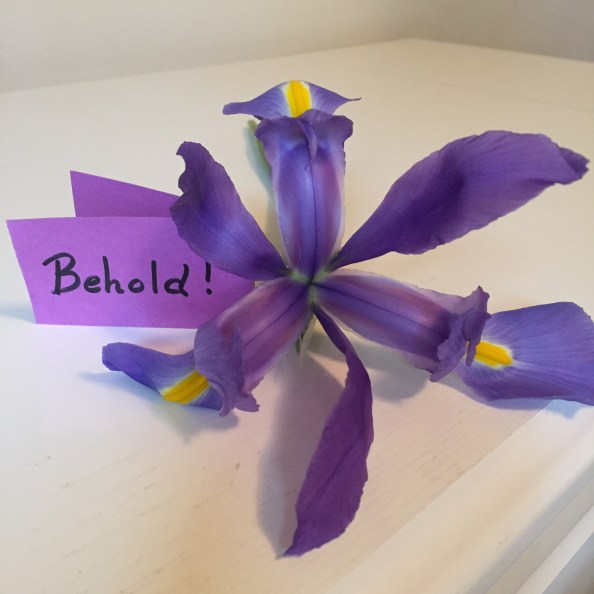
A friend reminded me of these truths with a flower and a word.

IMG_1070

What does this flower tell me about God?

One flower, three magnificent petals.

Three in One.

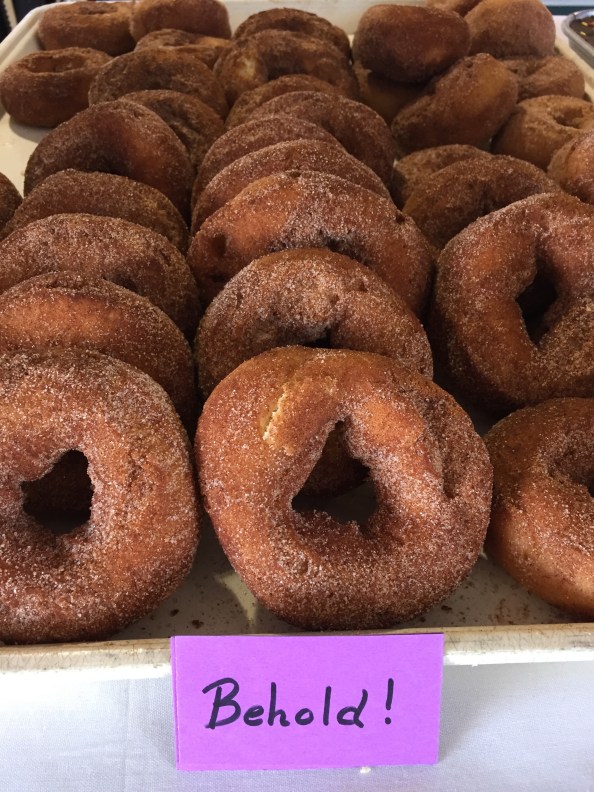
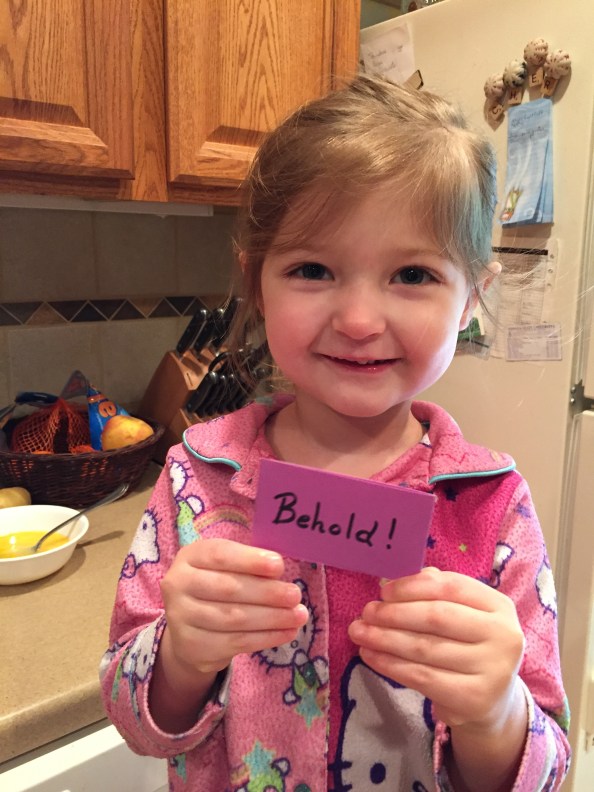
Behold!

I carried the word in my pocket all day.

It helped me see what is right before my eyes.

IMG_1086

IMG_1087

IMG_1089

IMG_1092

IMG_1066

Taste and See

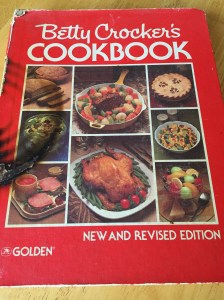
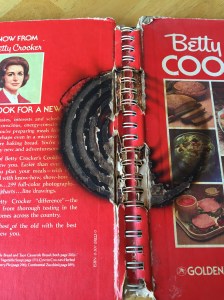
I tried to cook my cookbook.

IMG_1044

Ms. Betty Crocker was not amused.

See that look in her eye?

IMG_1045

No golden roasted chicken sprang forth, no practically perfect pie appeared, no crusty wholegrain bread was in sight. They all stayed put on the cover, taunting me.

The charred cookbook had no flavor.

Then someone taught me to open the pages, read the instructions and follow them obediently. I learned to get my hands in the dough, knead with all my might, patiently wait for the creation to come together. I discovered the joy of opening my mouth, taking in the goodness, savoring the flavor.

“Taste and see that the Lord is good.” (Psalm 34:8)

God wants me to use my senses to experience Him. It’s only in the opening up of myself to His Word, the working in and pushing out of the gospel, the willingness to wait for the Spirit to rise – only then can I begin to gain understanding of His goodness.

It’s only in the receiving of the Bread of Life, the swallow of commitment, the joyful discovery of nourishment – only then can I begin to see Him in all of His glory.

I can look at a cardboard picture of a roasted chicken,

but I can’t know the succulent, juicy flavor unless I taste the real thing.

I can observe evidence of God’s goodness in the world,

but I can’t know He is good to me until I take Him in.

“Open wide your mouth and I will fill it.” (Psalm 81:10)

Listen, listen to me, and eat what is good,

and you will delight in the richest of fare. (Isaiah 55:2)

Lengthen and Strengthen

I’ve been hanging out with Isaiah this month. He starts out strong and doesn’t let up for 66 chapters.  Lots of judgment in the first 39 chapters is followed by comfort and consolation (mixed with a little more judgment) in the last 27 chapters. Speaking on God’s behalf to a rebellious nation wasn’t an easy job, so not too many applied for the position.

But when God said, “Whom shall I send?” Isaiah was like the kid in the back row of the 3rd grade classroom who desperately wanted to be the first one to give the answer to the teacher.  Isaiah shot his hand up in the air and almost fell out of his seat, saying “Ooo, oo, oo, me!  Send me!!!  Pick me!!!”  God must have loved that.

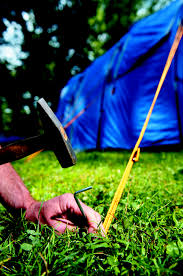
When I got to chapter 54, I hit the brakes and squealed to a halt.  There it was — flashing in red lights and sounding the siren. “Enlarge the site of your tent, and stretch out the drapes of your dwellings; don’t hold back. Lengthen your tent ropes and strengthen your stakes.” (verse 2)  

There has been a theme looking me square in the face every time I turn around lately. Every book I read, every Bible study and Sunday school class I sit in on, and even in a conference I attended, the same idea keeps hounding me.  It boils down to this:

I have spent a lot of time and effort putting my stakes down deep. I’ve studied, read, prayed and memorized. I’ve pounded down some sturdy anchors. Now it’s about time to lengthen the ropes.

Strong stakes aren’t for the purpose of keeping me safe and sound in my own little protective tent, complete with all the creature comforts this world has to offer. They are there to create the potential for enlarging my site, to make more room for whoever God wants to bring my way.  I don’t know exactly what “stretching out the drapes” will entail. I’m not sure what or who I’m making space for. But the message is loud and clear.

Strengthen the stakes and lengthen the ropes.

Lengthen and strengthen.

tent


Saving the World

I was talking to a friend recently about things we did when we were younger, when our fresh faith set us on fire for the Lord. We shared stories of innocent, but not very well thought-out attempts to share Jesus with everyone we possibly could.

She told about getting some friends together and going downtown at bar closing time with hot coffee. They stood on the sidewalks and “ministered” to tipsy people by handing out free cups of strong, black java. There were some issues with this “reaching out” tactic, however well intentioned. First, nobody remembered the nice church people in the morning. Second, it wasn’t the safest place for young people to be hanging out. Third, it got awkward when someone they recognized from the next pew stumbled out of the establishment.

coffee

Her story reminded me of my own fervent attempts to spread the love of Jesus. When I would visit a public restroom I would take a Sharpie marker out of my purse and add to the graffiti in the stall. Right above the roll of toilet paper, I would solemnly write, “Let Jesus wipe away your sins.” This method of evangelism also was questionable. First, writing on public property was vandalism. Second, it was borderline offensive. Third, I doubt if there was any real soul searching as a result of my entreaty.

tp

After some study, it appears that the Bible is silent on both handing out coffee at 2 a.m. and writing on bathroom walls. The closest the Good Book comes to mentioning coffee is naming a New Testament book Hebrews. The only thing that will actually be wiped away, according to the Bible, is tears. (“And God will wipe away every tear from their eyes.” Revelation 7:17)

God’s approach to saving the lost was much more effective.

“But God demonstrated His own love for us in this:

while we were yet sinners, Christ died for us.” 

Romans 5:8

 Maybe dying to myself and loving others sacrificially would get me better results.

Holy Week Confession

thornsI’m grateful for Saturday — the day after Good Friday. The intense emotions of Holy Week wear me out and a breather is welcome.

Engaging in the events that marked the last week of Jesus’ life on earth was a struggle for me this year. I didn’t know if I had it in me to walk through the suffering and death of my Jesus yet again. Every year it seems to hurt more. I seriously considered just going through the motions and pushing through the dark days until the relief and rejoicing of the empty tomb on Easter morning.

In other words, I wanted to skip the suffering and go straight to the celebration.

It doesn’t work.

Because going through the motions is exactly how to engage the emotions. As a pastor’s wife, Holy Week services are not optional. I intended to show up, but I planned to keep my heart guarded and not enter in to the agonizing story once more. But showing up was all it took for God to break down my resistance.

On Thursday, I sat in the quiet sanctuary, drew near to the table, tasted the bread, swallowed the juice. I took Him in.

On Friday, I heard the words of Isaiah and Luke, surveyed the wondrous cross, sang, “If ever I loved Thee, my Jesus, ’tis now.” He took me in.

Going through the motions is what ushered me straight into His presence.

On this blessed quiet Saturday, I am remembering that the day after the death of Christ is also the day before the glorious life of Christ. But it is the suffering of yesterday that gives weight to the jubilant joy of tomorrow.

“Weeping may endure for a night, but joy cometh in the morning.”         Psalm 30:5

A Slow Fast

I’ve finally discovered a way to slow down time.

Fast from something for 40 days.

My, how the days do seem to drag on.

turtle

For Lent this year, I chose to give up reading. At first it was nice to have quite a bit of extra time to do other things. But now I’m getting antsy — longing for the feel of a book in my hands. 

Here’s what I’ve been learning on this slow fast:

1. It’s good to have a chance to be alone with my thoughts. When I grab a book every time I have a few minutes (or hours) I’m continually cramming information into my brain. It all gets squished in there and I can’t differentiate between my thoughts and the notions of the five authors I’m reading. I was pleasantly surprised to find that, given a little space to breath, I do think my own thoughts.

2. There has been a feeling of empowerment with denying myself something I assumed I needed. I can look at my TBR pile of books and say, “You’re not the boss of me.” I can drive by the library and gloat, “You have no hold on me. (Or holds for me.) ” I can click out of Amazon and resist the urge to hit “Buy now with 1-Click”. I can.

3. Limiting my reading to only one book (the Bible) has made that precious time delightfully sweet. My eyes are more eager in the early morning hours to open the pages and soak in the words. I’m paying attention better, staying more engaged and falling in love with the words of life.

4. I am learning that I can do without things and it’s not really that hard. What seemed like a lofty and admirable plan on Ash Wednesday, quickly showed itself to be small potatoes. Coffee, chocolate, Facebook, spending money, reading — those things aren’t as big a deal as we think. We could live without any of it and survive.

5. Reading lots of books had become a source of pride for me. I’ve kept track of every book I’ve read over the last twelve years and adding a title to that list was puffing me up a bit. Or maybe a lot. I don’t know who I thought I was impressing, but I didn’t see it for what it was until now.

6. Now I know what it’s been like for PB all these years when he’s wanted to go to sleep and I’ve kept the light on to read. It’s so annoying. But I’m proud of my hubby – he’s read more than I have in the last month.

7. It’s been confirmed in my mind that TV is a wasteland. Outside of watching a few documentaries and basketball games, my only other go-to activity has been to go to bed. I’ve definitely gotten more sleep than usual.

8. On the scale of what qualifies as true sacrifice, giving up reading is pretty weak. It doesn’t come close to donating a kidney or falling on a grenade to save a fellow soldier. My little experiment pales in comparison with what this Lenten season is really all about. The supreme sacrifice will never be required again – my debt has been paid in full. My eternal future has been secured, not because I gave up reading for forty days, but because my Savior gave Himself up for the love of the world.


books

Abba

When Agnetha, Bjorn, Benny and Anni formed the Swedish rock group ABBA, I doubt if they knew they were using one of the dearest names for God found in the scriptures. I was a teenager in the 70s, so I still love me some “Dancing Queen” and “Waterloo”, but when I hear the word “Abba” my mind associates it with “Father”, not “Fernando”.

The word Abba appears three times in the Bible– it is used twice by Paul and only once by Jesus. It is an intimate term of endearment a child might use when addressing a much-loved father. Some scholars believe it can be translated “Daddy” or “Papa”. I get a little uneasy when people start using familiar names for God such as “Buddy” or “Pops” or “The Big Man Upstairs”. God is certainly our Father, but He’s not a jolly man that lets us crawl on His lap and tug on His beard.  The only time Jesus addressed God as “Abba” was when he was sweating great drops of blood while agonizing over his impending death on a Roman cross.

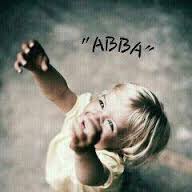
While many people like to relate to God on more familiar terms, using the name “Abba” actually says more about us than our Heavenly Father. If we want to use the term that conjures up visions of a toddler calling out “daddy”, then we have to realize that we are putting ourselves in the position of complete submission, with the unquestioning trust of a small child.

abba1

We may want to think of God in intimate ways and try to bring Him down to our level, but we can’t say “Abba” unless we are also willing to surrender without crossing our little arms and stomping our little feet.

“Papa, Father, you can—can’t you?—get me out of this. Take this cup away from me. But please, not what I want—what do you want?” Mark 14:36 (Message)

With Us

god with us

I used to know all the common prepositions by heart.

About, above, across, after, against, along, among — and 28 more. Memorizing that list helped in picking out the prepositional phrases when diagramming sentences, which was important because…… Why was that important?

The one thing that did stick with me from Freshman English was to never, ever, over-your-dead-body, end a sentence with a word from “the list”. The horror of leaving a preposition hanging there, right before a period, struck a fear into me that still exists today. No matter how much I want to write, “Who were you talking to?” I force myself to be proper and write, “To whom were you talking?” Sounds a bit formal, though, for this midwestern girl.

My favorite preposition is at the bottom of the list.  

…….over, since, through, to, toward, under, with.  

With.

What a lovely word.

When God picked out a name for His Son, it was Emmanuel —

God with us. (Isaiah 7:14)

I am grateful for that choice of names.

It’s so much better than

God above us, God behind us, God beyond us, God over us.

I love the “with-ness” of God.

“God With Us” by All Sons and Daughters

There are lots of great prepositions in this song (none dangling).


Beginning – Day 6

“Jesus had known from the beginning who would betray him.” John 6:64

I’m so glad I’m not omniscient. Knowing everything about everybody all the time would crush me. Not knowing things is actually a relief — it takes one off the hook for certain responsibilities.

For instance, if I don’t know how to start the snowblower, then I’m not expected to clear the driveway. That’s a good thing to not know.

In the early days of Jesus’ earthly ministry, he called twelve men to be his disciples.  The night before he finalized the list of twelve names, he didn’t sleep a wink.  He spent the whole night praying. (Luke 6:12)

By this time, Jesus had already called Peter, Andrew, James, John and Matthew, so there were only seven spots left to fill. Certainly there were some good prospects, some fine men from which to choose. What kept Him up all night?

I wonder if there might have been a struggle over one application for the position of disciple. You know the one I’m talking about –Judas Iscariot.

Jesus talked the decision over with His Father out on that Galilean hillside in the moonlight. “Uh…Judas? Father? Are you sure about that one? Do I have to invite him to join the group?”

Yet, when morning came, Judas was on the list.  In fact, Mark 3:13 says, “He called to him those he wanted.” Because, in the end, Jesus wanted the will of His Father more than anything. Jesus knew Judas was the betrayer even before Judas did. But that didn’t stop Jesus from walking on water to him, or sending him out to do ministry with the other disciples, or washing his feet.

I get the same grace Judas did.

That’s all I need to know.

god_is_omniscient


Beginning – Day 5

“I am the Alpha and the Omega, the Beginning and the End.”  Rev. 21:6

There is no end to our beginnings.

We start over again year after year, week after week, day after day.

The steadfast sun rises.

The calendar pages turn.

The toast is lifted — cheers!

And we’re off once more, beginning again.

This is what it is to live.

scroll

There is an end to our beginnings.

We hurry through our days, and weeks, and years.

The final curtain closes.

The last chapter concludes.

The finish line is crossed — glory!

And our one end becomes a grand genesis.

This is what it is to die.

scroll

There is no end to The Beginning.

Always and forever Alpha-Omega – who was, and is, and is to come.

The Self-Existent One.

Limitless in scope.

Unbound by space and time — yes!

Forever before the beginning, and after the end, forever.

This is what it is to be God.